

The Microsoft mobile dream never fully died — it simply migrated into the workshop, the concept studio, and the kernel of enthusiast forums where a small-but-persistent community keeps rebuilding, reimagining, and sometimes actually running Windows on phones again.
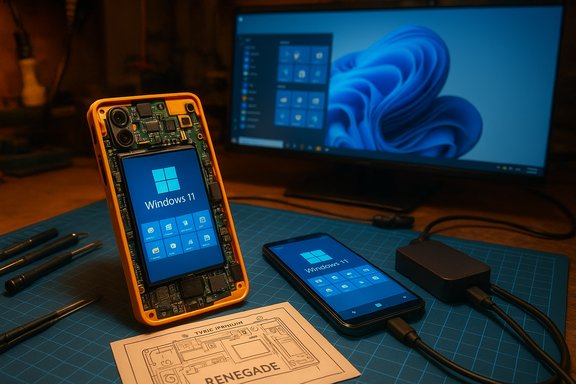
What started as nostalgia for Live Tiles and Lumia hardware has evolved into a patchwork of technical experiments, fan concepts, hardware mods, and bold proofs-of-concept. Enthusiasts have used projects like Renegade to install smartphone-compatible UEFI and run Windows 11 ARM on handsets; designers have published polished mockups that imagine a modern “Windows Phone 2.0” (often called Astria); and modders have physically transplanted modern internals into classic Lumia shells. These efforts are cultural as much as technical — they reveal what users valued about the Windows Phone era (clarity of UI, glanceable information, Continuum-style continuity) and expose the hard realities that sank that platform originally: apps, carriers, and long-term commercial commitment.
Yet the reasons Windows Phone failed — the app economy, carrier and OEM dependencies, and the need for long-term strategic commitment — remain decisive. The community can and will continue to tinker, inspire, and occasionally astonish. For a real commercial revival to succeed, the effort must solve the economics and distribution problems that killed the first attempt. Until then, these projects are a powerful reminder: great design and bold engineering can keep a product’s spirit alive long after official support ends, but turning passion into a sustainable platform requires a rare combination of product, partners, and patience.
Source: Thurrott.com The dream of a Windows Phone lives on
 Overview
What started as nostalgia for Live Tiles and Lumia hardware has evolved into a patchwork of technical experiments, fan concepts, hardware mods, and bold proofs-of-concept. Enthusiasts have used projects like Renegade to install smartphone-compatible UEFI and run Windows 11 ARM on handsets; designers have published polished mockups that imagine a modern “Windows Phone 2.0” (often called Astria); and modders have physically transplanted modern internals into classic Lumia shells. These efforts are cultural as much as technical — they reveal what users valued about the Windows Phone era (clarity of UI, glanceable information, Continuum-style continuity) and expose the hard realities that sank that platform originally: apps, carriers, and long-term commercial commitment. Background: how we got here
The historical turning point
Microsoft’s exit from the phone business remains a touchstone in its corporate narrative. Company leadership has publicly reflected on the decision as a strategic regret, with the CEO acknowledging that exiting the phone business was among the most difficult choices of his tenure and suggesting it might have been handled differently. This candid assessment helps explain why fans and some former employees still entertain “what if” scenarios for a revived Windows mobile story.The legacy tech and where experiments focus
Two threads run through most revival efforts:- Hardware nostalgia and modding — preserving Lumia industrial design, the camera module, and the Live Tile aesthetic while swapping modern internals or reusing iconic chassis. These projects are visible in community threads where modded Lumias and hybrid builds are celebrated and dissected.
- Software hacking — replacing a phone’s original firmware with a UEFI capable of booting ARM-native Windows builds (often using community tools like Project Renegade), followed by driver and power management tinkering to get a desktop OS to behave on a mobile SoC. This is the riskiest route but yields the most attention when it works.
The state of community projects: scope, wins, and limits
Running Windows 11 on actual phones
A small set of hobbyists has successfully booted Windows 11 ARM on smartphones. These demonstrations typically use a smartphone-adapted UEFI and an ARM build of Windows 11, and they are notable for proving technical possibility rather than everyday practicality. The community account of one eight-hour effort reports the OS booting and running, but also confirms severe practical limitations: poor battery life (on the order of only a few hours under normal use), lack of fast-charging drivers, touchscreen and driver quirks, and high thermal output. The experiment is fascinating but not a near-term consumer product. Key technical realities encountered in these projects:- UEFI installation is nontrivial and device-specific.
- Drivers (GPU, modem, charging, thermal management) are the main blocker for usability.
- Thermal and battery designs on phones assume a mobile OS: desktop OS workloads expose limits quickly.
Fan concepts and design work: Astria and the power of vision
Design projects such as “Windows Astria” are not code, but they serve a different function: they show how a modern Fluent‑style, tile‑oriented interface could scale across phones and foldables while accommodating Android apps through a subsystem. These concepts are persuasive visually and strategically — they reimagine Live Tiles as glanceable widgets and sketch a docked/docked-to-desktop continuity that modern users might value. But the transition from pixel-perfect mockups to shipping products would still require a developer ecosystem, runtime compatibility for apps, and carrier/OEM alignment.Hardware mods and hybrids
Some enthusiasts have taken a different tack: keep the Lumia look, upgrade the guts. These hybrid projects prove creative ingenuity — for example, transplanting modern phone internals into Lumia shells — but they remain artisanal one-offs with trade-offs in features, warranty, and long-term maintainability. They’re culture and inspiration rather than business models.Why the dream persists: design, continuity, and unmet needs
- UI clarity and glanceability. Many users still consider the Windows Phone Live Tile approach superior for delivering glanceable, contextual information without notification clutter. Concepts and mods often revive this principle as a core design advantage.
- Continuity and productivity. The promise of a phone that becomes a full Windows PC when docked (Continuum) still resonates. Enthusiasts and enterprise-oriented analysts argue that a pocket PC model — not a mass-market fight with iOS/Android — could suit Microsoft’s strengths today.
- Technical curiosity. Running a desktop OS on handheld hardware is an engineering puzzle that appeals to tinkerers: porting UEFI, getting ARM drivers to work, and adapting desktop UX to touch inputs are technical challenges with educational and demonstration value.
The hard realities: ecosystem, carriers, and economics
App ecosystem — the single decisive barrier
Platforms are two-sided: users follow apps, and developers follow users. The original Windows Phone collapsed because it could not sustain developer investment at scale. Any modern attempt that does not solve app availability — either via native apps or a reliable Android compatibility strategy — is very likely to fail commercially regardless of UI polish. This is not opinion; it is a structural market fact discussed repeatedly by analysts and community threads.Carrier certification, regulatory, and distribution complexity
Shipping a phone — especially with cellular connectivity — introduces carrier testing (VoLTE, eSIM provisioning, regulatory certifications) and distribution partnerships that are materially different from shipping PCs. These requirements are expensive and slow, and past Microsoft attempts stumbled here. A pragmatic path would start with niche enterprise or dock-first devices to avoid the full brunt of carrier economics.Long-term support and update guarantees
Hardware and OS update cadence determines trust. Past Microsoft device efforts (including Surface Duo) were critiqued for inconsistent update commitments; any new phone play must promise a clear multi-year policy or it risks the same reputation problems. The community rightly flags update discipline as a make-or-break factor.Technical feasibility: what actually works and what doesn’t
What the community can already do
- Boot Windows 11 ARM on select devices using community UEFI + the Renegade path. Demonstrations exist that show the OS running and some desktop apps launching.
- Run scaled desktop apps and experiment with Continuum-like docking using USB-C where hardware supports it.
What remains infeasible for general users
- Full modem integration with carrier voice/data features is hard without vendor cooperation and proper firmware/drivers.
- Efficient thermal and battery management for desktop workloads on phone thermal envelopes — current phones are optimized for mobile OS power profiles, not continuous desktop-class workloads.
- App parity: even if Android compatibility can be shipped, the Windows play at scale requires strong developer incentives and a consistent store/runtime strategy.
The Windows Subsystem for Android (WSA) lesson
Microsoft previously shipped an Android compatibility layer (WSA) for Windows 11 that allowed running Android apps via the Amazon Appstore. That experiment has been wound down; Microsoft announced WSA support would end and Amazon’s Appstore on Windows would be discontinued on a set timetable. The deprecation of WSA is a cautionary tale: even when OS vendors provide a compatibility layer, commercial and usage realities can make long-term support fragile. Any mobile revival that depends on a fragile runtime should be treated cautiously.Cross-checking the facts: verifiable numbers and claims
- Windows 10 Mobile’s extended support officially concluded in early 2020; the platform no longer receives mainstream updates from Microsoft. This is a fixed historical milestone that explains the archival state of the original Windows Phone ecosystem.
- Lumia 950 and 950 XL remain representative hardware of the last Microsoft-firstphone generation: both shipped with QHD AMOLED panels, 3 GB RAM, and Snapdragon 808/810 SoCs respectively — powerful for their time but far behind modern ARM PC silicon in thermal efficiency and sustained performance. These specs are well documented in contemporary press coverage.
- Proof-of-concept installs of Windows 11 on phones (Project Renegade examples) have been demonstrated and reported by reputable specialist outlets; those experiments consistently report severe battery and thermal trade-offs that make the installations unsuitable for daily use. These claims have been independently reported by multiple outlets and corroborated in community threads.
Strategic options and a pragmatic roadmap (for Microsoft or any potential entrant)
If a company wanted to reintroduce a Windows-like mobile experience, there are lower-risk strategies that address the big barriers:- Start niche, not mainstream:
- Target enterprise, developers, and productivity power users with a dock-first pocket PC model.
- Avoid full carrier-dependent launches initially; use Wi-Fi-first, eSIM pilots, or enterprise procurement channels.
- Guarantee updates and privacy:
- Commit to a public, binding multi-year update and security policy.
- Build transparent privacy/agent memory controls if AI agents are a core UX element.
- Solve app parity pragmatically:
- Offer a proven Android compatibility runtime with clear support promises, or a cloud/streaming strategy for legacy x86/x64 apps.
- Provide developer incentives for porting — not just lip service.
- Partner for radios and modems:
- Cooperate with modem vendors and carriers early in the hardware design phase to avoid last-minute certification bottlenecks.
- Validate via a multi-phase product plan:
- Phase 1: pocket PC for professionals (dock-first; limited cellular).
- Phase 2: OEM/carrier trials for business customers.
- Phase 3: scaled consumer launch only if developer traction and distribution prove viable.
Risks, ethical considerations, and what to watch for
- Security and update risk. Community installs and unsupported workarounds create security and update gaps; users who try them accept real operational risk. Community tools are great for experimentation but poor for daily security posture.
- False hope vs. useful prototypes. Polished design mockups can mislead non-technical audiences: they show what could be aesthetically pleasing but rarely capture regulatory, carrier, or developer economics. Treat concept art as inspiration, not a product spec.
- Platform fragility. Compatibility layers and app stores can be deprecated, as WSA’s end-of-life demonstrates. Any foundation relying on such layers needs contractual, technical, and economic resilience.
- Legal and warranty consequences. Bricking devices, installing unsupported OS images, or modifying firmware can void warranties and raise legal or safety issues. Hobbyists should take safeguards and avoid primary daily-driver devices.
Practical advice for tinkerers and enthusiasts
- If experimenting with Windows on phones, use expendable devices and accept the following checklist:
- Back up everything and maintain a recovery image.
- Confirm that tools and images are from trusted community channels and verify checksums where provided.
- Expect no fast-charging, limited driver support, and potential thermal hazards.
- Prefer offline, lab-style experiments — avoid exposing modified devices to carrier networks or production accounts.
- Document your process and share findings responsibly with the community.
- For designers and concept creators:
- Ground visuals in platform constraints early (battery, thermal, input modes).
- Design for progressive enhancement — imagine graceful fallbacks for low-power or single-app scenarios rather than full desktop parity.
- For developers curious about future opportunities:
- Watch enterprise docking use-cases and developer tools that bridge mobile and cloud; the most viable business models will likely be productivity-first rather than app-store mass-market plays.
Conclusion: a living dream, not a commercial inevitability
The dream of a Windows Phone lives on — but it has moved from corporate product roadmaps into community workshops, UX studios, and experimental repos. Enthusiasts have made technically impressive leaps (booting Windows 11 ARM on phones, stunning interface concepts, inventive hardware mods), and those efforts faithfully preserve what many still miss: a UI that felt purposeful, a vision of continuity, and a focus on productive workflows.Yet the reasons Windows Phone failed — the app economy, carrier and OEM dependencies, and the need for long-term strategic commitment — remain decisive. The community can and will continue to tinker, inspire, and occasionally astonish. For a real commercial revival to succeed, the effort must solve the economics and distribution problems that killed the first attempt. Until then, these projects are a powerful reminder: great design and bold engineering can keep a product’s spirit alive long after official support ends, but turning passion into a sustainable platform requires a rare combination of product, partners, and patience.
Source: Thurrott.com The dream of a Windows Phone lives on
