

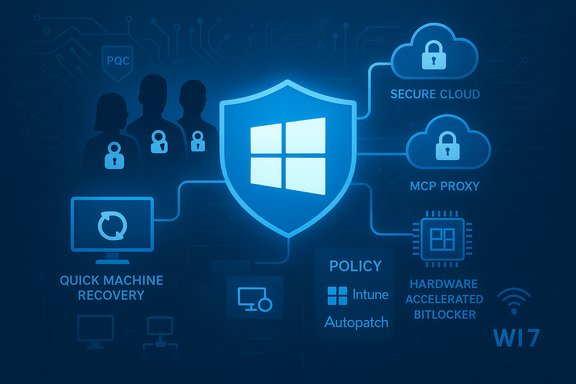
Windows’ latest security and resiliency announcements mark a clear pivot: Microsoft is weaving agentic AI, post‑quantum readiness, and cloud‑first recovery tools into the OS while hardening the platform so organizations can both innovate and recover faster from real‑world incidents. These changes—spanning agent workspaces and Model Context Protocol (MCP) governance, Post‑Quantum Cryptography (PQC) APIs, hardware‑accelerated BitLocker, the Windows Resiliency Initiative (WRI) recovery toolkit and Quick Machine Recovery (QMR)—aim to reduce blast radius from faulty updates and buggy drivers, speed incident triage, and give IT teams stronger, familiar controls to govern new agent behaviors.
Windows has been evolving from a traditional OS into a platform that must balance three competing demands: enabling AI‑driven productivity, maintaining enterprise control, and preserving recoverability at scale. Recent events and industry pressure have accelerated that evolution—Microsoft’s Secure Future Initiative (SFI) and the Windows Resiliency Initiative are direct responses to outages and supply‑chain incidents that showed how quickly device fleets can be affected by a single problematic component. The company is now integrating security and recovery capabilities into the platform rather than layering them purely in management tooling. This article synthesizes Microsoft’s announcements, corroborates technical claims with public product pages and independent reporting, and evaluates operational consequences for IT teams. Wherever possible, the platform claims are verified against Microsoft documentation and independent news coverage to separate widely supported facts from forward‑looking commitments that require cautious adoption.
To let the same agent code run in the cloud, Microsoft announced Windows 365 for Agents—cloud‑hosted, governed execution with the same security primitives so developers need not rewrite agent logic when moving between local and cloud execution. Agent connectors, introduced as a registry with an MCP proxy layer, provide consent, governance and audit hooks to secure communications between apps and MCP servers. Two security policies (default and developer bypass) will be available for on‑device registry enforcement.
Independent coverage of Microsoft’s broader agent strategy describes the Model Context Protocol (MCP) as an industry attempt to standardize agent behaviors and inter‑agent communication. Early reporting underscores that MCP adoption will increase the attack surface if not governed carefully, so Microsoft’s emphasis on signed agents and consented registry entries is a sensible mitigation.
Independent reporting and Windows docs corroborate QMR and the driver resiliency direction; organizations should expect certification time and driver rework windows as partners adapt to the new bar.
However, the transition carries trade‑offs. New governance processes, careful telemetry policy design, vendor coordination, and a realistic, multi‑year migration plan for drivers and cryptography are essential. Early adopters can gain significant operational advantages, but every organization should pilot these features carefully, validate the assumptions against their environment (especially networking and telemetry constraints), and update incident response playbooks to reflect the new platform primitives.
The technical direction is clear: Windows wants to be a resilient, governance‑friendly, and AI‑capable platform. For IT leaders, that means a window of opportunity to harden controls, modernize procurement choices, and redesign recovery workflows to make incidents less disruptive and far easier to remediate.
Source: Windows Blog Preparing for what’s next: Windows security and resiliency innovations help organizations mitigate risks, recover faster and prepare for the era of AI
 Background
Windows has been evolving from a traditional OS into a platform that must balance three competing demands: enabling AI‑driven productivity, maintaining enterprise control, and preserving recoverability at scale. Recent events and industry pressure have accelerated that evolution—Microsoft’s Secure Future Initiative (SFI) and the Windows Resiliency Initiative are direct responses to outages and supply‑chain incidents that showed how quickly device fleets can be affected by a single problematic component. The company is now integrating security and recovery capabilities into the platform rather than layering them purely in management tooling. This article synthesizes Microsoft’s announcements, corroborates technical claims with public product pages and independent reporting, and evaluates operational consequences for IT teams. Wherever possible, the platform claims are verified against Microsoft documentation and independent news coverage to separate widely supported facts from forward‑looking commitments that require cautious adoption.Overview of the announcements
- New agentic platform features — agent workspace, agent connectors, and support for the Model Context Protocol — with explicit design principles (distinct agent accounts, limited privileges, operational trust via signing, and privacy‑preserving data practices).
- Cloud extension via Windows 365 for Agents to let developers run agents locally or in a secured cloud execution environment while maintaining the same governance model.
- Security hardening and modernization: PQC APIs, hardware‑accelerated BitLocker on supported silicon, Sysmon functionality integrated into Windows, Zero Trust DNS, and Wi‑Fi 7 with WPA3‑Enterprise.
- Resiliency tooling under WRI: Quick Machine Recovery (QMR), WinRE networking, Autopatch QMR management, Intune remote recovery, point‑in‑time restore (PITR), and Cloud rebuild (reimage + Autopilot + OneDrive/backup restore).
- Ecosystem changes for drivers and AV partners: higher signing and certification requirements, encouragement to move logic out of kernel mode, and practical kernel guardrails (compiler safeguards, driver isolation, DMA‑remapping).
Securing agentic interactions on Windows
What Microsoft is shipping and why it matters
Microsoft is building agent workspaces — purpose‑bound, auditable execution contexts where AI agents can perform tasks on behalf of users while keeping user sessions isolated and traceable. In this model, agents run as a distinct identity (an agent user account) so every action is attributable to the agent rather than the human. The environment limits agent access to known local folders (Documents, Desktop, Downloads, Pictures) and uses standard Windows ACLs and platform policies to restrict privileges. Agent workspace is in private preview as of the announcement.To let the same agent code run in the cloud, Microsoft announced Windows 365 for Agents—cloud‑hosted, governed execution with the same security primitives so developers need not rewrite agent logic when moving between local and cloud execution. Agent connectors, introduced as a registry with an MCP proxy layer, provide consent, governance and audit hooks to secure communications between apps and MCP servers. Two security policies (default and developer bypass) will be available for on‑device registry enforcement.
Independent coverage of Microsoft’s broader agent strategy describes the Model Context Protocol (MCP) as an industry attempt to standardize agent behaviors and inter‑agent communication. Early reporting underscores that MCP adoption will increase the attack surface if not governed carefully, so Microsoft’s emphasis on signed agents and consented registry entries is a sensible mitigation.
Strengths
- Clear separation of identities. Running agents under their own accounts reduces ambiguity in audit logs and makes it feasible to apply different policies and revocation controls to agents. This is a meaningful improvement for compliance and incident investigations.
- Containment by default. The agent workspace model and the on‑device MCP proxy are built to be opt‑in for users and auditable by IT, giving enterprises explicit control over which devices and users may permit agents to act.
- Developer flexibility. Allowing local and cloud execution with consistent governance reduces developer friction and helps enterprises adopt agents incrementally under familiar management tools.
Risks and caveats
- New attack surfaces. MCP servers that gain access to local files, if misconfigured or compromised, could be leveraged by attackers. The promised default security bar is necessary but not sufficient; organizations must enforce strict signing and review workflows for connectors. Independent reporting cautions that early MCP deployments must be monitored for prompt‑injection and token exfiltration risks.
- Privacy and telemetry trade‑offs. QMR and agent telemetry rely on diagnostics flowing to Microsoft services during remediation and agent operation. Enterprises should evaluate data collection and retention settings during pilot phases.
- Operational complexity. While Microsoft exposes admin controls in Intune and Entra, governance will require policy design, onboarding processes, and regular audits to avoid expanding attack surface through permissive exceptions (developer bypass policies, for example).
Stronger‑by‑default security features
Post‑Quantum Cryptography (PQC) APIs
Microsoft is making PQC APIs available so organizations can begin testing and migrating to quantum‑resistant cryptographic algorithms. This is a forward‑looking addition: quantum‑threat mitigation is strategic planning rather than immediate protective necessity, but early adoption helps reduce churn later when standards finalize. Independent cryptography research and industry guidance strongly recommend early testing to prepare application stacks for PQC transitions.Hardware‑accelerated BitLocker
Hardware‑accelerated BitLocker will offload cryptographic operations to modern SoCs/CPUs (supported silicon) and wrap keys at the silicon level, improving performance and reducing exposure of keys in CPU memory. Microsoft states these enhancements will appear on new devices beginning in spring 2026; this timeline aligns with hardware vendor roadmaps that are shipping silicon with on‑die cryptographic primitives. Organizations planning fleet refreshes should include these devices in procurement plans for improved disk encryption performance and stronger key protection.Credential protection and passkeys
Windows Hello’s refreshed experience and passkey manager integration (with Microsoft Password Manager, 1Password, Bitwarden, etc. simplifies passwordless adoption. Microsoft announced passkey manager support arriving in a November 2025 security update—this reduces phishing and credential theft risks by making strong, phishing‑resistant authentication more practical across the Windows ecosystem. Independent coverage and Microsoft’s own identity guidance recommend prioritizing passkeys for high‑risk users and admins.Trusted apps, drivers and visibility
- App Control for Business and Intune managed installer reduce the likelihood that untrusted apps and unsigned drivers will run in enterprise environments. This lowers the risk of malicious attachments and socially engineered malware.
- Sysmon functionality integrated into Windows provides richer, customizable telemetry out of the box—this will simplify detection engineering and reduce the deployment burden of external Sysmon agents for many shops. Microsoft Learn and independent analysts confirm this will increase signal quality for security operations teams.
Network protections
- Zero Trust DNS enforces outbound name resolution via encrypted DNS and approved servers to prevent exfiltration and block malicious resolution paths—this ties directly into Zero Trust principles and NIST guidance.
- Wi‑Fi 7 for Enterprise with WPA3‑Enterprise raises authentication assurance and improves roaming performance for dense, high‑throughput enterprise wireless deployments. These network controls help protect lateral movement and reduce a common vector for targeted attacks.
Windows Resiliency Initiative (WRI): preventing, managing, recovering
Preventing incidents: driver and AV resiliency playbook
Microsoft is raising the bar for driver signing, certification tests, and in‑box driver coverage so partners can replace many custom kernel drivers with standardized Windows drivers or user‑mode alternatives. For AV specifically, the Microsoft Virus Initiative (MVI) introduced version 3.0 requirements for AV partners to maintain signing rights, and Microsoft previewed moving AV enforcement out of the kernel into user mode—reducing the chance that an AV bug can crash the entire OS. These changes are deliberately incremental: Microsoft will still allow third‑party kernel drivers where needed (for instance, graphics drivers for performance reasons) but will apply practical guardrails such as compiler safeguards, driver isolation, and DMA remapping.Independent reporting and Windows docs corroborate QMR and the driver resiliency direction; organizations should expect certification time and driver rework windows as partners adapt to the new bar.
Managing incidents: new controls and signals
- Customers with high‑impact needs can engage Windows product engineers through Mission Critical Services for Microsoft 365.
- Windows 365 Reserve is generally available to provide secure, temporary Cloud PCs to keep users productive if hardware is lost, damaged or compromised.
- Intune will surface WinRE boots for managed devices and Azure will show the same signals for Windows Server VMs that enter recovery, enabling fast triage at scale. Digital Signage mode suppresses persistent error screens on public displays to avoid exposing failure details to the public while allowing diagnostics to be performed with minimal display disruption.
Recovering at scale: Quick Machine Recovery, PITR, Cloud rebuild
Quick Machine Recovery (QMR) uses the Windows Recovery Environment (WinRE) to connect a failing machine to the network and apply targeted remediations sourced via Windows Update or a Microsoft remediation service. QMR is already documented on Microsoft Learn and is shipping in channels for testing; it’s designed as a best‑effort, policy‑governed remediation step that can dramatically reduce the need for manual reimaging. Microsoft announced plans to add WinRE networking (so pre‑boot networking can use the main Windows networking configuration, including enterprise Wi‑Fi with device certificates), and Autopatch integration to approve and manage QMR updates. For smaller incidents, Intune will be able to push custom recovery scripts to WinRE via a plug‑in model, and Azure will extend similar controls to Server VMs. Two recovery actions—Point‑in‑time restore (PITR) and Cloud rebuild—are intended to cover fast rollback and clean reimage scenarios, respectively. PITR will allow administrators to roll a PC back to a known‑good state; Cloud rebuild will automate reinstallation plus OneDrive/Windows Backup restoration and Autopilot provisioning for zero‑touch recovery. Preview availability timing varies, but industry reporting places some features in preview in 2026.Critical analysis — strengths, remaining gaps, and operational recommendations
Notable strengths
- Platform integration of recovery and security. Building QMR, PITR and Cloud rebuild into Windows reduces dependency on manual imaging and third‑party tooling for common large‑scale failures—this materially shortens mean time to recovery for many incidents.
- Pragmatic driver strategy. Encouraging user‑mode AV operation where feasible and raising signing/certification requirements will reduce the frequency and severity of system‑wide outages attributable to third‑party software.
- Governed agent model. Distinct agent accounts, on‑device registry/proxy and Intune/GPO controls present a workable governance model that enterprises can adopt incrementally.
Remaining risks and open questions
- Supply‑chain and third‑party readiness. Raising driver requirements and moving capabilities out of kernel mode will take years across OEMs and ISVs. During the transition, compatibility mismatches and certification delays are real risks. Organizations should plan for a multi‑year migration rather than an immediate zero‑touch cutover.
- Operational complexity of agent governance. Agent connectors with bypass policies and developer modes can create exceptions that erode the default security posture. IT must design enrollment and exception processes, including signing and revocation workflows, incident playbooks for agent compromises, and logs retention policies.
- Privacy and telemetry. Features like QMR rely on diagnostic uploads and cloud remediation services; enterprises with air‑gapped networks or strict telemetry policies will need deployment guidance and alternative workflows (Microsoft already documents management controls but bespoke policies may be required).
- PQC migration overhead. PQC APIs are ready for testing but migrating cryptographic systems across large estates—especially those with legacy protocols—requires careful planning, interoperability testing, and performance benchmarking.
Operational recommendations (practical next steps)
- Pilot agentic features in a controlled group. Define signing requirements and test revocation flows before enabling wide deployments.
- Test QMR and WinRE networking in lab fleets. Validate behavior for managed Wi‑Fi, VLANs and dot1x configurations.
- Inventory kernel‑mode drivers and prioritize migration paths. Identify drivers that can move to user mode or be replaced by in‑box drivers. Create a vendor engagement plan for those that cannot.
- Build PQC evaluation plans. Start by testing the PQC APIs in non‑production systems and measuring performance and interoperability with TLS stacks and PKI.
- Update incident playbooks to include QMR/PITR/Cloud rebuild flows and to handle agent‑related compromises, including signed connector revocation and evidence collection from distinct agent accounts.
- Validate telemetry and compliance settings. For regulated environments, define which data can leave devices during QMR and agent operations, and ensure DLP and consent controls align with policy.
What this means for procurement, partners and developers
- Procurement teams should begin preferring devices that support hardware‑accelerated cryptography and modern TPM/SoC security features in their refresh cycles, especially for high‑risk or high‑value assets.
- ISVs and AV vendors must prepare for stricter signing, packaging and certification tests. Partners who move proactively to user‑mode implementations and comply with MVI requirements will reduce the risk of their updates causing broad outages.
- Developers building agent connectors should follow Microsoft’s default security policy and use the on‑device MCP proxy to ensure consent, governance, and containment are enforced by design rather than added later.
Conclusion
Microsoft’s latest security and resiliency roadmap represents a meaningful shift: from optional add‑ons and third‑party workarounds to native platform capabilities designed for the realities of AI, quantum risks and large fleet operations. The combination of agent containment, hardware‑backed cryptography, improved detection telemetry, and built‑in recovery tools like QMR and Cloud rebuild promises to make Windows environments more resistant to both accidental outages and malicious activity.However, the transition carries trade‑offs. New governance processes, careful telemetry policy design, vendor coordination, and a realistic, multi‑year migration plan for drivers and cryptography are essential. Early adopters can gain significant operational advantages, but every organization should pilot these features carefully, validate the assumptions against their environment (especially networking and telemetry constraints), and update incident response playbooks to reflect the new platform primitives.
The technical direction is clear: Windows wants to be a resilient, governance‑friendly, and AI‑capable platform. For IT leaders, that means a window of opportunity to harden controls, modernize procurement choices, and redesign recovery workflows to make incidents less disruptive and far easier to remediate.
Source: Windows Blog Preparing for what’s next: Windows security and resiliency innovations help organizations mitigate risks, recover faster and prepare for the era of AI
