

Microsoft is preparing to make hardware trust a central requirement for the future of Windows volume activation, bringing TPM-backed attestation to the Key Management Service (KMS) infrastructure that many enterprises use to activate Windows at scale. The change, branded KMS Hardware-Secured, is designed to ensure that a KMS host is not merely configured correctly, but is also running on verified and uncompromised hardware before it can issue activation responses to Windows devices.
For IT administrators, this is more than a minor licensing-tool adjustment. KMS has historically been a comparatively quiet part of Windows Server operations: install the Volume Activation Services role, activate the host with a valid volume license key, publish the service through DNS, and let eligible clients renew activation in the background. Microsoft’s new approach adds a security verification layer beneath that familiar workflow.
The immediate impact is not expected to be a forced shutdown of existing KMS environments. Instead, the transition begins with readiness checks in Windows Server 2025 in August 2026. The larger change arrives with the next Windows Server Long-Term Servicing Channel (LTSC) release, when TPM attestation is set to become mandatory for the hardware-secured KMS activation model. While that future release is widely expected to be Windows Server 2028, Microsoft has not formally attached the requirement to a final commercial product name.
For organizations that still run KMS hosts on older physical servers, legacy virtual machines, or lightly managed infrastructure, the message is clear: inventory the activation estate now, not during the next server migration window.
Key Management Service, or KMS, is Microsoft’s volume activation technology for organizations with significant numbers of Windows installations. Rather than having every Windows device contact Microsoft independently for activation, a company deploys one or more internal KMS hosts.
Windows clients then locate those hosts, normally through DNS service records, and send activation requests over the local network. The KMS host verifies that the client is eligible and returns an activation response. That model helps enterprises manage activation efficiently in environments ranging from campus networks and branch offices to large, segmented datacenters.
KMS is built for scale. A properly configured KMS host can support a very large client population, and organizations with more than a small deployment commonly maintain at least two hosts for resiliency. The host does not necessarily need dedicated hardware either; it can coexist with other server roles, assuming the organization accepts the operational and security trade-offs.
That simplicity is one of KMS’s strengths. It is also part of the security challenge.
A KMS host represents a highly trusted service in the organization. If an attacker can impersonate, clone, redirect, or tamper with that host, the risk is not limited to a broken activation workflow. The attacker may create confusion around device licensing, cause activation failures across a broad Windows fleet, or use the trusted status of the service as part of a wider effort to undermine administrative controls.
KMS abuse has also long been associated with unauthorized activation tools and emulated KMS servers. Those tools are outside legitimate volume licensing practices, but their existence highlights a structural issue: a traditional client-server activation exchange does not inherently prove that the responding server is operating from an approved, healthy hardware platform.
KMS Hardware-Secured is Microsoft’s response to that weakness.
This is a meaningful shift in the trust model.
Previously, a KMS host’s authority was principally rooted in its software configuration, network placement, installed KMS host key, and ability to communicate with Microsoft’s activation infrastructure. Those safeguards remain important, but the new system is intended to extend trust down into the device itself.
Under KMS Hardware-Secured activation, the host must provide TPM-based evidence that ties its activation role to a verifiable hardware root of trust. Microsoft can then validate the attestation before allowing the KMS host to perform the activation function.
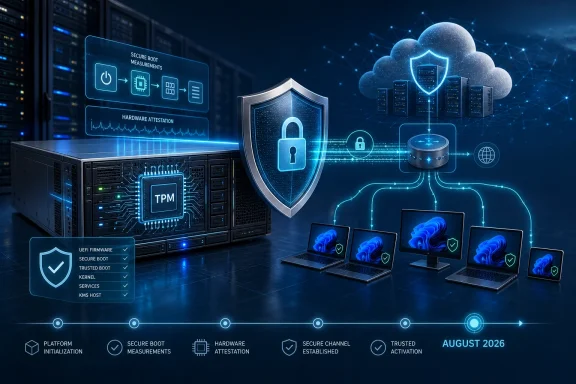
The model can be understood as a sequence:
That distinction matters. A server may have a TPM installed but still be poorly configured, boot from an untrusted path, or run out-of-date firmware. Hardware-backed KMS trust is most useful when it is paired with sound operational controls around firmware, Secure Boot, patching, administrative access, and physical security.
TPM technology is already familiar to many Windows administrators through features such as:
In the KMS scenario, the server is effectively being asked to prove: this activation host is the approved machine, operating from an acceptable platform state, rather than a copied configuration running somewhere else.
That makes it harder for an attacker to take a KMS installation, duplicate its configuration onto unauthorized infrastructure, and present the clone as a legitimate activation authority.
A TPM-backed identity raises the bar by anchoring trust to cryptographic material protected by the platform. The proof is designed to be much more difficult to reproduce on arbitrary hardware.
That does not mean TPM attestation makes a KMS host invulnerable. A legitimate server can still be compromised by weak administrator credentials, unpatched software, insecure remote-management interfaces, careless backup procedures, or privileged malware. However, it reduces a specific and important class of risk: unauthorized KMS hosts that attempt to impersonate or clone trusted activation infrastructure.
This is an important detail because it changes the immediate task from “deploy a new activation model” to “measure the current environment.” Administrators should be able to inspect whether an existing KMS host is eligible before the future requirement is enforced.
The primary tool is familiar:
Running the following command with appropriate administrative privileges provides detailed licensing and activation information:
For a KMS host that meets the forthcoming hardware-based conditions, the displayed status is expected to indicate:
For a device that does not satisfy the conditions, the status is expected to state:
That plain-language output is useful, but it should not become the entire assessment process. A successful status result confirms eligibility for the intended KMS Hardware-Secured path; it does not substitute for a full security review of the KMS server and its dependencies.
The key point is precision: Microsoft is not describing a requirement that suddenly invalidates every KMS deployment today. It is setting the direction for future KMS host security and providing a transition period through Windows Server 2025 readiness checks.
That distinction offers breathing room, but it should not encourage delay.
Server refresh cycles, datacenter procurement processes, firmware validation, virtualization design changes, and compliance approvals can take many months. Organizations that wait until the mandatory release is broadly deployed may find that their KMS host hardware cannot be upgraded in place or that their preferred virtualization architecture needs redesign.
Microsoft’s broader Windows Server security guidance consistently places TPM 2.0 alongside other platform protections, including:
A server that looks compliant in inventory software may still have a disabled TPM, legacy BIOS configuration, incomplete TPM provisioning, incompatible virtual TPM behavior, or firmware that has not been validated for the intended role.
KMS hosts have traditionally been able to run on either physical or virtual Windows systems. That flexibility makes sense: KMS consumes relatively little infrastructure capacity compared with major application platforms, and many organizations prefer to keep utility services virtualized for backup, mobility, and operational consistency.
Hardware-backed attestation complicates that picture.
A physical KMS host can work directly with a TPM embedded in or attached to its server platform. A virtual machine, by contrast, may rely on a virtual TPM, host-provided trust, platform-specific virtualization security, or an attestation chain that crosses several layers:
For a hardware-backed KMS model to be meaningful in a virtual machine, Microsoft will need to define how the system validates the relationship between the guest’s identity and the underlying trusted platform. That may involve virtual TPM requirements, supported hypervisor versions, host attestation, Secure Boot, or particular security baselines.
The safest current approach is to categorize KMS hosts into three groups:
This is not a reason to oppose the security change. It is a reason to budget early. Replacing a small KMS host may be inexpensive in isolation, but projects become more complex if the same host performs other undocumented duties or sits in a restricted network segment with unique dependencies.
That introduces a governance requirement. Server teams, Windows platform teams, security operations, and software asset management teams will need to communicate more closely than they may have in the past.
Administrators will need escalation paths for cases in which:
Organizations should include this in their disaster-recovery runbooks. A failover KMS host should be independently ready for the hardware-secured model, rather than being an untested emergency system with a different hardware profile.
Look for forgotten secondary hosts, regional hosts, lab environments, recovery sites, and systems retained after mergers or infrastructure migrations.
Capture the KMS Hardware-Secured eligibility result for every host. Store the output with the activation-service documentation rather than treating it as a one-time screen check.
Avoid making irreversible architecture decisions based on incomplete details. However, avoid assuming that a virtual KMS host will remain an automatic exception. A contingency design, including a supported physical standby host if warranted, may be prudent for large or highly regulated environments.
Confirm that:
The long-term logic is straightforward. Software controls are vital, but they are not sufficient if attackers can tamper with the platform beneath them. Firmware attacks, boot-chain manipulation, credential theft, and device impersonation all exploit the gap between a system’s apparent identity and its actual security posture.
By bringing TPM attestation to KMS, Microsoft is applying that principle to a core but often invisible service. Windows activation may not receive the same attention as identity, endpoint detection, or encryption, yet it sits at the intersection of licensing integrity, device management, and trusted enterprise infrastructure.
The transition will be easiest for organizations that have already standardized on modern server hardware, current firmware, secure boot practices, and disciplined lifecycle management. It will be harder for environments where volume activation has become an inherited service running on outdated infrastructure.
That gap is precisely why the readiness phase matters. Windows Server 2025 administrators now have a chance to discover which side of the line their KMS infrastructure occupies, resolve shortcomings methodically, and enter the next Windows Server LTSC era with activation hosts that are not only functional, but demonstrably trustworthy.
For IT administrators, this is more than a minor licensing-tool adjustment. KMS has historically been a comparatively quiet part of Windows Server operations: install the Volume Activation Services role, activate the host with a valid volume license key, publish the service through DNS, and let eligible clients renew activation in the background. Microsoft’s new approach adds a security verification layer beneath that familiar workflow.
The immediate impact is not expected to be a forced shutdown of existing KMS environments. Instead, the transition begins with readiness checks in Windows Server 2025 in August 2026. The larger change arrives with the next Windows Server Long-Term Servicing Channel (LTSC) release, when TPM attestation is set to become mandatory for the hardware-secured KMS activation model. While that future release is widely expected to be Windows Server 2028, Microsoft has not formally attached the requirement to a final commercial product name.
For organizations that still run KMS hosts on older physical servers, legacy virtual machines, or lightly managed infrastructure, the message is clear: inventory the activation estate now, not during the next server migration window.
 Background: Why KMS Security Matters
Key Management Service, or KMS, is Microsoft’s volume activation technology for organizations with significant numbers of Windows installations. Rather than having every Windows device contact Microsoft independently for activation, a company deploys one or more internal KMS hosts.Windows clients then locate those hosts, normally through DNS service records, and send activation requests over the local network. The KMS host verifies that the client is eligible and returns an activation response. That model helps enterprises manage activation efficiently in environments ranging from campus networks and branch offices to large, segmented datacenters.
KMS is built for scale. A properly configured KMS host can support a very large client population, and organizations with more than a small deployment commonly maintain at least two hosts for resiliency. The host does not necessarily need dedicated hardware either; it can coexist with other server roles, assuming the organization accepts the operational and security trade-offs.
That simplicity is one of KMS’s strengths. It is also part of the security challenge.
A KMS host represents a highly trusted service in the organization. If an attacker can impersonate, clone, redirect, or tamper with that host, the risk is not limited to a broken activation workflow. The attacker may create confusion around device licensing, cause activation failures across a broad Windows fleet, or use the trusted status of the service as part of a wider effort to undermine administrative controls.
KMS abuse has also long been associated with unauthorized activation tools and emulated KMS servers. Those tools are outside legitimate volume licensing practices, but their existence highlights a structural issue: a traditional client-server activation exchange does not inherently prove that the responding server is operating from an approved, healthy hardware platform.
KMS Hardware-Secured is Microsoft’s response to that weakness.
What KMS Hardware-Secured Changes
The new model adds hardware-backed trust to the KMS host. In practical terms, the KMS server will use its Trusted Platform Module to establish an attested identity and demonstrate that it is running in an approved state.This is a meaningful shift in the trust model.
Previously, a KMS host’s authority was principally rooted in its software configuration, network placement, installed KMS host key, and ability to communicate with Microsoft’s activation infrastructure. Those safeguards remain important, but the new system is intended to extend trust down into the device itself.
Under KMS Hardware-Secured activation, the host must provide TPM-based evidence that ties its activation role to a verifiable hardware root of trust. Microsoft can then validate the attestation before allowing the KMS host to perform the activation function.
The model can be understood as a sequence:
- The KMS host establishes a TPM-backed hardware identity.
- The host presents attestation information showing its platform state.
- Microsoft validates the attestation and determines whether the host meets the trust requirements.
- An approved host is permitted to provide KMS activation services to eligible Windows clients.
- A host that cannot meet the hardware-security conditions is identified as ineligible for the new model.
That distinction matters. A server may have a TPM installed but still be poorly configured, boot from an untrusted path, or run out-of-date firmware. Hardware-backed KMS trust is most useful when it is paired with sound operational controls around firmware, Secure Boot, patching, administrative access, and physical security.
TPM Attestation in Plain English
A Trusted Platform Module, usually abbreviated as TPM, is a dedicated hardware or firmware-backed security component. Windows uses it to protect cryptographic keys and record measurements related to the system’s boot process.TPM technology is already familiar to many Windows administrators through features such as:
- BitLocker Drive Encryption
- Windows Hello for Business
- Measured Boot
- Device Health Attestation
- Credential Guard
- System Guard
- Virtual smart cards
- Shielded virtual machines
In the KMS scenario, the server is effectively being asked to prove: this activation host is the approved machine, operating from an acceptable platform state, rather than a copied configuration running somewhere else.
That makes it harder for an attacker to take a KMS installation, duplicate its configuration onto unauthorized infrastructure, and present the clone as a legitimate activation authority.
Hardware identity is stronger than server identity alone
Traditional server identity commonly depends on credentials, certificates, host names, IP addresses, Active Directory objects, or application configuration. All of those are valuable, but some can be copied, redirected, stolen, or recreated by an attacker with sufficient access.A TPM-backed identity raises the bar by anchoring trust to cryptographic material protected by the platform. The proof is designed to be much more difficult to reproduce on arbitrary hardware.
That does not mean TPM attestation makes a KMS host invulnerable. A legitimate server can still be compromised by weak administrator credentials, unpatched software, insecure remote-management interfaces, careless backup procedures, or privileged malware. However, it reduces a specific and important class of risk: unauthorized KMS hosts that attempt to impersonate or clone trusted activation infrastructure.
The August 2026 Readiness Phase
The first operational milestone arrives in August 2026, when Windows Server 2025 is scheduled to begin surfacing readiness messaging for KMS Hardware-Secured support.This is an important detail because it changes the immediate task from “deploy a new activation model” to “measure the current environment.” Administrators should be able to inspect whether an existing KMS host is eligible before the future requirement is enforced.
The primary tool is familiar:
slmgr.Running the following command with appropriate administrative privileges provides detailed licensing and activation information:
slmgr /dlvFor a KMS host that meets the forthcoming hardware-based conditions, the displayed status is expected to indicate:
This device is eligible to serve as a KMS host with hardware-based security.For a device that does not satisfy the conditions, the status is expected to state:
This device does not meet the requirements for using KMS host with hardware-based security.That plain-language output is useful, but it should not become the entire assessment process. A successful status result confirms eligibility for the intended KMS Hardware-Secured path; it does not substitute for a full security review of the KMS server and its dependencies.
What administrators should record
The readiness phase is an opportunity to create a defensible baseline. For every KMS host, document:- The host name, operating system version, build, and patch level
- Whether the host is physical or virtual
- The host’s TPM version, provisioning state, and firmware status
- Secure Boot configuration and UEFI boot mode
- KMS host key type and supported client operating systems
- DNS publication settings and relevant service records
- Firewall configuration, including the customary TCP port 1688
- Network zones, routing dependencies, and branch-office reachability
- Whether a second KMS host exists for high availability
- Backup and recovery procedures for the KMS configuration
- Administrative ownership and privileged access controls
The Next LTSC Release Is the Real Deadline
Microsoft’s announcement places the mandatory element of the KMS Hardware-Secured approach with the next Windows Server LTSC release. This is the point organizations should treat as the strategic deadline, even though the exact final server branding and detailed implementation conditions may evolve before release.The key point is precision: Microsoft is not describing a requirement that suddenly invalidates every KMS deployment today. It is setting the direction for future KMS host security and providing a transition period through Windows Server 2025 readiness checks.
That distinction offers breathing room, but it should not encourage delay.
Server refresh cycles, datacenter procurement processes, firmware validation, virtualization design changes, and compliance approvals can take many months. Organizations that wait until the mandatory release is broadly deployed may find that their KMS host hardware cannot be upgraded in place or that their preferred virtualization architecture needs redesign.
Avoid assuming every TPM-capable server qualifies
A modern TPM is likely to be an important prerequisite, especially TPM 2.0, but enterprises should avoid treating TPM presence as equivalent to complete eligibility.Microsoft’s broader Windows Server security guidance consistently places TPM 2.0 alongside other platform protections, including:
- UEFI firmware
- Secure Boot
- Trusted boot measurements
- Firmware security controls
- Up-to-date platform software
- Compatible server hardware and drivers
A server that looks compliant in inventory software may still have a disabled TPM, legacy BIOS configuration, incomplete TPM provisioning, incompatible virtual TPM behavior, or firmware that has not been validated for the intended role.
Virtual KMS Hosts Need Special Attention
The most significant unanswered implementation question concerns virtualized KMS hosts.KMS hosts have traditionally been able to run on either physical or virtual Windows systems. That flexibility makes sense: KMS consumes relatively little infrastructure capacity compared with major application platforms, and many organizations prefer to keep utility services virtualized for backup, mobility, and operational consistency.
Hardware-backed attestation complicates that picture.
A physical KMS host can work directly with a TPM embedded in or attached to its server platform. A virtual machine, by contrast, may rely on a virtual TPM, host-provided trust, platform-specific virtualization security, or an attestation chain that crosses several layers:
- The guest operating system
- The guest’s virtual TPM implementation
- The hypervisor
- The physical host’s firmware and TPM
- The virtualization management plane
- The underlying attestation service
Why virtualization changes the trust question
Virtualization does not inherently weaken security. In well-designed environments, virtualization can support strong isolation, rapid recovery, controlled administration, and advanced protections such as shielded VMs. But the trust decision is more complicated because the KMS host’s apparent hardware identity may be virtualized.For a hardware-backed KMS model to be meaningful in a virtual machine, Microsoft will need to define how the system validates the relationship between the guest’s identity and the underlying trusted platform. That may involve virtual TPM requirements, supported hypervisor versions, host attestation, Secure Boot, or particular security baselines.
The safest current approach is to categorize KMS hosts into three groups:
- Physical KMS hosts with TPM 2.0 and modern UEFI security controls
- Virtual KMS hosts on supported, well-managed modern virtualization platforms
- Legacy or unclear deployments requiring remediation or replacement
Benefits of Hardware-Secured KMS
The main benefit is not convenience. It is a stronger, more defensible definition of what qualifies as a trusted activation authority.Better resistance to cloned activation hosts
A KMS server can be attractive to attackers because it provides a recognized service inside a Windows estate. Binding that role to TPM attestation makes simple configuration copying less useful. An unauthorized clone should not be able to establish the same trusted hardware posture merely by reproducing software settings.Alignment with Zero Trust principles
Modern enterprise security is increasingly moving away from implicit trust based solely on network location or directory membership. A device being “inside the network” is no longer considered enough. KMS Hardware-Secured extends that logic to Windows activation infrastructure: the host must continuously deserve trust based on a validated platform identity.Greater visibility before enforcement
The August 2026 readiness messaging is a practical strength. It gives administrators a direct way to discover whether a host meets the new standard before they are forced into a migration. That is markedly better than introducing a hard requirement with no diagnostic runway.Stronger licensing infrastructure hygiene
A KMS review can prompt organizations to improve related controls that are sometimes neglected:- Reducing unnecessary access to the KMS host
- Removing stale DNS records
- Updating host operating systems and firmware
- Verifying firewall scope
- Establishing failover capacity
- Documenting activation ownership
- Validating recovery procedures
Risks, Costs, and Operational Trade-Offs
The security argument is persuasive, but KMS Hardware-Secured will create real work for some organizations.Older server hardware may become a blocker
Some enterprises still use aging physical infrastructure for utility roles. A legacy KMS host may be perfectly functional from an activation perspective while lacking the firmware, TPM support, or secure boot configuration needed for the future model.This is not a reason to oppose the security change. It is a reason to budget early. Replacing a small KMS host may be inexpensive in isolation, but projects become more complex if the same host performs other undocumented duties or sits in a restricted network segment with unique dependencies.
Firmware maintenance becomes licensing-relevant
Firmware has traditionally been handled as an infrastructure-security concern rather than a licensing concern. Hardware-attested KMS changes that relationship. BIOS or UEFI settings, TPM state, boot configuration, and platform updates may now affect whether the activation host is eligible.That introduces a governance requirement. Server teams, Windows platform teams, security operations, and software asset management teams will need to communicate more closely than they may have in the past.
Attestation failures can create a new failure mode
A conventional KMS issue often involves DNS discovery, network routing, firewall rules, host-key activation, or service availability. Hardware-secured KMS introduces another category: attestation failure.Administrators will need escalation paths for cases in which:
- The TPM is not ready or not provisioned
- Firmware settings changed after maintenance
- Secure Boot is disabled
- A platform measurement no longer matches expected conditions
- A virtual host does not meet the final support criteria
- A server replacement changes the hardware trust identity
- An attestation service is unavailable or rejects the host
Privacy and hardware lifecycle considerations
Hardware-backed identity is deliberately specific. That strength can also affect replacement and disaster recovery planning. Moving a KMS workload to a different physical device is no longer just a matter of restoring a virtual machine or reapplying configuration; the new host may need to establish its own trusted identity and pass validation.Organizations should include this in their disaster-recovery runbooks. A failover KMS host should be independently ready for the hardware-secured model, rather than being an untested emergency system with a different hardware profile.
A Practical Preparation Plan for Windows Administrators
The most effective response is a phased preparation program rather than a last-minute technical fix.1. Identify every active KMS host
Do not rely exclusively on a CMDB entry or an old deployment document. Confirm which systems clients are currently using by examining DNS records, activation logs, configuration baselines, and network traffic where appropriate.Look for forgotten secondary hosts, regional hosts, lab environments, recovery sites, and systems retained after mergers or infrastructure migrations.
2. Update Windows Server 2025 hosts and run readiness checks
Once the August 2026 readiness functionality is available, update applicable hosts through the organization’s standard change process. Run:slmgr /dlvCapture the KMS Hardware-Secured eligibility result for every host. Store the output with the activation-service documentation rather than treating it as a one-time screen check.
3. Confirm the underlying platform posture
Validate that the host is operating in the expected mode:- TPM is present, enabled, and provisioned
- TPM 2.0 is in use where required
- UEFI is enabled rather than legacy BIOS compatibility mode
- Secure Boot is active
- Firmware and TPM firmware are current under the organization’s approved update policy
- The server platform is supported and remains within its lifecycle plan
- Privileged access to the host is tightly controlled
4. Separate physical and virtual KMS strategies
Physical KMS hosts can be evaluated directly against the hardware readiness criteria. Virtual KMS hosts should be documented separately and tracked against forthcoming guidance.Avoid making irreversible architecture decisions based on incomplete details. However, avoid assuming that a virtual KMS host will remain an automatic exception. A contingency design, including a supported physical standby host if warranted, may be prudent for large or highly regulated environments.
5. Test redundancy and recovery
KMS is normally easy to overlook precisely because it is reliable. That is why recovery testing matters.Confirm that:
- More than one KMS host is available where the client population and business impact justify it
- DNS can direct clients to an alternative host
- Firewall and network policies permit the backup path
- The standby host is validly licensed and configured
- Recovery documentation includes the hardware-attestation implications
- Service ownership is clear during a security or activation incident
6. Communicate the change beyond the Windows team
The KMS transition belongs to several operational disciplines:- Windows Server engineering
- Security architecture
- Hardware and datacenter operations
- Virtualization teams
- Software asset management
- Endpoint engineering
- Compliance and audit functions
The Broader Direction of Windows Security
KMS Hardware-Secured is part of a wider Microsoft strategy that increasingly treats hardware as a foundational part of enterprise trust. Windows security has been moving in this direction for years through TPM 2.0, Secure Boot, measured boot, virtualization-based security, credential isolation, passkey adoption, and hardware-assisted protection against firmware attacks.The long-term logic is straightforward. Software controls are vital, but they are not sufficient if attackers can tamper with the platform beneath them. Firmware attacks, boot-chain manipulation, credential theft, and device impersonation all exploit the gap between a system’s apparent identity and its actual security posture.
By bringing TPM attestation to KMS, Microsoft is applying that principle to a core but often invisible service. Windows activation may not receive the same attention as identity, endpoint detection, or encryption, yet it sits at the intersection of licensing integrity, device management, and trusted enterprise infrastructure.
The transition will be easiest for organizations that have already standardized on modern server hardware, current firmware, secure boot practices, and disciplined lifecycle management. It will be harder for environments where volume activation has become an inherited service running on outdated infrastructure.
That gap is precisely why the readiness phase matters. Windows Server 2025 administrators now have a chance to discover which side of the line their KMS infrastructure occupies, resolve shortcomings methodically, and enter the next Windows Server LTSC era with activation hosts that are not only functional, but demonstrably trustworthy.