

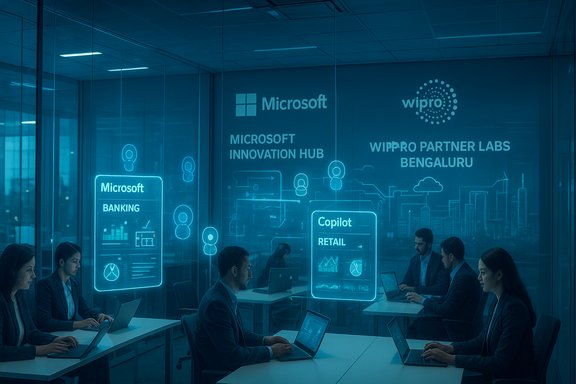
Wipro’s new three‑year pact with Microsoft marks a clear escalation in enterprise AI partnerships, pairing Wipro’s consulting‑led delivery and Wipro Intelligence™ platforms with Microsoft’s cloud and agentic‑AI stack to accelerate large‑scale Copilot and agent deployments — and it comes with an on‑site Microsoft Innovation Hub at Wipro’s Partner Labs in Bengaluru to fast‑track co‑innovation and immersive customer engagements.
Wipro and Microsoft framed the collaboration as a strategic, three‑year drive to convert clients into so‑called “Frontier Firms” — organisations that adopt Copilot and agentic AI early, at scale, and with governance baked in. The announcement positions Wipro’s consulting, engineering, and industry capability alongside Microsoft’s cloud, model and tools portfolio — calling out Microsoft Azure, Microsoft 365 Copilot, GitHub Copilot, Azure AI Foundry, and other enterprise platforms as the backbone of joint solutions. Wipro’s public communications also place the new Innovation Hub inside its Partner Labs in Bengaluru as a centre for co‑innovation: a physical space where clients can prototype AI‑enabled workflows, run immersive workshops, and evaluate domain agents and copilots built on Microsoft technology. Wipro’s broader innovation efforts — the Wipro Innovation Network and GitHub Center of Excellence — are explicitly invoked as complementary assets that will feed the hub with talent, IP and delivery pipelines.
Yet, the value will be realised only if the partnership addresses the hard engineering and governance problems that agentic AI introduces: secure data access, rigorous testing, clear operational boundaries, and cost control. Enterprises should treat headline numbers — the 50,000 Copilot licenses, the Innovation Hub, and upskilling figures — as strong indicators of commitment, but demand contractual clarity and practical proof points before greenlighting large transformational programs.
The Wipro‑Microsoft partnership is not a silver bullet, but it is a meaningful step toward mainstreaming agentic AI in enterprises: one that couples platform scale with systems integrator delivery bandwidth. The real test will be whether the Innovation Hub, Wipro’s internal Copilot rollout and the joint go‑to‑market efforts convert into repeatable, auditable production outcomes that are commercially sensible and operationally safe.
Source: Business Upturn Wipro partners Microsoft to accelerate AI adoption; launches Innovation Hub in Bengaluru - Business Upturn
 Background / Overview
Wipro and Microsoft framed the collaboration as a strategic, three‑year drive to convert clients into so‑called “Frontier Firms” — organisations that adopt Copilot and agentic AI early, at scale, and with governance baked in. The announcement positions Wipro’s consulting, engineering, and industry capability alongside Microsoft’s cloud, model and tools portfolio — calling out Microsoft Azure, Microsoft 365 Copilot, GitHub Copilot, Azure AI Foundry, and other enterprise platforms as the backbone of joint solutions. Wipro’s public communications also place the new Innovation Hub inside its Partner Labs in Bengaluru as a centre for co‑innovation: a physical space where clients can prototype AI‑enabled workflows, run immersive workshops, and evaluate domain agents and copilots built on Microsoft technology. Wipro’s broader innovation efforts — the Wipro Innovation Network and GitHub Center of Excellence — are explicitly invoked as complementary assets that will feed the hub with talent, IP and delivery pipelines. What the deal actually includes
Key commercial and technical elements
- A formal, multi‑year strategic partnership (three years, as described in the announcements).
- Integration of Wipro’s consulting and engineering delivery model with Microsoft cloud and AI offerings: Azure, Microsoft 365 Copilot, GitHub Copilot, Azure AI Foundry, and related enterprise tooling.
- Launch of a Microsoft Innovation Hub within Wipro’s Partner Labs in Bengaluru to support joint R&D, client workshops, and co‑development.
- A go‑to‑market emphasis on industry‑specific copilots and workflow automation across sectors such as financial services, retail, manufacturing, healthcare & life sciences, and airports.
- Scale commitments inside Wipro: the deployment of over 50,000 Microsoft Copilot licenses across Wipro’s workforce and an upskilling program covering 25,000+ employees on Microsoft Cloud and GitHub technologies.
Platform and tooling: what’s on the table
The partnership centres on Microsoft’s layered AI stack:- Microsoft Azure for cloud infrastructure and data platform capabilities.
- Microsoft 365 Copilot for knowledge worker productivity and enterprise workflows.
- GitHub Copilot embedded into engineering workflows (accelerated by Wipro’s GitHub Center of Excellence).
- Azure AI Foundry and agent services for building, managing and orchestrating agentic AI solutions.
Why this matters: commercial and industry context
1) Scale of internal adoption and the signalling effect
Deploying 50,000+ Copilot licenses internally and training tens of thousands of employees is a signal strategy: it both shortens Wipro’s time‑to‑market for Copilot‑enabled services and demonstrates internal proof points to clients. When global systems integrators adopt tools internally at scale, they can convert internal use cases into packaged services faster — lowering client adoption friction and accelerating revenue‑bearing engagements. Microsoft’s own announcements group Wipro with other Indian IT majors that are committing similar scale rollouts, positioning these firms as early enterprise deployment leaders.2) Market timing and Microsoft’s broader India investment
This partnership aligns with a much larger Microsoft push into the Indian market — including a multi‑billion investment and a raft of partnerships with systems integrators and product vendors. That context matters: hyperscalers are competing for ecosystem lock‑in as enterprises migrate workflows, data platforms and AI services to cloud platforms. For Wipro, being an early, visible partner of Microsoft can mean preferential access to co‑sell opportunities, technical roadmaps, and enterprise customers looking for end‑to‑end modernization partners.3) From pilots to production: the agent era
Azure’s agent services and marketplaces have matured significantly in recent months, enabling organisations to compose agentic AI (tools that can take multi‑step actions on behalf of users) rather than only single‑prompt generation workflows. Wipro’s messaging — and Microsoft’s agent‑first framing — points to a next phase of enterprise AI where automation is embedded in operational processes, not just in productivity overlays. This means more complex engineering, integration with transactional systems, and a higher bar for governance.The Innovation Hub in Bengaluru: what to expect
The Microsoft Innovation Hub in Wipro’s Partner Labs is described as a joint facility for:- Rapid prototyping of industry copilots and agents.
- Immersive client workshops and evaluation of AI‑enabled workflows.
- A runway for joint go‑to‑market packages that bundle Wipro’s vertical IP with Microsoft’s cloud services.
Strategic benefits for Wipro and Microsoft (and customers)
- For Wipro:
- Faster productization of AI services and more defensible, IP‑rich vertical offerings under Wipro Intelligence™.
- Internal modernization that creates case studies for client transformation projects.
- Access to Microsoft’s platform incentives, technical investments, and co‑selling channels.
- For Microsoft:
- Deeper enterprise traction for Microsoft 365 Copilot and Azure agent services through Wipro’s client base.
- A network effect as Wipro packages Copilot‑based solutions across industries and brings them to market.
- Reinforcement of Microsoft’s partner ecosystem narrative, crucial amid hyperscaler competition.
- For enterprise customers:
- Shorter paths from proof‑of‑concept to production via co‑engineered, industry‑specific copilots.
- Access to packaged, managed offerings rather than bespoke, high‑cost in‑house builds.
- Potential for faster ROI if governance, data and integration are handled correctly.
Technical and operational implications
Data, integration and architecture
Delivering agentic AI at scale requires more than model access. Enterprises must:- Establish robust data pipelines and catalogues to feed agents reliable, timely context.
- Implement identity, access and data governance patterns so agents only act where authorised.
- Provide audit trails, observability and human‑in‑the‑loop controls for decision‑critical operations.
- Design interoperable connectors to ERPs, CRM systems, and industry data sources to enable meaningful automation.
Developer productivity meets governance
Embedding GitHub Copilot and building a GitHub Center of Excellence accelerates engineers’ productivity. However, mass adoption of code‑generation tools demands standards: code review automation, dependency and license scanning, and CI/CD guardrails to ensure that Copilot‑assisted outputs conform to security, compliance and quality guidelines. Wipro’s GitHub CoE and internal upskilling programs are targeted at exactly this nexus: higher velocity with guardrails.Competing and complementary plays: who else is on the field
Microsoft is not the only hyperscaler pushing agent and model marketplaces; AWS, Oracle and others have launched agent marketplaces and similar capabilities. Indian systems integrators such as TCS, Infosys and Cognizant have made parallel commitments to Copilot deployments and agentic AI programs — Microsoft groups these firms together as emerging “Frontier Firms” in its announcements. That competitive cluster matters: enterprises will evaluate both hyperscaler‑led stacks and integrator packaging when selecting large transformation partners.Risks, constraints and where to watch closely
Every large‑scale Copilot and agent rollout faces pitfalls. The Wipro‑Microsoft tie‑up reduces some friction by combining platform and SI capabilities, but several risks persist:- Data governance and compliance: Agentic AI increases the attack surface for data leakage, inadvertent disclosure and regulatory non‑compliance. Enterprise customers need explicit data residency, lineage and retention policies. This is especially acute in regulated sectors like finance, healthcare and airports.
- Operational safety and hallucination: Agents that take multi‑step actions must be tested exhaustively. False or inappropriate actions can cascade into operational losses — for example, an agent that executes a financial transaction or modifies inventory records.
- Vendor lock‑in and platform dependence: Heavy dependence on Microsoft’s agent and Copilot ecosystems can increase switching costs. While standards and multi‑model architectures mitigate this risk, enterprises must plan for portability and hybrid models.
- Talent and cultural adoption: Training thousands of staff is necessary but not sufficient. Organizations must rewire processes, KPIs and governance frameworks to extract value from copilots — otherwise, Copilot becomes a bolt‑on productivity tool rather than an engine for structural transformation.
- Commercial and pricing complexity: Copilot licensing, agent runtime costs, and consumption‑based cloud spend can create unpredictable TCO if not modelled carefully. Negotiation and managed‑service packaging will be essential to deliver predictable outcomes.
How enterprises should evaluate offers from Wipro + Microsoft
When a vendor partnership promises packaged Copilot and agent solutions, procurement and IT leaders should evaluate offers against these practical criteria:- Data governance readiness — clear policies for data access, lineage and residency.
- Integration adapters — availability of pre‑built connectors for the enterprise’s key systems.
- Safety guarantees — evidence of red‑team testing, monitoring and human‑in‑the‑loop controls.
- Cost predictability — transparent licensing and consumption models, with managed‑service options to cap spend.
- Talent enablement — concrete plans for role redesign, incentives, and continuous upskilling beyond initial license training.
- Vendor neutrality — pathways to portability and multi‑cloud/model strategies to avoid excessive lock‑in.
Strengths of the partnership — what’s credible
- End‑to‑end capability: Wipro’s consulting and industry delivery plus Microsoft’s platform creates a credible route from ideation to production.
- Scale and signal: 50k Copilot licenses and the GitHub CoE are tangible, measurable commitments that indicate internal adoption and supply‑side capability.
- Co‑innovation focus: The Innovation Hub and Wipro Innovation Network provide physical and organisational structures for rapid prototyping and vertical IP creation.
- Market momentum: This partnership rides Microsoft’s broader strategic investment and hyperscaler momentum in India and globally, giving it co‑selling leverage.
Limitations and red flags
- Public statements vs. binding commitments: Press releases signal intent but rarely disclose contract terms, SLAs, or pricing models. Enterprises should seek verifiable SLAs and SOW commitments rather than rely on marketing language.
- Agent Marketplace specifics: While Wipro and partner announcements reference agent and marketplace approaches, some detailed claims (for example, proprietary “Agent Marketplace” inventories or monetization models) are not fully documented across multiple primary sources and may be marketing shorthand for broader partner ecosystems. Where a claim cannot be confirmed in an official product brief, it should be treated cautiously.
- Operational complexity: Achieving production‑grade agent behaviour requires deep integration and rigorous testing. Time and cost to achieve that readiness are often under‑estimated in initial announcements.
What to expect next: short and medium term signals
- Joint industry reference deals and proofs of value published by Wipro and Microsoft to demonstrate vertical outcomes (e.g., revenue uplift, cost reduction, automation metrics).
- Expansion of Innovation Hub workshops into customer engagements, with templated pilots for banking, retail and manufacturing.
- More detailed service and pricing packages that bundle Copilot licensing, agent runtime, and managed services — aimed at reducing enterprise procurement friction.
- Continued competition among SIs and hyperscalers to capture co‑sell and marketplace mindshare; expect similar announcements from rival integrators and cloud providers.
Bottom line: pragmatic optimism
The Wipro‑Microsoft partnership is a logical, well‑timed move for both companies. It combines Wipro’s industry reach and delivery scale with Microsoft’s rich platform stack and enterprise traction. For customers, the attraction is clear: a ready partner to move from experimentation to production with templated copilots, agent services and managed offerings.Yet, the value will be realised only if the partnership addresses the hard engineering and governance problems that agentic AI introduces: secure data access, rigorous testing, clear operational boundaries, and cost control. Enterprises should treat headline numbers — the 50,000 Copilot licenses, the Innovation Hub, and upskilling figures — as strong indicators of commitment, but demand contractual clarity and practical proof points before greenlighting large transformational programs.
Quick checklist for CIOs evaluating Wipro + Microsoft solutions
- Confirm whether proposed deployments include explicit data residency and audit controls.
- Ask for concrete pilot KPIs and the path to achieving them (timelines, owners, success metrics).
- Validate the scope of integration adapters available for your ERP/CRM and key line‑of‑business systems.
- Insist on transparent cost modelling for Copilot licenses, runtime agent consumption, and cloud infrastructure.
- Request documentation of the Hub’s prototyping outputs and a catalogue of reusable industry assets.
The Wipro‑Microsoft partnership is not a silver bullet, but it is a meaningful step toward mainstreaming agentic AI in enterprises: one that couples platform scale with systems integrator delivery bandwidth. The real test will be whether the Innovation Hub, Wipro’s internal Copilot rollout and the joint go‑to‑market efforts convert into repeatable, auditable production outcomes that are commercially sensible and operationally safe.
Source: Business Upturn Wipro partners Microsoft to accelerate AI adoption; launches Innovation Hub in Bengaluru - Business Upturn
