

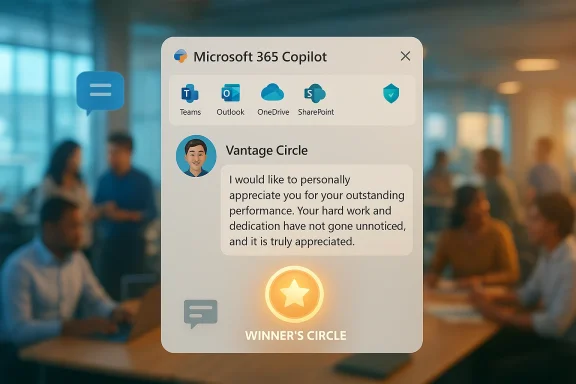
That matters because recognition has long been one of the hardest employee-experience functions to modernize. It is easy to automate a reward claim form; it is much harder to make appreciation feel timely, personal, and culturally authentic. Wipro’s move suggests that Copilot is increasingly being used not just to write emails or summarize meetings, but to make workplace culture itself more responsive. Microsoft’s customer story says the deployment had already crossed 200 monthly active users within two weeks, which is a strong early signal for a third-party agent embedded inside a major enterprise platform.
Overview
Wipro is a useful case study because it sits at the intersection of three forces reshaping enterprise software in 2026: AI copilots, workplace automation, and employee engagement platforms. The company is not adopting Microsoft 365 Copilot as a generic productivity tool alone. It is using it as a distribution layer for a specialized recognition system, internally branded as Winner’s Circle, built on Vantage Circle and tuned for the rhythms of everyday collaboration.
That is a meaningful strategic shift. For years, rewards and recognition platforms were largely standalone destinations—useful, but often disconnected from where work actually happened. Microsoft’s story makes clear that Wipro wanted to fix that fragmentation by letting users identify recognition opportunities from emails, Teams messages, meetings, OneDrive, SharePoint, and People data, then turn those signals into contextual praise and behavioral insights.
The broader implication is that enterprise AI is becoming less about isolated assistants and more about embedded orchestration. Microsoft has spent the last year pushing Copilot deeper into the “flow of work,” and the Wipro example shows how partners can build specialized experiences on top of that foundation. In other words, the platform is no longer just generating content; it is becoming a delivery mechanism for business processes.
There is also a market-design angle here. Wipro’s rollout reportedly began with managers and HR business partners, which is exactly the kind of controlled entry point that large enterprises favor when testing third-party agents. It lets the organization prove value, measure usage, and refine governance before extending the experience more broadly to employees. That is a conservative deployment pattern, but conservative is often how the best enterprise AI programs start.
Why This Story Matters Now
The timing is important because Microsoft has been pushing a more mature agent story across Microsoft 365. Recent Microsoft messaging emphasizes agents that work directly inside apps and chat, closing the gap between insight and action. The Wipro deployment fits that direction almost perfectly: it is not a flashy consumer-style chatbot, but a permissioned, work-centered agent that lives inside existing collaboration surfaces.
For Microsoft, stories like this help validate Copilot as a platform rather than a feature. If third-party agents can do real work inside Microsoft 365—recognition, messaging, behavior insights, and workflow prompts—then Copilot starts to look like an operating layer for enterprise action. That is a stronger pitch than “AI inside Office,” because it frames Microsoft 365 as a place where business logic can be executed, not just discussed.
For Wipro, the story is about scale and consistency. The customer story says the company already holds Microsoft 365 Copilot licenses and is using Microsoft’s broader suite—including Dynamics 365, Power Platform, and Copilot—to support scalability, security, and automation. That tells us Wipro sees Microsoft not merely as a vendor, but as a strategic substrate for internal innovation.
The recognition use case also lands at a moment when enterprises are looking for AI applications that are easier to trust than fully autonomous agents. Recognition is a relatively low-risk, high-visibility domain. The agent can suggest, draft, and contextualize, but it still depends on user authorization and human judgment. That makes it a sensible proving ground for practical AI inside a governed enterprise environment.
The significance of “in the flow of work”
Wipro’s language around “in the flow” recognition is not just a slogan. It reflects a growing belief that workplace software must be encountered where the work already happens, rather than in a separate portal that employees remember to visit later. Microsoft has been making that same argument across its Copilot ecosystem, and this customer story gives the idea a concrete business case.
That matters because delayed recognition often loses emotional value. If appreciation arrives days or weeks after the relevant contribution, it can start to feel transactional rather than sincere. Embedding recognition into Teams, email, and Copilot Chat compresses the time between action and acknowledgment, which is one of the most important levers in engagement design.
What Wipro Built
At the center of the deployment is a Vantage Circle agent that Microsoft says helps users identify recognition opportunities, craft contextual appreciation, and gain insight into team dynamics. It uses Microsoft 365 custom knowledge sources, including emails and Teams messages, to identify recognition moments and to suggest more relevant messages. That is a smart design choice because it ties appreciation to actual work signals rather than generic praise templates.
The story also highlights “hero prompts” that make the experience feel tangible. One example turns a recognition request into one-click appreciation with an auto-drafted message, while another summarizes a colleague’s recent contributions based on Teams chats. The practical value here is obvious: users do not have to hunt across systems or manually reconstruct the case for recognition. The agent assembles the context for them.
This kind of design matters because recognition systems often fail on friction. Employees may agree in principle that peers deserve praise, but if the act of documenting and submitting that praise feels cumbersome, usage declines. By reducing the effort required to recognize someone, Wipro is effectively removing the biggest behavioral barrier in the process. That is a small UX change with a potentially large cultural payoff.
Key capabilities in practice
Microsoft’s customer story and Wipro’s examples point to several capabilities that make the agent interesting beyond simple automation. These include identifying recognition gaps, drafting contextual messages, and surfacing behavioral patterns to managers and HR. Those functions are connected, not separate: the system can notice who is being overlooked, help explain why they matter, and nudge leaders toward action.
- Identifying employees who have not been recognized recently.
- Suggesting who deserves praise based on recent collaboration signals.
- Drafting appreciation messages that feel specific rather than generic.
- Surfacing team-level behavior patterns for managers and HR partners.
- Helping reinforce corporate values through ranked contribution insights.
- Supporting anniversary and milestone recognition without manual effort.
Why Microsoft 365 Copilot Is the Right Host
Microsoft’s role in this story is larger than distribution. The customer story makes clear that the company’s Microsoft 365 stack gives Wipro the scale, security, and AI automation needed for the deployment. That includes the usual enterprise virtues—identity, access control, and governance—but also the practical benefit of putting the agent where people already spend their day.
This is exactly why Microsoft’s agent strategy is resonating with large customers. The company has been positioning Copilot as a place where business apps and work data can meet conversation. Recent Microsoft guidance says agents in Microsoft 365 Copilot can bring everyday business apps into the flow of work, and that Copilot can surface visually rich or interactive experiences inside the conversation itself. Wipro’s recognition agent is a software cousin of that idea: the action happens where the conversation already lives.
There is also an architectural reason this matters. Recognition is not a standalone AI use case; it depends on visibility into collaboration, people data, and organizational context. Microsoft 365 is one of the few enterprise platforms that naturally spans all of those layers. That makes it unusually well suited to work that needs to connect communication, identity, and workflow without forcing users into another disconnected system.
Why third-party agents matter
The customer story describes Wipro’s rollout as one of the first large-scale deployments of a third-party-built digital agent inside Microsoft 365 Copilot Chat. Whether or not that proves unique in a strict technical sense, it does show that Microsoft’s platform is moving beyond first-party demos into partner-led production use cases. That is a major milestone for the ecosystem.
For Microsoft, the upside is obvious. If partners can build credible, secure, and widely adopted agents inside Copilot, the platform becomes more valuable with every new use case. That creates a flywheel: better partner experiences drive adoption, adoption justifies more investment, and more investment attracts still more partners. It is the classic platform play, now applied to enterprise AI.
Security, Trust, and Governance
The security model is one of the most important parts of the story, even if it is not the flashiest. Microsoft says insights are surfaced only from data the user is permitted to access within Microsoft 365. That is critical because employee recognition may feel harmless, but the underlying signals—messages, meetings, file access, and collaboration patterns—are still sensitive organizational data.
This permissioning model does two things. First, it protects privacy by keeping the agent within access boundaries. Second, it improves trust, because employees are more likely to use AI tools when they know the system is not casually vacuuming up information beyond their role. In enterprise AI, trust is a feature, not a byproduct.
There is also a compliance dimension. HR-adjacent systems can become politically fraught if leaders feel they are being surveilled or scored by opaque logic. Microsoft’s restricted-access approach helps Wipro avoid the impression that Copilot is acting as a hidden evaluator. Instead, it behaves more like a guided assistant operating within established permissions. That distinction is subtle, but it matters a great deal in large organizations.
Responsible AI in an HR setting
Embedding AI into recognition raises unique governance questions. What counts as a valid recognition moment? How much should the system infer from casual collaboration versus formal project work? And how do you avoid turning appreciation into a mechanized KPI? These are not minor issues; they go to the heart of employee trust and culture.
Wipro’s decision to start with managers and HR business partners suggests an awareness of those risks. That group is more likely than the general employee base to understand recognition norms, approval workflows, and cultural nuance. Starting there allows the company to tune the agent before expanding usage more broadly. That is a mature rollout pattern, and it is probably one reason adoption appears to have gained traction quickly.
Adoption and Change Management
The early adoption figures are notable because they show this is not a dormant pilot. Microsoft says the agent reached more than 200 monthly active users within two weeks of launch, supported by the “Recognize in Flow” campaign and AI Champion badges for early adopters. That tells us Wipro understood that good technology still needs social engineering to gain momentum.
The campaign design is instructive. “Recognize in Flow” is a message about behavior, not just product features. It asks employees to change when and how they think about appreciation, while the badges create a visible reward for exploration and early use. Those are old-school change-management tools, but they are still effective in enterprise settings where culture shifts more slowly than software updates.
This also highlights an important truth about workplace AI: adoption rarely comes from one brilliant prompt. It comes from repeated exposure, executive sponsorship, and a use case that people can understand in seconds. Recognition is powerful because everyone already understands the social value of praise. The AI layer simply reduces the friction between intention and action.
Why early usage matters
Early usage matters because it is usually the best predictor of whether a platform feature will become habit-forming. If managers and HR partners repeatedly use the agent to identify gaps and craft messages, they will build a pattern of reliance that is hard to reverse. That gives Wipro a chance to make recognition more consistent without requiring constant policy reminders.
It also gives the company a feedback loop. If the agent’s output is too formal, too vague, or too repetitive, users will notice quickly. If it is specific and helpful, its value compounds. In that sense, the first two weeks are less about success as an outcome and more about learning speed as an organizational capability.
What This Means for HR Technology
Wipro’s deployment is part of a broader change in HR tech: the shift from portal-based engagement tools to embedded experience layers. Traditional recognition systems asked employees to visit a separate product, complete a few steps, and wait for the organization to respond. The new model uses AI to collapse those steps into ordinary work conversations.
That has strategic implications for vendors. HR platforms can no longer compete only on redemption catalogs, reward structures, or reporting dashboards. They also have to compete on presence, timing, and contextual intelligence. If the employee experience is increasingly mediated by Microsoft 365 Copilot, then the value of a standalone HR tool depends on how well it can live inside that environment.
It also suggests a more mature view of employee engagement analytics. Instead of waiting for quarterly survey data or end-of-year reviews, organizations can now look at recognition flow as a near-real-time indicator of team health. That does not replace formal HR measurement, but it does give leaders a fresher signal about where appreciation is happening—and where it is missing.
From administration to intelligence
The biggest shift here is conceptual. Rewards and recognition used to be administrative systems. Now they are becoming intelligence systems that can guide managers toward better behavior. That is a more ambitious role, and it makes recognition software part of the broader productivity stack rather than just an HR utility.
- Recognition is becoming contextual rather than episodic.
- Manager prompts can expose cultural blind spots sooner.
- Behavioral insights can improve team-level decision-making.
- AI can reduce the writing burden that often suppresses praise.
- Embedded recognition can strengthen value alignment across departments.
Competitive Implications
For Microsoft, Wipro is a strong reference customer because it validates both the Copilot platform and the partner ecosystem around it. The company has been pushing harder to position Microsoft 365 Copilot as an environment where agents can operate directly in the flow of work, and this story shows a real enterprise use case that goes beyond generic productivity.
That puts pressure on competing ecosystems. Google, Salesforce, ServiceNow, and specialized HR tech vendors all want to own more of the employee workflow. But Microsoft’s strength is that it already sits at the center of document, chat, meeting, and identity layers in many enterprises. If recognition can be delivered there, rival tools have to justify why users should leave that environment to do something so simple.
The competitive question for Vantage Circle is different. The company is no longer just selling recognition software; it is selling a Copilot-enabled engagement layer. That is a better story because it makes the product feel more strategic and more embedded in modern work. But it also raises the bar, because customers will now expect interoperability, security, and AI quality equal to the Microsoft environment it lives inside.
Enterprise versus consumer impact
The consumer impact of this announcement is indirect, but it still matters. Employees increasingly expect workplace tools to feel as simple as consumer apps and as intelligent as modern chat systems. A recognition prompt inside Copilot Chat meets that expectation better than a traditional HR portal ever could.
For enterprises, the impact is more structural. This kind of integration can reduce manual HR work, improve recognition consistency, and give leaders a better view of how appreciation is distributed across teams. In large organizations, those are not cosmetic gains. They can affect retention, morale, and the perceived fairness of management itself.
Strengths and Opportunities
Wipro’s deployment has several obvious strengths. It uses a familiar platform, a clear business problem, and an AI layer that can make a repetitive task feel immediate and personalized. It also shows a realistic approach to adoption: start with the people who can shape usage, then expand once the process is trusted. The opportunity is to turn recognition from a once-in-a-while event into a durable cultural habit.
- It embeds recognition directly into daily collaboration.
- It reduces friction for managers and HR partners.
- It uses permitted Microsoft 365 data to improve relevance.
- It supports culture through timely, contextual appreciation.
- It creates a measurable early-adoption signal.
- It strengthens Microsoft’s Copilot ecosystem story.
- It gives Vantage Circle a more strategic enterprise position.
Risks and Concerns
The biggest risk is cultural over-automation. If appreciation starts to feel too machine-generated, too frequent, or too formulaic, employees may distrust it. Recognition works because it is emotionally specific, and AI can help with that only if it remains grounded in genuine human judgment.
- Over-automation could make praise feel transactional.
- Poor prompt design could produce generic messages.
- Leaders may misread recognition data as a complete cultural metric.
- Permissioned data use still raises privacy sensitivity.
- Adoption could plateau if prompts are not continuously refined.
- Integration depth may increase dependence on Microsoft’s ecosystem.
- HR teams may struggle to govern expectations across regions.
There is also a subtle managerial concern. If the agent becomes too good at surfacing recognition gaps, leaders may feel pressured to manage by dashboard rather than by direct observation. That is not inherently bad, but it can shift the tone of management if the data becomes the default lens instead of a supplementary one. Insight is valuable; replacement is dangerous.
Looking Ahead
The most likely next step is broader rollout and deeper automation. Microsoft’s story already says Wipro is continuing to enhance the agent with feedback-driven features such as award nomination report generation and automated announcements. That suggests the platform is still in its early phase, with more workflow coverage to come.
The bigger question is whether this becomes a repeatable template for other enterprises. If a company as large and complex as Wipro can make embedded recognition useful inside Microsoft 365 Copilot, then other global firms will almost certainly want to explore the same pattern. The combination of permissioned data, familiar collaboration surfaces, and contextual AI is likely to prove attractive across industries.
What to watch next
- Whether Wipro expands the agent beyond managers and HR.
- Whether usage stays high after the novelty period.
- Whether award nomination automation improves efficiency.
- Whether automated announcements reduce HR operational load.
- Whether other Microsoft customers copy the same model.
- Whether Vantage Circle adds more workflow-native agents.
- Whether Microsoft highlights this as a flagship Copilot partner story.
The deeper lesson is that enterprise AI is now being judged less by abstract model quality and more by its ability to improve human systems without breaking them. Wipro’s recognition deployment succeeds conceptually because it respects that balance. It uses AI to sharpen appreciation, not replace it, and it does so inside a platform that enterprises already trust for work, identity, and collaboration. If that formula holds, it may become a small but influential blueprint for the next phase of workplace AI.