

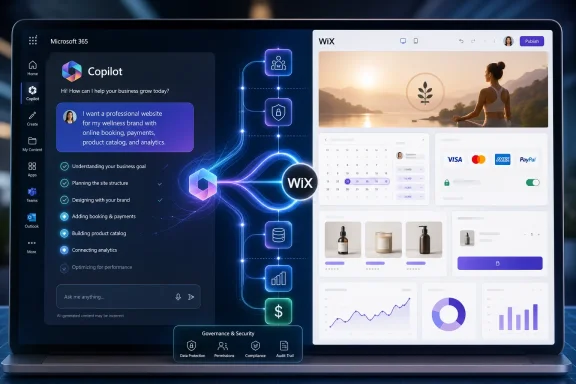
Wix.com announced on June 15, 2026, that Wix Harmony will be available inside Microsoft 365 Copilot, letting users create and manage Wix-powered websites from natural-language prompts within Microsoft’s productivity interface. The deal is not just another AI feature badge; it is an attempt to move Wix from a destination website builder into the workflow layer where small businesses already write, plan, sell, and analyze. For investors, that makes the Copilot integration a test of whether Wix can turn AI distribution into durable monetization rather than simply spending more to keep up with the generative-AI arms race.
For years, Wix’s investor story rested on a deceptively simple proposition: millions of entrepreneurs, creators, agencies, and small businesses need a professional web presence, and many of them would rather pay a platform than hire a developer. That was a good business while websites were hard enough to justify subscriptions, templates, commerce add-ons, booking tools, and payments infrastructure.
AI has made that story less comfortable. If a prompt can generate a competent landing page, the old website-builder category starts to look like a commodity. The bear case is not that Wix stops being useful overnight; it is that the perceived value of website creation falls faster than Wix can monetize the business functions around it.
That is why the Microsoft 365 Copilot integration matters. Wix is not merely saying, “Use AI to build a site faster.” It is saying, “Use Wix wherever work begins.” If the first draft of a marketing campaign, product launch, client proposal, or local-services business plan starts in Microsoft 365, Wix wants the website, store, booking flow, payment stack, and analytics dashboard to be one conversational step away.
The strategic ambition is clear: Wix wants to be the execution engine behind AI-generated business intent. A user tells Copilot, in plain language, what kind of business they are starting or updating; Wix Harmony turns that into a working web presence with commercial plumbing attached. That is a more ambitious pitch than template generation, and it is the difference between an AI feature and an AI distribution strategy.
That proximity changes the funnel. Historically, Wix had to persuade a user to visit Wix, choose a plan, select a template, and build from there. Inside Copilot, the intent may appear earlier and more naturally: “Create a site for this new service,” “Add online booking,” “Turn this product sheet into a store,” or “Improve our page based on last month’s sales.”
This is the kind of surface area that consumer-facing AI tools have made strategically precious. The winning app is often not the most complete application; it is the one that appears at the moment of intent. If Microsoft 365 Copilot becomes a daily business assistant for even a meaningful minority of small-business and enterprise users, embedded partners such as Wix can benefit from being present before the user searches for a separate tool.
For Wix investors, that is the bull case in miniature. AI may reduce the labor cost of creating a website, but it can also expand the number of moments when a business decides to create, update, test, or commercialize a digital presence. Wix’s job is to convert those moments into paid subscriptions, transaction revenue, and higher-value business-solutions usage.
That is why the Microsoft deal fits with Wix’s broader 2026 pattern. The company has been positioning Wix Headless and Wix Harmony as infrastructure that AI agents and developers can call from other environments. Its OpenAI Codex and Stripe-related moves point in the same direction: Wix wants its commercial back end to be available wherever AI-assisted building happens.
This matters because pure design generation is vulnerable to commoditization. Many tools can create a pretty page. Fewer can reliably provision a business-grade stack, connect transactions, handle scheduling, expose analytics, and keep the experience manageable for non-technical users.
If Wix can make its back end the default “business operating layer” for AI-created sites and applications, then the monetization story becomes less fragile. The company would not be selling only page creation; it would be selling the ongoing ability to run the business that page represents.
That is not guaranteed. Microsoft 365 Copilot itself is still evolving as a business workflow layer. Enterprises may be cautious about enabling third-party app interactions, and small businesses may not yet use Copilot as the command center Microsoft wants it to become. Even when users try the Wix integration, some may treat it as a novelty rather than a paid business platform.
There is also a channel conflict of sorts. The easier Wix makes creation, the more users may expect lower prices. AI can increase volume, but it can also reset expectations around what should be free, bundled, or cheap. Wix has to prove that ease of creation leads to more paid business functionality, not merely more free experimentation.
That is why metrics over the next several quarters matter more than the announcement itself. Management will need to show that AI-assisted acquisition improves the economics of the business. If revenue growth keeps softening while AI infrastructure and product investment rise, investors will not accept “strategic positioning” as a substitute for operating leverage.
That context prevents the Copilot news from becoming a clean victory lap. Wix is clearly investing in AI distribution, but it is doing so while managing slower growth, pressure in parts of the business, and a market that is increasingly skeptical of software companies asking for patience. The company’s raised free-cash-flow guidance helps, but it does not fully erase concerns about demand durability.
In other words, Wix is attempting two transformations at once. It is trying to become more AI-native in product and distribution, while also proving it can remain financially disciplined. That is a difficult balance, especially for a company whose category is directly exposed to the argument that AI will make traditional web-building tools less necessary.
The Microsoft integration strengthens the strategic narrative, but it does not override the financial one. For investors, the stock story still depends on whether Wix can maintain growth while defending margins and absorbing AI-related costs. A partnership can open the door; it cannot force customers to walk through it.
On one side, AI lets Wix automate more of the work that once created friction for users. A business owner who would have abandoned a site halfway through can now get something usable faster. An agency can serve more clients with fewer manual steps. A merchant can ask for changes in natural language rather than navigating menus and plugins.
On the other side, AI lowers the barrier for rival platforms. Newer AI-native builders can promise faster creation, lower prices, and more flexible generation. Developer-focused tools can skip the classic website-builder metaphor entirely and produce custom applications from prompts. Large platforms can bundle web presence tools into productivity, commerce, social, or cloud ecosystems.
This is why Wix’s ecosystem depth matters. If the company competes only on prompt-to-page generation, it risks being one of many. If it competes on prompt-to-business infrastructure, it has a stronger moat. But that moat must be experienced by customers, not merely described to investors.
The Microsoft 365 Copilot integration is therefore a distribution bet and a product-confidence bet. Wix is assuming that once users arrive through an AI interface, the breadth of Wix’s platform will keep them there. That is plausible, but it is not automatic.
A Wix-powered website flow gives Microsoft a concrete demonstration of agentic productivity. The user asks for a business outcome, and the assistant helps produce an operational asset. That is exactly the kind of example Microsoft needs as it tries to justify Copilot’s place in the Microsoft 365 stack.
For WindowsForum readers, this is the broader platform story. Microsoft is not just adding AI to Office; it is trying to turn Microsoft 365 into a place where third-party business workflows begin. If that model works, the winners will not only be Microsoft’s own apps but also the partners that become trusted execution endpoints inside Copilot.
That creates a familiar Microsoft ecosystem dynamic. Third-party vendors gain access to Microsoft’s distribution, but they also become dependent on Microsoft’s interface choices, governance policies, licensing model, and user adoption curve. Wix gets reach, but Microsoft owns the room.
A website by itself is often a means to an end. A restaurant wants reservations. A consultant wants leads. A fitness instructor wants bookings. A merchant wants checkout. A nonprofit wants donations. If Wix can attach itself to those outcomes, it has a monetization path even as the cost of generating pages trends downward.
That is why investors should watch Business Solutions revenue, payments adoption, commerce attach rates, bookings usage, and partner-channel behavior. These indicators reveal whether Wix is monetizing operations rather than just design. AI-generated front ends may become abundant; reliable business infrastructure can still command economics.
The Microsoft integration could help if it attracts users who are already in a business-planning context. Someone drafting a launch plan in Word, modeling pricing in Excel, or discussing go-to-market steps in Teams may be closer to commercial intent than a casual visitor trying a free website builder. That could improve conversion quality if the workflow is executed well.
But there is an opposing possibility. Copilot could drive top-of-funnel usage that is broad but shallow. If many users generate trial sites and few upgrade, Wix may absorb compute, support, and product complexity without a commensurate revenue lift. The difference between those outcomes is the difference between a strong AI monetization story and a costly distribution experiment.
If a user can ask Copilot to create a public-facing site based on business materials, organizations will want clarity on what data is passed, what gets stored, who owns the generated site, how publishing is controlled, and whether payment or customer-data features are enabled by default. These are not abstract concerns. They are the same governance issues that follow every powerful productivity integration, only now the output can be a live commercial presence.
Small businesses may welcome the convenience with fewer reservations. Larger organizations will likely move more slowly, especially if brand, legal, security, or customer-data obligations are involved. The integration’s practical success may depend as much on admin controls and enterprise trust as on prompt quality.
This is where Wix’s enterprise-grade positioning becomes important. The company wants to be seen not as a toy builder but as a serious business platform. Microsoft 365 Copilot gives it a more professional context, but that context also raises the bar.
The more cautious reading is that Wix is paying the strategic tax required to remain relevant. Every software company now needs an AI story, and many need distribution partnerships to avoid being pushed down the stack. The Microsoft deal may be necessary without being sufficient.
Both views can be true. The integration improves Wix’s strategic position, but it does not remove the need for execution. Investors should not treat the announcement as proof of monetization; they should treat it as a new channel that must earn its place in the model.
The next stage of the story will be less about press releases and more about evidence. Does AI increase paid conversion? Does it expand commerce and payments usage? Does it help partners deliver more value? Does it lower customer-acquisition friction? Does it protect margins after infrastructure costs?
 Wix Is Trying to Escape the Website Builder Box
For years, Wix’s investor story rested on a deceptively simple proposition: millions of entrepreneurs, creators, agencies, and small businesses need a professional web presence, and many of them would rather pay a platform than hire a developer. That was a good business while websites were hard enough to justify subscriptions, templates, commerce add-ons, booking tools, and payments infrastructure.AI has made that story less comfortable. If a prompt can generate a competent landing page, the old website-builder category starts to look like a commodity. The bear case is not that Wix stops being useful overnight; it is that the perceived value of website creation falls faster than Wix can monetize the business functions around it.
That is why the Microsoft 365 Copilot integration matters. Wix is not merely saying, “Use AI to build a site faster.” It is saying, “Use Wix wherever work begins.” If the first draft of a marketing campaign, product launch, client proposal, or local-services business plan starts in Microsoft 365, Wix wants the website, store, booking flow, payment stack, and analytics dashboard to be one conversational step away.
The strategic ambition is clear: Wix wants to be the execution engine behind AI-generated business intent. A user tells Copilot, in plain language, what kind of business they are starting or updating; Wix Harmony turns that into a working web presence with commercial plumbing attached. That is a more ambitious pitch than template generation, and it is the difference between an AI feature and an AI distribution strategy.
Microsoft Gives Wix Something More Valuable Than Hype
The most important asset Microsoft brings is not model quality. It is proximity. Microsoft 365 is where many businesses already keep their documents, spreadsheets, calendars, email, meetings, customer lists, and planning material.That proximity changes the funnel. Historically, Wix had to persuade a user to visit Wix, choose a plan, select a template, and build from there. Inside Copilot, the intent may appear earlier and more naturally: “Create a site for this new service,” “Add online booking,” “Turn this product sheet into a store,” or “Improve our page based on last month’s sales.”
This is the kind of surface area that consumer-facing AI tools have made strategically precious. The winning app is often not the most complete application; it is the one that appears at the moment of intent. If Microsoft 365 Copilot becomes a daily business assistant for even a meaningful minority of small-business and enterprise users, embedded partners such as Wix can benefit from being present before the user searches for a separate tool.
For Wix investors, that is the bull case in miniature. AI may reduce the labor cost of creating a website, but it can also expand the number of moments when a business decides to create, update, test, or commercialize a digital presence. Wix’s job is to convert those moments into paid subscriptions, transaction revenue, and higher-value business-solutions usage.
The Integration Is Really About the Back End
The phrase “AI website builder” undersells what Wix is trying to monetize. The valuable part of a modern small-business website is rarely the homepage. It is the machinery behind the homepage: payments, bookings, events, catalog management, customer data, analytics, SEO, accessibility, security, and integrations.That is why the Microsoft deal fits with Wix’s broader 2026 pattern. The company has been positioning Wix Headless and Wix Harmony as infrastructure that AI agents and developers can call from other environments. Its OpenAI Codex and Stripe-related moves point in the same direction: Wix wants its commercial back end to be available wherever AI-assisted building happens.
This matters because pure design generation is vulnerable to commoditization. Many tools can create a pretty page. Fewer can reliably provision a business-grade stack, connect transactions, handle scheduling, expose analytics, and keep the experience manageable for non-technical users.
If Wix can make its back end the default “business operating layer” for AI-created sites and applications, then the monetization story becomes less fragile. The company would not be selling only page creation; it would be selling the ongoing ability to run the business that page represents.
Investors Are Right to Ask Whether Distribution Converts
The market will not give Wix full credit for the Microsoft integration simply because the logo is impressive. Investors have seen enough AI partnerships to know that announcements and revenue contribution are different things. The question is whether Copilot placement generates measurable new demand, better conversion, higher average revenue per user, or lower customer-acquisition costs.That is not guaranteed. Microsoft 365 Copilot itself is still evolving as a business workflow layer. Enterprises may be cautious about enabling third-party app interactions, and small businesses may not yet use Copilot as the command center Microsoft wants it to become. Even when users try the Wix integration, some may treat it as a novelty rather than a paid business platform.
There is also a channel conflict of sorts. The easier Wix makes creation, the more users may expect lower prices. AI can increase volume, but it can also reset expectations around what should be free, bundled, or cheap. Wix has to prove that ease of creation leads to more paid business functionality, not merely more free experimentation.
That is why metrics over the next several quarters matter more than the announcement itself. Management will need to show that AI-assisted acquisition improves the economics of the business. If revenue growth keeps softening while AI infrastructure and product investment rise, investors will not accept “strategic positioning” as a substitute for operating leverage.
The Guidance Cut Keeps the Story Grounded
The timing of the Microsoft announcement is awkward in a useful way. Earlier in June, Wix reduced its 2026 outlook, moving from mid-teens revenue growth expectations to a low-to-mid-teens range and lowering bookings growth expectations. The company also disclosed a major workforce reduction of roughly 20%, with restructuring charges and a renewed emphasis on prioritizing strategic areas.That context prevents the Copilot news from becoming a clean victory lap. Wix is clearly investing in AI distribution, but it is doing so while managing slower growth, pressure in parts of the business, and a market that is increasingly skeptical of software companies asking for patience. The company’s raised free-cash-flow guidance helps, but it does not fully erase concerns about demand durability.
In other words, Wix is attempting two transformations at once. It is trying to become more AI-native in product and distribution, while also proving it can remain financially disciplined. That is a difficult balance, especially for a company whose category is directly exposed to the argument that AI will make traditional web-building tools less necessary.
The Microsoft integration strengthens the strategic narrative, but it does not override the financial one. For investors, the stock story still depends on whether Wix can maintain growth while defending margins and absorbing AI-related costs. A partnership can open the door; it cannot force customers to walk through it.
AI Makes Wix More Useful and More Exposed
There is a paradox at the center of Wix’s AI strategy. The same technology that makes Wix more powerful also makes the competitive landscape more dangerous.On one side, AI lets Wix automate more of the work that once created friction for users. A business owner who would have abandoned a site halfway through can now get something usable faster. An agency can serve more clients with fewer manual steps. A merchant can ask for changes in natural language rather than navigating menus and plugins.
On the other side, AI lowers the barrier for rival platforms. Newer AI-native builders can promise faster creation, lower prices, and more flexible generation. Developer-focused tools can skip the classic website-builder metaphor entirely and produce custom applications from prompts. Large platforms can bundle web presence tools into productivity, commerce, social, or cloud ecosystems.
This is why Wix’s ecosystem depth matters. If the company competes only on prompt-to-page generation, it risks being one of many. If it competes on prompt-to-business infrastructure, it has a stronger moat. But that moat must be experienced by customers, not merely described to investors.
The Microsoft 365 Copilot integration is therefore a distribution bet and a product-confidence bet. Wix is assuming that once users arrive through an AI interface, the breadth of Wix’s platform will keep them there. That is plausible, but it is not automatic.
Microsoft Also Gets a Better Copilot Story
The deal is not one-sided. Microsoft has its own reason to welcome partners like Wix into Copilot: it needs Copilot to feel less like a chat box and more like an action layer. Users are more likely to see value in Copilot if it can do real work across business systems rather than merely summarize documents or draft emails.A Wix-powered website flow gives Microsoft a concrete demonstration of agentic productivity. The user asks for a business outcome, and the assistant helps produce an operational asset. That is exactly the kind of example Microsoft needs as it tries to justify Copilot’s place in the Microsoft 365 stack.
For WindowsForum readers, this is the broader platform story. Microsoft is not just adding AI to Office; it is trying to turn Microsoft 365 into a place where third-party business workflows begin. If that model works, the winners will not only be Microsoft’s own apps but also the partners that become trusted execution endpoints inside Copilot.
That creates a familiar Microsoft ecosystem dynamic. Third-party vendors gain access to Microsoft’s distribution, but they also become dependent on Microsoft’s interface choices, governance policies, licensing model, and user adoption curve. Wix gets reach, but Microsoft owns the room.
The Investor Debate Moves From “Can AI Build Sites?” to “Who Captures the Transaction?”
The easiest AI question is whether software can generate a website. The harder business question is who captures the value after the site exists. Wix is trying to answer that second question.A website by itself is often a means to an end. A restaurant wants reservations. A consultant wants leads. A fitness instructor wants bookings. A merchant wants checkout. A nonprofit wants donations. If Wix can attach itself to those outcomes, it has a monetization path even as the cost of generating pages trends downward.
That is why investors should watch Business Solutions revenue, payments adoption, commerce attach rates, bookings usage, and partner-channel behavior. These indicators reveal whether Wix is monetizing operations rather than just design. AI-generated front ends may become abundant; reliable business infrastructure can still command economics.
The Microsoft integration could help if it attracts users who are already in a business-planning context. Someone drafting a launch plan in Word, modeling pricing in Excel, or discussing go-to-market steps in Teams may be closer to commercial intent than a casual visitor trying a free website builder. That could improve conversion quality if the workflow is executed well.
But there is an opposing possibility. Copilot could drive top-of-funnel usage that is broad but shallow. If many users generate trial sites and few upgrade, Wix may absorb compute, support, and product complexity without a commensurate revenue lift. The difference between those outcomes is the difference between a strong AI monetization story and a costly distribution experiment.
The Windows and IT Angle Is Governance, Not Just Convenience
For administrators, the most interesting part of the Wix-Copilot integration is not that employees can build websites faster. It is that business creation workflows may increasingly happen inside managed productivity environments. That raises questions about permissions, data boundaries, compliance, procurement, and shadow IT.If a user can ask Copilot to create a public-facing site based on business materials, organizations will want clarity on what data is passed, what gets stored, who owns the generated site, how publishing is controlled, and whether payment or customer-data features are enabled by default. These are not abstract concerns. They are the same governance issues that follow every powerful productivity integration, only now the output can be a live commercial presence.
Small businesses may welcome the convenience with fewer reservations. Larger organizations will likely move more slowly, especially if brand, legal, security, or customer-data obligations are involved. The integration’s practical success may depend as much on admin controls and enterprise trust as on prompt quality.
This is where Wix’s enterprise-grade positioning becomes important. The company wants to be seen not as a toy builder but as a serious business platform. Microsoft 365 Copilot gives it a more professional context, but that context also raises the bar.
The Copilot Deal Gives Wix a Better Story, Not a Free Pass
The most bullish reading is that Wix has found a way to ride the AI platform shift rather than be consumed by it. Instead of waiting for users to come to Wix.com, it is putting Wix inside the AI assistants and developer tools where users increasingly express intent. That is exactly what a threatened platform should do.The more cautious reading is that Wix is paying the strategic tax required to remain relevant. Every software company now needs an AI story, and many need distribution partnerships to avoid being pushed down the stack. The Microsoft deal may be necessary without being sufficient.
Both views can be true. The integration improves Wix’s strategic position, but it does not remove the need for execution. Investors should not treat the announcement as proof of monetization; they should treat it as a new channel that must earn its place in the model.
The next stage of the story will be less about press releases and more about evidence. Does AI increase paid conversion? Does it expand commerce and payments usage? Does it help partners deliver more value? Does it lower customer-acquisition friction? Does it protect margins after infrastructure costs?
The Numbers Wix Must Make Microsoft Matter
Wix’s Copilot move gives investors a cleaner framework for judging the AI strategy over the next few quarters. The important signals are concrete, and they will show up in operating metrics long before they show up in grand claims about the future of web creation.- Wix needs to show that Copilot and other AI channels create paid customers, not just free site-generation activity.
- Business Solutions revenue must keep growing faster than basic subscription revenue if Wix is successfully monetizing operations rather than templates.
- AI infrastructure spending has to translate into better conversion, retention, or product velocity, otherwise margin pressure will become the dominant investor concern.
- The Partner business remains a key risk because weakness there can offset gains from new AI distribution channels.
- Microsoft 365 Copilot adoption and third-party app usage will influence how much real demand Wix can capture from the integration.
- The strongest bull case depends on Wix becoming a business infrastructure layer for AI agents, not merely another prompt-based website generator.
References
- Primary source: simplywall.st
Published: 2026-06-28T02:25:12.586230
How Wix’s Microsoft 365 Copilot Integration Could Reshape Wix.com (WIX) Investors’ AI Monetization Story - Simply Wall St News
Earlier this month, Wix.com Ltd. announced a collaboration with Microsoft Corporation to integrate its Wix Harmony website creation tools directly into Microsoft 365 Copilot, allowing users to generate and manage feature-rich Wix sites via natural-language prompts inside the Microsoft 365...simplywall.st - Related coverage: globenewswire.com
Wix Partners with Microsoft 365 Copilot to Bring Website
Users can now generate Wix Harmony websites directly within Microsoft 365 Copilot without context switching NEW YORK - Wix (Nasdaq: WIX) Wix today...www.globenewswire.com - Related coverage: nasdaq.com
Wix Brings the Wix Headless Business Backend to Stripe Projects | Nasdaq
Wix Headless now lets developers and AI agents provision a complete Wix business backend directly from the Stripe Projects command-line interface. NEW YORK- Wix today announced that it has been named a provider in Stripe Projects, connecting the Stripe Projects command-line interface directly to...www.nasdaq.com - Related coverage: goldesel.de
Wix setzt bei Copilot auf KI: Wix Harmony läuft in Microsoft 365 Copil
KurzüberblickWix bringt die KI-gestützte Website-Erstellung Wix Harmony in die Arbeitsumgebung von Microsoft: Über die Integration soll Wix Harmony direkt... goldesel.de
- Related coverage: pl.investing.com
Wix integruje kreator stron z Microsoft 365 Copilot Przez Investing.com
Wix integruje kreator stron z Microsoft 365 Copilotpl.investing.com - Related coverage: tech.yahoo.com
Wix (WIX), Microsoft (MSFT) Partner to Integrate AI-Powered Website Creation into Microsoft 365 Copilot
Wix.com Ltd. (NASDAQ:WIX) is one of the underperforming tech stocks to buy according to analysts. On June 15, Wix partnered with Microsoft (MSFT) to integrate its “Wix Harmony” website creation platform directly into Microsoft 365 Copilot. By using the OpenAI Apps SDK, this integration allows...tech.yahoo.com
- Related coverage: br.investing.com
Wix integra criador de sites ao Microsoft 365 Copilot Por Investing.com
Wix integra criador de sites ao Microsoft 365 Copilotbr.investing.com - Related coverage: assets.publishing.service.gov.uk
- Related coverage: investing.com
Wix.com stock holds at Sector Perform as guidance cut on weakness By Investing.com
Wix.com stock holds at Sector Perform as guidance cut on weaknesswww.investing.com - Related coverage: fool.com
Wix.com (WIX) Q1 2026 Earnings Call Transcript | The Motley Fool
Wix.com (WIX) Q1 2026 Earnings Call Transcriptwww.fool.com - Related coverage: alphaspread.com
WIX Q1-2026 Earnings Call
Wix.Com Ltd (NASDAQ:WIX) Q1-2026 earnings call transcript.www.alphaspread.com
