

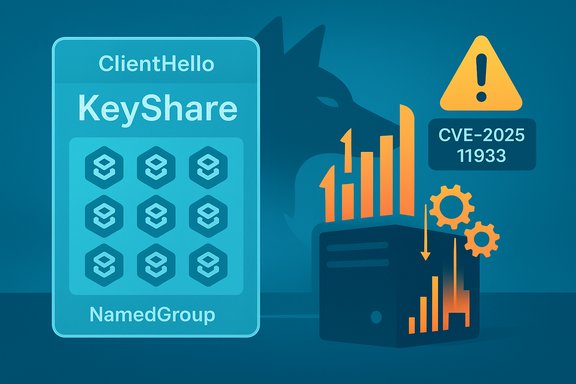
wolfSSL has published a patch and coordinated disclosures after researchers reported a denial‑of‑service weakness in its TLS 1.3 ClientHello parsing: specially crafted ClientHello messages that include duplicate key_share (CKS) entries can force excessive resource consumption in wolfSSL 5.8.2 and earlier, allowing a remote unauthenticated attacker to trigger application‑level DoS; the defect is tracked as CVE‑2025‑11933 and fixed in the wolfSSL 5.8.4 release.
Background / Overview
TLS 1.3 replaced older negotiation semantics with a streamlined handshake that uses the key_share extension to carry ephemeral Diffie‑Hellman parameters (KeyShareEntry items) from client to server. RFC 8446 defines this extension as a vector of KeyShareEntry records in the ClientHello; correct parsing and validation are essential because malformed or duplicate entries can break the assumptions used by the parser and resource management code. In late November 2025 the wolfSSL project and multiple vulnerability trackers documented that wolfSSL builds based on v5.8.2 mishandled duplicate key_share (CKS) extension entries in ClientHello messages: the parser did not reliably detect and reject duplicate CKS/KeyShareEntry groups, and certain crafted handshakes could consume CPU and memory in a way that results in availability loss for the TLS server process. The issue is classified as improper input validation (CWE‑20) and was assigned CVE‑2025‑11933.What the vulnerability actually is
Technical root cause (in plain terms)
- The handshake’s ClientHello can include a key_share extension containing one or more KeyShareEntry structures; each KeyShareEntry identifies a named group (for example, X25519 or P‑256) and an associated public value. Implementations must validate semantics — including rejecting duplicates where the specification or the implementation’s logic requires uniqueness — before consuming or stashing those entries.
- In wolfSSL v5.8.2 and some earlier snapshots, the key_share parser did not correctly detect duplicate CKS (Client Key Share) extension entries for the same group. A crafted ClientHello that repeatedly declares the same group in multiple KeyShareEntry fields could force the library into repeated or unchecked processing paths that allocate memory or fail to free intermediate structures, producing elevated CPU and memory usage and, in some cases, process instability. This is fundamentally an input validation and resource‑handling bug.
What it means practically
- Impact class: Availability (Denial of Service). There’s no public evidence that this issue allows remote code execution or private key compromise; the core impact is that an attacker who can repeatedly open TCP connections and send malformed ClientHello messages can cause a server that uses an affected wolfSSL build to degrade or crash.
- Attack surface: Network‑exposed TLS servers using vulnerable wolfSSL builds. Because the trigger is the initial ClientHello, no prior authentication or credentials are required — an unauthenticated remote client is sufficient.
Affected versions, fix, and timeline
- wolfSSL acknowledged the issue and merged a fix (pull request #9132) that adds explicit detection and rejection of duplicate CKS entries; that commit was merged into the project in August 2025 and included in the official wolfSSL 5.8.4 release. Administrators are advised to upgrade to wolfSSL 5.8.4 or later.
- Public trackers (NVD, Debian security tracker, Tenable and others) ingested the CVE and show the vulnerability metadata (CVE description, affected versions, and fixed tag). Debian’s tracking page lists the packages and states that the fix is the v5.8.4 commit that closes PR #9132.
- Published CVSS scores vary by source and scoring schema: vendor‑provided CVSS‑B vectors gave the issue a low base score under CVSS 4.0, while some legacy CVSSv3/v2 views in third‑party feeds differ; this divergence reflects differences in scoring assumptions (e.g., impact scope, attack complexity, and required privileges). Administrators should not treat the numeric CVSS value as the only priority signal — exposure and business context matter more.
Exploitability and real‑world risk
- Exploit complexity: Low for causing resource consumption. Constructing ClientHello messages with duplicate KeyShare entries is a protocol‑level manipulation (easy for a skilled attacker or an automated probing tool/fuzzer). An attacker able to generate many such handshakes (parallel connections) can amplify the effect.
- Prerequisites: Network access to the TLS service; no authentication required. Privileges: none.
- Evidence of in‑the‑wild exploitation: As of public tracking and initial vendor/maintainer disclosures, there has been no confirmed public evidence of widespread active exploitation. EPSS/telemetry numbers reported by aggregation services remain low. That does not imply the issue is safe — it simply means exploitation has not been observed at scale in public telemetry at the time of writing. Flagging: absence of evidence is not evidence of absence; defenders should assume active adversaries could attempt scanning/probing once the details are known.
Why this matters for WindowsForum readers and enterprise operators
- wolfSSL is a popular embedded and lightweight TLS library widely shipped inside IoT devices, networking appliances, VPN endpoints, and vendor firmware. Unlike OpenSSL or platform TLS stacks, wolfSSL is frequently statically compiled into firmware and distributed by third‑party vendors, which increases the time and effort required to deploy fixes. That supply‑chain reality is the central operational risk here: even with an upstream fix, many devices will remain vulnerable until vendors rebuild firmware and push updates.
- Public‑facing gateways, API endpoints, and TLS terminators that use wolfSSL directly — or vendor appliances that bundle an affected wolfSSL build — are the highest priorities for mitigation because attackers can reach them directly over the internet and can run high‑volume probing campaigns.
Detection, hunting, and forensic guidance
- Add the following signals to monitoring and SIEM rules:
- Sudden spikes in short‑lived TLS connections to servers using wolfSSL, especially accompanied by elevated CPU usage or memory growth in the TLS process.
- Repeated or anomalous ClientHello messages captured in PCAPs showing multiple KeyShare entries with the same NamedGroup. Capture ClientHello payloads and inspect the key_share extension.
- Handshake failure counts increasing without corresponding legitimate traffic growth. Monitor handshake duration and failure metrics if the TLS stack exposes observability counters.
- Forensic steps if you suspect probing or exploitation:
- Capture PCAPs of suspected traffic and preserve timestamps and flow metadata.
- Dump TLS server logs and heap/resident memory snapshots from the affected process.
- Preserve crash dumps and system telemetry for offline analysis.
- If firmware was exposed, collect firmware images for binary inspection and SCA (software composition analysis) to identify embedded wolfSSL versions.
Mitigation and remediation checklist (prioritized)
- Inventory
- Search codebases, binary packages, firmware images, and container images for wolfSSL usage and version strings. Look for static linking and vendor‑bundled copies, not just shared libraries. Use SCA tools and binary scanning to detect wolfSSL artifacts.
- Patch
- Upgrade to wolfSSL 5.8.4 or later where you control builds; rebuild and redeploy. For distribution packages, apply vendor or distro updates that include the 5.8.4 commit. Confirm the updated binary includes the commit that rejects duplicate CKS entries.
- Coordinate with vendors
- Open support cases with appliance and device vendors that ship wolfSSL‑based firmware. Request explicit timelines and ask whether the vendor’s firmware will include the 5.8.4 fix or a backported patch. Track these tickets and their update cadence.
- Compensating controls while you wait
- Terminate TLS at a patched reverse proxy or load balancer (move TLS termination to an updated, hardened proxy) so the vulnerable component is no longer directly exposed to the internet.
- Enforce connection and handshake rate limits at the network edge (WAF, cloud front, firewall rules) to reduce the blast radius of mass scanning.
- Restrict access to high‑value TLS endpoints to trusted networks where feasible (VPN or network ACLs).
- Validate
- After patching, run interoperability and regression tests that include malformed ClientHello variants (duplicate KeyShare entries) to make sure the server rejects them and does not leak resources. Add those tests to CI to prevent regressions.
Operational recommendations and developer guidance
- Developers should treat protocol parsing as security‑critical code. Add defensive checks that:
- Explicitly enforce uniqueness constraints for protocol fields where the spec or implementation semantics require them.
- Bound memory allocations and free intermediate objects on all error paths to avoid leaks.
- Add unit and fuzz tests that generate malformed ClientHello messages (duplicate or truncated key_share entries) and confirm deterministic, resource‑conserving failure modes.
- Testing and CI:
- Integrate the wolfSSL PR’s testcases (the reporter’s duplicator tests referenced in the PR) to ensure future changes don’t regress. If you vendor or fork wolfSSL, merge upstream fixes and maintain a clear mapping from commit hashes to your binary artifacts.
- Vendor management:
- For third‑party appliances, insist on signed firmware updates and a documented update plan. Where vendors are slow to respond, consider isolating vulnerable devices behind patched proxies or replacing high‑risk appliances with vendor options that publish security update guarantees.
Why scoring and public severity vary (and how to interpret it)
Different vulnerability feeds report different numeric severities for CVE‑2025‑11933. That divergence stems from how scoring systems weigh the same facts:- CVSS v4.0 (vendor CVSS‑B) emphasizes the direct, narrow impact here (availability only) and the limited exploit payload (DoS rather than data breach), which can produce a low numeric score in some scoring models.
- Legacy or alternate scorings that treat availability loss in server‑scale services more harshly can present higher severity ratings. Third‑party aggregators (Tenable, cvedetails) sometimes show a broader range due to historical or automated scoring differences; treat those numbers as context, not the sole decision driver.
Critical analysis — strengths and risks
Notable strengths of the public and vendor response
- The vulnerability was responsibly reported and the fix was small, targeted, and merged upstream (PR #9132 followed by release of v5.8.4). That quick upstream reaction reduces the window during which new exploits are easy to craft against unpatched code.
- The bug is a protocol‑parsing issue rather than memory‑corruption or arbitrary code execution, which reduces the immediate catastrophic risk. The remediation is straightforward for codebases that can be rebuilt with the fixed library.
Persistent risks and caveats
- Supply‑chain lag is the biggest operational risk: many devices and vendor appliances embed wolfSSL statically and require vendor firmware rebuilds before the fix reaches end users. Those fleets can remain vulnerable for months or years.
- Detection difficulty: the attack is a malformed TLS handshake; many IDS/WAFs that inspect only HTTP layers will miss handshake‑level anomalies. Effective detection requires TLS‑level visibility or packet capture.
- Scanners and opportunistic attackers: once scanner signatures for duplicate KeyShare probing appear, large‑scale scanning can quickly find exposed endpoints. If infrastructure is not rate‑limited, an attacker can amplify the impact.
Practical quick checklist (one page, actionable)
- Immediately: run an SCA/binary scan to list wolfSSL instances and versions.
- Within 24–72 hours: apply wolfSSL 5.8.4 to controlled builds; request firmware updates from appliance vendors and escalate if needed.
- Short term: terminate TLS at a patched perimeter proxy for high‑exposure services; apply handshake rate limits and network ACLs.
- Medium term: add malformed ClientHello testcases to CI/fuzz suites; document and remove compensating controls once firm patches are deployed.
Verification notes and cautionary flags
- The core technical claims in this article were cross‑checked against multiple independent sources: wolfSSL’s upstream GitHub PR and commit that implements duplicate CKS detection (PR #9132 / commit 2885df6), NVD’s CVE summary for CVE‑2025‑11933, and distribution advisories such as Debian’s security tracker that map upstream commits to package status. These independent confirmations reduce the risk of mischaracterization.
- Where public feeds differ in numeric scoring (CVSS v3 vs v4), the article highlights that discrepancy and recommends prioritizing exposure and business impact over raw numeric severity. Readers should verify scoring details for their own risk models.
- Unverifiable claims: there is no confirmed public evidence of active exploitation at scale for CVE‑2025‑11933 as of the public disclosure and tracker entries used for this article. This is based on currently published telemetry and EPSS scoring; defenders should treat that as a time‑bound observation and reassess as new telemetry arrives.
Conclusion
CVE‑2025‑11933 is a clear example of how small deviations from protocol validation rules — in this case failing to detect duplicate TLS 1.3 key_share (CKS) entries — can produce practical availability problems in real deployments. The technical fix in wolfSSL was concise and upstreamed, but the operational burden falls on integrators, appliance vendors, and administrators who must inventory affected binaries, push updates or compensating controls, and validate their repair. Prioritize internet‑facing and low‑latency internal TLS endpoints that use wolfSSL, apply the wolfSSL 5.8.4 update where possible, and deploy perimeter controls until vendor firmware and packaged updates are confirmed across your estate.Source: MSRC Security Update Guide - Microsoft Security Response Center
