

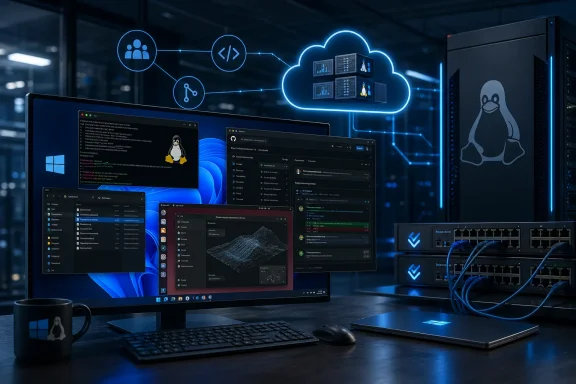
Microsoft has stopped treating Linux as a rival to be defeated and now builds it into Windows through WSL, ships its own Azure Linux distribution, supports Debian-based SONiC networking, and runs more than 60% of Azure customer workloads on Linux rather than Windows Server. This is not a sentimental conversion to open-source ideology. It is a commercial response to a computing market in which developers, containers, cloud infrastructure, and networking increasingly assume Linux will be present. Microsoft did not defeat Linux; it made Linux part of the Microsoft platform.
That distinction matters because the old Windows-versus-Linux framing now obscures more than it explains. Microsoft still wants users buying Windows PCs, organizations subscribing to its services, and enterprises operating inside Azure, but it no longer needs every workload underneath those relationships to run on Windows. The company’s strategic objective has shifted from controlling the operating system everywhere to controlling the most valuable layer around it: development tools, cloud capacity, identity, management, support, and the relationship with the customer.
The clearest expression of Microsoft’s reversal is the Windows Subsystem for Linux, or WSL. As How-To Geek notes in its account of the company’s transformation, WSL allows Linux programs to run inside Windows without requiring users to construct a conventional virtual machine, repartition a system for dual booting, or replace Windows with a full “bare metal” Linux installation.
WSL initially concentrated on command-line applications, which made it especially useful to developers who needed Bash, Linux utilities, package managers, or software intended for Linux servers. That alone solved an important strategic problem for Microsoft: developers could use Windows as their primary desktop while building and testing software for a Linux-based destination.
The feature has since expanded beyond a terminal window. Microsoft’s documentation confirms that WSL can run Linux graphical applications using X11 and Wayland, integrating them into the Windows desktop rather than forcing users to treat Linux as an entirely separate machine. A Linux application can therefore exist alongside conventional Windows software as part of the same working environment.
That integration is more important than it may sound. Desktop operating systems benefit from inertia: users remain where their files, applications, devices, credentials, and habits already live. By bringing Linux tools into Windows, Microsoft reduces the pressure on developers to abandon Windows simply because the software they deploy ultimately runs on Linux.
WSL is therefore not merely an accommodation for Linux enthusiasts. It is a developer-retention mechanism. It allows Microsoft to say, in effect, that choosing Linux for production no longer requires rejecting Windows on the desktop.
The old Microsoft might have tried to persuade developers that the server should run Windows because the workstation ran Windows. The new Microsoft accepts the Linux server and instead makes Windows a convenient control surface for it. That is a more pragmatic position—and, given the direction of cloud development, a far more defensible one.
WSL2 took the more consequential route: it runs a full Linux kernel. Rather than continuing to approximate Linux behavior one system call at a time, Microsoft accepted that the best way to provide Linux compatibility was to include Linux itself.
That architectural change weakened the argument that WSL was merely a clever Windows compatibility feature. WSL2 made Linux an operating component of a Microsoft-supported Windows workflow. Ars Technica characterized the arrival of a genuine Linux kernel in Windows as a line that would once have seemed almost impossible for the company to cross.
The significance is not that Windows somehow “became Linux.” It did not. The significance is that Microsoft concluded a real Linux kernel offered more value than preserving architectural purity.
For developers, that means fewer discrepancies between local development and Linux deployment targets. For Microsoft, it means Windows can remain relevant even when the application stack above it and the production infrastructure beyond it are designed around Linux conventions.
There are still operational boundaries. A WSL2 environment is not simply another Windows application process, and administrators should not pretend that Windows controls automatically govern every package, credential, service, or configuration inside a Linux distribution. Convenience can conceal that separation, especially when files and tools move easily between the two environments.
But that is an administrative challenge created by WSL’s success. Microsoft has made Linux feel sufficiently integrated that organizations can forget they are managing two operating environments rather than one.
Ubuntu, one of the Linux distributions available to WSL users, illustrates the model. A developer can retain Windows applications and hardware support while opening a Linux environment when the task requires Linux tooling. There is no reboot into a second operating system and no need to dedicate another physical computer to the work.
How-To Geek presents this as an accessible way for inexperienced users to begin learning Linux. That is true, but the enterprise implication is larger. WSL can reduce the distance between Windows-oriented corporate desktops and Linux-oriented engineering teams without forcing either side to surrender its preferred environment.
This hybrid arrangement gives Microsoft something that a simple Windows-versus-Linux contest could not: participation on both sides of the deployment boundary. Windows remains the employee-facing platform, while Microsoft tools and services follow the application into a Linux-based cloud.
The approach also turns interoperability into a competitive feature. If a Windows workstation can comfortably support Linux command-line tools and graphical applications, Microsoft no longer needs to win every argument over which operating system is technically or culturally superior. It needs only to make Windows the least disruptive place from which to use both.
That is why WSL should not be dismissed as Microsoft conceding the desktop to Linux, nor celebrated as evidence that Windows is about to disappear. It is a deliberate attempt to make the operating-system choice less consequential at the point where Microsoft already has a strong position.
For Windows users, this means Linux expertise is becoming more useful even when Windows remains their primary desktop. For IT departments, it means that denying the existence of Linux inside the Windows estate is no longer a realistic governance strategy.
The economics are straightforward. A cloud provider that resisted Linux would turn away much of the cloud market. Customers deploying Linux servers, open-source databases, containers, web applications, or other Linux-based infrastructure are still valuable Azure customers, regardless of whether they purchase a Windows Server license for each workload.
This is where Microsoft’s transformation becomes less ideological and more structural. The company once earned much of its influence by binding applications to Windows and selling software licenses around that dependency. In cloud computing, the recurring relationship can be more valuable than the operating system running inside an individual virtual machine.
Azure customers pay Microsoft for infrastructure and associated services even when the guest operating system is Linux. Microsoft can supply compute, storage, networking, management, support, and other cloud capabilities without requiring the customer’s application to become a Windows application.
Linux therefore ceased to be only a competitor and became an engine of Azure consumption. Once that happened, investing in Linux was not an act of corporate generosity. It was an investment in the workloads generating demand for Microsoft’s cloud.
This also explains why the transformation goes deeper than marketing campaigns or conference-stage declarations of affection for open source. Microsoft has had to develop Linux engineering expertise because Azure’s commercial credibility depends on Linux workloads functioning reliably. When most customer cores are running Linux-based workloads, Linux support is part of the cloud’s core business rather than an optional compatibility program.
Windows Server has not vanished, but its role is narrower than Microsoft once imagined. How-To Geek points to legacy Microsoft applications and Access or SQL database workloads as examples of the continuing Windows Server estate. Those systems can remain important without defining the direction of every new cloud deployment.
The practical consequence for enterprise IT is that “Microsoft shop” no longer means “Windows everywhere.” An organization can be deeply committed to Azure, Microsoft development tools, and Microsoft-managed services while operating a large Linux server estate. Vendor alignment and operating-system uniformity have become separate decisions.
Microsoft describes Azure Linux as a commercially supported distribution optimized for Azure virtual machines and container environments. How-To Geek correctly identifies the surreal quality of the situation: the company that once treated Linux as a threat now builds, distributes, and supports Linux under the Azure name.
Azure Linux is not presented as a conventional desktop replacement for Windows. Its purpose is operational consistency in cloud environments, particularly where organizations need a minimal and controlled foundation for containers. The value proposition is not a consumer-friendly desktop, an extensive collection of bundled applications, or a campaign to convert Windows laptop owners.
It is standardization. Microsoft can maintain an operating-system base aligned with the infrastructure on which it runs, reduce unnecessary variation, and provide customers with a clearer support path. In an enterprise cloud, those qualities frequently matter more than the ideological provenance of the operating system.
This is also where Microsoft’s old strategy has been inverted. Historically, the company used Windows ownership to pull customers toward Microsoft applications and development tools. Azure Linux uses Microsoft’s cloud ownership to give customers a Microsoft-supported route into Linux.
The operating system is no longer necessarily the product that captures the customer. It can be a component that makes the larger Azure product easier to buy.
The familiar saying that “nobody ever got fired for buying IBM” captured the appeal of choosing a well-established vendor whose scale reduced personal and institutional risk. How-To Geek argues that a version of that sentiment eventually transferred to Microsoft. Azure Linux extends it into territory Microsoft once would have preferred to reserve for Windows: a risk-averse enterprise can now choose a Microsoft-backed Linux environment.
That does not make Azure Linux neutral. Its optimization and support story are tied to Microsoft’s cloud objectives. Organizations should evaluate it as they would any vendor-aligned distribution, asking who controls updates, how workloads move elsewhere, what support boundaries apply, and whether the benefit of standardization outweighs the cost of deeper platform dependence.
The critical point is that Microsoft no longer needs Windows to be the answer to every infrastructure question. Sometimes the strategically correct Microsoft answer is Microsoft’s Linux.
The Linux Foundation described SONiC’s move as a way to provide neutral governance and expand ecosystem participation. That transition is notable because it shows Microsoft using open-source governance not simply to publish code, but to encourage adoption of infrastructure it helped create.
A networking platform becomes more useful when hardware vendors, operators, and developers can participate without treating it as the proprietary extension of a single cloud provider. Moving development into a broader foundation can reduce that concern while allowing Microsoft to continue benefiting from the resulting ecosystem.
This is the less visible side of Microsoft’s Linux transformation. WSL is tangible to a Windows user because it appears on a PC. Azure Linux is understandable as a server distribution. SONiC reveals that Microsoft’s dependence on Linux also exists in the machinery connecting enormous cloud environments together.
It further undermines the notion that this is a temporary détente driven by developer fashion. Linux is present in Microsoft’s workstation strategy, cloud workload strategy, container-host strategy, and networking strategy. Removing it would now damage Microsoft’s own products and infrastructure.
Linux is no longer outside Microsoft’s perimeter. It is part of the perimeter.
The evidence of substantial change is nevertheless difficult to dismiss. Microsoft purchased GitHub, the dominant hosting platform for open-source projects, and said the service would retain its developer-first character and remain an open platform. The acquisition placed Microsoft at the center of how much of the software industry stores code, reviews contributions, tracks problems, and coordinates releases.
Microsoft has also released significant technologies as open source. The list cited by How-To Geek includes the .NET framework, the C# language, WSL, Windows Terminal, Windows Calculator, and even MS-DOS 4.0. These projects vary enormously in strategic weight, but collectively they show that open source is no longer confined to disposable samples or publicity exercises.
Windows Terminal matters because it is a daily interface for developers and administrators. The .NET framework and C# matter because they sit within Microsoft’s development ecosystem. WSL matters because it is the bridge between Windows and Linux that anchors the company’s cross-platform developer strategy.
Open-sourcing Windows Calculator or an old operating-system version can generate goodwill and historical interest. Opening active developer infrastructure changes how outside contributors can inspect, discuss, and potentially improve technology that remains relevant to Microsoft’s current platform.
Ars Technica observed that the shift became especially difficult to ignore when Microsoft put a genuine Linux kernel inside a Windows feature. More recently, the WSL repository itself has become publicly available, with related open-source repositories for the Linux kernel used by WSL2 and the graphical integration supporting Linux applications.
This progression matters more than any single announcement. Microsoft moved from tolerating open-source software, to supporting it on Azure, to building development workflows around it, to publishing substantial parts of those workflows. Each step made retreat more expensive.
Steven Vaughan-Nichols argued in The Register that “Microsoft is effectively a Linux and open-source company now.” The claim is intentionally provocative, but it captures an important financial reality: a meaningful portion of Microsoft’s platform value depends on Linux and open-source software succeeding.
The qualification is equally important. Microsoft remains a commercial vendor with proprietary products, platform incentives, and an interest in keeping customers inside its services. Open source did not erase those incentives. It became one of the mechanisms through which Microsoft pursues them.
By the 2000s, Microsoft representatives were describing Linux with terms such as “communism” or “cancer.” The company was also associated with a strategy caricatured as “embracing and extending,” then “extinguishing” open standards: support a competing standard, add Microsoft-specific behavior, and use control of the dominant platform to marginalize the original.
That history explains why skepticism persists. Developers and administrators who experienced Microsoft’s most aggressive platform era are unlikely to interpret every open-source release as proof of permanent cultural redemption. GitHub ownership, Azure integration, and WSL can be seen simultaneously as useful contributions and as ways to pull developers toward Microsoft-controlled commercial surfaces.
The error is assuming that only one interpretation can be true. Microsoft can genuinely improve access to Linux while using that access to keep Windows attractive. It can contribute to open-source projects while seeking greater Azure consumption. It can support neutral governance for SONiC while benefiting from the standardization and adoption that neutral governance encourages.
Corporate strategy rarely requires pure motives. It requires aligned incentives. The modern software market made Linux support and open-source participation profitable for Microsoft, and that alignment has produced tools that users can value even if they remain cautious about the company behind them.
The more durable question is therefore not whether Microsoft “loves” Linux. Companies do not love operating systems. The question is whether Microsoft’s revenue, infrastructure, and developer relationships now depend on Linux enough to make continued investment rational.
The evidence says they do. More than 60% of Azure customer cores running Linux workloads is not a slogan. WSL’s evolution from translated calls to a full Linux kernel is not a branding exercise. Azure Linux and SONiC are not desktop demonstrations assembled for applause.
They are infrastructure. That makes Microsoft’s Linux commitment more credible than affection ever could.
Cloud computing weakened that model. One employee can use Windows locally, Linux through WSL, Linux servers in Azure, open-source code stored on GitHub, and Microsoft-managed tools around all of it. There is no single operating-system contest to settle.
Microsoft has adapted by making itself present at every junction. Windows supplies the workstation. WSL supplies the local Linux environment. GitHub hosts development. Azure runs production. Azure Linux can provide a Microsoft-supported server foundation, while SONiC operates farther down in the network.
That is a stronger strategic position than insisting every layer display a Windows logo. It allows Microsoft to profit from heterogeneous environments instead of treating heterogeneity as defeat.
For users, the result is greater flexibility but also greater complexity. A Windows PC can now contain a Linux package ecosystem, separate credentials, Linux files, graphical Linux applications, and services that behave differently from their Windows equivalents. The experience may look integrated while the security and maintenance models remain distinct.
For administrators, WSL must therefore be governed as an operating environment, not dismissed as an enhanced command prompt. A vulnerable or unmaintained Linux package does not become safe merely because it runs behind a Windows desktop. Nor should sensitive files be moved casually between environments simply because the integration makes doing so easy.
That distinction matters because the old Windows-versus-Linux framing now obscures more than it explains. Microsoft still wants users buying Windows PCs, organizations subscribing to its services, and enterprises operating inside Azure, but it no longer needs every workload underneath those relationships to run on Windows. The company’s strategic objective has shifted from controlling the operating system everywhere to controlling the most valuable layer around it: development tools, cloud capacity, identity, management, support, and the relationship with the customer.
 WSL Turned a Rival Platform Into a Windows Feature
The clearest expression of Microsoft’s reversal is the Windows Subsystem for Linux, or WSL. As How-To Geek notes in its account of the company’s transformation, WSL allows Linux programs to run inside Windows without requiring users to construct a conventional virtual machine, repartition a system for dual booting, or replace Windows with a full “bare metal” Linux installation.WSL initially concentrated on command-line applications, which made it especially useful to developers who needed Bash, Linux utilities, package managers, or software intended for Linux servers. That alone solved an important strategic problem for Microsoft: developers could use Windows as their primary desktop while building and testing software for a Linux-based destination.
The feature has since expanded beyond a terminal window. Microsoft’s documentation confirms that WSL can run Linux graphical applications using X11 and Wayland, integrating them into the Windows desktop rather than forcing users to treat Linux as an entirely separate machine. A Linux application can therefore exist alongside conventional Windows software as part of the same working environment.
That integration is more important than it may sound. Desktop operating systems benefit from inertia: users remain where their files, applications, devices, credentials, and habits already live. By bringing Linux tools into Windows, Microsoft reduces the pressure on developers to abandon Windows simply because the software they deploy ultimately runs on Linux.
WSL is therefore not merely an accommodation for Linux enthusiasts. It is a developer-retention mechanism. It allows Microsoft to say, in effect, that choosing Linux for production no longer requires rejecting Windows on the desktop.
The old Microsoft might have tried to persuade developers that the server should run Windows because the workstation ran Windows. The new Microsoft accepts the Linux server and instead makes Windows a convenient control surface for it. That is a more pragmatic position—and, given the direction of cloud development, a far more defensible one.
WSL2 Abandoned Translation for the Real Thing
The evolution from WSL1 to WSL2 reveals how thoroughly Microsoft’s assumptions changed. WSL1 translated Linux system calls into Windows equivalents, allowing Linux applications to operate through a compatibility layer built around Windows internals. It was an ingenious approach, but it also reflected the traditional Microsoft instinct to reproduce another environment on Microsoft’s own technical foundation.WSL2 took the more consequential route: it runs a full Linux kernel. Rather than continuing to approximate Linux behavior one system call at a time, Microsoft accepted that the best way to provide Linux compatibility was to include Linux itself.
| WSL generation | Core implementation | Linux kernel | Application emphasis | Strategic effect |
|---|---|---|---|---|
| WSL1 | Translates Linux system calls into Windows ones | No full Linux kernel | Originated around command-line applications | Makes Linux tools available through Windows translation |
| WSL2 | Runs a full Linux kernel | Yes | Command-line and Linux GUI applications, including X11 and Wayland | Makes Windows a host for a substantially more authentic Linux environment |
The significance is not that Windows somehow “became Linux.” It did not. The significance is that Microsoft concluded a real Linux kernel offered more value than preserving architectural purity.
For developers, that means fewer discrepancies between local development and Linux deployment targets. For Microsoft, it means Windows can remain relevant even when the application stack above it and the production infrastructure beyond it are designed around Linux conventions.
There are still operational boundaries. A WSL2 environment is not simply another Windows application process, and administrators should not pretend that Windows controls automatically govern every package, credential, service, or configuration inside a Linux distribution. Convenience can conceal that separation, especially when files and tools move easily between the two environments.
But that is an administrative challenge created by WSL’s success. Microsoft has made Linux feel sufficiently integrated that organizations can forget they are managing two operating environments rather than one.
Windows Is Becoming the Workbench, Not the Destination
WSL reflects a broader change in what a developer workstation is expected to do. A Windows machine no longer needs to represent the operating system on which the finished application will run. It can instead be the place where code is written, containers are assembled, cloud resources are managed, and Linux-targeted software is tested.Ubuntu, one of the Linux distributions available to WSL users, illustrates the model. A developer can retain Windows applications and hardware support while opening a Linux environment when the task requires Linux tooling. There is no reboot into a second operating system and no need to dedicate another physical computer to the work.
How-To Geek presents this as an accessible way for inexperienced users to begin learning Linux. That is true, but the enterprise implication is larger. WSL can reduce the distance between Windows-oriented corporate desktops and Linux-oriented engineering teams without forcing either side to surrender its preferred environment.
This hybrid arrangement gives Microsoft something that a simple Windows-versus-Linux contest could not: participation on both sides of the deployment boundary. Windows remains the employee-facing platform, while Microsoft tools and services follow the application into a Linux-based cloud.
The approach also turns interoperability into a competitive feature. If a Windows workstation can comfortably support Linux command-line tools and graphical applications, Microsoft no longer needs to win every argument over which operating system is technically or culturally superior. It needs only to make Windows the least disruptive place from which to use both.
That is why WSL should not be dismissed as Microsoft conceding the desktop to Linux, nor celebrated as evidence that Windows is about to disappear. It is a deliberate attempt to make the operating-system choice less consequential at the point where Microsoft already has a strong position.
For Windows users, this means Linux expertise is becoming more useful even when Windows remains their primary desktop. For IT departments, it means that denying the existence of Linux inside the Windows estate is no longer a realistic governance strategy.
Azure Made Opposition to Linux Economically Impossible
If WSL explains why Microsoft wants Linux on Windows, Azure explains why Microsoft needs Linux throughout the company. Microsoft estimates that more than 60% of customer cores in Azure run Linux workloads, a figure that overturns the historical assumption that a Microsoft cloud would principally be a remote home for Windows Server.The economics are straightforward. A cloud provider that resisted Linux would turn away much of the cloud market. Customers deploying Linux servers, open-source databases, containers, web applications, or other Linux-based infrastructure are still valuable Azure customers, regardless of whether they purchase a Windows Server license for each workload.
This is where Microsoft’s transformation becomes less ideological and more structural. The company once earned much of its influence by binding applications to Windows and selling software licenses around that dependency. In cloud computing, the recurring relationship can be more valuable than the operating system running inside an individual virtual machine.
Azure customers pay Microsoft for infrastructure and associated services even when the guest operating system is Linux. Microsoft can supply compute, storage, networking, management, support, and other cloud capabilities without requiring the customer’s application to become a Windows application.
Linux therefore ceased to be only a competitor and became an engine of Azure consumption. Once that happened, investing in Linux was not an act of corporate generosity. It was an investment in the workloads generating demand for Microsoft’s cloud.
This also explains why the transformation goes deeper than marketing campaigns or conference-stage declarations of affection for open source. Microsoft has had to develop Linux engineering expertise because Azure’s commercial credibility depends on Linux workloads functioning reliably. When most customer cores are running Linux-based workloads, Linux support is part of the cloud’s core business rather than an optional compatibility program.
Windows Server has not vanished, but its role is narrower than Microsoft once imagined. How-To Geek points to legacy Microsoft applications and Access or SQL database workloads as examples of the continuing Windows Server estate. Those systems can remain important without defining the direction of every new cloud deployment.
The practical consequence for enterprise IT is that “Microsoft shop” no longer means “Windows everywhere.” An organization can be deeply committed to Azure, Microsoft development tools, and Microsoft-managed services while operating a large Linux server estate. Vendor alignment and operating-system uniformity have become separate decisions.
Azure Linux Is the Admission That Support Matters More Than Branding
Azure Linux takes that logic to its natural conclusion. Microsoft is not merely hosting Linux distributions made by others; it offers its own Linux distribution intended for cloud servers and containerized workloads.Microsoft describes Azure Linux as a commercially supported distribution optimized for Azure virtual machines and container environments. How-To Geek correctly identifies the surreal quality of the situation: the company that once treated Linux as a threat now builds, distributes, and supports Linux under the Azure name.
Azure Linux is not presented as a conventional desktop replacement for Windows. Its purpose is operational consistency in cloud environments, particularly where organizations need a minimal and controlled foundation for containers. The value proposition is not a consumer-friendly desktop, an extensive collection of bundled applications, or a campaign to convert Windows laptop owners.
It is standardization. Microsoft can maintain an operating-system base aligned with the infrastructure on which it runs, reduce unnecessary variation, and provide customers with a clearer support path. In an enterprise cloud, those qualities frequently matter more than the ideological provenance of the operating system.
This is also where Microsoft’s old strategy has been inverted. Historically, the company used Windows ownership to pull customers toward Microsoft applications and development tools. Azure Linux uses Microsoft’s cloud ownership to give customers a Microsoft-supported route into Linux.
The operating system is no longer necessarily the product that captures the customer. It can be a component that makes the larger Azure product easier to buy.
The familiar saying that “nobody ever got fired for buying IBM” captured the appeal of choosing a well-established vendor whose scale reduced personal and institutional risk. How-To Geek argues that a version of that sentiment eventually transferred to Microsoft. Azure Linux extends it into territory Microsoft once would have preferred to reserve for Windows: a risk-averse enterprise can now choose a Microsoft-backed Linux environment.
That does not make Azure Linux neutral. Its optimization and support story are tied to Microsoft’s cloud objectives. Organizations should evaluate it as they would any vendor-aligned distribution, asking who controls updates, how workloads move elsewhere, what support boundaries apply, and whether the benefit of standardization outweighs the cost of deeper platform dependence.
The critical point is that Microsoft no longer needs Windows to be the answer to every infrastructure question. Sometimes the strategically correct Microsoft answer is Microsoft’s Linux.
SONiC Shows Linux Reaching Beneath the Cloud
SONiC, Microsoft’s networking operating system based on Debian, demonstrates that the Linux strategy reaches below application hosts into the network fabric. It is designed for cloud networking rather than as a general-purpose Windows alternative, and the project is now developed under the Linux Foundation.The Linux Foundation described SONiC’s move as a way to provide neutral governance and expand ecosystem participation. That transition is notable because it shows Microsoft using open-source governance not simply to publish code, but to encourage adoption of infrastructure it helped create.
A networking platform becomes more useful when hardware vendors, operators, and developers can participate without treating it as the proprietary extension of a single cloud provider. Moving development into a broader foundation can reduce that concern while allowing Microsoft to continue benefiting from the resulting ecosystem.
This is the less visible side of Microsoft’s Linux transformation. WSL is tangible to a Windows user because it appears on a PC. Azure Linux is understandable as a server distribution. SONiC reveals that Microsoft’s dependence on Linux also exists in the machinery connecting enormous cloud environments together.
It further undermines the notion that this is a temporary détente driven by developer fashion. Linux is present in Microsoft’s workstation strategy, cloud workload strategy, container-host strategy, and networking strategy. Removing it would now damage Microsoft’s own products and infrastructure.
Linux is no longer outside Microsoft’s perimeter. It is part of the perimeter.
Open Source Became the Price of Developer Relevance
Linux adoption and open-source participation are related but not identical. A company can use Linux while keeping much of its surrounding technology proprietary, just as it can publish individual projects without embracing open development across its entire business. Microsoft’s shift includes both, but it should not be reduced to a single claim that the company has become universally “open.”The evidence of substantial change is nevertheless difficult to dismiss. Microsoft purchased GitHub, the dominant hosting platform for open-source projects, and said the service would retain its developer-first character and remain an open platform. The acquisition placed Microsoft at the center of how much of the software industry stores code, reviews contributions, tracks problems, and coordinates releases.
Microsoft has also released significant technologies as open source. The list cited by How-To Geek includes the .NET framework, the C# language, WSL, Windows Terminal, Windows Calculator, and even MS-DOS 4.0. These projects vary enormously in strategic weight, but collectively they show that open source is no longer confined to disposable samples or publicity exercises.
Windows Terminal matters because it is a daily interface for developers and administrators. The .NET framework and C# matter because they sit within Microsoft’s development ecosystem. WSL matters because it is the bridge between Windows and Linux that anchors the company’s cross-platform developer strategy.
Open-sourcing Windows Calculator or an old operating-system version can generate goodwill and historical interest. Opening active developer infrastructure changes how outside contributors can inspect, discuss, and potentially improve technology that remains relevant to Microsoft’s current platform.
Ars Technica observed that the shift became especially difficult to ignore when Microsoft put a genuine Linux kernel inside a Windows feature. More recently, the WSL repository itself has become publicly available, with related open-source repositories for the Linux kernel used by WSL2 and the graphical integration supporting Linux applications.
This progression matters more than any single announcement. Microsoft moved from tolerating open-source software, to supporting it on Azure, to building development workflows around it, to publishing substantial parts of those workflows. Each step made retreat more expensive.
Steven Vaughan-Nichols argued in The Register that “Microsoft is effectively a Linux and open-source company now.” The claim is intentionally provocative, but it captures an important financial reality: a meaningful portion of Microsoft’s platform value depends on Linux and open-source software succeeding.
The qualification is equally important. Microsoft remains a commercial vendor with proprietary products, platform incentives, and an interest in keeping customers inside its services. Open source did not erase those incentives. It became one of the mechanisms through which Microsoft pursues them.
The Conversion Was Commercial, Not Spiritual
Microsoft’s historical hostility toward open source was rooted in a business model that treated software copying as lost revenue and platform alternatives as direct threats. How-To Geek reaches back to Bill Gates’s “Open Letter to Hobbyists” in the 1970s, written in connection with the use of Altair BASIC without payment, as an early expression of the company’s proprietary instincts.By the 2000s, Microsoft representatives were describing Linux with terms such as “communism” or “cancer.” The company was also associated with a strategy caricatured as “embracing and extending,” then “extinguishing” open standards: support a competing standard, add Microsoft-specific behavior, and use control of the dominant platform to marginalize the original.
That history explains why skepticism persists. Developers and administrators who experienced Microsoft’s most aggressive platform era are unlikely to interpret every open-source release as proof of permanent cultural redemption. GitHub ownership, Azure integration, and WSL can be seen simultaneously as useful contributions and as ways to pull developers toward Microsoft-controlled commercial surfaces.
The error is assuming that only one interpretation can be true. Microsoft can genuinely improve access to Linux while using that access to keep Windows attractive. It can contribute to open-source projects while seeking greater Azure consumption. It can support neutral governance for SONiC while benefiting from the standardization and adoption that neutral governance encourages.
Corporate strategy rarely requires pure motives. It requires aligned incentives. The modern software market made Linux support and open-source participation profitable for Microsoft, and that alignment has produced tools that users can value even if they remain cautious about the company behind them.
The more durable question is therefore not whether Microsoft “loves” Linux. Companies do not love operating systems. The question is whether Microsoft’s revenue, infrastructure, and developer relationships now depend on Linux enough to make continued investment rational.
The evidence says they do. More than 60% of Azure customer cores running Linux workloads is not a slogan. WSL’s evolution from translated calls to a full Linux kernel is not a branding exercise. Azure Linux and SONiC are not desktop demonstrations assembled for applause.
They are infrastructure. That makes Microsoft’s Linux commitment more credible than affection ever could.
The Rivalry Ended Because the Battlefield Moved
The classic Windows-Linux rivalry assumed that operating systems competed for ownership of a machine. One would be installed, the other excluded, and the winner would determine which applications, tools, and formats dominated the user’s work.Cloud computing weakened that model. One employee can use Windows locally, Linux through WSL, Linux servers in Azure, open-source code stored on GitHub, and Microsoft-managed tools around all of it. There is no single operating-system contest to settle.
Microsoft has adapted by making itself present at every junction. Windows supplies the workstation. WSL supplies the local Linux environment. GitHub hosts development. Azure runs production. Azure Linux can provide a Microsoft-supported server foundation, while SONiC operates farther down in the network.
That is a stronger strategic position than insisting every layer display a Windows logo. It allows Microsoft to profit from heterogeneous environments instead of treating heterogeneity as defeat.
For users, the result is greater flexibility but also greater complexity. A Windows PC can now contain a Linux package ecosystem, separate credentials, Linux files, graphical Linux applications, and services that behave differently from their Windows equivalents. The experience may look integrated while the security and maintenance models remain distinct.
For administrators, WSL must therefore be governed as an operating environment, not dismissed as an enhanced command prompt. A vulnerable or unmaintained Linux package does not become safe merely because it runs behind a Windows desktop. Nor should sensitive files be moved casually between environments simply because the integration makes doing so easy.
Action checklist for admins
- Inventory where WSL is enabled and identify which Linux distributions teams are using.
- Record whether each workload depends on WSL1 translation or the full Linux kernel provided by WSL2.
- Establish separate patching expectations for Windows, WSL, and packages installed inside each Linux distribution.
- Define which Windows data, credentials, development secrets, and network resources Linux applications may access.
- Review Linux GUI applications using X11 or Wayland as executable software, not as harmless terminal accessories.
- Decide whether Azure Linux and SONiC fall under Windows operations, Linux operations, cloud engineering, or networking ownership before incidents expose an accountability gap.
Microsoft’s Linux Era in Six Practical Conclusions
The corporate reversal is dramatic, but its consequences are more useful than the irony. Windows users and IT departments should treat Microsoft’s Linux work as a permanent part of the platform strategy rather than a temporary outreach campaign.- WSL keeps Windows relevant for developers whose applications ultimately run on Linux.
- WSL2’s full Linux kernel is a fundamental architectural commitment, not simple command emulation.
- X11 and Wayland support make Linux graphical applications part of the Windows workstation experience.
- Azure’s Linux majority makes strong Linux support a commercial requirement for Microsoft.
- Azure Linux and Debian-based SONiC show Microsoft building Linux for servers and cloud networking, not merely hosting third-party distributions.
- GitHub, .NET, C#, WSL, Windows Terminal, and other open-source projects place Microsoft inside the development model it once resisted.
References
- Primary source: How-To Geek
Published: 2026-07-12T10:32:08.728991
Loading…
www.howtogeek.com - Official source: learn.microsoft.com
Loading…
learn.microsoft.com - Official source: azure.microsoft.com
Azure Linux | Microsoft Azure
Explore Azure Linux, a Microsoft-built Linux distribution for Azure. Run secure and efficient workloads on virtual machines and containers.azure.microsoft.com
- Related coverage: arstechnica.com
Loading…
arstechnica.com - Related coverage: linuxfoundation.org
Loading…
www.linuxfoundation.org - Official source: techcommunity.microsoft.com
Loading…
techcommunity.microsoft.com
- Official source: cdn-dynmedia-1.microsoft.com
MSFT_logo_rgb_C-Gray
Photographer: David Johnson Location: Austin, TX Catapult Systems David Fuess–CEO Captured: December 2016 Usage Rights: Global Perpetuitycdn-dynmedia-1.microsoft.com
- Official source: marketingassets.microsoft.com
1552881556
Tablet, designer and serious woman research in business startup office at night on deadline. Technology, creative professional or Indian entrepreneur reading information, email or app in neon companymarketingassets.microsoft.com
- Official source: github.com
GitHub - microsoft/WSL: Windows Subsystem for Linux · GitHub
Windows Subsystem for Linux. Contribute to microsoft/WSL development by creating an account on GitHub. github.com
- Official source: blogs.microsoft.com
Microsoft completes GitHub acquisition - The Official Microsoft Blog
Microsoft has completed its acquisition of GitHub. Nat Friedman, former CEO of Xamarin (acquired by Microsoft in 2016), is taking over as GitHub’s CEO, reporting to Scott Guthrie, Microsoft Cloud + AI Group Executive Vice President. GitHub will retain its developer-first ethos, operate...blogs.microsoft.com - Related coverage: theregister.com
Loading…
www.theregister.com