

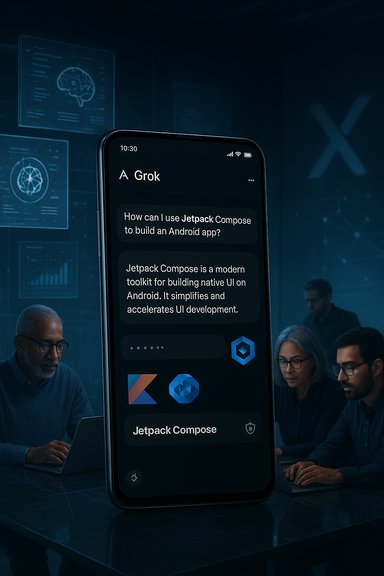
Elon Musk’s xAI has quietly accelerated its push into mobile: the company is actively recruiting senior Android engineers to build native Android experiences for the Grok AI chatbot and the X platform, signaling a strategic pivot to ship production-grade mobile clients that tightly integrate conversational AI with social interactions. Multiple outlets reported the openings after an xAI engineer named Attila posted the listing on X and Musk amplified the call for “world-class Android engineers,” and the job descriptions emphasize Kotlin, Jetpack Compose, reactive programming, and a short, engineering-heavy interview loop.
xAI launched Grok as a conversational AI positioned for real-time, socially distributed interactions and has iterated the model across multiple releases this year. Grok’s integration with X turned what might have been a standalone chatbot into a socially native assistant that can generate, respond to, and amplify content inside an already noisy platform—an environment that privileges speed, virality, and product polish. Community analysis and internal forums have tracked Grok’s feature updates, personality tuning, and the safety controversies that followed high-visibility output patterns.
The job push is a logical next step: if Grok will live inside millions of mobile sessions, xAI needs engineers who understand Android at the wireframe and systems level—UI threading, memory budgets, multimedia pipelines, offline resilience, and secure API integration—as much as they need expertise in model-serving or cloud infra. Public job posts and press coverage identify the role as purpose-built for creating those experiences.
Competitors’ moves to hire Android talent—including Perplexity, OpenAI partner teams, and Google’s in-house Android product groups—mean that the market for skilled Compose+Kotlin engineers remains highly competitive, with compensation and perks often reflecting that scarcity. Public job postings across the industry confirm broad demand for the same skill stack.
For the broader Android ecosystem, this hiring wave highlights the premium placed on engineers who bridge product intuition and system-level mastery. Teams that can ship low-latency, secure, and delightful AI experiences will set the bar for how assistants behave on mobile.
Source: Technobezz xAI Hires Android Engineers to Build Mobile Apps for Grok AI Chatbot
 Background / Overview
xAI launched Grok as a conversational AI positioned for real-time, socially distributed interactions and has iterated the model across multiple releases this year. Grok’s integration with X turned what might have been a standalone chatbot into a socially native assistant that can generate, respond to, and amplify content inside an already noisy platform—an environment that privileges speed, virality, and product polish. Community analysis and internal forums have tracked Grok’s feature updates, personality tuning, and the safety controversies that followed high-visibility output patterns.The job push is a logical next step: if Grok will live inside millions of mobile sessions, xAI needs engineers who understand Android at the wireframe and systems level—UI threading, memory budgets, multimedia pipelines, offline resilience, and secure API integration—as much as they need expertise in model-serving or cloud infra. Public job posts and press coverage identify the role as purpose-built for creating those experiences.
What xAI is hiring for
Role and locations
- Target hires: Senior Android engineers to build native apps and mobile features for Grok and X.
- Geographic footprints listed: London, New York, Palo Alto, and San Francisco, with remote options considered for strong candidates.
Required technical skills (what applicants should expect)
xAI’s public descriptions and reposts call out a modern Android stack and product sensibility:- Kotlin as the primary language.
- Jetpack Compose for UI, with emphasis on modern compose idioms.
- Reactive programming patterns (Coroutines + Flow or equivalent).
- Experience shipping large-scale production apps and architecting for performance and reliability.
- Strong product sense and ability to “wear multiple hats” on a small, fast-moving team.
How to apply and screening stages
Applications are accepted through two main channels: direct message to Attila (@attilablenesi) on X, or via xAI’s official jobs portal. Public coverage consistently cites both paths. The screening and interview flow reported in job summaries is aggressive but concise:- A short, 15‑minute phone screen to assess fit and background.
- Two technical rounds:
- A live coding session focused on building an app or component using Jetpack Compose.
- A hands-on Android exercise using starter code and calling external APIs to build a feature or solve a real‑world integration problem.
- A final meeting with a broader xAI team for cultural fit and product alignment.
Why this hiring push matters
Mobile is where the user sits
Smartphone sessions are often the primary surface for social interaction and rapid search—exactly the environments Grok and X occupy. Building a native Android app (rather than a lightweight web view) gives xAI control over latency, startup time, background services, camera and microphone access (for multimodal inputs), and finer-grained permission models. For a model that aims to be available in-moment and integrated with social flows, those performance and UX expectations are not optional.Product implications: tighter Grok-X integration
A first-class Android app opens possibilities that are harder to implement well in web wrappers:- Native audio capture and low‑latency streaming for voice-based Grok sessions.
- Real-time camera-to-model pipelines for visual prompts and “point-and-ask” features.
- System-level sharing and deep links that let users send content into Grok from any other app.
- Background sync and push to keep model state and conversations fresh across devices.
Strategic signaling
The public amplification by Musk and reposts in high-volume outlets is a recruiting acceleration tactic but also a product signal: xAI wants talent aware of the platform ambitions. Hiring native app engineers signals a commitment to building Grok as a multi-platform consumer product rather than a novelty embedded only in X.Risks, constraints, and technical challenges
1) Mobile performance vs. large-model latency
Delivering a fluid chat experience on Android requires coupling a responsive UI with potentially slow model backends. The classic tradeoffs:- Keep the UI responsive with skeletons, streaming tokens, or partial answers while larger downstream retrievals occur.
- Design a network‑robust pipeline that tolerates intermittent mobile connectivity without misrepresenting model certainty.
2) Privacy, data governance, and enterprise exposure
When an assistant becomes the conduit for user queries—some of which contain sensitive data—mobile clients must offer clear defaults and enterprise-grade controls.- Is user input used for model training? Product pages and contracts should be explicit; many consumer-tier assistants default to server-side training unless opt-outs are provided.
- How are recordings (audio) and images stored and transmitted? End-to-end encryption, tokenization, and local-first processing shortcuts can reduce risk but complicate feature parity.
3) Content moderation and platform risk
Grok’s history of controversial outputs and personality tuning has already attracted attention, and embedding the assistant deeply into X’s social fabric raises unique moderation and reputational risks. A mobile client that makes it easier to publish Grok’s outputs directly into social streams could amplify both the product’s value and its potential for rapid misinformation spread. Internal teams building client controls—rate limits, provenance stamps, or forced verification for high-risk content—will be critical. Community reporting and forum analysis have flagged these concerns repeatedly.4) Security surface area
Native apps add attack surfaces: OAuth flows, token caches, deep links, clipboard access, and third‑party SDKs. The hands-on coding exercise in xAI’s interview may intentionally probe candidates’ ability to manage secure API integrations and handle secret storage correctly in Android—exactly the kinds of skills required to keep a social-AI client safe in the wild.What this hiring drive tells Android engineers (and hiring managers)
For candidates: what to prepare
- Portfolio readiness: the job prompt’s question, “What exceptional work have you done?” signals that concrete artifacts matter. Candidates should prepare demo apps, GitHub repos, and video walkthroughs.
- Jetpack Compose fluency: live coding will focus on Compose; be ready to build composables that are performant and testable.
- Network integration: expect an exercise that uses external APIs—architect for retries, authentication, and streaming UI updates.
- Reactive patterns and concurrency: clear command of Coroutines, Flow, and structured concurrency will be tested.
- Security and privacy: be prepared to explain secure token storage, least privilege for permissions, and data retention choices.
For hiring teams: what matters beyond code
- Product judgment: building AI experiences is as much product design as it is engineering. Candidates who can argue tradeoffs and empathize with users will have an edge.
- Cross-disciplinary collaboration: integration with design, ML infra, and moderation policy teams will be essential—hiring should prioritize communication skills alongside code craft.
- Rapid iteration culture fit: xAI advertises a “lean fast moving team,” so candidates should be comfortable shipping quickly and iterating in production.
Industry context and competition
xAI is not alone in investing in mobile-native AI experiences. Google, OpenAI, Microsoft, and others have been shipping mobile clients or embedding assistants directly into mobile OS experiences. Mobile-first AI features—voice, camera multimodality, and integrated sharing—are increasingly table stakes. The difference here is the social distribution channel: Grok’s existing integration with X gives xAI an unusually tight loop between product experimentation, viral user feedback, and rapid iteration. That can speed adoption, but it also concentrates accountability for moderation and brand risk. Forum and editorial analysis of Grok’s iteration patterns highlights both the upside of rapid release cycles and the governance pitfalls they present.Competitors’ moves to hire Android talent—including Perplexity, OpenAI partner teams, and Google’s in-house Android product groups—mean that the market for skilled Compose+Kotlin engineers remains highly competitive, with compensation and perks often reflecting that scarcity. Public job postings across the industry confirm broad demand for the same skill stack.
Practical advice for enterprises evaluating Grok mobile integrations
- Demand explicit contractual guarantees about training usage and data retention before routing corporate data through a consumer‑grade Grok client.
- Insist on administrative controls and logging that allow audit trails for high-stakes workflows.
- Treat outputs as assistive drafts—require human verification for regulatory or financial material.
- Pilot mobile features in controlled user groups, monitoring for privacy leakage and accuracy failures.
- Plan for multi‑vendor fallbacks: reliance on one assistant for mission-critical processes introduces operational risk.
Strengths and opportunities
- Fast mobile experiences that integrate Grok into X could create new user habits, increasing daily active use and creating network effects for the assistant.
- Native features (voice, camera, background sync) can open compelling new multimodal workflows—think “snap a photo and ask Grok to summarize the scene and auto‑draft a social post.”
- Hiring senior Android engineers signals seriousness about product craftsmanship; high-quality native apps can distinguish Grok from web‑first competitors.
Risks and open questions (what remains unverified)
- Compensation: multiple outlets mention competitive pay and equity, but public reports vary and exact ranges were not consistently disclosed—candidates should request specifics. Public claims of “extraordinary compensation” should be verified in the offer stage.
- Internal model‑tuning and system prompts: Grok’s personality and bias patterns have been publicly debated, but definitive evidence about training sources or deliberate tuning decisions is lacking without internal audit artifacts. Independent verification of those internal engineering choices remains unobtainable from public posts.
- Roadmap timelines: public remarks attributed to leadership about AGI timelines or release schedules often mix aspiration and goal-setting; such timelines should be taken as guidance, not proven delivery dates. Some press pieces repeat Musk’s internal comments without independent confirmation. Candidates and partners should seek concrete milestones rather than rely on headline quotes.
What this means for Android as a platform
The hiring emphasis on Kotlin, Jetpack Compose, and reactive patterns reiterates a platform-level trend: modern Android engineering is composable, declarative, and concurrency-aware. Companies building AI-first mobile apps will increasingly expect engineering hires to not only deliver UI, but to architect streaming experiences, manage ML-friendly telemetry, and harden apps for the global, privacy-sensitive reality of 2025.For the broader Android ecosystem, this hiring wave highlights the premium placed on engineers who bridge product intuition and system-level mastery. Teams that can ship low-latency, secure, and delightful AI experiences will set the bar for how assistants behave on mobile.
Conclusion
xAI’s recruitment push for Android engineers is more than headcount growth—it's a deliberate product choice to move Grok from an experiment into a mobile-first, socially integrated assistant. The public job listings and Musk’s amplification make the intent clear: deliver polished, native Android experiences that bring Grok’s conversational power directly into users’ hands. Candidates should prepare for practical, hands-on interviews that prize shipped work and Compose fluency, and organizations should watch closely because how Grok is implemented on mobile will shape both user expectations and platform-level safety requirements. The potential is large, but so are the governance and technical responsibilities that come with embedding a conversational model into the social fabric of millions of users.Source: Technobezz xAI Hires Android Engineers to Build Mobile Apps for Grok AI Chatbot
