

Windows Weekly episode 991, “Strategically Repositioned Productivity Surface,” published by TWiT on July 8, 2026, brought Leo Laporte, Paul Thurrott, and Richard Campbell together to examine Microsoft’s 4,800 job cuts, the Xbox reset, Windows 11 cloud recovery, browser changes, in-house AI models, and gaming’s increasingly digital future. The episode’s deliberately absurd title obscures a remarkably coherent theme: Microsoft is stripping complexity out of businesses that became too expensive, too layered, or too dependent on somebody else’s platform. Xbox is the crisis at the center, but it is not an isolated crisis. Across gaming, Windows, Edge, and AI, Microsoft is deciding which parts of its empire it must own, which it can simplify, and which it can no longer afford to carry.
The most consequential subject in episode 991 is Microsoft’s announcement that it is eliminating around 4,800 roles, approximately 2.1 percent of its global workforce. Microsoft Chief People Officer Amy Coleman said the changes mostly fall within the company’s commercial and Xbox organizations, framing them as part of a wider effort to align people and investment with Microsoft’s highest priorities.
Microsoft also insisted that the eliminated roles are not simply being replaced by AI. That distinction matters, but only up to a point: Coleman acknowledged in the same communication that AI is changing how work is performed, automating some tasks and forcing employees to acquire new skills. The company’s argument is therefore narrower than the comforting headline suggests—AI may not be taking each eliminated position directly, but it is helping rewrite the economic assumptions behind the organization.
Xbox accounts for most of the announced restructuring. Xbox chief Asha Sharma said the division will eliminate approximately 3,200 roles throughout the fiscal year, beginning with around 1,600 immediate cuts. Microsoft described this as the most significant restructuring in Xbox history, language that rejects the usual corporate fiction that a major reorganization is merely a routine adjustment.
The official message is unusually candid about why the reset is happening. Sharma said Xbox is operating at margins three to ten times lower than comparable platform and publishing businesses, entered the current console generation with a smaller installed base and a higher cost structure, and did not see Game Pass, multiplatform publishing, or its broader content portfolio grow at the expected pace. Even more strikingly, she said that in a typical year Xbox lost 64 cents for every dollar invested in parts of its portfolio.
Those are not the words of a business making small efficiency improvements. They are the words of a platform owner admitting that scale, acquisitions, and strategic optionality did not automatically produce a sustainable operating model.
This is why the episode’s treatment of the layoffs goes beyond the weekly ritual of counting dismissed employees and cataloguing affected studios. Thurrott’s framing focuses on what Sharma said—and what she left unanswered. Microsoft disclosed enough to confirm that Xbox’s economic model is under severe strain, but not enough to establish precisely how the restructured business will escape it.
Since 2018, Xbox expanded its studio portfolio aggressively. The strategy was understandable: subscriptions require a steady supply of content, a platform needs exclusives or differentiated experiences, and a publisher competing across console, PC, cloud, and rival devices benefits from a broad catalogue. The problem is that each new studio adds management, production, integration, technology, marketing, and scheduling demands that do not disappear merely because Microsoft can afford them.
Sharma’s memo describes work passing through as many as 14 management layers in some parts of Xbox. It says the platform teams became 40 percent larger than they were at the start of the generation even while the player base and playtime declined. Microsoft plans to reduce those management layers to no more than five—and, where possible, three—while cutting vendor spending by half.
That is an indictment of organizational design, not creative output. A company can own excellent developers and still make them less effective by placing too many approval gates, overlapping services, reporting structures, and corporate mandates between an idea and a shipped product.
It also reveals the contradiction built into the acquisition strategy. Microsoft wanted the creative unpredictability of independent studios, the efficiency of a centrally managed platform, the recurring revenue of subscriptions, the reach of multiplatform publishing, and the margins of a mature software business. Those goals can support one another, but they can also impose incompatible incentives.
A subscription rewards engagement and retention. A premium game rewards direct sales. A console platform historically rewards exclusivity. Multiplatform publishing rewards availability on competing hardware. Cloud distribution rewards infrastructure scale, while independent studios often benefit from smaller teams, distinctive cultures, and freedom from centralized processes.
The great Xbox experiment was to do all of those things simultaneously. Episode 991 arrives at the moment Microsoft publicly acknowledges that Xbox cannot do everything at once.
The outcomes differ by studio, which makes the details more important than the broad label of “divestiture.”
Microsoft says no publicly announced first-party game or project is being cancelled as part of the reductions. That assurance is meaningful for customers but necessarily limited: a project can survive while its scope, schedule, staffing, budget, platform strategy, or post-release support changes substantially.
The optimistic interpretation is that Microsoft has learned an important lesson. A studio need not be owned by Xbox to make games that benefit Xbox. Development tools, publishing support, distribution, Game Pass agreements, cloud infrastructure, and a large audience can create value without requiring Microsoft to place every developer inside the same corporate structure.
The darker interpretation is that Microsoft is retreating after discovering that it could not generate adequate returns from businesses it spent heavily to acquire. Independence can preserve a studio’s culture, but it also exposes that studio to financing pressure, publisher negotiations, and market risk that Microsoft ownership was supposed to absorb.
GamesBeat guest contributor Jon Kimmich compared Xbox’s position to a burning platform, invoking the famous Nokia-era metaphor for a business forced into drastic action because remaining in place is no longer viable. Windows Weekly did not accept every element of that argument uncritically, but the comparison is difficult to dismiss when Xbox itself says its business is unhealthy, its cost structure is too high, and its expected growth did not materialize.
The Xbox reset is not evidence that Microsoft is leaving gaming. It is evidence that Microsoft no longer believes ownership alone is a strategy.
That wording is careful. It does not mean Game Pass failed, nor does it mean the service is about to disappear. It means that Game Pass could not compensate for every weakness elsewhere in the business: console share, development costs, organizational sprawl, content-production risk, and the expense of supporting a platform across an expanding collection of devices.
Subscription economics are unforgiving. Customers expect a continuous stream of desirable releases, but adding more content raises acquisition and production costs. Price increases improve revenue but risk cancellations. Releasing major games into the service can attract subscribers, yet it also changes how Microsoft captures the value of games that might otherwise generate premium sales.
The episode notes another group of games heading to Game Pass, including Gears of War Reloaded, but the routine catalogue update lands differently alongside the restructuring. Each addition is no longer merely a consumer benefit; it is part of a larger test of whether Microsoft can convert an enormous content portfolio into recurring, defensible revenue.
The old Xbox pitch was relatively straightforward: buy the console, purchase games, and subscribe for online services. The newer pitch asks players to understand Xbox as a service available across consoles, Windows PCs, handhelds, televisions, cloud endpoints, and competing platforms. That approach increases Xbox’s potential audience while weakening the importance of any single Xbox-owned device.
Game Pass therefore has to become more than a console subscription without becoming an indiscriminate content warehouse. It must deliver enough value to retain users, enough revenue to support expensive development, and enough strategic differentiation to justify Microsoft’s continued operation of a dedicated gaming platform.
If the reset succeeds, Game Pass could emerge with a smaller but more deliberate portfolio and clearer economics. If it fails, Microsoft may discover that distributing games everywhere is a strong publishing strategy but an insufficient replacement for platform gravity.
The timing is significant because the industry’s relationship with physical media continues to weaken. Nintendo is preparing to end sales of the original Switch in Europe, while Sony’s longer-term physical-media plans have renewed discussion about what happens to game ownership when hardware vendors and publishers increasingly favor downloads.
A disc-to-digital program sounds consumer-friendly, but implementing one is harder than the slogan implies. Microsoft would need to prevent a customer from converting a disc and then selling or lending it while retaining the digital licence. It would also need cooperation from publishers, rules for unsupported or delisted games, regional licensing controls, and a durable record connecting physical ownership to an account.
The larger issue is trust. A physical disc is imperfect archival media, especially when games depend on patches, servers, account authentication, or downloaded components. But it remains a visible object that the customer possesses. A digital entitlement exists only as long as the platform recognizes the licence, maintains compatible infrastructure, and honors its terms.
Xbox’s shift toward services makes that trust more important, not less. Microsoft wants players to believe that their library follows them across hardware generations and device categories. A credible conversion program could help bridge the physical and digital eras, but only if it offers more than a temporary promotion or narrowly restricted trade-in mechanism.
The browser-based version of Half-Life 2 mentioned in the episode supplies an almost comic counterpoint. Software once tightly associated with a local PC installation can now reportedly run through a web browser, while platform holders still struggle to define what it means to own a game. Distribution technology is becoming more flexible at the same time commercial rights are becoming more abstract.
Unlike Reset this PC, Cloud rebuild downloads both the target Windows image and the device’s drivers from Windows Update. Microsoft’s aim is to return the device to working order without USB installation media, a locally stored recovery image, or dependence on the health of the installed operating system.
That is a deceptively important shift. Traditional recovery processes often fail at exactly the moment they are needed because the local image is corrupt, the recovery partition is damaged, or the available installation media lacks network, storage, or device-specific drivers. Cloud rebuild moves the source of truth away from the failed PC and toward Microsoft’s servicing infrastructure.
For consumers, the appeal is obvious: fewer emergency USB drives and less time hunting for drivers on another computer. For IT departments, the implications are more complicated.
A recovery environment that can obtain Windows and appropriate drivers from the cloud could reduce hands-on support, particularly for remote employees. It could also make factory images less important and improve recovery consistency across mixed fleets. A user with a boot failure might be able to recover a machine without shipping it to a central help desk.
However, enterprise adoption will depend on details not resolved by the initial preview. Administrators will need to understand network requirements, proxy and certificate behavior, driver-selection logic, BitLocker handling, identity and enrollment workflows, data-loss warnings, logging, and whether policy can expose, restrict, or preconfigure the feature.
The phrase “known-good state” also requires discipline. A fresh Microsoft image may be known-good as an operating system, but it is not automatically a fully managed business endpoint. Recovery must still reconnect the device to organizational identity, security baselines, endpoint management, application deployment, data protection, and compliance systems.
Cloud rebuild is therefore best understood as a stronger operating-system recovery foundation, not a complete enterprise recovery strategy. It may restore Windows and drivers; it does not eliminate the need for backups, deployment automation, tested enrollment, or incident-response procedures.
For users who rely on Gmail or other Google services but prefer Edge’s interface or Windows integration, this removes friction. For Microsoft, it is an acknowledgment that account requirements can repel potential users more effectively than product features attract them.
Chrome’s dominance gives Google little incentive to reciprocate by supporting Microsoft accounts. Microsoft must therefore compete under asymmetric conditions: it needs to welcome identities from a rival ecosystem, while the rival does not necessarily need to return the favor.
At the same time, Microsoft is retiring Edge’s sidebar app list as part of what it calls a simplification effort. New apps can no longer be added there, and currently pinned apps are expected to disappear in a later update.
Those two decisions point in the same direction. Edge spent years accumulating shopping tools, sidebar experiences, services, prompts, integrations, and Microsoft-account hooks. Supporting Google identity broadens access, while removing sidebar apps trims a part of the browser that failed to become indispensable.
This is not Microsoft abandoning differentiation. It is Microsoft recognizing that a browser must first succeed as a browser. Every additional surface creates maintenance work, user-interface complexity, administrative policy questions, and another opportunity for users to feel that the product is serving Microsoft’s priorities rather than their own.
Opera One’s Paste Protect feature, also discussed in episode 991, demonstrates a more focused form of differentiation. Opera says the browser-native protection detects attempts to place potentially malicious commands into the clipboard, targeting social-engineering attacks that persuade users to paste code into a terminal or other sensitive interface.
Such protection cannot make careless command execution safe, and administrators should not treat a browser feature as a replacement for application control, least privilege, endpoint protection, or user education. But it addresses a real attack pattern at the point where the browser hands potentially dangerous content to the operating system.
The contrast is useful. A sidebar full of web apps asks users to adopt a browser-specific workflow. Clipboard protection attempts to stop a browser-mediated threat. One is a product-engagement strategy; the other is a security control. In an era of forced simplification, the second is easier to defend.
The key phrase is where the workload allows it. Microsoft’s internal models reportedly do not yet match the most capable external frontier models across every task. But Excel, Outlook, PowerPoint, Teams, and other productivity applications do not necessarily require the most expensive model for every request.
A bounded task can often be served by a smaller, cheaper, faster, or more specialized model. Spreadsheet assistance, message summarization, transcription, presentation imagery, and narrowly defined document operations may benefit more from predictable latency, controllable costs, and integration than from maximum general-purpose intelligence.
This is the enterprise version of a familiar infrastructure decision. A company does not deploy its largest database, most expensive virtual machine, or highest-performance storage tier for every workload. If Microsoft can route tasks among models according to capability, risk, latency, and price, it can improve the economics of Copilot without visibly degrading common experiences.
Owning more of the model stack would also give Microsoft greater control over deployment, optimization, data handling, product schedules, and bargaining power. The company has invested deeply in external AI partnerships, but permanent strategic dependence on another organization is uncomfortable for a platform vendor of Microsoft’s size.
The risk is that cost reduction becomes the primary product requirement. Users already struggle to judge when an AI assistant is correct, partially correct, or confidently wrong. Substituting a weaker model may be economically sensible, but Microsoft must ensure that model routing does not turn Copilot into an inconsistent system whose quality changes invisibly between tasks.
The AI transition echoes Xbox in reverse. In gaming, Microsoft discovered that owning more studios did not guarantee an efficient business. In AI, it is discovering that relying on premium external intelligence for every operation may be equally unsustainable. The correct level of ownership is not “everything” or “nothing”; it is whatever provides control where control produces measurable value.
He is the owner of Thurrott.com and hosts Windows Weekly with Leo Laporte and Richard Campbell, Hands-On Windows, and First Ring Daily with Brad Sams. He previously served as senior technology analyst at Windows IT Pro, created the SuperSite for Windows and ran it from 1999 to 2014, and was Major Domo of Thurrott.com at BWW Media Group from 2015 to 2023.
That history matters because Microsoft has repeatedly moved between expansion and simplification. It builds platforms, layers products around them, adds services and account requirements, reorganizes around strategic priorities, and eventually confronts the complexity created by the previous cycle.
Episode 991 is strongest when it treats the week’s stories as manifestations of that cycle rather than unrelated news items. Xbox expanded until management layers and costs overwhelmed its operating model. Edge accumulated features before returning to simplification. Windows recovery is moving from local complexity toward cloud servicing. Microsoft’s AI products are shifting from expensive external dependency toward selective internal control.
Even Thurrott’s update on the Windows 11 Field Guide reflects the same editorial instinct. He reported reducing the guide from more than 1,150 pages and over 300 MB at its largest to 847 pages and 67 MB in the latest update mentioned during the episode. The page count rose slightly from an earlier stage of the rewrite, but the file became dramatically smaller as the work was reorganized and refined.
The metaphor is almost too convenient: usefulness does not always increase with volume. Whether the product is a book, browser, corporate hierarchy, studio portfolio, or AI stack, accumulation eventually creates its own tax.
July 2, 2026 — Thurrott.com covered Opera One’s Paste Protect feature, placing browser-native clipboard protection on the episode’s security agenda.
July 3, 2026 — Thurrott.com reported the gradual rollout of Google account sign-ins in Microsoft Edge and the beginning of the sidebar app list’s retirement.
July 6, 2026 — Microsoft announced approximately 4,800 job eliminations, while Xbox disclosed a restructuring affecting approximately 3,200 roles throughout the fiscal year and changes involving several studios.
July 6, 2026 — Microsoft released four Windows 11 Insider builds, with Cloud rebuild appearing as the most consequential new recovery feature.
July 7, 2026 — GamesBeat published Jon Kimmich’s argument that Xbox had become Microsoft’s new burning platform, while Thurrott.com covered Microsoft’s reported shift toward in-house AI models.
July 8, 2026 — TWiT published Windows Weekly episode 991 with Leo Laporte, Paul Thurrott, and Richard Campbell.
July 9, 2026 — Thurrott.com published its companion post for “Windows Weekly 991: Strategically Repositioned Productivity Surface.”
Cloud rebuild moves recovery away from fragile local state and into a centrally serviced model. Edge lowers an identity barrier and retires an underused feature surface. Opera adds a narrowly targeted defense instead of another engagement mechanism. Microsoft reportedly shifts suitable AI workloads toward models it can operate more economically. Xbox reduces ownership, management layers, vendors, and organizational fragmentation.
These decisions vary enormously in human impact. Removing a browser sidebar feature cannot be equated with eliminating thousands of jobs. But they are driven by a common demand: reduce the distance between resources spent and value delivered.
Microsoft’s challenge is that simplification is easy to announce and difficult to sustain. Organizations remove layers and then gradually recreate them. Product teams delete features and later add replacements. Cost reductions improve short-term margins but can damage long-term quality. Divested studios gain freedom but lose the financial shelter of a trillion-dollar parent company.
The company must also avoid confusing operational discipline with strategic clarity. A flatter Xbox can still pursue the wrong products. A cheaper AI model can still deliver an unreliable answer. A cloud recovery feature can still leave an endpoint improperly configured. A simplified browser can still overwhelm users with prompts and services elsewhere.
The reset will be judged not by how much Microsoft removes but by whether the resulting products become easier to understand, support, trust, and operate.
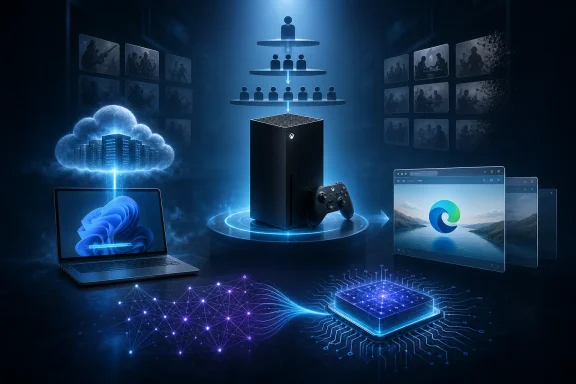 Xbox Turns a Layoff Announcement Into a Corporate Confession
The most consequential subject in episode 991 is Microsoft’s announcement that it is eliminating around 4,800 roles, approximately 2.1 percent of its global workforce. Microsoft Chief People Officer Amy Coleman said the changes mostly fall within the company’s commercial and Xbox organizations, framing them as part of a wider effort to align people and investment with Microsoft’s highest priorities.Microsoft also insisted that the eliminated roles are not simply being replaced by AI. That distinction matters, but only up to a point: Coleman acknowledged in the same communication that AI is changing how work is performed, automating some tasks and forcing employees to acquire new skills. The company’s argument is therefore narrower than the comforting headline suggests—AI may not be taking each eliminated position directly, but it is helping rewrite the economic assumptions behind the organization.
Xbox accounts for most of the announced restructuring. Xbox chief Asha Sharma said the division will eliminate approximately 3,200 roles throughout the fiscal year, beginning with around 1,600 immediate cuts. Microsoft described this as the most significant restructuring in Xbox history, language that rejects the usual corporate fiction that a major reorganization is merely a routine adjustment.
The official message is unusually candid about why the reset is happening. Sharma said Xbox is operating at margins three to ten times lower than comparable platform and publishing businesses, entered the current console generation with a smaller installed base and a higher cost structure, and did not see Game Pass, multiplatform publishing, or its broader content portfolio grow at the expected pace. Even more strikingly, she said that in a typical year Xbox lost 64 cents for every dollar invested in parts of its portfolio.
Those are not the words of a business making small efficiency improvements. They are the words of a platform owner admitting that scale, acquisitions, and strategic optionality did not automatically produce a sustainable operating model.
This is why the episode’s treatment of the layoffs goes beyond the weekly ritual of counting dismissed employees and cataloguing affected studios. Thurrott’s framing focuses on what Sharma said—and what she left unanswered. Microsoft disclosed enough to confirm that Xbox’s economic model is under severe strain, but not enough to establish precisely how the restructured business will escape it.
Microsoft Bought Scale Before It Proved the Model
Xbox’s problem is not that Microsoft lacks games, studios, intellectual property, distribution, engineering talent, or capital. It is that Microsoft accumulated those assets before demonstrating that they could operate together as a disciplined platform.Since 2018, Xbox expanded its studio portfolio aggressively. The strategy was understandable: subscriptions require a steady supply of content, a platform needs exclusives or differentiated experiences, and a publisher competing across console, PC, cloud, and rival devices benefits from a broad catalogue. The problem is that each new studio adds management, production, integration, technology, marketing, and scheduling demands that do not disappear merely because Microsoft can afford them.
Sharma’s memo describes work passing through as many as 14 management layers in some parts of Xbox. It says the platform teams became 40 percent larger than they were at the start of the generation even while the player base and playtime declined. Microsoft plans to reduce those management layers to no more than five—and, where possible, three—while cutting vendor spending by half.
That is an indictment of organizational design, not creative output. A company can own excellent developers and still make them less effective by placing too many approval gates, overlapping services, reporting structures, and corporate mandates between an idea and a shipped product.
It also reveals the contradiction built into the acquisition strategy. Microsoft wanted the creative unpredictability of independent studios, the efficiency of a centrally managed platform, the recurring revenue of subscriptions, the reach of multiplatform publishing, and the margins of a mature software business. Those goals can support one another, but they can also impose incompatible incentives.
A subscription rewards engagement and retention. A premium game rewards direct sales. A console platform historically rewards exclusivity. Multiplatform publishing rewards availability on competing hardware. Cloud distribution rewards infrastructure scale, while independent studios often benefit from smaller teams, distinctive cultures, and freedom from centralized processes.
The great Xbox experiment was to do all of those things simultaneously. Episode 991 arrives at the moment Microsoft publicly acknowledges that Xbox cannot do everything at once.
The Studios Are Leaving, but Microsoft Wants the Games to Survive
The restructuring does not simply close studios and cancel projects. Microsoft is attempting a more complicated operation: reducing ownership while preserving intellectual property, development pipelines, and future releases.The outcomes differ by studio, which makes the details more important than the broad label of “divestiture.”
| Studio | Announced direction | Intellectual property or project status | Immediate implication |
|---|---|---|---|
| Double Fine Productions | Return to management as an independent studio | Retains its IP and catalogue, with runway for its next game | Microsoft gives up ownership while trying to preserve the studio |
| Compulsion Games | Return to management as an independent studio | Retains its IP and catalogue, with runway for its next game | Creative continuity is prioritized over corporate control |
| Ninja Theory | Entered terms to join new ownership | Funding intended to complete and grow Senua | The project continues outside direct Xbox ownership |
| Undead Labs | Entered terms to join new ownership | Funding intended to complete and grow State of Decay 3 | Microsoft reduces internal scope without abandoning the announced game |
| Arkane Lyon | Consultation over potential strategic options | Work on Marvel’s Blade remains publicly announced | Its long-term ownership structure remains unresolved |
The optimistic interpretation is that Microsoft has learned an important lesson. A studio need not be owned by Xbox to make games that benefit Xbox. Development tools, publishing support, distribution, Game Pass agreements, cloud infrastructure, and a large audience can create value without requiring Microsoft to place every developer inside the same corporate structure.
The darker interpretation is that Microsoft is retreating after discovering that it could not generate adequate returns from businesses it spent heavily to acquire. Independence can preserve a studio’s culture, but it also exposes that studio to financing pressure, publisher negotiations, and market risk that Microsoft ownership was supposed to absorb.
GamesBeat guest contributor Jon Kimmich compared Xbox’s position to a burning platform, invoking the famous Nokia-era metaphor for a business forced into drastic action because remaining in place is no longer viable. Windows Weekly did not accept every element of that argument uncritically, but the comparison is difficult to dismiss when Xbox itself says its business is unhealthy, its cost structure is too high, and its expected growth did not materialize.
The Xbox reset is not evidence that Microsoft is leaving gaming. It is evidence that Microsoft no longer believes ownership alone is a strategy.
Game Pass Faces Its Most Important Test
Game Pass remains one of Xbox’s most recognizable products, but the restructuring strips away some of the mythology that accumulated around it. The service created meaningful value, according to Microsoft, but did not grow as quickly as expected.That wording is careful. It does not mean Game Pass failed, nor does it mean the service is about to disappear. It means that Game Pass could not compensate for every weakness elsewhere in the business: console share, development costs, organizational sprawl, content-production risk, and the expense of supporting a platform across an expanding collection of devices.
Subscription economics are unforgiving. Customers expect a continuous stream of desirable releases, but adding more content raises acquisition and production costs. Price increases improve revenue but risk cancellations. Releasing major games into the service can attract subscribers, yet it also changes how Microsoft captures the value of games that might otherwise generate premium sales.
The episode notes another group of games heading to Game Pass, including Gears of War Reloaded, but the routine catalogue update lands differently alongside the restructuring. Each addition is no longer merely a consumer benefit; it is part of a larger test of whether Microsoft can convert an enormous content portfolio into recurring, defensible revenue.
The old Xbox pitch was relatively straightforward: buy the console, purchase games, and subscribe for online services. The newer pitch asks players to understand Xbox as a service available across consoles, Windows PCs, handhelds, televisions, cloud endpoints, and competing platforms. That approach increases Xbox’s potential audience while weakening the importance of any single Xbox-owned device.
Game Pass therefore has to become more than a console subscription without becoming an indiscriminate content warehouse. It must deliver enough value to retain users, enough revenue to support expensive development, and enough strategic differentiation to justify Microsoft’s continued operation of a dedicated gaming platform.
If the reset succeeds, Game Pass could emerge with a smaller but more deliberate portfolio and clearer economics. If it fails, Microsoft may discover that distributing games everywhere is a strong publishing strategy but an insufficient replacement for platform gravity.
The Disc-to-Digital Rumor Exposes Xbox’s Identity Problem
Episode 991 also revisits what Thurrott describes as one of the oldest rumors in Xbox history: Microsoft reportedly working on a disc-to-digital conversion program. The concept would give customers some mechanism for converting ownership of physical Xbox games into digital entitlements.The timing is significant because the industry’s relationship with physical media continues to weaken. Nintendo is preparing to end sales of the original Switch in Europe, while Sony’s longer-term physical-media plans have renewed discussion about what happens to game ownership when hardware vendors and publishers increasingly favor downloads.
A disc-to-digital program sounds consumer-friendly, but implementing one is harder than the slogan implies. Microsoft would need to prevent a customer from converting a disc and then selling or lending it while retaining the digital licence. It would also need cooperation from publishers, rules for unsupported or delisted games, regional licensing controls, and a durable record connecting physical ownership to an account.
The larger issue is trust. A physical disc is imperfect archival media, especially when games depend on patches, servers, account authentication, or downloaded components. But it remains a visible object that the customer possesses. A digital entitlement exists only as long as the platform recognizes the licence, maintains compatible infrastructure, and honors its terms.
Xbox’s shift toward services makes that trust more important, not less. Microsoft wants players to believe that their library follows them across hardware generations and device categories. A credible conversion program could help bridge the physical and digital eras, but only if it offers more than a temporary promotion or narrowly restricted trade-in mechanism.
The browser-based version of Half-Life 2 mentioned in the episode supplies an almost comic counterpoint. Software once tightly associated with a local PC installation can now reportedly run through a web browser, while platform holders still struggle to define what it means to own a game. Distribution technology is becoming more flexible at the same time commercial rights are becoming more abstract.
Windows Cloud Rebuild Is the Practical News IT Should Not Miss
The Xbox crisis dominates the episode, but the most directly useful Windows development is Microsoft’s new Cloud rebuild recovery option for Windows 11. Introduced in an Experimental Windows Insider release, it is designed to restore a PC to a clean, known-good state through a full operating-system reinstall, even when Windows cannot boot.Unlike Reset this PC, Cloud rebuild downloads both the target Windows image and the device’s drivers from Windows Update. Microsoft’s aim is to return the device to working order without USB installation media, a locally stored recovery image, or dependence on the health of the installed operating system.
That is a deceptively important shift. Traditional recovery processes often fail at exactly the moment they are needed because the local image is corrupt, the recovery partition is damaged, or the available installation media lacks network, storage, or device-specific drivers. Cloud rebuild moves the source of truth away from the failed PC and toward Microsoft’s servicing infrastructure.
For consumers, the appeal is obvious: fewer emergency USB drives and less time hunting for drivers on another computer. For IT departments, the implications are more complicated.
A recovery environment that can obtain Windows and appropriate drivers from the cloud could reduce hands-on support, particularly for remote employees. It could also make factory images less important and improve recovery consistency across mixed fleets. A user with a boot failure might be able to recover a machine without shipping it to a central help desk.
However, enterprise adoption will depend on details not resolved by the initial preview. Administrators will need to understand network requirements, proxy and certificate behavior, driver-selection logic, BitLocker handling, identity and enrollment workflows, data-loss warnings, logging, and whether policy can expose, restrict, or preconfigure the feature.
The phrase “known-good state” also requires discipline. A fresh Microsoft image may be known-good as an operating system, but it is not automatically a fully managed business endpoint. Recovery must still reconnect the device to organizational identity, security baselines, endpoint management, application deployment, data protection, and compliance systems.
Cloud rebuild is therefore best understood as a stronger operating-system recovery foundation, not a complete enterprise recovery strategy. It may restore Windows and drivers; it does not eliminate the need for backups, deployment automation, tested enrollment, or incident-response procedures.
Action checklist for admins
- Keep Cloud rebuild testing confined to designated Windows Insider lab devices until Microsoft documents production support and policy controls.
- Record recovery keys and verify BitLocker procedures before intentionally testing an unbootable-device scenario.
- Test the feature through the same proxies, firewalls, DNS controls, and restricted networks used by remote and branch-office devices.
- Confirm that recovered PCs can re-enroll in endpoint management and automatically receive security baselines, required applications, certificates, and configuration policies.
- Compare the resulting driver set with OEM-approved packages, especially on business laptops with specialized storage, networking, biometric, or dock hardware.
- Continue maintaining independent user-data backups and established offline recovery options while the cloud workflow remains experimental.
Edge Accepts Google Identity While Removing More of Its Own Furniture
Microsoft Edge’s support for Google account sign-ins is another small feature that reveals a larger strategic concession. Microsoft is gradually allowing Windows and Mac users to sign in to Edge with a Google account rather than requiring a Microsoft account for browser-data synchronization.For users who rely on Gmail or other Google services but prefer Edge’s interface or Windows integration, this removes friction. For Microsoft, it is an acknowledgment that account requirements can repel potential users more effectively than product features attract them.
Chrome’s dominance gives Google little incentive to reciprocate by supporting Microsoft accounts. Microsoft must therefore compete under asymmetric conditions: it needs to welcome identities from a rival ecosystem, while the rival does not necessarily need to return the favor.
At the same time, Microsoft is retiring Edge’s sidebar app list as part of what it calls a simplification effort. New apps can no longer be added there, and currently pinned apps are expected to disappear in a later update.
Those two decisions point in the same direction. Edge spent years accumulating shopping tools, sidebar experiences, services, prompts, integrations, and Microsoft-account hooks. Supporting Google identity broadens access, while removing sidebar apps trims a part of the browser that failed to become indispensable.
This is not Microsoft abandoning differentiation. It is Microsoft recognizing that a browser must first succeed as a browser. Every additional surface creates maintenance work, user-interface complexity, administrative policy questions, and another opportunity for users to feel that the product is serving Microsoft’s priorities rather than their own.
Opera One’s Paste Protect feature, also discussed in episode 991, demonstrates a more focused form of differentiation. Opera says the browser-native protection detects attempts to place potentially malicious commands into the clipboard, targeting social-engineering attacks that persuade users to paste code into a terminal or other sensitive interface.
Such protection cannot make careless command execution safe, and administrators should not treat a browser feature as a replacement for application control, least privilege, endpoint protection, or user education. But it addresses a real attack pattern at the point where the browser hands potentially dangerous content to the operating system.
The contrast is useful. A sidebar full of web apps asks users to adopt a browser-specific workflow. Clipboard protection attempts to stop a browser-mediated threat. One is a product-engagement strategy; the other is a security control. In an era of forced simplification, the second is easier to defend.
Microsoft Wants AI Independence Without Paying the Intelligence Tax Everywhere
The episode’s AI segment extends the same economic argument into Microsoft 365. According to Bloomberg reporting discussed by Thurrott, Microsoft is reportedly beginning to use its own MAI models in place of OpenAI and Anthropic models where the workload allows it, in part to reduce costs.The key phrase is where the workload allows it. Microsoft’s internal models reportedly do not yet match the most capable external frontier models across every task. But Excel, Outlook, PowerPoint, Teams, and other productivity applications do not necessarily require the most expensive model for every request.
A bounded task can often be served by a smaller, cheaper, faster, or more specialized model. Spreadsheet assistance, message summarization, transcription, presentation imagery, and narrowly defined document operations may benefit more from predictable latency, controllable costs, and integration than from maximum general-purpose intelligence.
This is the enterprise version of a familiar infrastructure decision. A company does not deploy its largest database, most expensive virtual machine, or highest-performance storage tier for every workload. If Microsoft can route tasks among models according to capability, risk, latency, and price, it can improve the economics of Copilot without visibly degrading common experiences.
Owning more of the model stack would also give Microsoft greater control over deployment, optimization, data handling, product schedules, and bargaining power. The company has invested deeply in external AI partnerships, but permanent strategic dependence on another organization is uncomfortable for a platform vendor of Microsoft’s size.
The risk is that cost reduction becomes the primary product requirement. Users already struggle to judge when an AI assistant is correct, partially correct, or confidently wrong. Substituting a weaker model may be economically sensible, but Microsoft must ensure that model routing does not turn Copilot into an inconsistent system whose quality changes invisibly between tasks.
The AI transition echoes Xbox in reverse. In gaming, Microsoft discovered that owning more studios did not guarantee an efficient business. In AI, it is discovering that relying on premium external intelligence for every operation may be equally unsustainable. The correct level of ownership is not “everything” or “nothing”; it is whatever provides control where control produces measurable value.
Episode 991 Works Because Thurrott Has Seen the Cycle Before
Paul Thurrott’s role in the episode is not simply that of a commentator reading a list of Microsoft announcements. His biography places the discussion within 30 years of industry coverage and 30 authored books, including long-running work focused on Windows and Microsoft’s wider ecosystem.He is the owner of Thurrott.com and hosts Windows Weekly with Leo Laporte and Richard Campbell, Hands-On Windows, and First Ring Daily with Brad Sams. He previously served as senior technology analyst at Windows IT Pro, created the SuperSite for Windows and ran it from 1999 to 2014, and was Major Domo of Thurrott.com at BWW Media Group from 2015 to 2023.
That history matters because Microsoft has repeatedly moved between expansion and simplification. It builds platforms, layers products around them, adds services and account requirements, reorganizes around strategic priorities, and eventually confronts the complexity created by the previous cycle.
Episode 991 is strongest when it treats the week’s stories as manifestations of that cycle rather than unrelated news items. Xbox expanded until management layers and costs overwhelmed its operating model. Edge accumulated features before returning to simplification. Windows recovery is moving from local complexity toward cloud servicing. Microsoft’s AI products are shifting from expensive external dependency toward selective internal control.
Even Thurrott’s update on the Windows 11 Field Guide reflects the same editorial instinct. He reported reducing the guide from more than 1,150 pages and over 300 MB at its largest to 847 pages and 67 MB in the latest update mentioned during the episode. The page count rose slightly from an earlier stage of the rewrite, but the file became dramatically smaller as the work was reorganized and refined.
The metaphor is almost too convenient: usefulness does not always increase with volume. Whether the product is a book, browser, corporate hierarchy, studio portfolio, or AI stack, accumulation eventually creates its own tax.
Timeline
July 1, 2026 — Microsoft began its new fiscal year, the corporate boundary around which major organizational and staffing changes are often implemented.July 2, 2026 — Thurrott.com covered Opera One’s Paste Protect feature, placing browser-native clipboard protection on the episode’s security agenda.
July 3, 2026 — Thurrott.com reported the gradual rollout of Google account sign-ins in Microsoft Edge and the beginning of the sidebar app list’s retirement.
July 6, 2026 — Microsoft announced approximately 4,800 job eliminations, while Xbox disclosed a restructuring affecting approximately 3,200 roles throughout the fiscal year and changes involving several studios.
July 6, 2026 — Microsoft released four Windows 11 Insider builds, with Cloud rebuild appearing as the most consequential new recovery feature.
July 7, 2026 — GamesBeat published Jon Kimmich’s argument that Xbox had become Microsoft’s new burning platform, while Thurrott.com covered Microsoft’s reported shift toward in-house AI models.
July 8, 2026 — TWiT published Windows Weekly episode 991 with Leo Laporte, Paul Thurrott, and Richard Campbell.
July 9, 2026 — Thurrott.com published its companion post for “Windows Weekly 991: Strategically Repositioned Productivity Surface.”
The Reset Extends Far Beyond Xbox
The tempting interpretation of episode 991 is that Xbox suffered a crisis while the rest of Microsoft continued with normal product updates. The more persuasive reading is that Xbox is merely the place where Microsoft’s broader strategic pressures became impossible to hide.Cloud rebuild moves recovery away from fragile local state and into a centrally serviced model. Edge lowers an identity barrier and retires an underused feature surface. Opera adds a narrowly targeted defense instead of another engagement mechanism. Microsoft reportedly shifts suitable AI workloads toward models it can operate more economically. Xbox reduces ownership, management layers, vendors, and organizational fragmentation.
These decisions vary enormously in human impact. Removing a browser sidebar feature cannot be equated with eliminating thousands of jobs. But they are driven by a common demand: reduce the distance between resources spent and value delivered.
Microsoft’s challenge is that simplification is easy to announce and difficult to sustain. Organizations remove layers and then gradually recreate them. Product teams delete features and later add replacements. Cost reductions improve short-term margins but can damage long-term quality. Divested studios gain freedom but lose the financial shelter of a trillion-dollar parent company.
The company must also avoid confusing operational discipline with strategic clarity. A flatter Xbox can still pursue the wrong products. A cheaper AI model can still deliver an unreliable answer. A cloud recovery feature can still leave an endpoint improperly configured. A simplified browser can still overwhelm users with prompts and services elsewhere.
The reset will be judged not by how much Microsoft removes but by whether the resulting products become easier to understand, support, trust, and operate.
What Windows and Xbox Users Should Carry Forward
Episode 991’s value lies in connecting a painful corporate restructuring with quieter technical changes that reveal how Microsoft now thinks about platforms, ownership, identity, and operating cost.- Microsoft’s 4,800 announced job cuts are concentrated largely in its commercial and Xbox organizations, with approximately 3,200 Xbox roles affected throughout the fiscal year.
- Xbox has publicly acknowledged weak margins, excessive management depth, higher costs, declining engagement measures, and slower-than-expected growth from its major strategic bets.
- Several studios are moving toward independence or new ownership, but Microsoft says publicly announced first-party projects are not being cancelled as part of the reductions.
- Windows 11 Cloud rebuild could materially improve failed-PC recovery by downloading both Windows and drivers, though enterprises still need backups, enrollment automation, and policy controls.
- Edge’s Google account support and sidebar retreat suggest Microsoft is finally prioritizing lower friction over mandatory ecosystem loyalty.
- Microsoft’s reported use of in-house MAI models shows that the next phase of enterprise AI will be determined as much by workload economics as benchmark leadership.
References
- Primary source: thurrott.com
Published: Wed, 08 Jul 2026 18:03:44 GMT
Loading…
www.thurrott.com - Related coverage: twit.tv
Windows Weekly | Microsoft Tech Podcast | Windows, Office, Xbox | TWiT
Dive into the world of Microsoft with the Windows Weekly podcast. Join experts Leo Laporte, Paul Thurrott, and Richard Campbell for insights on Windows, Office, Xbox, andtwit.tv