

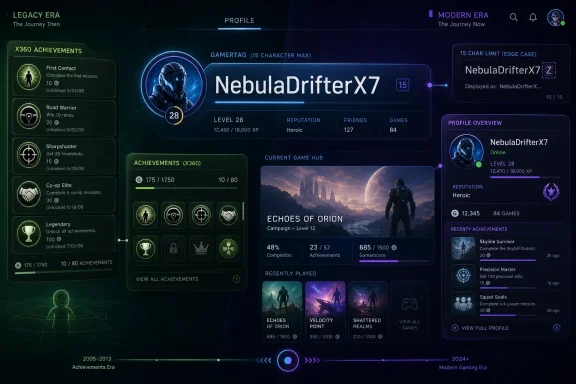
Microsoft announced on June 24, 2026, that Xbox Insiders in the Alpha Skip-Ahead ring can test longer unique gamertags of up to 15 characters and new Xbox 360 achievement surfaces inside game hubs and profile popups. The short answer is: do not change your gamertag just because the limit moved unless the exact 13-to-15-character name you want is available, unique, and worth locking in early. If you care more about stability than first access, wait for broader rollout; if you care about shaping the naming and legacy-achievement UX, Alpha Skip-Ahead is where Microsoft is listening first.
This is not a cosmetic footnote. Microsoft is testing two pieces of Xbox identity at once: what players call themselves, and how their older gaming history is displayed in the modern Xbox shell. That makes this Alpha Skip-Ahead release more meaningful than the usual “new tile here, new menu there” console preview.
The headline change is simple but uneven by design. Unique, available Xbox gamertags can now stretch to 15 characters, up from the previous 12-character ceiling. That sounds like a small change until you remember that gamertags are Xbox’s oldest social currency: the thing friends remember, rivals recognize, and achievement hunters carry across console generations.
But the extra space does not apply to every naming path. Non-unique gamertags and gamertags using non-Latin characters can still use suffixes, and those remain capped at 12 characters. In other words, Microsoft is not throwing out the modern suffix-based system; it is giving the traditional unique-name model more room to breathe.
That distinction matters. If your dream name is genuinely unique and available, the new ceiling gives you three more characters to make it work without resorting to numbers, abbreviations, or awkward spellings. If you are using the suffix system, or if your identity depends on non-Latin characters, this preview does not give you the same expanded canvas.
The practical answer, then, is conditional. Change your gamertag now only if the name you want depends on the new 15-character limit and you are comfortable participating in an early Insider ring. Otherwise, there is little reason to rush, because the test is beginning in Alpha Skip-Ahead first and the broader rollout timing has not been specified.
That sounds obvious, but gamertags have a long memory. People keep them for years, use them across friend lists and party chats, and sometimes build streaming, Discord, or clan identities around them. A rushed rename can be more annoying than a slightly cramped old one.
The safer process is straightforward: write down your preferred 13-to-15-character name, strip away anything you are adding only because you can, and ask whether it still looks good in a party roster, a profile popup, and an achievement notification. If the answer is yes, the Alpha Skip-Ahead test may be worth your attention. If the name only feels better because it is longer, wait.
There is also a fairness angle here. Early tests can create a perceived land rush around desirable names, especially when the feature being tested concerns identity. Microsoft has not framed this as a general availability launch, so players should treat the preview as a test environment rather than a guarantee that every naming edge case will behave exactly as expected.
If you enroll in early rings only to get features first, you are accepting preview risk without doing the useful part: reporting what breaks, what confuses, and what feels inconsistent. For this release, the valuable feedback is likely to be less about whether longer names exist and more about where they fit badly. Do 15-character gamertags truncate in profile popups? Do they look awkward in game hubs? Do they behave consistently beside suffix-based names?
That is where WindowsForum’s enthusiast and admin-minded audience should be especially useful. Xbox today is not just a console dashboard; it is an identity layer touching console, PC, cloud, Game Bar, and mobile surfaces. A name-length change that looks harmless in one screen can expose layout assumptions elsewhere.
This is why the Alpha Skip-Ahead placement is a signal. Microsoft appears to be testing not merely a database rule, but the user-interface consequences of a longer identity string inside the Xbox ecosystem. The feature is small enough to describe in one sentence, but broad enough to reveal old assumptions.
That may sound like archival housekeeping, but it is more interesting than that. Xbox 360 achievements are part of the emotional infrastructure of Xbox Live. They belong to a period when achievements became a shared language: 1,000-point completions, rare grinds, impossible multiplayer unlocks, and the particular satisfaction of seeing an old game’s progress bar move.
By surfacing Xbox 360 achievement data more naturally inside game hubs and profile popups, Microsoft is narrowing the gap between legacy content and the current shell. The point is not merely that old achievements exist. The point is that they are becoming easier to inspect in the places players already look.
That is a UX correction long overdue. Backward compatibility made old games playable; better hubs make old games legible. For achievement hunters, that difference matters.
The more Xbox highlights old achievements in modern surfaces, the more it treats legacy activity as current identity rather than museum material. That is good for players who never stopped caring about their 360 completions. It is also good for Microsoft, because legacy depth is one of Xbox’s strongest ecosystem arguments.
There is a useful comparison to recent Xbox UI experiments. WindowsForum has already covered Microsoft’s push to make Xbox personalization, badges, and profile presentation more prominent, as well as its work on redesigned achievement experiences for Xbox on PC and Game Bar. This latest Insider test belongs to the same pattern: Xbox identity is being made more visible, more portable, and more expressive.
The risk is clutter. A profile can only carry so many badges, histories, popups, and identity markers before it becomes noisy. Microsoft’s challenge is to make Xbox 360 achievement detail feel discoverable without making every old data point fight for attention.
Microsoft’s split between unique 15-character names and 12-character suffixed or non-Latin names is especially worth watching. On one hand, it preserves the suffix model that lets more players use the visible name they want. On the other, it gives the most traditional form of Xbox identity — a unique, suffix-free gamertag — a new advantage in expressiveness.
That could push some players back toward unique-name hunting. It could also frustrate players who prefer non-Latin scripts or who rely on suffixes because their chosen name is already taken. Microsoft may have solid technical reasons for the distinction, but user perception will matter.
The best version of this feature gives players more room without making one identity path feel first-class and another feel constrained. Alpha Skip-Ahead is exactly where that perception should be tested before a broader audience sees it.
Old Xbox 360 titles can have odd achievement structures, discontinued online modes, legacy metadata, and uneven capture histories. Bringing that information into modern hubs is valuable, but it also invites mismatches. A polished hub for one famous backward-compatible title does not prove the experience is polished across the catalog.
Achievement hunters in Alpha Skip-Ahead should resist the urge to test only their favorite completions. They should check games with partial progress, older captures, awkward achievement names, and profiles with a long history. The feature’s quality will be measured by the weird cases.
That is where community feedback can materially change the final UX. Microsoft does not need players merely to say “this is cool.” It needs them to show where the old Xbox 360 layer does not map cleanly onto the modern Xbox interface.
That is why this preview should interest PC-first Xbox users, even if they rarely boot a console. Microsoft has been tightening the relationship between Xbox console UX and Windows gaming UX, from Game Bar changes to achievement toast redesigns and cloud access experiments. The longer-term trend is clear: Xbox is becoming less a box under the TV and more a profile-driven service layer.
The gamertag limit increase fits that direction. So does the resurfacing of Xbox 360 achievement detail. Both make the player’s account feel more durable than the device being used.
For IT pros and sysadmins, the enterprise relevance is admittedly indirect. But many WindowsForum readers manage Microsoft ecosystems by day and live in them by night. The same instincts apply: watch identity changes early, pay attention to UI consistency across clients, and do not assume a backend policy change is finished just because it appears simple.
The June 24 Alpha Skip-Ahead changes point in that direction. Longer unique gamertags let players refine the identity they present now. Xbox 360 game hubs and profile achievement popups bring older accomplishments into current navigation. Together, they suggest Microsoft is treating memory as an active part of the Xbox product.
That is smart, because nostalgia by itself is cheap. Every platform can celebrate anniversaries and sell retro-themed merchandise. What matters is whether old activity remains usable, inspectable, and socially meaningful in the present interface.
This is where Xbox has often been stronger than its messaging. Backward compatibility gave the platform credibility with preservation-minded players. Better achievement hubs can make that credibility visible every time someone opens an old game card.
But fear of missing out is a poor reason to join Alpha Skip-Ahead. Preview rings exist to expose users to unfinished work. If your Xbox is a shared family console, a living-room appliance, or the device you rely on for a stable weekend gaming routine, early access may not be worth the friction.
There is also no need to treat this as a universal rename moment. Many of the best gamertags are short. A 15-character maximum is not a command to use all 15 characters. In many cases, a clean 8-to-12-character name will remain more readable and memorable than a longer one.
The better reason to jump early is not panic. It is intention. If you have a specific name that now becomes possible, or if you care enough about Xbox 360 achievement presentation to file useful feedback, Alpha Skip-Ahead has a purpose for you.
The same applies to Xbox 360 achievement hubs. If progress appears in one place but not another, if captures are surfaced awkwardly, or if profile popups bury useful detail, the feedback should be concrete. “Make this better” is not as useful as “this achievement list view loses context compared with the game hub.”
Players who remember the Xbox 360 era may be unusually good testers here because they know what the old achievement culture felt like. They know why completion percentage matters, why profile visibility matters, and why a legacy game hub should not feel like a second-class page. That historical literacy is valuable product feedback.
There is a lesson for Microsoft, too. If the company wants to make Xbox history a living part of the platform, it should listen most closely to the people who have been carrying that history around for nearly two decades.
Now that unique available gamertags can reach 15 characters, that prestige may grow. A unique name can be longer and cleaner, while a suffixed name remains shorter and visibly qualified. That may be acceptable to many users, but it is still a product choice with social meaning.
The non-Latin character limitation is also worth watching carefully. Xbox is a global platform, and identity systems can easily feel uneven across languages and scripts. The verified facts do not explain Microsoft’s technical reasoning, so the fairest reading is that this is a preview constraint rather than a philosophical statement.
Still, constraints shape behavior. If Microsoft receives strong feedback that the rule feels inequitable or confusing, Alpha Skip-Ahead is the right place to hear it.
The June 24 Insider update sits inside that broader repositioning. Xbox is not merely making names longer or old achievements easier to find. It is making the account itself richer as a surface. The profile is becoming a more important product area.
That can be good for players who want their history to matter. It can also make the interface busier and more status-conscious. Microsoft will need to balance expression against legibility, especially on TV screens where distance and controller navigation punish clutter quickly.
The best Xbox identity UI is not the one with the most data. It is the one that makes the right data feel obvious at the right moment.
This is not a cosmetic footnote. Microsoft is testing two pieces of Xbox identity at once: what players call themselves, and how their older gaming history is displayed in the modern Xbox shell. That makes this Alpha Skip-Ahead release more meaningful than the usual “new tile here, new menu there” console preview.
 Microsoft Moves the Nameplate Without Moving Everyone
The headline change is simple but uneven by design. Unique, available Xbox gamertags can now stretch to 15 characters, up from the previous 12-character ceiling. That sounds like a small change until you remember that gamertags are Xbox’s oldest social currency: the thing friends remember, rivals recognize, and achievement hunters carry across console generations.But the extra space does not apply to every naming path. Non-unique gamertags and gamertags using non-Latin characters can still use suffixes, and those remain capped at 12 characters. In other words, Microsoft is not throwing out the modern suffix-based system; it is giving the traditional unique-name model more room to breathe.
That distinction matters. If your dream name is genuinely unique and available, the new ceiling gives you three more characters to make it work without resorting to numbers, abbreviations, or awkward spellings. If you are using the suffix system, or if your identity depends on non-Latin characters, this preview does not give you the same expanded canvas.
The practical answer, then, is conditional. Change your gamertag now only if the name you want depends on the new 15-character limit and you are comfortable participating in an early Insider ring. Otherwise, there is little reason to rush, because the test is beginning in Alpha Skip-Ahead first and the broader rollout timing has not been specified.
The Smart Move Is to Check the Name, Not Chase the Feature
For players tempted to jump immediately, the first task is not joining a ring or rewriting your Xbox identity. It is deciding whether the extra three characters actually solve a problem. A 15-character unique gamertag is valuable only if it gives you a name you would still want after the novelty wears off.That sounds obvious, but gamertags have a long memory. People keep them for years, use them across friend lists and party chats, and sometimes build streaming, Discord, or clan identities around them. A rushed rename can be more annoying than a slightly cramped old one.
The safer process is straightforward: write down your preferred 13-to-15-character name, strip away anything you are adding only because you can, and ask whether it still looks good in a party roster, a profile popup, and an achievement notification. If the answer is yes, the Alpha Skip-Ahead test may be worth your attention. If the name only feels better because it is longer, wait.
There is also a fairness angle here. Early tests can create a perceived land rush around desirable names, especially when the feature being tested concerns identity. Microsoft has not framed this as a general availability launch, so players should treat the preview as a test environment rather than a guarantee that every naming edge case will behave exactly as expected.
Alpha Skip-Ahead Is the Point, Not a Footnote
The Alpha Skip-Ahead ring is not just “early access” in the marketing sense. It is where Microsoft puts changes that may still need meaningful feedback before they reach a wider Xbox audience. That matters because gamertags and achievement surfaces are both highly visible, socially loaded features.If you enroll in early rings only to get features first, you are accepting preview risk without doing the useful part: reporting what breaks, what confuses, and what feels inconsistent. For this release, the valuable feedback is likely to be less about whether longer names exist and more about where they fit badly. Do 15-character gamertags truncate in profile popups? Do they look awkward in game hubs? Do they behave consistently beside suffix-based names?
That is where WindowsForum’s enthusiast and admin-minded audience should be especially useful. Xbox today is not just a console dashboard; it is an identity layer touching console, PC, cloud, Game Bar, and mobile surfaces. A name-length change that looks harmless in one screen can expose layout assumptions elsewhere.
This is why the Alpha Skip-Ahead placement is a signal. Microsoft appears to be testing not merely a database rule, but the user-interface consequences of a longer identity string inside the Xbox ecosystem. The feature is small enough to describe in one sentence, but broad enough to reveal old assumptions.
Xbox 360 Achievements Finally Get a More Modern Front Door
The second change is aimed at a different kind of Xbox user: the player whose history stretches back to the Xbox 360 era and who still cares about that history being visible. Xbox 360 game cards now include game hubs with achievement progress, captures, and related information. Detailed achievement popups are also available from Xbox 360 achievement lists in a player’s profile.That may sound like archival housekeeping, but it is more interesting than that. Xbox 360 achievements are part of the emotional infrastructure of Xbox Live. They belong to a period when achievements became a shared language: 1,000-point completions, rare grinds, impossible multiplayer unlocks, and the particular satisfaction of seeing an old game’s progress bar move.
By surfacing Xbox 360 achievement data more naturally inside game hubs and profile popups, Microsoft is narrowing the gap between legacy content and the current shell. The point is not merely that old achievements exist. The point is that they are becoming easier to inspect in the places players already look.
That is a UX correction long overdue. Backward compatibility made old games playable; better hubs make old games legible. For achievement hunters, that difference matters.
Legacy Status Is Becoming Part of the Modern Profile
Microsoft has spent much of the modern Xbox era trying to make the platform feel continuous across devices and generations. The company talks about the player’s library, history, and identity as things that should persist even as hardware changes. Xbox 360 achievement surfacing fits neatly into that strategy.The more Xbox highlights old achievements in modern surfaces, the more it treats legacy activity as current identity rather than museum material. That is good for players who never stopped caring about their 360 completions. It is also good for Microsoft, because legacy depth is one of Xbox’s strongest ecosystem arguments.
There is a useful comparison to recent Xbox UI experiments. WindowsForum has already covered Microsoft’s push to make Xbox personalization, badges, and profile presentation more prominent, as well as its work on redesigned achievement experiences for Xbox on PC and Game Bar. This latest Insider test belongs to the same pattern: Xbox identity is being made more visible, more portable, and more expressive.
The risk is clutter. A profile can only carry so many badges, histories, popups, and identity markers before it becomes noisy. Microsoft’s challenge is to make Xbox 360 achievement detail feel discoverable without making every old data point fight for attention.
The Gamertag Change Is Really a Database Policy With Social Consequences
A longer unique gamertag sounds like a string-length update, but identity systems are never just string fields. They create incentives. They shape what names people choose, what communities recognize, and what kinds of impersonation or confusion platforms must manage.Microsoft’s split between unique 15-character names and 12-character suffixed or non-Latin names is especially worth watching. On one hand, it preserves the suffix model that lets more players use the visible name they want. On the other, it gives the most traditional form of Xbox identity — a unique, suffix-free gamertag — a new advantage in expressiveness.
That could push some players back toward unique-name hunting. It could also frustrate players who prefer non-Latin scripts or who rely on suffixes because their chosen name is already taken. Microsoft may have solid technical reasons for the distinction, but user perception will matter.
The best version of this feature gives players more room without making one identity path feel first-class and another feel constrained. Alpha Skip-Ahead is exactly where that perception should be tested before a broader audience sees it.
Achievement Hunters Should Test the Boring Screens First
For Xbox 360 achievement fans, the exciting part is obvious: more useful hubs, richer profile popups, and less digging for old progress. But the places that need testing are often mundane. The question is how consistently the data appears and how gracefully the UI handles edge cases.Old Xbox 360 titles can have odd achievement structures, discontinued online modes, legacy metadata, and uneven capture histories. Bringing that information into modern hubs is valuable, but it also invites mismatches. A polished hub for one famous backward-compatible title does not prove the experience is polished across the catalog.
Achievement hunters in Alpha Skip-Ahead should resist the urge to test only their favorite completions. They should check games with partial progress, older captures, awkward achievement names, and profiles with a long history. The feature’s quality will be measured by the weird cases.
That is where community feedback can materially change the final UX. Microsoft does not need players merely to say “this is cool.” It needs them to show where the old Xbox 360 layer does not map cleanly onto the modern Xbox interface.
Windows and Xbox Are Sharing More Than a Brand
This story belongs on WindowsForum because Xbox identity no longer stops at the console. Xbox on PC, Game Bar, cloud gaming, and handheld-oriented work all depend on the same broad account and social fabric. A gamertag that changes on console is not merely a console label; it is part of how the player appears across Microsoft’s gaming surfaces.That is why this preview should interest PC-first Xbox users, even if they rarely boot a console. Microsoft has been tightening the relationship between Xbox console UX and Windows gaming UX, from Game Bar changes to achievement toast redesigns and cloud access experiments. The longer-term trend is clear: Xbox is becoming less a box under the TV and more a profile-driven service layer.
The gamertag limit increase fits that direction. So does the resurfacing of Xbox 360 achievement detail. Both make the player’s account feel more durable than the device being used.
For IT pros and sysadmins, the enterprise relevance is admittedly indirect. But many WindowsForum readers manage Microsoft ecosystems by day and live in them by night. The same instincts apply: watch identity changes early, pay attention to UI consistency across clients, and do not assume a backend policy change is finished just because it appears simple.
Microsoft Is Testing Memory as a Product Feature
Xbox has an advantage many newer gaming platforms cannot fake: accumulated history. Players have gamertags, friends lists, gamerscore, captures, and achievements going back years. The harder problem is making that history feel alive rather than dusty.The June 24 Alpha Skip-Ahead changes point in that direction. Longer unique gamertags let players refine the identity they present now. Xbox 360 game hubs and profile achievement popups bring older accomplishments into current navigation. Together, they suggest Microsoft is treating memory as an active part of the Xbox product.
That is smart, because nostalgia by itself is cheap. Every platform can celebrate anniversaries and sell retro-themed merchandise. What matters is whether old activity remains usable, inspectable, and socially meaningful in the present interface.
This is where Xbox has often been stronger than its messaging. Backward compatibility gave the platform credibility with preservation-minded players. Better achievement hubs can make that credibility visible every time someone opens an old game card.
The Case Against Rushing Is Stronger Than the Fear of Missing Out
The obvious counterargument is that desirable names may go quickly. If 15-character unique gamertags open up combinations that were previously impossible, some players will want to grab them as early as possible. That instinct is understandable.But fear of missing out is a poor reason to join Alpha Skip-Ahead. Preview rings exist to expose users to unfinished work. If your Xbox is a shared family console, a living-room appliance, or the device you rely on for a stable weekend gaming routine, early access may not be worth the friction.
There is also no need to treat this as a universal rename moment. Many of the best gamertags are short. A 15-character maximum is not a command to use all 15 characters. In many cases, a clean 8-to-12-character name will remain more readable and memorable than a longer one.
The better reason to jump early is not panic. It is intention. If you have a specific name that now becomes possible, or if you care enough about Xbox 360 achievement presentation to file useful feedback, Alpha Skip-Ahead has a purpose for you.
The Best Early Testers Will Be the Pickiest Ones
Microsoft does not need cheerleading from Alpha Skip-Ahead users. It needs irritation, specificity, and screenshots sent through the right channels. A longer gamertag that clips by one character in a popup is exactly the kind of problem a preview ring should catch.The same applies to Xbox 360 achievement hubs. If progress appears in one place but not another, if captures are surfaced awkwardly, or if profile popups bury useful detail, the feedback should be concrete. “Make this better” is not as useful as “this achievement list view loses context compared with the game hub.”
Players who remember the Xbox 360 era may be unusually good testers here because they know what the old achievement culture felt like. They know why completion percentage matters, why profile visibility matters, and why a legacy game hub should not feel like a second-class page. That historical literacy is valuable product feedback.
There is a lesson for Microsoft, too. If the company wants to make Xbox history a living part of the platform, it should listen most closely to the people who have been carrying that history around for nearly two decades.
The Small Print Around Suffixes Deserves More Attention
The most delicate part of the gamertag announcement is the cap that remains in place for non-unique names or names using non-Latin characters. Microsoft’s modern gamertag system was built to let more people use the display name they want by adding suffixes when needed. That solved one problem while creating another: the suffix-free unique name still carries a certain prestige.Now that unique available gamertags can reach 15 characters, that prestige may grow. A unique name can be longer and cleaner, while a suffixed name remains shorter and visibly qualified. That may be acceptable to many users, but it is still a product choice with social meaning.
The non-Latin character limitation is also worth watching carefully. Xbox is a global platform, and identity systems can easily feel uneven across languages and scripts. The verified facts do not explain Microsoft’s technical reasoning, so the fairest reading is that this is a preview constraint rather than a philosophical statement.
Still, constraints shape behavior. If Microsoft receives strong feedback that the rule feels inequitable or confusing, Alpha Skip-Ahead is the right place to hear it.
The Console Shell Is Becoming a Reputation System
Gamertags, gamerscore, achievements, badges, captures, hubs, and profile popups are not separate UI decorations. They are pieces of a reputation system. They tell other players who you are, what you play, how long you have been around, and what you value.The June 24 Insider update sits inside that broader repositioning. Xbox is not merely making names longer or old achievements easier to find. It is making the account itself richer as a surface. The profile is becoming a more important product area.
That can be good for players who want their history to matter. It can also make the interface busier and more status-conscious. Microsoft will need to balance expression against legibility, especially on TV screens where distance and controller navigation punish clutter quickly.
The best Xbox identity UI is not the one with the most data. It is the one that makes the right data feel obvious at the right moment.
The Practical Verdict for Gamertag Hunters and Achievement Diehards
This is one of those Insider releases where the recommendation depends less on the feature and more on the user. Microsoft has opened a meaningful test, but it has not created an emergency. The right move is to match your appetite for preview software against the value of early identity access.- If your ideal unique gamertag is 13 to 15 characters long and available, Alpha Skip-Ahead may be worth considering before broader rollout.
- If you use a suffixed gamertag or non-Latin characters, the new 15-character limit does not currently apply to your naming path.
- If you mainly care about Xbox 360 achievements, the value is in testing whether hubs, progress, captures, and profile popups present old games cleanly.
- If your console needs to stay boring and reliable, waiting for a wider release is the safer choice.
- If you do join early, useful feedback should focus on truncation, inconsistent profile behavior, confusing achievement surfaces, and legacy games that do not display cleanly.
References
- Primary source: news.xbox.com
- Primary source: WindowsForum
Xbox 360 Gamers : Gamertags | Windows Forum
The thread invites users to share their Xbox Live Gamertags, with the original poster providing theirs early on. Subsequent posts follow with other user...windowsforum.com

