

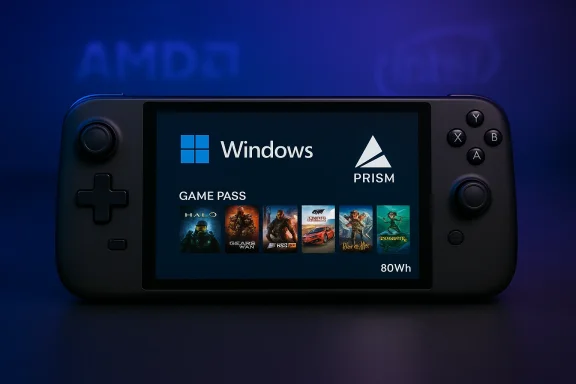
Microsoft’s January wave of portable-gaming news quietly reset several expectations for Windows handhelds: the Xbox PC app now runs on Arm-based Windows 11 devices, Microsoft’s Prism emulator has been upgraded with AVX/AVX2 and anti-cheat support that unlocks many Game Pass titles, third-party Linux efforts and vendor partnerships continue to shuffle the handheld software stack, new battery-first Windows handhelds are being announced, and the handheld market’s price and availability dynamics are shifting as AMD and Intel renew public sparring over mobile silicon.
This piece synthesizes the week’s headlines and technical details, verifies claims where possible, flags areas that remain unproven or disputed, and explains what these developments mean for Windows handheld buyers and enthusiasts.
Key developments covered:
The practical headlines:
That claim drew an immediate rebuttal from members of the Bazzite project. Reports show the Bazzite founder explicitly denied a formal claim that they had no recent contact and that GPD’s statement was inaccurate. The situation is unresolved: community‑level testing and official confirmations from both parties are still needed. Treat GPD’s statement as a vendor initiative rather than an independently verified, project-endorsed port until Bazzite itself confirms.
Why this matters: official vendor support matters for driver packaging, firmware tweaks, and QA. When an OS project signs an OEM, the vendor can push tested drivers and simplify updates; false or premature claims risk user frustration and fractured support threads.
Why skepticism is justified:
Why that matters: when a hardware SKU is broadly available, reviewers can test more units, third‑party docks and cases proliferate, and buyers face less pressure to pre-order sight unseen.
Practical buying advice:
What to watch next:
That said, the landscape remains heterogeneous. Emulation improves compatibility but cannot deliver native x86 throughput; per‑title validation, driver maturity, and publisher opt‑in will continue to shape which games feel “right” on each handheld. Buyers who value portability and battery life now have more real, tested choices; enthusiasts should expect more rapid iteration, more competition between AMD and Intel in the mobile space, and continued churn in pricing and SKUs as vendors jockey for position.
In short: the ecosystem is maturing, not finished. For handheld owners and Windows enthusiasts, the immediate opportunity is to test the titles you care about on the devices you consider — armed with Xbox app badges, Windows Performance Fit estimates, and the knowledge that Arm is now a practical option for an expanding slice of PC gaming.
Source: NoobFeed Windows Handheld Gaming News Featuring ARM Expansion and New Releases | NoobFeed
 Overview
This piece synthesizes the week’s headlines and technical details, verifies claims where possible, flags areas that remain unproven or disputed, and explains what these developments mean for Windows handheld buyers and enthusiasts.Key developments covered:
- The Xfor Arm‑based Windows 11 and the Prism emulation improvements that enabled it.
- The messy GPD / Bazzite superficial “support” actually implies.
- New handheld announcements and unverified hardware claims, including an 80Wh, 7‑inch, Ryzen AI suggestion in vendor copy that needs confirmation. (Unverified)
- Improved retail availability for models such as the MSI Claw A8 and continued discount pressure on the ROG Xbox Ally.
- Renewed public competition between AMD and Intel over mobile APU performance after CES, and why immediate independent verification remains incomplete.
Background: why the Xbox app on Arm matters
For years Windows on Arm has represented a tradeoff: excellent battery life and cellular options in thin form factors, but poorer compatibility with traditional x86/x64 PC software — especially games that probeures (AVX/AVX2) or depend on kernel-mode anti‑cheat drivers. Microsoft’s January update moves the Xbox PC app from a streaming-first convenience into a first-class client on Arm machines by pairing the storefront experience with deeper platform changes.The practical headlines:
- The Xbox PC app is now available for Arm-based Windows 11 PCs, enabling players to install and run many Game Pass titles locally. Microsoft states that “more than 85% of the Game Pass catalog” is compatible with Arm PCs today. That number is a company-provided compatibility estimate and should be read as a progress metric rather than an absolute guarantee for every title on every device.
- Microsoft’s Prism translation layer now advertises and translates additional x86 instruction set extensions — notably AVX and AVX2, plus related SIMD families — which resolves a large class of hard-launch failures where games abort at startup because expected CPU features are missing. This is a compatibility, not a performance, win.
- Anti‑cheat vendors, including Epic’s Easy Anti‑Cheat (EAC), have shipped Arm-aware components or paths that let multiplayer titles run on Arm devices where anti‑cheat was previously a blocker. That unlocks local multiplayer for several games.
Technical deep dive: Prism, AVX/AVX2, and the limits of emulation
What Prism does now
Prism is Windows’ x86/x64→Arm64 runtime translation layer. The crucial change is that Prism now advertises and translates a broader set of x86 vector and math extensions that many engines expect during startup or runtime. That means games that used to fail self‑checks now often start under Prism.What this doesn’t do
- Prism’s emulation of AVX/AVX2 is a compatibility trick, not a throughput wide‑vector SIMD into Arm sequences or software fallbacks carries overhead; CPU‑heavy code paths — larger allocation, and some AI workloads — can remain slower than on native x86 silicon. In short: a game that launches successfully may still require lower settings or run at lower frame rates.
- Hardware and driver variance matter. Arm-based PCs use a range of SoCs and GPU drivers; results on one Snapdragon X2 or N1X device won’t automatically generalize to another. OEM driver cadence and per‑title driver optimizations remain key.
Anti‑cheat: necessary but incremental
Anti‑cheat vendor work is the second pillar. Getting kernel-mode cheat stacks to behave on Arm requires careful engineering and publisher opt‑in; Epic’s EAC and other vendors shipping Arm‑aware components is a step, but support is still per‑title and per‑vendor. Expect exceptions for some high‑profile multiplayer titles initially.The immediate user checklist: how to get the best Arm handheld experience
- Update Windows 11 to the latest build (24H2 or later) and patch the Xbox PC app.
- Check the Xbox PC app for Handheld Optimized or Mostly Compatible badges and consult Windows Performance Fit guidance for per‑device expectations.
- Try GPU‑bound, less CPU‑intensive titles first — these are most likely to run well under emulation.
- Use Xbox Cloud Gaming for blocked or poorly performing titles — it’s still Microsoft’s supported fallback.
Software ecosystems: Linux, Bazzite, and vendor claims
GPD Win 5 and Bazzite: support or claim?
GPD has publicly said work has begun to make Bazzite OS (a Fedora Atomic-based game OS with Steam preinstalled) compatible with the GPD Win 5. According to GPD, this would be the first official Bazzite-supported Strix Halo device and users were asked to report bugs through Discord.That claim drew an immediate rebuttal from members of the Bazzite project. Reports show the Bazzite founder explicitly denied a formal claim that they had no recent contact and that GPD’s statement was inaccurate. The situation is unresolved: community‑level testing and official confirmations from both parties are still needed. Treat GPD’s statement as a vendor initiative rather than an independently verified, project-endorsed port until Bazzite itself confirms.
Why this matters: official vendor support matters for driver packaging, firmware tweaks, and QA. When an OS project signs an OEM, the vendor can push tested drivers and simplify updates; false or premature claims risk user frustration and fractured support threads.
New handheld hardware claims: battery-first devices and the "Ryzen AI 9HX470"
A recent vendor mention described a compact, battery-first Windows handheld with an 80Wh battery, a 7‑inch OLED, and a purported AMD Ryzen AI 9HX470 APU — a chip that, if real in the described SKU, would make the device a public example of an AMD Ryzen AI 400 family APU in handheld form. That single-sentence hardware claim is influential for enthusiasts, but I could not find independent retail, OEM, or AMD confirmation of the specific APU designation or ship schedules in public hands‑on reporting. Treat the claimed APU as unverified until product pages, press materials, or hands‑on teardowns confirm the silicon and power/thermal behavior.Why skepticism is justified:
- Vendors announcing ambitious SKUs during CES season or via teaser posts sometimes conflate planned silicon families with specific finished APU part numbers.
- A handheld’s real-world performance and battery life depend on power‑budget tuning, thermal design, and driver maturity — not just the name on the SoC.
Availability and pricing: MSI Claw A8 and the ROG Xbox Ally
MSI Claw A8: supply normalization
The MSI Claw A8 — a thicker, larger-screen handheld with a Ryzen Z2 Extreme, 24GB LPDDR5x, 1TB SSD and 80Wh battery — is reportedly easier to find in stock at multiple retailers than some earlier handheld launches, which were plagued by sellouts and scalper activity. Retail listings from multiple stores indicate consistent model listings and regular inventory. That implies a calmer aftermarket and makes buyer comparisons and community reviews easier.Why that matters: when a hardware SKU is broadly available, reviewers can test more units, third‑party docks and cases proliferate, and buyers face less pressure to pre-order sight unseen.
ROG Xbox Ally price pressure
The ROG Xbox Ally — Microsoft and ASUS’ handheld collaboration — has seen repeated price cuts on retail channels (standard model down from $599 to around $ich has driven steady sales at the reduced price point. These discounts make the Ally a much stronger value for buyers who accept its known performance envelope. Multiple retailers reported $100 drops during late‑2025 promotions, and similar parity pricing has reappeared in January windows.Practical buying advice:
- If you want a mainstream, controller‑first Windows handheld with good ergonomics and Xbox integration, discounted ROG Ally units at $499 offer strong value.
- If you want sustained native AAA performance and more RAM/battery headroom, look at the higher‑tier Ally X or alternative flagship handhelds — but expect higher prices and variable stocvs Intel mobile APU narrative after CES
What to watch next:
- Independent, repeatable benchmarks from multiple publications and reviewers across a consistent set of games and power budgets.
- Real-world handheld use cases where thermals ane constrained — these often shift the leaderboard compared with desktop or full‑size laptop testing.
Cloud services and peripheral support: GeForce Now, flight sticks, and new games
Cloud gaming services remain an important piece of this ecosystem. Recent service changes reported include added peripheral support (flight sticks) and a batch of newly added titles on GeForce Now, with availability notes for higher‑end hardware acceleration targets. These changes broaden the kinds of games a handheld owner can enjoy, particularly when local performance or anti‑cheat issues prevent local installs. Some of the specific game tails mentioned in vendor summaries are new and lightly reported; where possible, look for confirmation from the cloud service’s official release notes. (When vendor release notes are unavailable, treat specific claims as tentative.)Strengths, risks, and the next 6–12 months for Windows handheld gaming
Strengths and momentum
- **Practical Arm pr Prism upgrades and anti‑cheat vendor cooperation convert large parts of the Game Pass catalog into local play opportunities, expanding handhelds’ usefulness.
- Diversity of OS choices: More devices shipping or being tested with SteamOS or Linux‑based images give players practical choices between Windows’ flexibility and Linux’s often leaner handheld experience.
- Retail stability: When units like MSI’s Claw A8 show better stock behavior, the hobbyist market benefits from more reliable buying and review cycles.
Risks and consumer caveats
- Performance variance: Emulation closes compatibility gaps but does not eliminate architectural performance differences — some titles will run but at a clear disadvantage to x86 hardware.
- Per‑title anti‑cheat and DRM issues: Not all publishers or anti‑cheat vendors move at the same pace; expect exceptions and publisher‑level opt‑ins.
- Premature vendor claims: Announcements or social posts claiming “official support” from OS projects or showcasing unverified APU model numbers should be treated cautiously until corroborated by the OS project, the OEM’s product pages, or reputable hands‑on reviews. The GPD/Bazzite exchange is a recent example of how support claims can be disputed publicly.
Practical recommendations for buyers and enthusiasts
- Prioritize devices with good driver update models and manufacturer responsiveness; these matter more than headline SoC names for handheld stability.
- Use the Xbox PC app’s handheld badges and Windows Performance Fit guidance to set realistic expectations before downloading large installs.
- If you need competitive native performance or low latency for esports titles, x86 handhelds and laptops still lead; Arm devices are now viable for many users but are not yet a universal replacement.
- Follow vendor channels for confirmed firmware, driver, and OS‑level updates. Treat unconfirmed product‑name leaks and social-media posts as rumors until verified in official spec sheets or multiple reputable hands‑on reports.
Conclusion
This wave of updates — the Xbox app on Arm, Prism’s expanded emulation, anti‑cheat progress, vendor OS plays, and more predictable retail behavior for certain models — is less a single transformative moment than the visible convergence of many incremental wins. Together they lower friction for Arm handheld owners, improve the practical viability of local Game Pass installs, and reduce the reliance on cloud streaming as the only path to playable PC games on ultraportable devices.That said, the landscape remains heterogeneous. Emulation improves compatibility but cannot deliver native x86 throughput; per‑title validation, driver maturity, and publisher opt‑in will continue to shape which games feel “right” on each handheld. Buyers who value portability and battery life now have more real, tested choices; enthusiasts should expect more rapid iteration, more competition between AMD and Intel in the mobile space, and continued churn in pricing and SKUs as vendors jockey for position.
In short: the ecosystem is maturing, not finished. For handheld owners and Windows enthusiasts, the immediate opportunity is to test the titles you care about on the devices you consider — armed with Xbox app badges, Windows Performance Fit estimates, and the knowledge that Arm is now a practical option for an expanding slice of PC gaming.
Source: NoobFeed Windows Handheld Gaming News Featuring ARM Expansion and New Releases | NoobFeed
