

Microsoft will use the Xbox Dev Summit at GDC to put a public marker on its next‑generation plans, scheduling a March 11 session that Xbox leadership intends to use to brief developers about the platform direction — including what the industry and leaks have been calling a “next‑generation” console that blurs the line between console and Windows PC. ([developer.microsofper.microsoft.com/en-us/games/articles/2026/02/xbox-at-gdc-2026/)
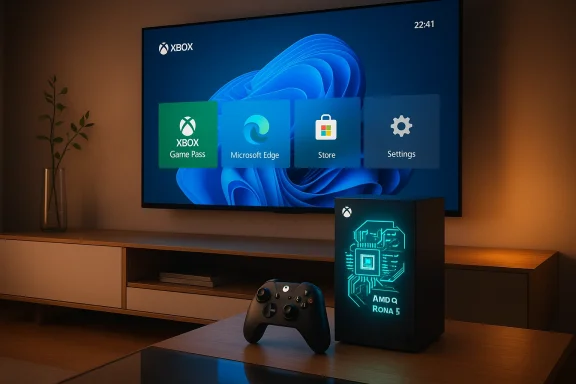
For several months the narrative around Microsoft’s next Xbox has shifted from rumor to an increasingly concrete program: Microsoft appears to be leaning into a strategy that packages a TV‑first, controller‑centric shell over a full Windows 11 runtime. That approach has been tested publicly on Windows handheld hardware (the ASUS ROG Xbox Ally family) and via Windows 11 features like the Xbox Full Screen Experience (FSE), and recent statements from AMD suggest the silicon roadmap could support a consumer launch as early as 2027.
The Xbox Dev Summit keynote, listed on Microsoft’s GDC schedule and headlined by Jason Ronald (VP of Next Gen), is explicitly framed as “Building for the Future with Xbox” and is timed for 10:10am on Wednesday, March 11. That makes the session the natural stage for Microsoft to translate executive teasers and engineering groundwork into a developer‑facing roadmap, with practical guidance about how studios should prepare for the platform.
That summary aligns with Microsoft’s own GDC programming and with wider coverage of AMD’s comment that development of a semi‑custom SoC for Microsoft is “progressing well to support a launch in 2027.” The combination of (a) Microsoft’s public testing of the FSE on retail handhelds, (b) an explicit Xbox Dev Summit keynote and sessions at GDC, and (c) AMD’s timeline comments form the principal evidence chain reporters are using to argue this is Microsoft’s strategic direction.
Key business considerations
But there are real execution risks:
Developers should attend the March 11 session expecting strategic framing and practical guidance; journalists and analysts should watch for the specific technical commitments that will turn credible leaks and supplier timelines into a concrete product plan. Until Microsoft publishes final specifications and a clear policy framework, treat leaked hardware figures and launch dates as directional signals rather than immutable facts.
Source: TechPowerUp Xbox Dev Summit Will Include "Next Generation" Console Talk on March 11 | TechPowerUp}
 Background / Overview
For several months the narrative around Microsoft’s next Xbox has shifted from rumor to an increasingly concrete program: Microsoft appears to be leaning into a strategy that packages a TV‑first, controller‑centric shell over a full Windows 11 runtime. That approach has been tested publicly on Windows handheld hardware (the ASUS ROG Xbox Ally family) and via Windows 11 features like the Xbox Full Screen Experience (FSE), and recent statements from AMD suggest the silicon roadmap could support a consumer launch as early as 2027.The Xbox Dev Summit keynote, listed on Microsoft’s GDC schedule and headlined by Jason Ronald (VP of Next Gen), is explicitly framed as “Building for the Future with Xbox” and is timed for 10:10am on Wednesday, March 11. That makes the session the natural stage for Microsoft to translate executive teasers and engineering groundwork into a developer‑facing roadmap, with practical guidance about how studios should prepare for the platform.
What the TechPowerUp report says — a short, verified summary
TechPowerUp reported that the Xbox Dev Summit will iosoft’s next‑generation console on March 11, describing the event as an opportunity for Xbox to present new hardware and platform direction to developers. The article situates that news within the broader stream of leaks and Microsoft signals claiming the next Xbox may be a Windows‑rooted device that defaults to a console‑like UX but exposes a full Windows experience underneath for power users and third‑party storefronts.That summary aligns with Microsoft’s own GDC programming and with wider coverage of AMD’s comment that development of a semi‑custom SoC for Microsoft is “progressing well to support a launch in 2027.” The combination of (a) Microsoft’s public testing of the FSE on retail handhelds, (b) an explicit Xbox Dev Summit keynote and sessions at GDC, and (c) AMD’s timeline comments form the principal evidence chain reporters are using to argue this is Microsoft’s strategic direction.
Why March 11 matters: dev outreach, optics, and timing
Microsoft chose GDC and the Xbox Dev Summit as the venue for a reason. GDC is where developers gather to evaluate platform tools, engine support, and certification pipelines. By placing a next‑gen console talk at 10:10am on March 11, Microsoft signals this is primarily a developer conversation — not a consumer marketing reveal — and that the company intends to bring third‑party studios and middleware partners into the planning conversation early.- Developers need early clarity about operating system behavior (Windows‑rooted console vs. bespoke Xbox OS), store policies (how Game Pass, Microsoft Store, Steam, Epic, etc. will be treated), and anti‑cheat/DRM expectations.
- An early developer‑focused announcement reduces porting friction and helps studios decide whether to optimize for a console shell, a Windows runtime, or both.
- Putting the talk at GDC rather than at a consumer show lowers marketing risk; technical audiences can ask the tough questions that shape tooling and certification.
Technical posture: what Microsoft has already shipped and what it implies
Microsoft and partners have already shipped key building blocks that make a Windows‑rooted console concept plausible:- Xbox Full Screen Experience (FSE): Launched initially on the ASUS ROG Xbox Ally and Ally X handhelds, FSE provides a controller‑first, console‑style UI that can be set as the device’s boot posture and that defers background Windows services to prioritize game performance. Microsoft has been expanding FSE availability into Windows Insider builds and more Windows 11 form factors.
- ASUS ROG Xbox Ally family: These retail handhelds demonstrate a practical engineering model: ship Windows 11 as the base OS, layer a controller‑optimized Xbox UI on top, and provide a way to “exit” to full Windows when needed. The Ally devices have been a visible testbed for the model’s UX and technical trade‑offs.
- Microsoft–AMD co‑engineering: Microsoft and AMD publicly announced a multi‑year collaboration to co‑design semi‑custom silicon for consoles and complementary devices. AMD’s recent earnings call comment that the semi‑custom SoC development is “progressing well to support a launch in 2027” is the most concrete timeline signal to date.
The leaked hardware picture — what’s claimed, what’s plausible, and what’s unverifiable
A large set of hardware leaks — most prominently a Moore’s Law Is Dead (MLID) package summarized by multiple outlets — claim Microsoft’s next SoC (codenamed Magnus in leaks) will be a very large, high‑power AMD semi‑custom APU featuring RDNA 5 GPU blocks, Zen 6 CPU cores in hybrid configuration, a wide GDDR7 memory bus, and an on‑chip NPU. Reported headline figures across those leaks include:- Up to 68 RDNA 5 Compute Units (CUs) on the GPU die.
- A hybrid CPU cluster (3 large Zen 6 cores + 8 Zen 6c cores).
- A 192‑bit memory bus and leak figures as high as 48 GB GDDR7 cited in some reports.
- An on‑die NPU in leak estimates up to ~110 TOPS for higher power states.
- Die size and TDP estimates that place the device at the high end of console power envelopes.
- These numbers originate from leaks and third‑party analysis, not from AMD or Microsoft product specifications. Treat the detailed CU counts, memory sizes, and TOPS figures as plausible rumor rather than confirmed fact. Multiple outlets have reprinted the leak, but AMD has not confirmed specific technical counts in public investor materials.
- The key, verifiable, and meaningful signal is AMD’s stated readiness and the strategic partnership with Microsoft — i.e., supplier readiness to support a 2027 window — not the precise CU or memory numbers. Public AMD commentary is a strong timeline indicator; leaked CU counts should be used to understand potential performance direction, not to assume final SKU specs.
- Historically, leaks change during validation and yield optimization; final shipping SKUs often differ in clock rates, enabled units, and memory configurations. Expect more conservative shipping numbers than the most optimistic leak screenshots unless Microsoft and AMD publish exact specs. Flag: speculative.
Platform and ecosystem implications for developers
If Microsoft ships a living‑room device that is fundamentally a Windows 11 PC under a console shell, the implications are broad and complex:Positives
- Reduced porting friction: Native Windows underpinnings would make it simpler to move PC titles to the living room without deep console rework, potentially accelerating cross‑platform releases.
- Tooling harmonization: Game engines and middleware that already target Windows can more easily support the console‑style UX and controller‑first flows.
- Store flexibility: A Windows root could, in principle, allow multiple storefronts to operate on the device (subject to DRM/anti‑cheat and policy constraints).
- Power features: Larger RAM budgets and on‑chip NPUs could enable OS‑level AI upscaling, improved background services, and richer cloud/edge integrations.
Risks and developer headaches
- Update complexity: Windows’ patch cadence and optional background services are not the same as a closed console’s tightly controlled update pipeline. Microsoft must ensure OS updates don’t destabilize a living‑room experience — a historically hard problem.
- Anti‑cheat and DRM fragmentation: PC storefronts and games use a range of anti‑cheat and DRM systems; coordinating these within a single device that sometimes hides the desktop could introduce reliability and policy frictions.
- Performance predictability: Console developers expect a fixed target hardware and OS environment. Even small degrees of background variance from a Windows runtime could complicate certification or optimization if Microsoft doesn’t tightly lock down the default console posture.
- Pricing and adoption: Higher BOM for more memory, larger SoCs, and NPUs likely pushes retail price higher — potentially into a premium tier. That narrows early adopters and could fragment the market if multiple SKUs are needed. Leaked price estimates range widely; treat them with skepticism.
Business strategy and competitive context
Microsoft’s move — if executed as reported — would be strategically consistent with a multi‑device, service‑first posture designed to maximize Game Pass reach and to leverage Microsoft’s Windows assets. It transforms the console from a closed hardware wallet into an entry point to a broader PC ecosystem while maintaining mainstream simplicity through the Xbox shell.Key business considerations
- Revenue mix: Microsoft needs hardware to be profitable at scale or to drive services revenue that offsets premium BOMs. The higher the launch price, the more Microsoft will depend on subscriptions and cross‑platform sales to drive lifetime value. Recent internal pressure for higher margins is part of the context behind Xbox’s overall strategy.
- Retail and channel planning: Retailers will need SKU differentiation — console bundles for casual buyers, PC‑style bundles for power users — which complicates distribution and inventory. Microsoft historically favored clarity; this model forces a more segmented retail approach.
- Regulatory and platform policy: A Windows‑rooted box that can run third‑party stores invites scrutiny about store access, platform fees, and competition. Microsoft’s promise of openness must square with contractual and technical constraints around anti‑cheat and platform services.
What to expect at Xbox Dev Summit on March 11
Developers attending the Xbox Dev Summit should expect a mix of strategic framing and technical detail. Reasonable expectations for the session include:- A clear statement of platform posture: Is the living‑room device Windows‑rooted by default, or will it run a bespoke Xbox OS? Expect Microsoft to articulate the default UX (FSE) and the “exit to Windows” scenario if the hybrid model is real.
- Tooling and SDK updates: Guidance on performance targets, driver models, and how the Xbox PC app will aggregate storefronts and installs. Expect practical sessions on porting and certification workflows.
- Answers (or at least frameworks) for anti‑cheat, DRM, and store interoperability: Developers will demand specifics on how Steam, Epic, and other storefronts behave when launched, especially in multiplayer and competitive contexts.
- Roadmap signals: Microsoft may be cautious about consumer launch dates, but could reiterate partner timelines and confirm that AMD and Microsoft engineering are aligned on a multi‑year plan. Public AMD comments supporting a 2027‑era readiness make a timeline discussion likely.
Practical advice for developers and studios
If you are a studio planning for this platform shift, take these pragmatic steps now:- Inventory assumptions: Catalog any OS‑level dependencies, anti‑cheat hooks, and native integrations that your game or tools assume on Windows or consoles.
- Test with FSE now: Use the Xbox Full Screen Experience on Windows Insider builds and on devices like the ROG Xbox Ally to understand controller navigation, lifecycle behavior, and resource management.
- Plan for multiple distribution paths: Architect your packaging and update systems to be resilient across Microsoft Store / Game Pass, Steam, Epic, and other stores.
- Engage with the Xbox dev program: Attend Xbox Dev Summit sessions, follow the new documentation, and ask direct questions about certification and OS updates.
- Budget for QA across modes: If the device supports both console‑style and full Windows operation, add QA cycles for both UX flows and for hot‑swap behavior between them.
Strengths, risks, and where Microsoft must prove itself
This strategy has clear strengths: it leverages Microsoft’s unique ownership of Windows and a powerful silicon partner in AMD; it could dramatically simplify developer workflows and expand consumer choice; and it positions Xbox to benefit from both console simplicity and PC openness.But there are real execution risks:
- Reliability vs. openness: Delivering a turn‑on‑and‑play console experience while preserving Windows flexibility is an engineering balancing act. Users expect consoles to “just work” — any failure here will hurt trust.
- Policy and ecosystem friction: Anti‑cheat, competing store economics, and platform governance will be politically fraught. Microsoft must publish clear policies to avoid fragmentation and developer frustration.
- Pricing: Higher BOM will push retail price upwards, limiting mainstream adoption. Microsoft must justify premium pricing with clear value (exclusive features, performance, and Game Pass economics).
- Leak vs. fact: Many of the most exciting hardware numbers come from leaks; Microsoft and AMD still control the final narrative. Treat leaked spec sheets as directional, not definitive.
Final assessment and why the March 11 session matters
The March 11 Xbox Dev Summit session is more than calendar theatre; it is Microsoft’s opportunity to convert a smear of leaks, partner comments, and platform experiments into a coherent developer platform story. For the strategy to succeed, Microsoft must:- Be transparent about the OS and update model developers will face.
- Provide concrete SDKs, memory and performance budgets, and anti‑cheat guidance.
- Clarify store interoperability and certification lanes for third‑party storefronts.
- Demonstrate realistic timelines that match AMD’s supplier readiness while acknowledging the difference between supplier readiness and retail commitment.
Conclusion
Microsoft’s Xbox Dev Summit keynote on March 11 is poised to be a pivotal moment in the platform’s trajectory. The company has already shipped the foundational technology (Xbox Full Screen Experience on Windows handhelds) and has public partner signals (AMD’s readiness comments) that make a Windows‑rooted, console‑skinned next Xbox plausible. The real question is whether Microsoft can deliver the developer tooling, update discipline, and platform policy clarity needed to make a hybrid console both compelling and reliable.Developers should attend the March 11 session expecting strategic framing and practical guidance; journalists and analysts should watch for the specific technical commitments that will turn credible leaks and supplier timelines into a concrete product plan. Until Microsoft publishes final specifications and a clear policy framework, treat leaked hardware figures and launch dates as directional signals rather than immutable facts.
Source: TechPowerUp Xbox Dev Summit Will Include "Next Generation" Console Talk on March 11 | TechPowerUp}
