

Xbox’s new boss has just given the clearest signal yet that Microsoft’s long experiment with turning first‑party Xbox titles into multiplatform releases isn’t unconditional — and that the company may be willing to walk parts of that back if the data, strategy, or business case demands it.
For nearly a quarter of a century, the idea of platform exclusives was central to console identity. Microsoft’s Xbox built cultural and commercial cachet on tentpole franchises — Halo, Gears of War, Forza among them — that helped justify buying Xbox hardware and created a distinct ecosystem for players and developers alike. In recent years, Microsoft’s approach shifted: blockbuster first‑party titles and many future releases were announced for Xbox, Windows PC, and, increasingly, PlayStation 5 and other platforms. That change flipped the old exclusivity calculus and provoked a broad debate across players, developers, and investors about what “value” a console should deliver.
The most visible signal of this strategy shift came during and after the Xbox Developer Direct and related showcases when Microsoft confirmed multiple high‑profile first‑party games were headed to PS5 as well as Xbox and PC — among them entries like Forza Horizon, Fable, and even a Halo remake — a move that erased long‑standing assumptions about what “exclusive” meant on Xbox. That commercial pivot has been defended internally as a scale play: broader distribution drives higher lifetime value across a game’s audience, bolsters Game Pass subscriptions, and feeds cloud and PC storefront engagement. But it has also left core console fans asking whether owning Xbox hardware still carries unique, must‑have value.
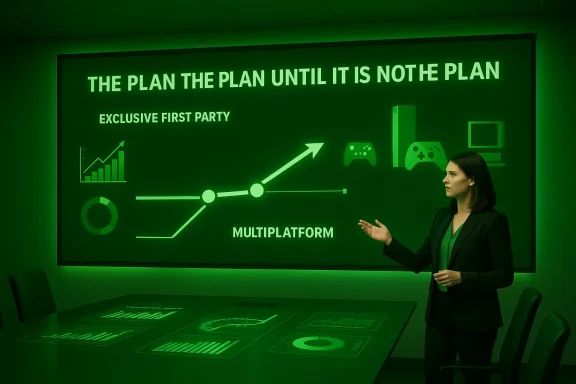
Into that debate steps Asha Sharma, Microsoft’s newly appointed head of Microsoft Gaming, whose early public comments have immediately become a touchstone for the question of whether exclusivity is dead, or simply evolving. In a recent interview with Windows Central she did not rule out a return to some form of exclusivity, and she said she was still learning the “why” behind previous decisions and would evaluate them with a focus on lifetime value. Her turn of phrase was arresting: “The plan’s the plan until it’s not the plan.” That sentence — quoted verbatim and widely republished — is now being read as an opening for strategy reversal.
Put plainly: when hardware revenue falls and content revenue is uneven, executives will reassess which levers should be pulled to boost device attach, customer lifetime value, and long‑term growth. That is exactly the context Sharma described when she said she was looking at “lifetime value” and wanting to understand the “why” of prior decisions.
Expect:
For Microsoft the core task is to reconcile three competing imperatives:
This moment is a rare one for Xbox: a new leader, measurable financial tensions, and a public conversation about the meaning of exclusives. The decisions Asha Sharma makes in the coming months — and how transparently Microsoft explains the metrics behind them — will determine whether Xbox’s next chapter is a pragmatic revival or a course correction that leaves fans and partners frustrated.
Conclusion
Executives rarely speak in absolutes, but language matters — and when the new head of Xbox says “the plan’s the plan until it’s not the plan,” she gives the company permission to rethink one of gaming’s oldest rules. The sensible route for Microsoft is exactly what Sharma described: learn, measure lifetime value, test carefully, and only then change course. That process will take time, and it will force trade‑offs across hardware, subscriptions, and developer partnerships. The outcome will shape not only what’s on your living‑room shelf next holiday season, but how console identity and platform economics evolve across the next generation of gaming.
Source: Windows Central Xbox’s stance on exclusives is changing — and “the plan” might too
 Background / Overview
For nearly a quarter of a century, the idea of platform exclusives was central to console identity. Microsoft’s Xbox built cultural and commercial cachet on tentpole franchises — Halo, Gears of War, Forza among them — that helped justify buying Xbox hardware and created a distinct ecosystem for players and developers alike. In recent years, Microsoft’s approach shifted: blockbuster first‑party titles and many future releases were announced for Xbox, Windows PC, and, increasingly, PlayStation 5 and other platforms. That change flipped the old exclusivity calculus and provoked a broad debate across players, developers, and investors about what “value” a console should deliver.The most visible signal of this strategy shift came during and after the Xbox Developer Direct and related showcases when Microsoft confirmed multiple high‑profile first‑party games were headed to PS5 as well as Xbox and PC — among them entries like Forza Horizon, Fable, and even a Halo remake — a move that erased long‑standing assumptions about what “exclusive” meant on Xbox. That commercial pivot has been defended internally as a scale play: broader distribution drives higher lifetime value across a game’s audience, bolsters Game Pass subscriptions, and feeds cloud and PC storefront engagement. But it has also left core console fans asking whether owning Xbox hardware still carries unique, must‑have value.
Into that debate steps Asha Sharma, Microsoft’s newly appointed head of Microsoft Gaming, whose early public comments have immediately become a touchstone for the question of whether exclusivity is dead, or simply evolving. In a recent interview with Windows Central she did not rule out a return to some form of exclusivity, and she said she was still learning the “why” behind previous decisions and would evaluate them with a focus on lifetime value. Her turn of phrase was arresting: “The plan’s the plan until it’s not the plan.” That sentence — quoted verbatim and widely republished — is now being read as an opening for strategy reversal.
What Asha Sharma actually said — context and reading the quote
The quote, explained
When pressed about whether Xbox might return to exclusive first‑party releases, Sharma said she needed to “learn, candidly” about the reasons and trade‑offs behind earlier decisions, what metrics were being optimized, and how to measure lifetime value rather than short‑term efficiencies. Then she added, “The plan’s the plan until it’s not the plan.” That sentence is not a policy announcement; it is an executive framing device. But its directness — and the fact it came so early in her tenure — is unusual, and industry outlets copied the line almost instantly.How to read it
There are three practical readings of Sharma’s words:- She is buying time and signalling openness: Sharma is publicly signalling that the company’s strategy is not etched in stone and that she will evaluate the data and trade‑offs before committing to a course. That’s corporate prudence.
- She is recalibrating expectations for players and partners: the phrasing gives both internal teams and external audiences permission to expect change, while explicitly avoiding a sudden about‑face. In other words, it’s a hedge rather than a switch.
- She is telegraphing leverage in negotiations: the line allows Microsoft to keep flexibility as it calculates what returning certain franchises to a console‑only footing might do for hardware sales, Game Pass economics, partner relationships, and regulatory optics. That can signal to Sony, third‑party partners, and Microsoft’s own studios that platform allocation is a re‑negotiable lever.
Why exclusives matter: the economic and cultural case
The business rationale for exclusives
Historically, exclusives have performed three distinct functions:- Device demand: Exclusives create reasons for consumers to buy or stick with a particular console, boosting hardware lifecycle sales and margins.
- Brand identity and customer loyalty: Flagship franchises become shorthand for a platform’s personality and community.
- Developer leverage and long‑term monetization: Platform owners can shape release cadence, monetization windows, and technical integration in ways that optimize both user experience and back‑end economics.
The counterargument: scale, Game Pass, and cross‑platform economics
Microsoft’s defenders point to a different calculus. By expanding the reach of first‑party games to PS5 and other platforms, Microsoft can:- Tap a larger addressable market, increasing total lifetime player numbers and bringing more gamers into associated ecosystems.
- Turn premium first‑party launches into subscriber drivers for platforms where Microsoft also sells services (e.g., PC storefronts, Game Pass on PC, and cloud streaming).
- Reduce single‑platform dependency risk: spreading releases makes a game less vulnerable to a console’s market fluctuations.
Evidence Microsoft’s strategy is under financial pressure
No single executive quote exists in a vacuum: Sharma inherited a business unit operating inside a company that is itself balancing explosive cloud and AI growth against uneven hardware and gaming results. Over the last several quarters Microsoft’s gaming figures have shown a recurring pattern: Xbox hardware revenue has declined substantially, while Xbox content and services has fluctuated, in part due to the Activision Blizzard acquisition baseline effect and uneven release cadence for first‑party titles. Several financial summaries and reporting outlets document measurable hardware declines (declines in the high‑tens to low‑thirties percent range in recent quarters) and a softer, bumpier trajectory for content and services than Microsoft likely hoped. Those trends are the pragmatic backdrop for the current strategic conversation.Put plainly: when hardware revenue falls and content revenue is uneven, executives will reassess which levers should be pulled to boost device attach, customer lifetime value, and long‑term growth. That is exactly the context Sharma described when she said she was looking at “lifetime value” and wanting to understand the “why” of prior decisions.
The technical and organizational constraints of reversing course
Even if leadership decides to move back toward exclusivity, the practicalities are non‑trivial.Development pipelines and porting economics
Many of the games now planned for multiple platforms were designed and budgeted with multiplatform releases in mind. Reversing that midstream can:- Require rearchitecting code and pipelines that were built to be portable.
- Raise contractual and legal complexity if studios, partners, or external publishers were promised or budgeted around multiplatform windows.
- Increase overall costs, because true platform‑first optimization typically demands extra QA, bespoke platform integrations, and sometimes content differences that were explicitly avoided during a port‑centric architecture.
Opportunity cost and investor expectations
Shifting back to exclusivity could boost hardware sales in the short term, but it risks reducing total available market and limiting long‑tail revenue on non‑Xbox platforms. Investors who have priced Microsoft’s gaming franchise partly on scale and content monetization might balk at a step that reduces addressable players — at least until Microsoft articulates a convincing alternate plan for sustained revenue growth. The company’s broader pivot to cloud and AI also means capital and mindshare are being allocated across competing priorities, not just consoles.Studio relations and morale
Many Microsoft studios have now worked in a multiplatform framework and in some cases partnered with external porting houses. A sudden doctrinal change could strain relationships with teams and third‑party partners who had already aligned roadmaps to the new normal. Studios need stable expectations to make multi‑year creative investments; strategy whiplash is expensive.What returning to exclusives could look like — realistic scenarios
If Microsoft chooses to move toward more platform‑centric releases, the company has several practical levers it can pull. Each option carries different upside and risk.1) Selective exclusivity for platform identity titles
Microsoft could designate a small subset of franchises as “console‑first” or “console‑exclusive” for a generation. Think of Halo or Gears as identity titles that land first (and maybe only) on Xbox and Game Pass, while other properties remain multiplatform. This preserves a reason to buy hardware while keeping broader distribution for other franchises. It’s the least disruptive option and the one most aligned to brand management.2) Timed exclusivity and staggered windows
A common middle ground is timed exclusivity: Xbox gets a 6–12 month window of exclusive access, after which the game ships on other platforms. That model preserves initial device demand while enabling long‑term scale. Timed windows also create negotiation leverage with retailers and marketing partners. Sony and other platform holders have used similar mechanics to protect launches while ultimately broadening reach.3) Platform‑first technical differentiation
Even without full exclusivity, Microsoft could create platform incentives that make the Xbox version the “definitive” one: exclusive content, earlier DLC, advanced features tied to Xbox hardware, or integrations with PC and cloud services that are unavailable elsewhere. This retains some unique benefits for buyers of Xbox hardware without fully walling off the games.4) Hardware renaissance + ecosystem bundling
Sharma’s public line about “returning to Xbox” explicitly included hardware: she said the return would “start with console, that starts with hardware” and promised more investments and announcements. If Microsoft invests in a new hardware cycle — premium revisions, a handheld or hybrid Xbox powered by Windows, or differentiated bundles (hardware + long Game Pass windows) — that could restore the console’s exclusive draw even if some content remains multiplatform later. This is the highest cost but potentially the highest brand payoff.Developer and partner considerations: what studios will want
Studios and independent developers care about predictability, economics, and tools. If Microsoft pivots back toward exclusivity, studios will watch for:- Clear contractual terms that protect creators’ revenue and IP.
- Funding commitments and marketing support that justify keeping a title exclusive.
- Technical support and investment for next‑gen Xbox features that justify the integration burden.
- Transparent roadmaps for Game Pass monetization, royalties, and post‑launch live services.
Consumer calculus: why own an Xbox in a world of ports?
For many players the decision to buy a console depends on more than exclusives. The Xbox proposition still includes:- Game Pass as a high‑value content subscription with day‑one releases.
- Backward compatibility and access to decades of digital purchases and saves.
- Hardware features (controllers, performance, unique integrations) and ecosystem conveniences.
- Cloud streaming and cross‑save continuity across Xbox, PC, and mobile.
Strategic recommendations — how Microsoft could navigate this safely
If the goal is to boost both hardware demand and long‑term player lifetime value, Microsoft’s leadership should consider a phased, data‑driven approach — precisely what Asha Sharma signalled she intends to do. A practical framework:- Commit to a transparent review: publish an interim strategic framework and timeframe for decisions so studios, partners, and players know what to expect.
- Protect identity franchises: designate a small, defensible slate of platform‑first launches for the near term to re‑establish differentiation without tearing up existing contracts.
- Use timed exclusivity deliberately: pair initial exclusive windows with aggressive Game Pass promotion, technical differentiation, and clear post‑window plans.
- Invest in hardware that supports ecosystem moves: if Microsoft wants consoles to matter again, put its money into a hardware roadmap that makes owning an Xbox demonstrably superior for the company’s target gamers.
- Improve developer economics and transparency: better revenue share, clearer post‑launch royalty models, and predictable funding will make exclusivity more attractive to creators.
- Measure, iterate, and publish results: track attach, retention, subscription uptake, and revenue per user publicly where possible to justify decisions to investors and the community.
Risks and side‑effects Microsoft must manage
Returning to more exclusivity carries clear downsides:- Brand damage on platforms where Microsoft previously signalled openness.
- Short‑term revenue loss from excluding large installed bases on rival hardware.
- Regulatory and competitive scrutiny: platform moves that lock content can attract antitrust attention in some jurisdictions.
- Internal frictions and talent flight if the change is abrupt or poorly communicated.
What the near term will likely look like
Short of a dramatic, public reversal, the likeliest near‑term outcome is a calibrated strategy that preserves Microsoft’s multiplatform relationships where they clearly increase total value while reserving the right to make select titles feel “exclusive enough” to matter for hardware buyers.Expect:
- More nuance in announcements: “console‑first,” “timed exclusivity,” or “platform‑definitive” language instead of binary exclusive/non‑exclusive headlines.
- Continued investments in hardware messaging and incremental announcements that aim to rebuild the Xbox as a living‑room anchor. Sharma has explicitly promised “more about that soon” on hardware.
- A sustained emphasis on Game Pass and cloud as strategic levers: even if some titles return temporarily to exclusivity, Game Pass will remain the core vehicle to monetize scale and capture lifetime value.
Final assessment: pragmatic revival, not a magical reversal
Asha Sharma’s line — “the plan’s the plan until it’s not the plan” — is both an honest executive hedge and a strategic opening. It does not by itself undo years of organization, contracts, and public signaling. It does, however, mean Microsoft’s Playbook is under active review and that exclusivity remains a live policy lever.For Microsoft the core task is to reconcile three competing imperatives:
- Build hardware and a platform identity that still gives players a reason to buy.
- Preserve the reach and revenue growth unlocked by multiplatform distribution and Game Pass.
- Maintain developer goodwill and predictable economics.
This moment is a rare one for Xbox: a new leader, measurable financial tensions, and a public conversation about the meaning of exclusives. The decisions Asha Sharma makes in the coming months — and how transparently Microsoft explains the metrics behind them — will determine whether Xbox’s next chapter is a pragmatic revival or a course correction that leaves fans and partners frustrated.
Conclusion
Executives rarely speak in absolutes, but language matters — and when the new head of Xbox says “the plan’s the plan until it’s not the plan,” she gives the company permission to rethink one of gaming’s oldest rules. The sensible route for Microsoft is exactly what Sharma described: learn, measure lifetime value, test carefully, and only then change course. That process will take time, and it will force trade‑offs across hardware, subscriptions, and developer partnerships. The outcome will shape not only what’s on your living‑room shelf next holiday season, but how console identity and platform economics evolve across the next generation of gaming.
Source: Windows Central Xbox’s stance on exclusives is changing — and “the plan” might too
