

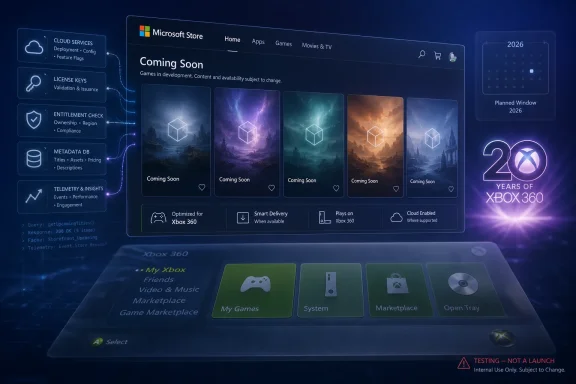
Microsoft is testing previously delisted Xbox 360 game listings in the modern Xbox Store, where some dormant titles have briefly reappeared with “Coming Soon” labels ahead of Xbox’s 25th anniversary plans later in 2026. For players, the practical move is simple: do not treat these listings as purchases, promises, or a finished compatibility rollout yet. For Microsoft watchers, though, the important signal is not the storefront label itself; it is that legacy-game delivery plumbing appears to be moving again after years of backward-compatibility silence.
The immediate story is straightforward. WindowsForum users have been discussing a cluster of delisted Xbox 360-era listings that resurfaced in the Microsoft Store carrying “Coming Soon” tags, a visual cue that naturally triggered speculation about new backward-compatible releases. Microsoft has not announced a new batch of Xbox 360 titles, and the listings should be treated as testing artifacts until the company says otherwise.
That caveat matters because the Xbox Store has a long memory and a messy job. It has to reconcile licenses, historical metadata, entitlement systems, emulator packages, regional availability, achievement records, DLC, age ratings, and platform targeting across multiple generations of hardware. When an old listing reappears, it can be a clerical ghost, a backend test, a mistaken publication, or the first visible edge of a real rollout.
The reason this incident deserves more than a shrug is timing. Microsoft said on March 11, 2026, that it would be “rolling out new ways to play some of the most iconic games from our past” as part of Xbox’s 25th anniversary later this year. That phrase was broad enough to cover many things, but narrow enough to make every legacy-catalog movement look newly significant.
The safest read is this: Microsoft appears to be testing some part of its legacy content pipeline, but the public evidence does not yet prove a new backward-compatibility wave. The more interesting read is that Microsoft may be preparing the store, entitlement, and platform layers that would make such a wave possible.
Microsoft kept backward-compatible Xbox 360 games available for purchase through the modern Microsoft Store on Xbox One and Xbox Series X|S. That split is crucial. The 360-era storefront died; the compatibility catalog on newer Xbox systems remained alive.
That distinction is why these new “Coming Soon” sightings matter. If delisted 360 games are reappearing in the modern Store, Microsoft is not simply poking at the dead Xbox 360 marketplace. It is touching the surviving channel through which legacy games can still be sold, licensed, downloaded, and played on current hardware.
For WindowsForum readers, this is the practical baseline. If you already own a supported backward-compatible Xbox 360 game, you should still expect to access it through your account library on modern Xbox consoles. If a delisted game appears with a “Coming Soon” tag, you should not assume you can buy it, preload it, or play it until Microsoft flips the real availability switch.
The difference between nostalgia and infrastructure is the heart of the story. A nostalgic announcement says, “Here are some old games.” An infrastructure move says, “Here is a way to keep old games flowing through modern devices.” The Store behavior points more toward the second category.
That silence changed the meaning of every little signal. In an active program, a Store placeholder is just noise. In a dormant program, a Store placeholder becomes a flare.
Microsoft trained its audience to pay attention to backward compatibility because it once made the feature central to Xbox’s identity. The company used compatibility to soften generational breaks, preserve purchases, and distinguish Xbox from a console market that too often treated old libraries as collateral damage. When that pipeline stopped expanding, fans did not stop caring; they simply stopped expecting movement.
Now Microsoft has given them a reason to look again. The anniversary promise about “iconic games from our past” is not a formal backward-compatibility announcement, but it is a deliberate bit of corporate foreshadowing. Pair that with delisted 360 listings surfacing in the modern Store, and the speculation becomes less random than it first appears.
The old catalog is not merely sentimental content. It is a strategic asset. In a hardware market where Microsoft is increasingly talking about Xbox as an ecosystem rather than a single box under the TV, old games become a way to make that ecosystem feel continuous.
But Microsoft’s harder problem may be less cinematic: entitlement. Who owns what? Which SKU maps to which license? Does a disc grant access? Does a digital purchase from 2010 still attach cleanly to a modern account? Can DLC be sold separately? Can a game be available in one region and not another without breaking the Store?
Those questions are why a “Coming Soon” label on a delisted game can be more revealing than a leaked screenshot of a game running. The Store is where rights, commerce, metadata, age ratings, platform targeting, and user ownership all converge. If Microsoft is testing old listings, it may be testing the part of the system that decides whether a legacy game can be delivered legally and reliably.
That also explains why any return would likely be selective. Microsoft cannot simply wave a wand over the entire Xbox 360 catalog. Some games have expired music licenses, abandoned publishers, middleware dependencies, delisted DLC, or legal baggage that makes re-release difficult. The technical ability to run a game is only one piece of the puzzle.
This is where enthusiasts should temper expectations. A new backward-compatibility wave, if it happens, may not mean hundreds of games. It may mean a curated batch of titles whose rights, store pages, emulator profiles, and compatibility wrappers can be made to line up.
But the sharper strategic angle points beyond the console. Microsoft has spent years making Xbox less dependent on one living-room device, and legacy games become more valuable if they can travel across console, PC, cloud, and handheld form factors. A backward-compatible title that only lives on Series X|S is preservation. A backward-compatible title that follows an account across devices is platform glue.
That is why the Windows angle keeps surfacing in community discussion. WindowsForum has already hosted related debate about Xbox classics on Windows PCs and handhelds, and the renewed Store anomalies fit neatly into that broader question. If Microsoft can normalize legacy Xbox delivery through modern Store infrastructure, the long-term target may not be just the console catalog.
This does not mean every Xbox 360 game is about to run natively on Windows PCs. That would be a much larger claim than the evidence supports. But it does mean that the Store layer Microsoft is testing could be relevant to a future where Xbox identity, purchase rights, and compatibility wrappers are less tightly bound to a single console generation.
Handhelds make the idea more urgent. A Windows-based gaming handheld benefits from Steam, Epic, Game Pass, cloud streaming, and local PC games, but Xbox’s own historical catalog remains awkwardly fragmented. If Microsoft wants an Xbox-branded or Xbox-adjacent handheld experience to feel complete, legacy Xbox games are not a luxury; they are part of the brand promise.
That is why this does not look like a simple database accident. It may still be one, but delisted titles are not the easiest place to stumble by chance. Bringing them back into a “Coming Soon” state suggests some kind of interaction with dormant catalog records.
The Store label itself is not proof of intent. Storefronts routinely expose placeholders, hidden products, test entries, and automated metadata before a plan is ready for public consumption. But delisted Xbox 360 games are not ordinary products; they sit at the intersection of nostalgia, licensing, and platform strategy.
If Microsoft is stress-testing the pipeline, delisted games are precisely the kind of material that would reveal weak spots. Can the old product ID be revived? Can the modern Store display the correct platform support? Can the title be blocked from purchase while still visible to testers? Can it be associated with backward-compatibility targeting without confusing users?
This is why the current speculation feels more substantial than a random Store glitch, even if the public facts remain thin. A glitch is usually interesting for a day. A backend test, if that is what this is, points toward a roadmap.
The 20th anniversary in 2021 brought the last major backward-compatibility expansion. That historical symmetry is hard to ignore. Microsoft knows exactly how much goodwill a backward-compatibility announcement can generate, particularly among the players most invested in Xbox as a long-term library rather than a subscription feed.
A 25th anniversary backward-compatibility wave would also let Microsoft reframe the Xbox conversation. The company has spent recent years explaining changing hardware plans, cloud ambitions, Game Pass economics, and a broader multiplatform publishing strategy. Legacy compatibility gives it a simpler message: Xbox is where your gaming past remains playable.
That message matters because trust in digital libraries is fragile. Every store closure teaches users that purchases are not quite the same as possession. Microsoft’s backward-compatibility program has been one of the few counterarguments strong enough to soften that anxiety.
The company does not need to revive every missing game to make the point. It needs enough visible movement to prove the pipeline is not dead.
The same pattern appears across enterprise software. Old applications persist long after their original delivery systems are retired. Users expect entitlements to survive migrations. Administrators need clarity about what is supported, what is merely tolerated, and what disappears when a backend service is shut down.
Xbox backward compatibility is a consumer-facing version of the same lifecycle problem. The original storefront closes, but the user’s identity, purchase history, and access expectations remain. The platform owner then has to decide how much compatibility it is willing to maintain as infrastructure changes around it.
That makes the Store sightings useful as a Microsoft case study. They show how old product records can resurface when backend systems evolve. They also show why public communication matters. A “Coming Soon” badge may be harmless in a test environment, but in a live consumer store it becomes a promise-shaped object.
For admins managing Microsoft ecosystems, the lesson is familiar. The boundary between “retired” and “still accessible through a newer surface” is increasingly important. Whether the asset is a game, an app, a license, or a cloud service, users experience continuity or breakage at the account and delivery layer.
PC complicates everything. Windows is open, varied, driver-dependent, and full of competing storefronts. A tightly controlled console emulator profile does not automatically translate into a clean PC experience. The support matrix becomes harder the moment Microsoft leaves the fixed hardware target of an Xbox console.
Handheld PCs complicate it further. They promise console-like convenience on Windows, but they inherit Windows’ complexity. If Microsoft wants Xbox classics to feel natural on these devices, it has to solve not only emulation but controls, suspend behavior, display scaling, offline licensing, cloud saves, and Store discoverability.
That is why a Store-first signal is so important. Before Microsoft can make legacy Xbox games feel native on new devices, it needs a catalog system that knows what those games are, who owns them, where they are allowed to run, and how they should be presented. The storefront is not the glamorous part of backward compatibility, but it is the part that makes the whole thing commercially real.
If Microsoft is preparing a broader compatibility future, the first public artifacts would look exactly this boring: listings, tags, hidden availability states, and metadata shifting in places only obsessive fans notice.
The public facts support a narrower claim. The Xbox 360 Store is closed. Backward-compatible Xbox 360 games remain purchasable through the modern Store. Microsoft has promised new ways to play iconic older games later in 2026. Some delisted 360 listings have reportedly reappeared with “Coming Soon” tags.
That is enough to justify attention, not enough to justify certainty. The listings could represent active preparation for a new compatibility batch. They could represent Store testing for a smaller anniversary initiative. They could even be artifacts of internal catalog maintenance that never reaches players.
The most likely outcome, if Microsoft is moving, is incremental rather than explosive. Expect selected games, controlled messaging, and careful language around availability. Microsoft has no incentive to imply that every missing Xbox 360 title can return when the rights landscape almost certainly says otherwise.
Players should therefore avoid making purchases, selling discs, or changing library plans based on Store ghosts. Watch for official Xbox announcements, actual product pages with purchase buttons, and clear platform labels. Anything short of that is a signal, not a release.
When users buy digital media, they are betting that platform owners will keep the pipes working. They know, intellectually, that licenses can expire and stores can close. What they want emotionally is continuity: the feeling that a purchase made in one era will not become meaningless in the next.
Microsoft has historically understood that better than most console vendors. Xbox backward compatibility gave the company a pro-consumer argument at moments when it needed one. It made Xbox feel less disposable.
The 360 Store shutdown put that promise under pressure. Microsoft handled the transition better than it might have by keeping compatible titles alive in the modern Store, but the closure still marked a hard limit. Many games outside the compatibility program became harder or impossible to buy.
A renewed compatibility push would not erase that loss. It would, however, tell players that Microsoft still sees value in repairing some of the gaps. In a market increasingly defined by subscriptions and cloud access, that would be a meaningful statement.
The cleanest evidence would be official Xbox messaging paired with live Store pages. A subtler sign would be old purchases mapping correctly to modern libraries before a public announcement. The noisiest sign would be more listings appearing and disappearing without explanation.
For enthusiasts, the smart move is to document without overclaiming. Screenshots, dates, visible labels, and title names are useful. Assertions about Microsoft’s full plan are not, unless Microsoft makes them.
For IT-minded readers, watch the platform labels as closely as the game names. If Microsoft keeps the story console-only, this is a backward-compatibility revival in the familiar sense. If Windows, PC, cloud, or handheld language enters the announcement, the implications become much bigger.
That is the dividing line. A few 360 games returning to Xbox consoles would be welcome. A legacy Xbox delivery system that stretches into Windows and handhelds would be a strategic shift.
The most concrete takeaways are narrow but important:
 A Store Flicker Is Not a Launch, but It Is Not Nothing
The immediate story is straightforward. WindowsForum users have been discussing a cluster of delisted Xbox 360-era listings that resurfaced in the Microsoft Store carrying “Coming Soon” tags, a visual cue that naturally triggered speculation about new backward-compatible releases. Microsoft has not announced a new batch of Xbox 360 titles, and the listings should be treated as testing artifacts until the company says otherwise.That caveat matters because the Xbox Store has a long memory and a messy job. It has to reconcile licenses, historical metadata, entitlement systems, emulator packages, regional availability, achievement records, DLC, age ratings, and platform targeting across multiple generations of hardware. When an old listing reappears, it can be a clerical ghost, a backend test, a mistaken publication, or the first visible edge of a real rollout.
The reason this incident deserves more than a shrug is timing. Microsoft said on March 11, 2026, that it would be “rolling out new ways to play some of the most iconic games from our past” as part of Xbox’s 25th anniversary later this year. That phrase was broad enough to cover many things, but narrow enough to make every legacy-catalog movement look newly significant.
The safest read is this: Microsoft appears to be testing some part of its legacy content pipeline, but the public evidence does not yet prove a new backward-compatibility wave. The more interesting read is that Microsoft may be preparing the store, entitlement, and platform layers that would make such a wave possible.
The 360 Store Died, but the Compatibility Store Survived
The Xbox 360 Store shut down on July 29, 2024. That date closed a major chapter in console history, especially for digital-only Xbox Live Arcade titles and old downloadable content tied to the original 360 marketplace. But it did not kill every Xbox 360 purchase path.Microsoft kept backward-compatible Xbox 360 games available for purchase through the modern Microsoft Store on Xbox One and Xbox Series X|S. That split is crucial. The 360-era storefront died; the compatibility catalog on newer Xbox systems remained alive.
That distinction is why these new “Coming Soon” sightings matter. If delisted 360 games are reappearing in the modern Store, Microsoft is not simply poking at the dead Xbox 360 marketplace. It is touching the surviving channel through which legacy games can still be sold, licensed, downloaded, and played on current hardware.
For WindowsForum readers, this is the practical baseline. If you already own a supported backward-compatible Xbox 360 game, you should still expect to access it through your account library on modern Xbox consoles. If a delisted game appears with a “Coming Soon” tag, you should not assume you can buy it, preload it, or play it until Microsoft flips the real availability switch.
The difference between nostalgia and infrastructure is the heart of the story. A nostalgic announcement says, “Here are some old games.” An infrastructure move says, “Here is a way to keep old games flowing through modern devices.” The Store behavior points more toward the second category.
Microsoft’s Long Silence Made Every Metadata Change Louder
The last major backward-compatibility expansion arrived in November 2021, when Microsoft said the catalog had grown by more than 70 original Xbox and Xbox 360 titles. That update was celebrated because it felt like both a victory lap and an endpoint. Since then, Xbox backward compatibility has remained one of Microsoft’s best platform arguments, but not one of its most visibly active programs.That silence changed the meaning of every little signal. In an active program, a Store placeholder is just noise. In a dormant program, a Store placeholder becomes a flare.
Microsoft trained its audience to pay attention to backward compatibility because it once made the feature central to Xbox’s identity. The company used compatibility to soften generational breaks, preserve purchases, and distinguish Xbox from a console market that too often treated old libraries as collateral damage. When that pipeline stopped expanding, fans did not stop caring; they simply stopped expecting movement.
Now Microsoft has given them a reason to look again. The anniversary promise about “iconic games from our past” is not a formal backward-compatibility announcement, but it is a deliberate bit of corporate foreshadowing. Pair that with delisted 360 listings surfacing in the modern Store, and the speculation becomes less random than it first appears.
The old catalog is not merely sentimental content. It is a strategic asset. In a hardware market where Microsoft is increasingly talking about Xbox as an ecosystem rather than a single box under the TV, old games become a way to make that ecosystem feel continuous.
The Real Test Is Entitlement, Not Emulation
Backward compatibility is often discussed as an emulator problem, because emulation is the most visible technical magic. Can the old game boot? Does it render correctly? Does the input latency feel right? Does the frame rate hold?But Microsoft’s harder problem may be less cinematic: entitlement. Who owns what? Which SKU maps to which license? Does a disc grant access? Does a digital purchase from 2010 still attach cleanly to a modern account? Can DLC be sold separately? Can a game be available in one region and not another without breaking the Store?
Those questions are why a “Coming Soon” label on a delisted game can be more revealing than a leaked screenshot of a game running. The Store is where rights, commerce, metadata, age ratings, platform targeting, and user ownership all converge. If Microsoft is testing old listings, it may be testing the part of the system that decides whether a legacy game can be delivered legally and reliably.
That also explains why any return would likely be selective. Microsoft cannot simply wave a wand over the entire Xbox 360 catalog. Some games have expired music licenses, abandoned publishers, middleware dependencies, delisted DLC, or legal baggage that makes re-release difficult. The technical ability to run a game is only one piece of the puzzle.
This is where enthusiasts should temper expectations. A new backward-compatibility wave, if it happens, may not mean hundreds of games. It may mean a curated batch of titles whose rights, store pages, emulator profiles, and compatibility wrappers can be made to line up.
The Console Story Is Only Half the Story
The obvious audience for any revived Xbox 360 compatibility push is the Xbox Series X|S owner with an old library and a long memory. That user wants more classics to appear in the Store, more discs to authenticate, and more digital purchases to carry forward. For that audience, Microsoft has a clean emotional pitch: your Xbox history still matters.But the sharper strategic angle points beyond the console. Microsoft has spent years making Xbox less dependent on one living-room device, and legacy games become more valuable if they can travel across console, PC, cloud, and handheld form factors. A backward-compatible title that only lives on Series X|S is preservation. A backward-compatible title that follows an account across devices is platform glue.
That is why the Windows angle keeps surfacing in community discussion. WindowsForum has already hosted related debate about Xbox classics on Windows PCs and handhelds, and the renewed Store anomalies fit neatly into that broader question. If Microsoft can normalize legacy Xbox delivery through modern Store infrastructure, the long-term target may not be just the console catalog.
This does not mean every Xbox 360 game is about to run natively on Windows PCs. That would be a much larger claim than the evidence supports. But it does mean that the Store layer Microsoft is testing could be relevant to a future where Xbox identity, purchase rights, and compatibility wrappers are less tightly bound to a single console generation.
Handhelds make the idea more urgent. A Windows-based gaming handheld benefits from Steam, Epic, Game Pass, cloud streaming, and local PC games, but Xbox’s own historical catalog remains awkwardly fragmented. If Microsoft wants an Xbox-branded or Xbox-adjacent handheld experience to feel complete, legacy Xbox games are not a luxury; they are part of the brand promise.
Delisted Games Are the Hardest Test Case
The reappearance of delisted games is especially interesting because delisted software is where digital preservation gets ugly. A game that remains available in the Store is already inside the system. A game that vanished has to be re-qualified for commerce, presentation, purchase, and support.That is why this does not look like a simple database accident. It may still be one, but delisted titles are not the easiest place to stumble by chance. Bringing them back into a “Coming Soon” state suggests some kind of interaction with dormant catalog records.
The Store label itself is not proof of intent. Storefronts routinely expose placeholders, hidden products, test entries, and automated metadata before a plan is ready for public consumption. But delisted Xbox 360 games are not ordinary products; they sit at the intersection of nostalgia, licensing, and platform strategy.
If Microsoft is stress-testing the pipeline, delisted games are precisely the kind of material that would reveal weak spots. Can the old product ID be revived? Can the modern Store display the correct platform support? Can the title be blocked from purchase while still visible to testers? Can it be associated with backward-compatibility targeting without confusing users?
This is why the current speculation feels more substantial than a random Store glitch, even if the public facts remain thin. A glitch is usually interesting for a day. A backend test, if that is what this is, points toward a roadmap.
The 25th Anniversary Gives Microsoft a Deadline and a Stage
Xbox turns 25 later in 2026, and Microsoft has already attached legacy games to that anniversary cycle. That does not guarantee a backward-compatibility announcement, but it gives the company a natural stage for one. Anniversary events are built for catalog memory, brand continuity, and fan-service moments that also serve a strategic purpose.The 20th anniversary in 2021 brought the last major backward-compatibility expansion. That historical symmetry is hard to ignore. Microsoft knows exactly how much goodwill a backward-compatibility announcement can generate, particularly among the players most invested in Xbox as a long-term library rather than a subscription feed.
A 25th anniversary backward-compatibility wave would also let Microsoft reframe the Xbox conversation. The company has spent recent years explaining changing hardware plans, cloud ambitions, Game Pass economics, and a broader multiplatform publishing strategy. Legacy compatibility gives it a simpler message: Xbox is where your gaming past remains playable.
That message matters because trust in digital libraries is fragile. Every store closure teaches users that purchases are not quite the same as possession. Microsoft’s backward-compatibility program has been one of the few counterarguments strong enough to soften that anxiety.
The company does not need to revive every missing game to make the point. It needs enough visible movement to prove the pipeline is not dead.
Why IT Pros Should Care About a Gaming Store Test
At first glance, this looks like consumer gaming gossip. For IT pros and sysadmins, the relevance is broader: Microsoft is testing how legacy software rights, modern identity systems, cloud-backed stores, and heterogeneous devices can work together without breaking user expectations. That is not just an Xbox problem.The same pattern appears across enterprise software. Old applications persist long after their original delivery systems are retired. Users expect entitlements to survive migrations. Administrators need clarity about what is supported, what is merely tolerated, and what disappears when a backend service is shut down.
Xbox backward compatibility is a consumer-facing version of the same lifecycle problem. The original storefront closes, but the user’s identity, purchase history, and access expectations remain. The platform owner then has to decide how much compatibility it is willing to maintain as infrastructure changes around it.
That makes the Store sightings useful as a Microsoft case study. They show how old product records can resurface when backend systems evolve. They also show why public communication matters. A “Coming Soon” badge may be harmless in a test environment, but in a live consumer store it becomes a promise-shaped object.
For admins managing Microsoft ecosystems, the lesson is familiar. The boundary between “retired” and “still accessible through a newer surface” is increasingly important. Whether the asset is a game, an app, a license, or a cloud service, users experience continuity or breakage at the account and delivery layer.
The PC and Handheld Angle Could Redefine Backward Compatibility
Traditional console backward compatibility asks whether a new console can play an old console’s games. Microsoft’s future problem is broader: can Xbox identity make old console games available wherever Xbox now claims to exist? That is a much more ambitious question.PC complicates everything. Windows is open, varied, driver-dependent, and full of competing storefronts. A tightly controlled console emulator profile does not automatically translate into a clean PC experience. The support matrix becomes harder the moment Microsoft leaves the fixed hardware target of an Xbox console.
Handheld PCs complicate it further. They promise console-like convenience on Windows, but they inherit Windows’ complexity. If Microsoft wants Xbox classics to feel natural on these devices, it has to solve not only emulation but controls, suspend behavior, display scaling, offline licensing, cloud saves, and Store discoverability.
That is why a Store-first signal is so important. Before Microsoft can make legacy Xbox games feel native on new devices, it needs a catalog system that knows what those games are, who owns them, where they are allowed to run, and how they should be presented. The storefront is not the glamorous part of backward compatibility, but it is the part that makes the whole thing commercially real.
If Microsoft is preparing a broader compatibility future, the first public artifacts would look exactly this boring: listings, tags, hidden availability states, and metadata shifting in places only obsessive fans notice.
Do Not Buy the Hype Before Microsoft Ships the Bits
There is a trap in every backward-compatibility rumor cycle. Fans jump from “a listing appeared” to “my favorite delisted game is coming back” to “the whole 360 catalog is returning.” That chain is emotionally satisfying and evidentially weak.The public facts support a narrower claim. The Xbox 360 Store is closed. Backward-compatible Xbox 360 games remain purchasable through the modern Store. Microsoft has promised new ways to play iconic older games later in 2026. Some delisted 360 listings have reportedly reappeared with “Coming Soon” tags.
That is enough to justify attention, not enough to justify certainty. The listings could represent active preparation for a new compatibility batch. They could represent Store testing for a smaller anniversary initiative. They could even be artifacts of internal catalog maintenance that never reaches players.
The most likely outcome, if Microsoft is moving, is incremental rather than explosive. Expect selected games, controlled messaging, and careful language around availability. Microsoft has no incentive to imply that every missing Xbox 360 title can return when the rights landscape almost certainly says otherwise.
Players should therefore avoid making purchases, selling discs, or changing library plans based on Store ghosts. Watch for official Xbox announcements, actual product pages with purchase buttons, and clear platform labels. Anything short of that is a signal, not a release.
The Catalog War Is Really a Trust War
Backward compatibility is often framed as a feature comparison. Xbox has it here, PlayStation has it there, Nintendo handles its classics another way, PC has its own messy permanence. But the deeper issue is trust.When users buy digital media, they are betting that platform owners will keep the pipes working. They know, intellectually, that licenses can expire and stores can close. What they want emotionally is continuity: the feeling that a purchase made in one era will not become meaningless in the next.
Microsoft has historically understood that better than most console vendors. Xbox backward compatibility gave the company a pro-consumer argument at moments when it needed one. It made Xbox feel less disposable.
The 360 Store shutdown put that promise under pressure. Microsoft handled the transition better than it might have by keeping compatible titles alive in the modern Store, but the closure still marked a hard limit. Many games outside the compatibility program became harder or impossible to buy.
A renewed compatibility push would not erase that loss. It would, however, tell players that Microsoft still sees value in repairing some of the gaps. In a market increasingly defined by subscriptions and cloud access, that would be a meaningful statement.
The Signal to Watch Is When “Coming Soon” Becomes “Owned”
The next phase of this story will not be decided by screenshots. It will be decided by entitlements. If a delisted Xbox 360 game moves from “Coming Soon” to purchasable, claimable, installable, or playable on modern hardware, then Microsoft has crossed from testing into delivery.The cleanest evidence would be official Xbox messaging paired with live Store pages. A subtler sign would be old purchases mapping correctly to modern libraries before a public announcement. The noisiest sign would be more listings appearing and disappearing without explanation.
For enthusiasts, the smart move is to document without overclaiming. Screenshots, dates, visible labels, and title names are useful. Assertions about Microsoft’s full plan are not, unless Microsoft makes them.
For IT-minded readers, watch the platform labels as closely as the game names. If Microsoft keeps the story console-only, this is a backward-compatibility revival in the familiar sense. If Windows, PC, cloud, or handheld language enters the announcement, the implications become much bigger.
That is the dividing line. A few 360 games returning to Xbox consoles would be welcome. A legacy Xbox delivery system that stretches into Windows and handhelds would be a strategic shift.
The Store Is Whispering Before Xbox Speaks
For now, the useful answer is restrained. The reappearing delisted Xbox 360 listings do not prove that Microsoft is relaunching backward compatibility. They do suggest that Microsoft is touching the systems that would be involved in such a relaunch, and they arrive at a moment when the company has already promised anniversary-era movement around older games.The most concrete takeaways are narrow but important:
- Microsoft has not officially announced a new backward-compatibility batch tied to these Store listings.
- The Xbox 360 Store closed on July 29, 2024, but backward-compatible Xbox 360 games can still be sold through the modern Microsoft Store.
- The last major backward-compatibility expansion was in November 2021, when Microsoft added more than 70 original Xbox and Xbox 360 games.
- Microsoft has said it will roll out new ways to play iconic older games as part of Xbox’s 25th anniversary later in 2026.
- The appearance of “Coming Soon” tags on delisted 360 listings is best read as a backend signal, not a player-facing promise.
- The biggest question is whether any renewed compatibility work remains console-only or expands toward Windows PCs and handhelds.
References
- Primary source: windowscentral.com
- Independent coverage: tomshardware.com
Delisted Xbox 360 games briefly reappear on the Xbox Store — Microsoft prepares backward compatibility revival
Several previously removed titles appeared and vanished within hours.www.tomshardware.com
- Independent coverage: notebookcheck.net
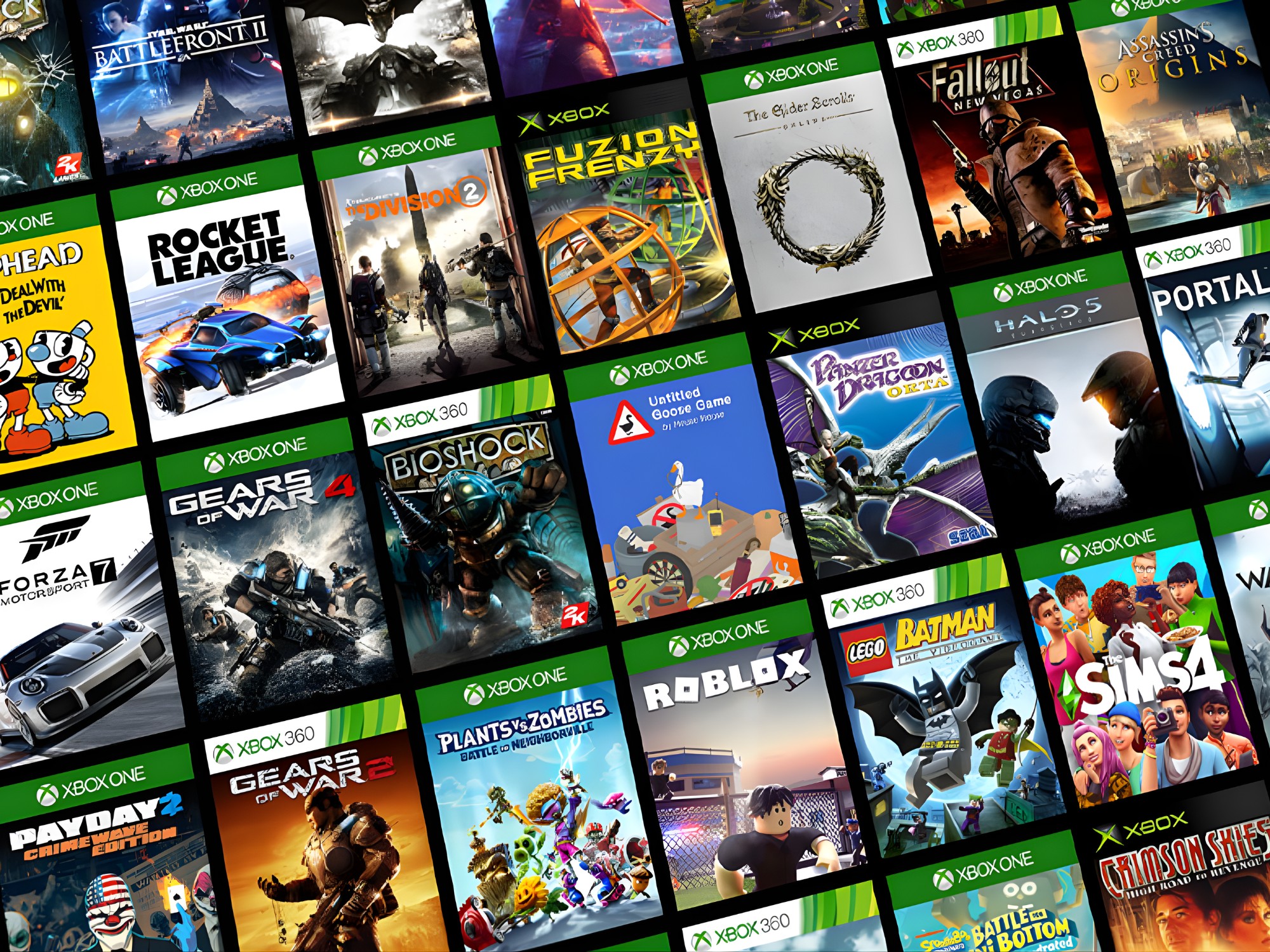
Delisted Xbox 360 games appear on Microsoft Store, hinting at console and PC backward compatibility
Microsoft may reintroduce older Xbox 360 games earlier than expected. Gamers spotted delisted titles with "coming soon" banners appearing on the Microsoft Store. There have been rumors about an Xbox 360 emulator benefiting Windows handhelds and a new Xbox console. www.notebookcheck.net
- Independent coverage: technetbooks.com

Delisted Xbox 360 Games Reappear on Microsoft Store as Coming Soon Sparking Community Speculation
Previously delisted Xbox 360 games are reappearing on the Microsoft Store marked as 'coming soon'. www.technetbooks.com
- Independent coverage: windowsreport.com
- Independent coverage: en.techinbengali.com
Delisted Xbox 360 Games Mysteriously Appear as Coming Soon on Microsoft Store
Several delisted Xbox 360 titles are suddenly showing up as coming soon on the Microsoft Store in certain regions, sparking speculation about a potential return or just another store glitch. en.techinbengali.com

- Independent coverage: escapistmagazine.com
Delisted Xbox 360 games have shown up on Microsoft's store, but why are they "coming soon?" - The Escapist
There were a handful of delisted Xbox 360 games on the Microsoft Store, and they could be "coming soon." Here's what that could mean. www.escapistmagazine.com
- Independent coverage: thegamer.com

Multiple Delisted Xbox 360 Games Have Started Re-Appearing Online
Don't get your hopes up just yet. We've seen similar things happen before. www.thegamer.com
- Independent coverage: purexbox.com
