

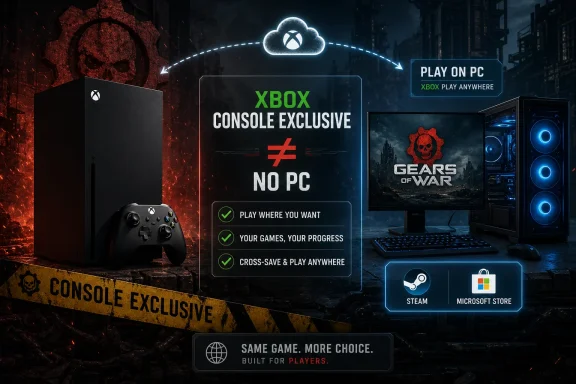
Microsoft’s Xbox leadership has clarified in June 2026 that “Xbox console exclusive” does not mean “not on PC,” with Gears of War: E-Day still planned for PC storefronts and cloud despite being held back from rival consoles. That distinction matters because Xbox has spent years training its audience to think of PC as part of the Xbox business, not a side platform. The panic was understandable, but the correction is revealing: Microsoft is not retreating from PC gaming. It is trying to rebuild the value of owning Xbox hardware without burning down the larger Windows ecosystem that now carries much of its gaming strategy.
The phrase “console exclusive” used to be simple. A game was either on your machine or it was not, and the rest was playground arithmetic. In 2026, Microsoft has made the phrase more complicated because Xbox is no longer only a console business, even when it desperately wants the console to matter again.
That is the tension behind the Gears of War: E-Day messaging. When Asha Sharma presented the game as an Xbox console exclusive, the immediate fear among PC players was that Microsoft was reaching for an older playbook: sell the box first, let the PC version arrive later, and treat Windows players as a secondary market. Matt Booty’s clarification cuts against that reading. Xbox exclusivity, in this case, is about console competition, not a wall between Xbox and PC.
That distinction is not marketing trivia. It is the core of Microsoft’s gaming identity crisis. Xbox wants to give customers a reason to buy Xbox hardware again, but it cannot plausibly pretend that PC is an outsider platform. Windows is Microsoft’s own foundation, Steam is one of the biggest storefronts in gaming, and Game Pass for PC remains one of the few parts of the subscription story that still makes strategic sense.
So the new bargain seems to be this: Xbox may become more selective about PlayStation and Nintendo releases, especially for flagship single-player franchises, but PC remains inside the tent. That is good news for Windows players. It is also the clearest sign yet that Microsoft’s exclusivity reset is not a nostalgic return to the Xbox 360 era so much as a narrower attempt to stop Xbox consoles from becoming ornamental.
That is why the Gears announcement generated confusion so quickly. Xbox has spent the better part of a decade saying that it wants players to access games wherever they are: console, PC, cloud, handheld, and subscription. Then it walked onstage and used the most platform-war-coded term in the industry. The audience heard the old language before Microsoft explained the new grammar.
Booty’s clarification matters because it restores the intended hierarchy. “Xbox console exclusive” appears to mean that the game is exclusive among consoles to Xbox hardware while still coming to PC through Microsoft’s normal channels. In other words, PlayStation is outside the fence; Windows is not. Cloud access also remains part of the distribution picture, which reinforces the idea that Microsoft still sees Xbox as a service layer as much as a device.
But this is still a muddled message. If Microsoft wants to use exclusivity as a strategic tool again, it needs to say exactly what kind of exclusivity it means every time. Console exclusive, timed exclusive, full exclusive, Game Pass day-one, Microsoft Store, Steam, cloud: these are not interchangeable terms. They define whether a game is a hardware seller, a subscription driver, a storefront asset, or simply another multiplatform release with Xbox branding.
That does not mean PC users always get a frictionless experience. The Microsoft Store has a long history of inspiring groans, and the Xbox app on Windows has improved from a rough starting point rather than arriving fully formed. Game Pass for PC has been valuable, but it has also exposed users to the messiness of entitlements, launcher dependencies, install paths, mod support, and cross-store expectations. PC gamers are patient about many things, but they are not sentimental about bad software.
Still, Microsoft has spent years building the assumption that first-party Xbox games arrive on PC at launch. Halo, Forza, Age of Empires, Flight Simulator, Starfield, and other tentpole releases have conditioned Windows players to expect day-one access, often through both Microsoft’s own ecosystem and Steam. Reversing that would be self-sabotage. It would hand Steam-first PC users another reason to distrust Microsoft and weaken Game Pass precisely where the subscription can still feel like a bargain.
Gears of War: E-Day is therefore a test not only of franchise nostalgia, but of whether Xbox can use exclusivity without confusing its most strategically important non-console audience. If the game lands on PC cleanly, on time, and without storefront nonsense, the panic will fade. If messaging stays sloppy, every future Xbox showcase will turn into a forensic exercise in platform wording.
The return of console exclusives fits that larger rescue mission. Xbox hardware has been squeezed between two realities: Sony’s stronger console identity and Microsoft’s own willingness to release more games elsewhere. If every Xbox game is available on PlayStation, and every Xbox service is available on PC or cloud, the console becomes harder to justify beyond habit, controller preference, or library inertia. That is not a healthy place for a hardware platform to live.
But the fix cannot be crude. Microsoft cannot simply slam the door on all rival platforms and pretend the last decade did not happen. It owns too many studios, serves too many communities, and depends too much on recurring revenue from games that thrive through scale. Minecraft, Call of Duty, Diablo, Sea of Thieves, and other service-driven or community-driven games do not benefit from sudden enclosure. They benefit from reach.
That is why a case-by-case approach, however inelegant, is probably inevitable. Single-player prestige games can be used to strengthen Xbox hardware. Live-service titles need broad player pools. PC remains a Microsoft-native destination. The strategy is not simple, but the business is no longer simple either.
That nostalgia cuts both ways. For Xbox console fans, making E-Day a console exclusive signals that Microsoft is willing to protect something for them again. For PlayStation players, it draws a line after a period in which Xbox releases on rival platforms had begun to feel increasingly normal. For PC users, the anxiety comes from remembering when “Xbox” did not always mean “Windows too.”
The smarter interpretation is that Microsoft is trying to make Gears do two jobs at once. It wants the game to be a reason to own or consider an Xbox console, while also preserving the day-one PC availability that now defines Microsoft’s broader publishing model. That is a difficult balance, but not an impossible one. In fact, it may be the only balance that makes sense.
Gears also has practical PC appeal. The series has a long-standing audience among shooter fans, and modern Windows gaming hardware is exactly where a showcase-heavy action game can stretch its legs. Cutting PC out would not just annoy players; it would reduce the game’s technical and commercial surface area. For a franchise trying to return with force, that would be a strange sacrifice.
That is an unhealthy communications environment. It encourages rumor loops, platform-war theatrics, and bad-faith readings because Microsoft has not always been consistent enough to deserve the benefit of the doubt. When a company says “play anywhere” for years and then starts saying “exclusive” again, the burden is on the company to explain the new map.
The industry also has a habit of hiding business decisions behind vocabulary that sounds more precise than it is. “Console exclusive” can mean a lifetime lockout from competing consoles, a timed arrangement, or simply a launch-window distinction. “Available on PC” can mean Steam, Microsoft Store, Epic, Battle.net, or some awkward mixture of launchers and account requirements. “Cloud” can mean access for subscribers, limited regional availability, or a fallback for hardware that cannot run the game locally.
For IT-minded WindowsForum readers, this is familiar territory. Ambiguous product language creates operational risk. Consumers ask whether their platform is supported; administrators ask what devices, accounts, subscriptions, and storefronts are involved; developers ask where the audience actually lives. Xbox’s new strategy needs less vibes and more contract-grade clarity.
That logic helped Microsoft expand Xbox beyond the console. It also weakened the console’s emotional and commercial role. If Xbox is everywhere, then the Xbox console must either become the best way to experience that ecosystem or risk becoming merely one way among many. Sharma’s apparent reset is an attempt to restore some hierarchy without abandoning the reach that Game Pass depends on.
PC is central to that effort. Game Pass for PC gives Microsoft a direct subscription path into Windows gaming, but Steam remains too important to ignore. Releasing first-party games on PC broadly lets Microsoft capture different customer types: subscribers, Steam purchasers, Microsoft Store users, handheld PC owners, and cloud players. That flexibility is a strength, not a weakness.
The danger is that Game Pass can no longer be treated as magic dust. Price cuts may help perception, but the service still depends on a reliable cadence of desirable games. If Xbox exclusives become confusing, delayed, or fragmented by platform, the subscription loses some of its clean proposition. The message has to be boringly dependable: if you are on Xbox console or PC, you are part of the primary launch plan.
If Xbox is serious about serving players wherever they are, handheld PCs are not a side quest. They are a growing proof point that many players want console-like convenience without giving up PC libraries. Microsoft’s challenge is to make Windows feel less like a desktop OS reluctantly squeezed into a portable shell and more like a first-class gaming environment.
That makes day-one PC releases even more important. A Gears of War: E-Day launch that works well across desktop rigs, laptops, and handheld PCs would reinforce the idea that Xbox’s platform is broader than the living room. It would also let Microsoft claim a kind of ecosystem advantage Sony cannot easily match: one game purchase or subscription relationship spanning console, Windows PC, and cloud.
Of course, that only works if the experience is good. PC gamers are less forgiving than console audiences when a port stutters, crashes, ships without sensible settings, or buries users under account prompts. If Xbox wants PC to remain reassured, it cannot merely say the games are coming. It has to ship them well.
This does not mean every Microsoft game will disappear from PlayStation. That would be commercially reckless, especially for franchises with existing cross-platform communities or contractual expectations. The better bet is selective exclusivity: Gears here, perhaps other single-player or brand-defining titles there, while service games and already-multiplatform franchises continue to chase the largest possible audience.
That approach will annoy players who hoped the industry was moving toward fewer platform barriers. It will please Xbox loyalists who felt Microsoft had been giving away the store. Both reactions are rational. Exclusivity is consumer-hostile in the narrow sense that it restricts where a game can be played, but platform holders use it because hardware businesses need differentiation.
The interesting wrinkle is that PC escapes the usual platform-war frame. A Windows release does not undermine Microsoft in the same way a PlayStation release might. It may even strengthen the company’s total gaming position. That is why PC players should see the new exclusivity push less as a threat and more as confirmation that Windows has become part of Xbox’s home territory.
If Xbox leadership is saying the business needs to win players back while also acknowledging overextension, then exclusivity becomes part of a wider attempt to impose discipline. Which games sell hardware? Which games drive subscriptions? Which games justify multiplatform reach? Which teams are making products that fit the new plan? Those are not abstract questions inside a company facing cuts.
For players, this is where optimism should stay measured. Yes, PC support appears safe. No, that does not mean the Xbox roadmap is frictionless. A company can maintain PC releases while still cancelling projects, shrinking teams, changing monetization, or narrowing platform ambitions elsewhere. The healthiest reading is that Microsoft is choosing PC as a core market, not that everything inside Xbox is suddenly stable.
That matters because Windows users often experience corporate upheaval indirectly. A delayed port, a rough launcher, a cancelled feature, or a degraded support experience can all be downstream effects of reorganization. The promise that games are coming to PC is welcome. The real test is whether Microsoft funds, staffs, and manages those releases as first-class launches.
But the message is not complete because it does not answer every future case. What happens with Fable, Perfect Dark, State of Decay, Halo, Forza, or new IP from recently acquired studios? Will “case-by-case” always include PC as a default? Will Steam releases remain standard? Will Microsoft experiment with timed Microsoft Store or Game Pass windows? The company may know the answers internally, but players do not.
Microsoft would be wise to adopt a cleaner public taxonomy. If a game is exclusive only against other consoles, say “Xbox console and PC at launch.” If it is not coming to PlayStation, say that plainly. If it is coming to Steam, say that too. If it is cloud-enabled through Game Pass Ultimate or another route, put that in the same breath. The more Xbox relies on nuance, the more it needs plain English.
This is not just about avoiding outrage. Clear platform communication affects preorders, hardware purchases, subscription decisions, and upgrade planning. PC players need to know whether they can stick with their rigs. Xbox owners need to know whether their console is still being rewarded. PlayStation players need to know whether waiting is pointless. Ambiguity may create headlines, but it rarely creates confidence.
That is the cost of strategic whiplash. Xbox spent years arguing for access over ownership, then began rediscovering the value of exclusives. It pushed subscriptions hard, then had to confront price sensitivity. It flirted with AI features in gaming, then reportedly backed away from at least some of that push under new leadership. Each decision may be defensible on its own. Together, they create a feeling that the map is being redrawn while players are still walking it.
Trust is especially fragile on PC because the audience is used to abundance. If Microsoft makes PC gaming annoying, PC players can buy elsewhere, wait for discounts, skip Game Pass, or ignore the Xbox app entirely. Unlike console owners, they are not locked into one storefront or one hardware identity. Microsoft has to compete for them every time.
That competitive pressure is healthy. It is probably why PC remains protected in the current strategy. Windows players are not being kept out of Xbox’s future because Microsoft needs them too much. The real question is whether Xbox can make them feel wanted rather than merely counted.
That does not mean every detail is settled. Storefront availability, launch quality, cloud access, Game Pass tiering, and handheld performance still matter. But the central fear — that Microsoft is going back to the old model of making PC players wait months for major Xbox games — is not supported by the latest clarification.
The more useful posture is cautious relief. PC players should welcome the clarification while continuing to demand precise platform information for each game. Xbox console owners should understand that PC support is not the enemy of console identity. Microsoft’s challenge is not choosing between the two; it is proving that both can be treated as first-class without making the word “Xbox” meaningless.
That is a harder task than a simple exclusivity push. It requires Microsoft to maintain the emotional benefits of a console ecosystem while preserving the commercial and technical benefits of PC openness. Done well, it gives Xbox a broader home field than Sony or Nintendo. Done poorly, it turns every announcement into a semantics fight.
 Xbox Is Relearning the Difference Between a Platform and a Box
The phrase “console exclusive” used to be simple. A game was either on your machine or it was not, and the rest was playground arithmetic. In 2026, Microsoft has made the phrase more complicated because Xbox is no longer only a console business, even when it desperately wants the console to matter again.That is the tension behind the Gears of War: E-Day messaging. When Asha Sharma presented the game as an Xbox console exclusive, the immediate fear among PC players was that Microsoft was reaching for an older playbook: sell the box first, let the PC version arrive later, and treat Windows players as a secondary market. Matt Booty’s clarification cuts against that reading. Xbox exclusivity, in this case, is about console competition, not a wall between Xbox and PC.
That distinction is not marketing trivia. It is the core of Microsoft’s gaming identity crisis. Xbox wants to give customers a reason to buy Xbox hardware again, but it cannot plausibly pretend that PC is an outsider platform. Windows is Microsoft’s own foundation, Steam is one of the biggest storefronts in gaming, and Game Pass for PC remains one of the few parts of the subscription story that still makes strategic sense.
So the new bargain seems to be this: Xbox may become more selective about PlayStation and Nintendo releases, especially for flagship single-player franchises, but PC remains inside the tent. That is good news for Windows players. It is also the clearest sign yet that Microsoft’s exclusivity reset is not a nostalgic return to the Xbox 360 era so much as a narrower attempt to stop Xbox consoles from becoming ornamental.
The Word “Exclusive” Now Has an Asterisk Built In
The problem for Microsoft is that the word “exclusive” carries decades of baggage. For console loyalists, it means identity, leverage, and bragging rights. For PC players, it can mean delayed ports, locked storefronts, poor optimization, and the faint sense that they are being punished for not buying a plastic box with the same corporate logo on it.That is why the Gears announcement generated confusion so quickly. Xbox has spent the better part of a decade saying that it wants players to access games wherever they are: console, PC, cloud, handheld, and subscription. Then it walked onstage and used the most platform-war-coded term in the industry. The audience heard the old language before Microsoft explained the new grammar.
Booty’s clarification matters because it restores the intended hierarchy. “Xbox console exclusive” appears to mean that the game is exclusive among consoles to Xbox hardware while still coming to PC through Microsoft’s normal channels. In other words, PlayStation is outside the fence; Windows is not. Cloud access also remains part of the distribution picture, which reinforces the idea that Microsoft still sees Xbox as a service layer as much as a device.
But this is still a muddled message. If Microsoft wants to use exclusivity as a strategic tool again, it needs to say exactly what kind of exclusivity it means every time. Console exclusive, timed exclusive, full exclusive, Game Pass day-one, Microsoft Store, Steam, cloud: these are not interchangeable terms. They define whether a game is a hardware seller, a subscription driver, a storefront asset, or simply another multiplatform release with Xbox branding.
PC Was Never the Audience Microsoft Could Afford to Lose
The strongest reason PC players should not panic is also the most obvious one: Microsoft cannot afford to alienate PC players. The Windows gaming audience is not an accessory to Xbox. It is one of the few places where Microsoft’s gaming ambitions, operating-system dominance, storefront experiments, and subscription strategy all intersect.That does not mean PC users always get a frictionless experience. The Microsoft Store has a long history of inspiring groans, and the Xbox app on Windows has improved from a rough starting point rather than arriving fully formed. Game Pass for PC has been valuable, but it has also exposed users to the messiness of entitlements, launcher dependencies, install paths, mod support, and cross-store expectations. PC gamers are patient about many things, but they are not sentimental about bad software.
Still, Microsoft has spent years building the assumption that first-party Xbox games arrive on PC at launch. Halo, Forza, Age of Empires, Flight Simulator, Starfield, and other tentpole releases have conditioned Windows players to expect day-one access, often through both Microsoft’s own ecosystem and Steam. Reversing that would be self-sabotage. It would hand Steam-first PC users another reason to distrust Microsoft and weaken Game Pass precisely where the subscription can still feel like a bargain.
Gears of War: E-Day is therefore a test not only of franchise nostalgia, but of whether Xbox can use exclusivity without confusing its most strategically important non-console audience. If the game lands on PC cleanly, on time, and without storefront nonsense, the panic will fade. If messaging stays sloppy, every future Xbox showcase will turn into a forensic exercise in platform wording.
Sharma’s Xbox Reset Is a Console Rescue Mission, Not a PC Divorce
Asha Sharma’s early tenure has been framed as a reset, and resets tend to create both hope and whiplash. Scrapping Copilot-for-gaming efforts, lowering Game Pass pricing, refocusing the brand, and talking more bluntly about winning back players all point toward a leadership team that understands Xbox has an audience trust problem. The issue is that trust is not restored by making one good call. It is restored by making the next ten calls legible.The return of console exclusives fits that larger rescue mission. Xbox hardware has been squeezed between two realities: Sony’s stronger console identity and Microsoft’s own willingness to release more games elsewhere. If every Xbox game is available on PlayStation, and every Xbox service is available on PC or cloud, the console becomes harder to justify beyond habit, controller preference, or library inertia. That is not a healthy place for a hardware platform to live.
But the fix cannot be crude. Microsoft cannot simply slam the door on all rival platforms and pretend the last decade did not happen. It owns too many studios, serves too many communities, and depends too much on recurring revenue from games that thrive through scale. Minecraft, Call of Duty, Diablo, Sea of Thieves, and other service-driven or community-driven games do not benefit from sudden enclosure. They benefit from reach.
That is why a case-by-case approach, however inelegant, is probably inevitable. Single-player prestige games can be used to strengthen Xbox hardware. Live-service titles need broad player pools. PC remains a Microsoft-native destination. The strategy is not simple, but the business is no longer simple either.
Gears Is the Right Franchise for the Test Because It Still Smells Like Xbox
If Microsoft wanted to reassert console identity, Gears of War was always one of the cleaner choices. The franchise is tied to Xbox’s most confident era, when the platform had a clearer voice, a stronger first-party image, and a reputation for games that felt engineered for living-room spectacle. Gears is not just another Microsoft-owned property. It is one of the few remaining franchises that can still make longtime Xbox players feel the brand in their bones.That nostalgia cuts both ways. For Xbox console fans, making E-Day a console exclusive signals that Microsoft is willing to protect something for them again. For PlayStation players, it draws a line after a period in which Xbox releases on rival platforms had begun to feel increasingly normal. For PC users, the anxiety comes from remembering when “Xbox” did not always mean “Windows too.”
The smarter interpretation is that Microsoft is trying to make Gears do two jobs at once. It wants the game to be a reason to own or consider an Xbox console, while also preserving the day-one PC availability that now defines Microsoft’s broader publishing model. That is a difficult balance, but not an impossible one. In fact, it may be the only balance that makes sense.
Gears also has practical PC appeal. The series has a long-standing audience among shooter fans, and modern Windows gaming hardware is exactly where a showcase-heavy action game can stretch its legs. Cutting PC out would not just annoy players; it would reduce the game’s technical and commercial surface area. For a franchise trying to return with force, that would be a strange sacrifice.
The Real Risk Is Not PC Abandonment, But Policy Fog
The immediate fear that Xbox would stop releasing major games on PC appears overstated. The more credible problem is policy fog. Microsoft has been changing its gaming posture so often that players now treat every phrase as a potential reversal, every showcase line as a coded memo, and every executive interview as damage control.That is an unhealthy communications environment. It encourages rumor loops, platform-war theatrics, and bad-faith readings because Microsoft has not always been consistent enough to deserve the benefit of the doubt. When a company says “play anywhere” for years and then starts saying “exclusive” again, the burden is on the company to explain the new map.
The industry also has a habit of hiding business decisions behind vocabulary that sounds more precise than it is. “Console exclusive” can mean a lifetime lockout from competing consoles, a timed arrangement, or simply a launch-window distinction. “Available on PC” can mean Steam, Microsoft Store, Epic, Battle.net, or some awkward mixture of launchers and account requirements. “Cloud” can mean access for subscribers, limited regional availability, or a fallback for hardware that cannot run the game locally.
For IT-minded WindowsForum readers, this is familiar territory. Ambiguous product language creates operational risk. Consumers ask whether their platform is supported; administrators ask what devices, accounts, subscriptions, and storefronts are involved; developers ask where the audience actually lives. Xbox’s new strategy needs less vibes and more contract-grade clarity.
Game Pass Still Sits in the Middle of the Argument
Any Xbox exclusivity discussion eventually circles back to Game Pass. The subscription changed how Microsoft talked about games, turning releases into recurring-value events rather than one-time purchases. It also complicated the question of what a platform even is. If the most important relationship is between player and subscription, then hardware becomes a delivery mechanism rather than the main product.That logic helped Microsoft expand Xbox beyond the console. It also weakened the console’s emotional and commercial role. If Xbox is everywhere, then the Xbox console must either become the best way to experience that ecosystem or risk becoming merely one way among many. Sharma’s apparent reset is an attempt to restore some hierarchy without abandoning the reach that Game Pass depends on.
PC is central to that effort. Game Pass for PC gives Microsoft a direct subscription path into Windows gaming, but Steam remains too important to ignore. Releasing first-party games on PC broadly lets Microsoft capture different customer types: subscribers, Steam purchasers, Microsoft Store users, handheld PC owners, and cloud players. That flexibility is a strength, not a weakness.
The danger is that Game Pass can no longer be treated as magic dust. Price cuts may help perception, but the service still depends on a reliable cadence of desirable games. If Xbox exclusives become confusing, delayed, or fragmented by platform, the subscription loses some of its clean proposition. The message has to be boringly dependable: if you are on Xbox console or PC, you are part of the primary launch plan.
Windows Handhelds Make PC Support Even Harder to Walk Back
The rise of handheld gaming PCs makes the PC question even more strategically loaded. Devices in the Steam Deck, ROG Ally, Legion Go, and Windows handheld category have blurred the old boundary between console and computer. For Microsoft, that creates both embarrassment and opportunity. Windows is not always the most elegant handheld gaming OS, but it is the operating system with the broadest compatibility story.If Xbox is serious about serving players wherever they are, handheld PCs are not a side quest. They are a growing proof point that many players want console-like convenience without giving up PC libraries. Microsoft’s challenge is to make Windows feel less like a desktop OS reluctantly squeezed into a portable shell and more like a first-class gaming environment.
That makes day-one PC releases even more important. A Gears of War: E-Day launch that works well across desktop rigs, laptops, and handheld PCs would reinforce the idea that Xbox’s platform is broader than the living room. It would also let Microsoft claim a kind of ecosystem advantage Sony cannot easily match: one game purchase or subscription relationship spanning console, Windows PC, and cloud.
Of course, that only works if the experience is good. PC gamers are less forgiving than console audiences when a port stutters, crashes, ships without sensible settings, or buries users under account prompts. If Xbox wants PC to remain reassured, it cannot merely say the games are coming. It has to ship them well.
PlayStation Is the Real Target of the New Exclusivity Line
The clearest reading of the current strategy is that Microsoft is rebuilding a wall facing PlayStation, not one facing PC. That is a meaningful shift after a period when Xbox seemed increasingly willing to publish across rival consoles. The company appears to be deciding that some games need to remain associated with Xbox hardware if the console business is to have any identity left.This does not mean every Microsoft game will disappear from PlayStation. That would be commercially reckless, especially for franchises with existing cross-platform communities or contractual expectations. The better bet is selective exclusivity: Gears here, perhaps other single-player or brand-defining titles there, while service games and already-multiplatform franchises continue to chase the largest possible audience.
That approach will annoy players who hoped the industry was moving toward fewer platform barriers. It will please Xbox loyalists who felt Microsoft had been giving away the store. Both reactions are rational. Exclusivity is consumer-hostile in the narrow sense that it restricts where a game can be played, but platform holders use it because hardware businesses need differentiation.
The interesting wrinkle is that PC escapes the usual platform-war frame. A Windows release does not undermine Microsoft in the same way a PlayStation release might. It may even strengthen the company’s total gaming position. That is why PC players should see the new exclusivity push less as a threat and more as confirmation that Windows has become part of Xbox’s home territory.
The Layoff Shadow Makes the Strategy Feel Less Academic
The reported possibility of major Xbox layoffs and budget tightening gives the exclusivity debate a harder edge. Platform strategy is not just a branding exercise when studios, headcount, and release calendars are under pressure. Microsoft’s gaming empire is enormous after the Bethesda and Activision Blizzard deals, and scale brings its own brutal accounting.If Xbox leadership is saying the business needs to win players back while also acknowledging overextension, then exclusivity becomes part of a wider attempt to impose discipline. Which games sell hardware? Which games drive subscriptions? Which games justify multiplatform reach? Which teams are making products that fit the new plan? Those are not abstract questions inside a company facing cuts.
For players, this is where optimism should stay measured. Yes, PC support appears safe. No, that does not mean the Xbox roadmap is frictionless. A company can maintain PC releases while still cancelling projects, shrinking teams, changing monetization, or narrowing platform ambitions elsewhere. The healthiest reading is that Microsoft is choosing PC as a core market, not that everything inside Xbox is suddenly stable.
That matters because Windows users often experience corporate upheaval indirectly. A delayed port, a rough launcher, a cancelled feature, or a degraded support experience can all be downstream effects of reorganization. The promise that games are coming to PC is welcome. The real test is whether Microsoft funds, staffs, and manages those releases as first-class launches.
Microsoft’s Message to PC Players Is Reassuring but Not Complete
Booty’s clarification does what it needed to do in the short term. It tells PC players that the scary interpretation of “Xbox console exclusive” was wrong. Gears of War: E-Day is not being pulled away from Windows. The broader Xbox release model still treats PC as a normal destination for Microsoft-published games.But the message is not complete because it does not answer every future case. What happens with Fable, Perfect Dark, State of Decay, Halo, Forza, or new IP from recently acquired studios? Will “case-by-case” always include PC as a default? Will Steam releases remain standard? Will Microsoft experiment with timed Microsoft Store or Game Pass windows? The company may know the answers internally, but players do not.
Microsoft would be wise to adopt a cleaner public taxonomy. If a game is exclusive only against other consoles, say “Xbox console and PC at launch.” If it is not coming to PlayStation, say that plainly. If it is coming to Steam, say that too. If it is cloud-enabled through Game Pass Ultimate or another route, put that in the same breath. The more Xbox relies on nuance, the more it needs plain English.
This is not just about avoiding outrage. Clear platform communication affects preorders, hardware purchases, subscription decisions, and upgrade planning. PC players need to know whether they can stick with their rigs. Xbox owners need to know whether their console is still being rewarded. PlayStation players need to know whether waiting is pointless. Ambiguity may create headlines, but it rarely creates confidence.
The Gears Panic Reveals the New Rules of Xbox Trust
The most revealing part of this episode is not that PC gamers panicked. It is that the panic was plausible. Microsoft has changed direction enough times that its audience now treats every statement as provisional until another executive explains it in an interview.That is the cost of strategic whiplash. Xbox spent years arguing for access over ownership, then began rediscovering the value of exclusives. It pushed subscriptions hard, then had to confront price sensitivity. It flirted with AI features in gaming, then reportedly backed away from at least some of that push under new leadership. Each decision may be defensible on its own. Together, they create a feeling that the map is being redrawn while players are still walking it.
Trust is especially fragile on PC because the audience is used to abundance. If Microsoft makes PC gaming annoying, PC players can buy elsewhere, wait for discounts, skip Game Pass, or ignore the Xbox app entirely. Unlike console owners, they are not locked into one storefront or one hardware identity. Microsoft has to compete for them every time.
That competitive pressure is healthy. It is probably why PC remains protected in the current strategy. Windows players are not being kept out of Xbox’s future because Microsoft needs them too much. The real question is whether Xbox can make them feel wanted rather than merely counted.
The Practical Reading for Windows Gamers Is Surprisingly Calm
For all the noise, the practical advice is straightforward: do not treat “Xbox console exclusive” as meaning “no PC version.” In Microsoft’s current usage, the phrase appears aimed at rival consoles. PC remains part of the Xbox release perimeter, particularly for first-party games where Windows has already become a standard launch platform.That does not mean every detail is settled. Storefront availability, launch quality, cloud access, Game Pass tiering, and handheld performance still matter. But the central fear — that Microsoft is going back to the old model of making PC players wait months for major Xbox games — is not supported by the latest clarification.
The more useful posture is cautious relief. PC players should welcome the clarification while continuing to demand precise platform information for each game. Xbox console owners should understand that PC support is not the enemy of console identity. Microsoft’s challenge is not choosing between the two; it is proving that both can be treated as first-class without making the word “Xbox” meaningless.
That is a harder task than a simple exclusivity push. It requires Microsoft to maintain the emotional benefits of a console ecosystem while preserving the commercial and technical benefits of PC openness. Done well, it gives Xbox a broader home field than Sony or Nintendo. Done poorly, it turns every announcement into a semantics fight.
The E-Day Fine Print Is the Story PC Players Should Actually Read
The immediate takeaway is that Xbox’s exclusivity reset is narrower than the panic suggested, but broader than the old “everything everywhere” slogan implied. Gears of War: E-Day is the clearest early example of a new compromise: protect Xbox against competing consoles, keep PC in the family, and use cloud as an extension layer rather than a replacement.- Gears of War: E-Day is still expected to launch on PC even though Microsoft is calling it an Xbox console exclusive.
- The exclusivity language appears designed to separate Xbox from PlayStation, not to separate Xbox from Windows.
- Microsoft’s first-party PC strategy remains too important to Game Pass, Steam sales, Windows handhelds, and cloud access to abandon casually.
- The biggest risk for PC players is not immediate exclusion, but confusing case-by-case messaging that makes every future release feel uncertain.
- Xbox’s console business needs stronger reasons to exist, but those reasons do not require treating PC users as second-class customers.
- Microsoft will have to prove the strategy through launch execution, because a day-one PC release only reassures players if it performs well and arrives without storefront friction.
References
- Primary source: PCGamesN
Published: 2026-06-11T09:59:07.498786
Don't panic: Xbox is still releasing games on PC despite exclusivity push
Xbox CEO Asha Sharma's push for exclusive games on consoles left PC gamers worried, but the good news is we'll still be getting releases.www.pcgamesn.com - Related coverage: pcgamer.com
Gears of War: E-Day is an 'Xbox console exclusive,' but still coming to PC | PC Gamer
The console wars are heating back up, but Microsoft isn't pulling away from PC gaming—at least not right now.www.pcgamer.com - Related coverage: techradar.com
'It's only fitting' — Sorry PS5 owners, Gears of War: E-Day will be an Xbox console exclusive when it launches in October | TechRadar
Microsoft has officially confirmed a release date for Gears of War: E-Day and confirmed that it will be an Xbox console launch exclusive.www.techradar.com - Related coverage: gamesradar.com
"Our business today is not healthy": Xbox exec says plan for exclusive games is "not ready" but Microsoft is working on it | GamesRadar+
Gears of War is exclusive, but Halo is notwww.gamesradar.com - Related coverage: windowscentral.com
New report suggests Gears of War: E-Day will NOT be on PS5 — has the new Xbox CEO made her first big exclusivity call? | Windows Central
Gears of War has only just made its PlayStation debut, but with a new one on the horizon, it sounds like exclusivity is back on the table.www.windowscentral.com - Related coverage: techtimes.com
Xbox Returns to Console Exclusives: Gears of War E-Day Skips PlayStation Permanently
Xbox exclusives 2026 are back: Asha Sharma confirmed Gears of War: E-Day and Clockwork Revolution will skip PlayStation 5 permanently, the biggest Xbox console exclusive games policy shift since thewww.techtimes.com
- Related coverage: gamespot.com
Xbox Clarifies Its Exclusivity Strategy Moving Forward, Wants You To Buy An Xbox - GameSpot
"If we promised something to players, we're going to honor that promise."www.gamespot.com - Related coverage: tomshardware.com
Xbox CEO Asha Sharma kills Copilot for Gaming — overhauls leadership with CoreAI veterans | Tom's Hardware
Xbox seeks to reverse a revenue slump.www.tomshardware.com - Related coverage: purexbox.com
- Related coverage: insider-gaming.com
Gears of War E-Day is Confirmed as an Xbox Console Exclusive - Insider Gaming
Gears of War E-Day will be an Xbox console exclusive, marking the beginning of the publisher's return to exclusives.insider-gaming.com - Related coverage: tech.yahoo.com
Gears of War: E-Day is an 'Xbox console exclusive,' but still coming to PC
The console wars are heating back up, but Microsoft isn't pulling away from PC gaming—at least not right now.tech.yahoo.com - Related coverage: gameinformer.com
Gears Of War: E-Day Launches As A Console Exclusive On Xbox Series X/S And PC This October
Surive Emergence Day.gameinformer.com
