

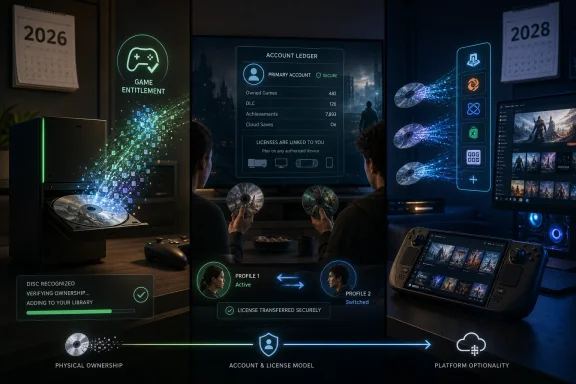
Microsoft is reportedly testing an Xbox disc-to-digital system in July 2026 that would let owners of Xbox One and Xbox Series X discs unlock digital entitlements, just as Sony’s planned 2028 exit from new PlayStation disc production sharpens the case for PC gaming. The timing is not subtle. As Windows Central argues, the console’s old bargain — cheap locked-down hardware in exchange for simplicity, exclusives, and physical ownership — is starting to look much less durable. Mashable framed Microsoft’s move as an attempt to win back disaffected gamers, but the deeper story is that Xbox may be trying to soften a transition it can no longer avoid.
For decades, the living-room console had a clean sales pitch: buy the box, put in the disc, play the game. The hardware was standardized, the setup was simple, and the disc was proof that you owned something you could lend, resell, collect, or rediscover years later. Even when patches, DLC, and online accounts complicated that story, the plastic case on the shelf remained a psychological anchor.
That anchor is now being pulled up. Windows Central’s Cale Hunt published the blunt version of the argument on July 4, asking what a console is for when discs disappear and exclusives increasingly migrate to PC. The answer is not that consoles become useless overnight. It is that their differentiation narrows to convenience, price, and ecosystem lock-in — and two of those three are under pressure.
The disc-to-digital reports, first pushed into the wider conversation by The Verge and then amplified by Mashable, Windows Central, Tom’s Hardware, GameSpot, and others, should be read as a transitional mechanism rather than a preservation victory. Microsoft appears to understand that ripping out the disc drive without a bridge would be brand malpractice. But a bridge is not the same thing as the old road.
Sony’s reported 2028 cutoff for new PlayStation game discs gives the debate a date. Microsoft’s reported testing gives it a mechanism. PC gaming gives it an escape hatch.
That distinction cuts through some of the initial excitement. If the program launches as reported, it will not magically turn every old Xbox disc into a permanent, platform-agnostic digital copy. It would be a licensing system tied to Microsoft accounts, supported discs, Microsoft’s servers, and the company’s rules for transfer. That is useful. It is not the same as physical ownership.
The clever part is that Microsoft may preserve some of the social behavior around discs. GameSpot and other outlets, citing The Verge’s reporting, described a model where the digital entitlement is tied to the specific disc and can move when the disc is swapped or used with another Xbox profile. In other words, Microsoft appears to be trying to prevent the obvious abuse case — convert a disc, sell the disc, keep the game — while still allowing lending and resale to exist in some constrained form.
That is exactly the kind of compromise only a platform holder could love. It is technically interesting, commercially sensible, and philosophically awkward. The disc remains the token, but the playable right becomes a server-mediated credential.
For Xbox owners, that may be enough. A physical library that works on a future all-digital Xbox, streams through Xbox Cloud Gaming when eligible, and unlocks Xbox Play Anywhere benefits where supported would be better than a box of obsolete discs. But it also proves the central point: the future console library is not a collection of objects. It is a database of permissions.
The outrage was predictable because physical media carries more meaning than its sales share suggests. Many players already buy digital by default. Yet even digital-first players often like knowing that physical remains an option, because the option restrains the platform holder. A disc can be discounted by retailers, resold by owners, shared among friends, archived by collectors, and sometimes played long after a storefront changes direction.
Digital-only ecosystems remove much of that friction. Prices become more dependent on the platform store. Access becomes more dependent on account health, licensing terms, regional availability, server status, and corporate patience. When digital access works, it is wonderfully convenient. When it breaks, the customer usually discovers how little leverage they actually have.
This is why Sony’s move makes Microsoft’s reported disc-to-digital work look both prudent and defensive. Xbox has spent years cultivating a reputation for backward compatibility, preservation, and cross-device access. If the next Xbox arrives without a disc drive, Microsoft cannot afford to sound like Sony with a green logo. It needs a story that says: your old library still matters here.
The problem is that “still matters” is not the same as “still works the way it used to.” A disc-to-digital program could preserve access while retiring the medium. That is a better fate than abandonment, but it is still a transfer of power from the player’s shelf to the platform holder’s ledger.
That is where PC gaming looks newly attractive. It is not because PC gaming is simple. It is because its complexity buys freedom. A Windows gaming PC can use Steam, GOG, Epic Games Store, Battle.net, Xbox, itch.io, emulators, mods, cloud services, and old installers in ways no traditional console can match.
The strongest PC argument is not raw frame rate or ray tracing. It is optionality. If Steam changes a policy, a player may still have GOG, Microsoft Store, Epic, or direct publisher launchers. If a game supports mods, the PC version often becomes a long-lived platform of its own. If hardware ages, parts can be replaced. If a storefront removes a listing, the local install, backup, or DRM-free copy may still matter.
That does not make PC ownership pure. Steam purchases are still licenses. DRM exists. Launchers are annoying. Anti-cheat systems can be invasive. Shader compilation stutter is real. Windows itself sometimes feels like it wandered into the living room wearing a work badge. But the PC’s messiness is also its defense against any single company becoming the final authority over a player’s library.
Consoles used to counter that with the simplicity of physical media and guaranteed compatibility. Now the first advantage is fading, and the second is complicated by generational transitions, account systems, patches, and server dependencies. The PC did not become perfect. The console became more PC-like while keeping many of the console restrictions.
That gap is narrowing. Valve’s Steam Deck proved that a console-like PC interface could work for mainstream players, and SteamOS has steadily pushed the idea that PC games do not have to feel trapped at a desk. Windows handhelds remain uneven, but they have pushed Microsoft to think harder about controller-first interfaces, full-screen game libraries, and Xbox-branded experiences on Windows.
Windows Central pointed to Microsoft’s Xbox Mode for Windows 11 and Valve’s SteamOS work as signs that the simplicity advantage is eroding. That does not mean a living-room PC is as frictionless as a PlayStation or Xbox today. It means the direction of travel favors the PC. Every year, the PC becomes more console-like where it helps; every year, the console becomes more PC-like where it benefits the platform holder.
The next Xbox, often discussed in reports under the Project Helix banner, appears to sit right in the middle of this tension. Microsoft has hinted at a future in which Xbox hardware and Windows gaming are more closely aligned, potentially with support for Xbox games, PC software, and broader storefront compatibility. If Microsoft really builds that machine, it could be the most interesting console in years.
But it also raises an uncomfortable question: if the next Xbox is a Windows-ish gaming PC with a locked-down business model, why not buy or build the more open version? Microsoft can answer with price, integration, Game Pass, backward compatibility, and controller simplicity. Those are real answers. They are just not as overwhelming as “put the disc in and it works.”
Windows Central’s feature argues that next-generation consoles may not be affordable in the traditional sense and speculates that prices could push toward PC territory. That exact number remains uncertain, and platform holders will fight hard to avoid sticker shock. But the broader point is sound: the closer console prices move to compact gaming PCs, the more consumers will compare restrictions rather than just specs.
The current generation already showed the split. Microsoft sold the Xbox Series S as a cheaper digital entry point, while the Series X kept the disc drive and stronger hardware. Sony offered digital and disc-capable PlayStation 5 models. The market learned to accept the idea that the drive was optional. The next step is making it absent.
A disc-to-digital program helps Microsoft make that leap without telling collectors to start over. Yet it may also confirm that future hardware will not treat discs as first-class citizens. If your old disc needs to become a digital entitlement to survive, the disc is no longer the medium. It is an authentication artifact.
For some players, that is fine. A shelf of aging discs is less useful than an instantly available digital library across console, PC, handheld, and cloud. For others, it is the loss of the thing that made console ownership feel grounded. The industry is betting the first group is larger than the second. The backlash shows the second group is still loud, organized, and culturally important.
Xbox deserves credit for doing more than most console platforms on compatibility. The Xbox One and Xbox Series generations brought a serious commitment to backward compatibility, and Microsoft has repeatedly positioned itself as friendlier to old libraries than its competitors. The reported disc-to-digital program fits that brand.
But preservation based on account entitlements is still platform-dependent preservation. It requires authentication systems, catalog records, content servers, rights agreements, emulator layers, and corporate will. It is vastly better than throwing old discs into the void, but it does not produce the same confidence as a self-contained physical copy, a DRM-free installer, or a well-documented open platform.
PC gaming is not immune to loss. Multiplayer games die. Launchers vanish. DRM servers fail. Games disappear from sale because of expired music, cars, sports licenses, or publisher consolidation. But PC games often leave more traces: files, mods, fan patches, private servers, compatibility wrappers, storefront mirrors, and community knowledge. The PC’s openness creates preservation surface area.
Consoles, by contrast, centralize preservation through the platform holder. That works beautifully when the platform holder cares. It fails abruptly when priorities change. The lesson of the digital transition is not that Microsoft, Sony, or Nintendo are uniquely untrustworthy. It is that no corporation should be the only custodian of cultural memory.
That is the seductive part of subscriptions. They turn access into abundance. They also make disappearance feel normal. A game leaves the catalog, the tile vanishes, and the customer moves on unless that game mattered personally.
Game Pass does not eliminate ownership, but it changes expectations around it. Xbox Play Anywhere does something similar from another angle by making a purchase feel more flexible across console and PC. In Microsoft’s best version of the future, the customer stops thinking about plastic discs and starts thinking about an Xbox identity that follows them across screens.
The disc-to-digital program, if it ships, would fit neatly into that architecture. A physical purchase becomes another entitlement inside the account. If the game supports cloud streaming, it becomes playable beyond the console. If it supports Play Anywhere, it may gain PC relevance. That is powerful because it makes the old library behave like the new ecosystem.
The catch is that flexibility and ownership are being braided together until consumers may not notice which strand is being shortened. A player gains convenience. Microsoft gains a tighter account relationship. Retail loses leverage. The used market becomes programmable. The shelf becomes symbolic.
Digital-only consoles collapse that map into the platform store and a handful of code sellers. That may be efficient, but efficiency usually benefits the party that controls the marketplace. The fewer alternative channels exist, the more pricing, visibility, refunds, and availability become platform policy questions.
This is where the PC again looks different. Steam is dominant, but it is not alone. GOG’s DRM-free positioning gives it a consumer-rights argument that consoles struggle to match. Epic’s giveaways and publisher deals create competitive pressure. Microsoft’s own PC store, for all its baggage, is another route. Even when PC storefronts annoy users, their plurality matters.
A console without physical media is not merely a console without a slot. It is a console with one fewer check on the platform holder. That does not guarantee abuse. It does increase dependency.
Microsoft seems to know this, which is why a well-designed disc-to-digital feature could be more than a technical footnote. If physical discs can still circulate and transfer their entitlements, even in a controlled way, Microsoft can claim it preserved some of the social and economic function of discs. The details will decide whether that claim is convincing or cosmetic.
If Microsoft announces a disc-to-digital program with broad support, clear transfer rules, no surprise fees, and a credible path for future hardware, it can turn Sony’s hard break into an Xbox talking point. It can tell players: we know you bought these games, and we built a way forward. For a brand that has struggled with hardware momentum, that kind of goodwill matters.
But Microsoft’s history makes this delicate. The Xbox One reveal in 2013 was haunted by digital licensing, check-ins, used-game uncertainty, and a sense that Microsoft had designed the future before persuading customers to want it. The company spent much of the next decade repairing that trust. Any modern disc-to-digital plan will be judged against that memory.
The company also has to avoid overpromising. If only some discs qualify, say so plainly. If Xbox 360 and original Xbox discs are excluded, do not bury the disappointment. If licenses move when discs are lent or sold, explain what happens offline, across accounts, and after delisting. If the next Xbox has no drive, users need to know whether current consoles become the required conversion machines.
The worst version of Positron would be a vague promise used to justify removing hardware. The best version would be a transparent, tested, consumer-friendly migration path that acknowledges the loss rather than pretending nothing changed.
That strategy is rational. It aligns with Windows, cloud gaming, handheld PCs, Game Pass, and Microsoft’s broader services business. It also mirrors how entertainment has moved elsewhere: music, movies, books, and productivity software all shifted from owned media toward accounts and subscriptions.
The danger is that gaming is not exactly like music or video. Games are software, communities, performances, competitive environments, and historical artifacts. They require hardware compatibility, input methods, servers, patches, engines, and rights. When access disappears, it is not just a file going missing. It can be an entire mode of play.
This is why gamers argue so intensely over a shrinking physical market. The disc is a proxy for control. It represents the player’s ability to say that a purchase exists outside a platform holder’s current business model.
A disc-to-digital system can respect that anxiety, or it can launder it into another account feature. The implementation will tell us which Microsoft has chosen.
The next few years will likely produce messy hybrids. Current consoles will keep reading discs. Retailers will keep selling old stock and collector editions where demand exists. Some publishers will experiment with limited physical runs, download codes in boxes, or premium merchandise bundles. But the center of gravity has moved.
For WindowsForum readers, the important part is not to mourn plastic for its own sake. It is to understand what replaces it. A game library that lives in an account can be more convenient, more portable, and more resilient against disc damage. It can also be easier to revoke, reshape, regionalize, delist, or strand.
The smartest consumers will treat the transition as a rights question, not a nostalgia fight.
 The Console Bargain Is Being Renegotiated Without the Customer
For decades, the living-room console had a clean sales pitch: buy the box, put in the disc, play the game. The hardware was standardized, the setup was simple, and the disc was proof that you owned something you could lend, resell, collect, or rediscover years later. Even when patches, DLC, and online accounts complicated that story, the plastic case on the shelf remained a psychological anchor.That anchor is now being pulled up. Windows Central’s Cale Hunt published the blunt version of the argument on July 4, asking what a console is for when discs disappear and exclusives increasingly migrate to PC. The answer is not that consoles become useless overnight. It is that their differentiation narrows to convenience, price, and ecosystem lock-in — and two of those three are under pressure.
The disc-to-digital reports, first pushed into the wider conversation by The Verge and then amplified by Mashable, Windows Central, Tom’s Hardware, GameSpot, and others, should be read as a transitional mechanism rather than a preservation victory. Microsoft appears to understand that ripping out the disc drive without a bridge would be brand malpractice. But a bridge is not the same thing as the old road.
Sony’s reported 2028 cutoff for new PlayStation game discs gives the debate a date. Microsoft’s reported testing gives it a mechanism. PC gaming gives it an escape hatch.
Microsoft’s Positron Looks Less Like Generosity Than Damage Control
According to reporting attributed to The Verge, Microsoft has been testing a disc-to-digital feature that would grant a digital entitlement when a supported physical Xbox disc is inserted into a console. Windows Central has referred to the project by the codename “Positron,” while other outlets have described the feature more plainly as a way to digitize a physical game collection. The reported scope matters: Xbox One and Xbox Series X discs are expected to be the focus, not original Xbox or Xbox 360 discs.That distinction cuts through some of the initial excitement. If the program launches as reported, it will not magically turn every old Xbox disc into a permanent, platform-agnostic digital copy. It would be a licensing system tied to Microsoft accounts, supported discs, Microsoft’s servers, and the company’s rules for transfer. That is useful. It is not the same as physical ownership.
The clever part is that Microsoft may preserve some of the social behavior around discs. GameSpot and other outlets, citing The Verge’s reporting, described a model where the digital entitlement is tied to the specific disc and can move when the disc is swapped or used with another Xbox profile. In other words, Microsoft appears to be trying to prevent the obvious abuse case — convert a disc, sell the disc, keep the game — while still allowing lending and resale to exist in some constrained form.
That is exactly the kind of compromise only a platform holder could love. It is technically interesting, commercially sensible, and philosophically awkward. The disc remains the token, but the playable right becomes a server-mediated credential.
For Xbox owners, that may be enough. A physical library that works on a future all-digital Xbox, streams through Xbox Cloud Gaming when eligible, and unlocks Xbox Play Anywhere benefits where supported would be better than a box of obsolete discs. But it also proves the central point: the future console library is not a collection of objects. It is a database of permissions.
Sony Made the Quiet Part Loud
Sony’s reported plan to stop producing new PlayStation games on disc in 2028 landed like a flare in a dry forest because it said openly what the industry has been implying for years. Physical games are no longer central to the business model. They are a legacy channel to be managed until the costs, logistics, and retail compromises outweigh the upside.The outrage was predictable because physical media carries more meaning than its sales share suggests. Many players already buy digital by default. Yet even digital-first players often like knowing that physical remains an option, because the option restrains the platform holder. A disc can be discounted by retailers, resold by owners, shared among friends, archived by collectors, and sometimes played long after a storefront changes direction.
Digital-only ecosystems remove much of that friction. Prices become more dependent on the platform store. Access becomes more dependent on account health, licensing terms, regional availability, server status, and corporate patience. When digital access works, it is wonderfully convenient. When it breaks, the customer usually discovers how little leverage they actually have.
This is why Sony’s move makes Microsoft’s reported disc-to-digital work look both prudent and defensive. Xbox has spent years cultivating a reputation for backward compatibility, preservation, and cross-device access. If the next Xbox arrives without a disc drive, Microsoft cannot afford to sound like Sony with a green logo. It needs a story that says: your old library still matters here.
The problem is that “still matters” is not the same as “still works the way it used to.” A disc-to-digital program could preserve access while retiring the medium. That is a better fate than abandonment, but it is still a transfer of power from the player’s shelf to the platform holder’s ledger.
PC Gaming Wins by Looking Less Like a Walled Garden
Windows Central’s argument lands hardest when it compares a digital-only console with a living-room PC. If both platforms are now mainly digital storefront machines, the console has to justify why its store should be the only store, why online multiplayer should require a subscription, and why the hardware should be treated as an appliance instead of a general-purpose computer.That is where PC gaming looks newly attractive. It is not because PC gaming is simple. It is because its complexity buys freedom. A Windows gaming PC can use Steam, GOG, Epic Games Store, Battle.net, Xbox, itch.io, emulators, mods, cloud services, and old installers in ways no traditional console can match.
The strongest PC argument is not raw frame rate or ray tracing. It is optionality. If Steam changes a policy, a player may still have GOG, Microsoft Store, Epic, or direct publisher launchers. If a game supports mods, the PC version often becomes a long-lived platform of its own. If hardware ages, parts can be replaced. If a storefront removes a listing, the local install, backup, or DRM-free copy may still matter.
That does not make PC ownership pure. Steam purchases are still licenses. DRM exists. Launchers are annoying. Anti-cheat systems can be invasive. Shader compilation stutter is real. Windows itself sometimes feels like it wandered into the living room wearing a work badge. But the PC’s messiness is also its defense against any single company becoming the final authority over a player’s library.
Consoles used to counter that with the simplicity of physical media and guaranteed compatibility. Now the first advantage is fading, and the second is complicated by generational transitions, account systems, patches, and server dependencies. The PC did not become perfect. The console became more PC-like while keeping many of the console restrictions.
The Living Room Is No Longer Console Territory by Default
The old objection to PC gaming in the living room was that it felt like PC gaming in the living room. You needed a keyboard nearby, a tolerance for driver weirdness, and a willingness to troubleshoot when the TV, controller, launcher, or game decided to misbehave. Consoles won because they hid the machinery.That gap is narrowing. Valve’s Steam Deck proved that a console-like PC interface could work for mainstream players, and SteamOS has steadily pushed the idea that PC games do not have to feel trapped at a desk. Windows handhelds remain uneven, but they have pushed Microsoft to think harder about controller-first interfaces, full-screen game libraries, and Xbox-branded experiences on Windows.
Windows Central pointed to Microsoft’s Xbox Mode for Windows 11 and Valve’s SteamOS work as signs that the simplicity advantage is eroding. That does not mean a living-room PC is as frictionless as a PlayStation or Xbox today. It means the direction of travel favors the PC. Every year, the PC becomes more console-like where it helps; every year, the console becomes more PC-like where it benefits the platform holder.
The next Xbox, often discussed in reports under the Project Helix banner, appears to sit right in the middle of this tension. Microsoft has hinted at a future in which Xbox hardware and Windows gaming are more closely aligned, potentially with support for Xbox games, PC software, and broader storefront compatibility. If Microsoft really builds that machine, it could be the most interesting console in years.
But it also raises an uncomfortable question: if the next Xbox is a Windows-ish gaming PC with a locked-down business model, why not buy or build the more open version? Microsoft can answer with price, integration, Game Pass, backward compatibility, and controller simplicity. Those are real answers. They are just not as overwhelming as “put the disc in and it works.”
The Price Argument Is Getting Harder to Win
Consoles have traditionally been cheaper than comparable gaming PCs because platform holders could subsidize hardware and make money back through software royalties, subscriptions, accessories, and store control. That model still exists, but it is under strain. Component prices, storage demands, high-performance CPUs and GPUs, and the economics of advanced manufacturing make a dramatically cheap next-generation box harder to imagine.Windows Central’s feature argues that next-generation consoles may not be affordable in the traditional sense and speculates that prices could push toward PC territory. That exact number remains uncertain, and platform holders will fight hard to avoid sticker shock. But the broader point is sound: the closer console prices move to compact gaming PCs, the more consumers will compare restrictions rather than just specs.
The current generation already showed the split. Microsoft sold the Xbox Series S as a cheaper digital entry point, while the Series X kept the disc drive and stronger hardware. Sony offered digital and disc-capable PlayStation 5 models. The market learned to accept the idea that the drive was optional. The next step is making it absent.
A disc-to-digital program helps Microsoft make that leap without telling collectors to start over. Yet it may also confirm that future hardware will not treat discs as first-class citizens. If your old disc needs to become a digital entitlement to survive, the disc is no longer the medium. It is an authentication artifact.
For some players, that is fine. A shelf of aging discs is less useful than an instantly available digital library across console, PC, handheld, and cloud. For others, it is the loss of the thing that made console ownership feel grounded. The industry is betting the first group is larger than the second. The backlash shows the second group is still loud, organized, and culturally important.
Preservation Is the Word Everyone Uses and Almost Nobody Defines
The game industry loves to talk about preservation when it is really talking about compatibility. Those are related ideas, but they are not identical. Compatibility means a customer can play an old game on new hardware. Preservation means the work can survive beyond the business conditions that originally sold it.Xbox deserves credit for doing more than most console platforms on compatibility. The Xbox One and Xbox Series generations brought a serious commitment to backward compatibility, and Microsoft has repeatedly positioned itself as friendlier to old libraries than its competitors. The reported disc-to-digital program fits that brand.
But preservation based on account entitlements is still platform-dependent preservation. It requires authentication systems, catalog records, content servers, rights agreements, emulator layers, and corporate will. It is vastly better than throwing old discs into the void, but it does not produce the same confidence as a self-contained physical copy, a DRM-free installer, or a well-documented open platform.
PC gaming is not immune to loss. Multiplayer games die. Launchers vanish. DRM servers fail. Games disappear from sale because of expired music, cars, sports licenses, or publisher consolidation. But PC games often leave more traces: files, mods, fan patches, private servers, compatibility wrappers, storefront mirrors, and community knowledge. The PC’s openness creates preservation surface area.
Consoles, by contrast, centralize preservation through the platform holder. That works beautifully when the platform holder cares. It fails abruptly when priorities change. The lesson of the digital transition is not that Microsoft, Sony, or Nintendo are uniquely untrustworthy. It is that no corporation should be the only custodian of cultural memory.
Game Pass Makes the Library Feel Bigger and Ownership Feel Smaller
Microsoft’s strongest counterweight to the ownership critique is Game Pass. A subscription can make the old buy-and-shelve model feel quaint, especially for players who sample widely and rarely replay old titles. If hundreds of games are available on console, PC, and cloud for a monthly fee, the argument over one disc can seem like nostalgia pretending to be consumer advocacy.That is the seductive part of subscriptions. They turn access into abundance. They also make disappearance feel normal. A game leaves the catalog, the tile vanishes, and the customer moves on unless that game mattered personally.
Game Pass does not eliminate ownership, but it changes expectations around it. Xbox Play Anywhere does something similar from another angle by making a purchase feel more flexible across console and PC. In Microsoft’s best version of the future, the customer stops thinking about plastic discs and starts thinking about an Xbox identity that follows them across screens.
The disc-to-digital program, if it ships, would fit neatly into that architecture. A physical purchase becomes another entitlement inside the account. If the game supports cloud streaming, it becomes playable beyond the console. If it supports Play Anywhere, it may gain PC relevance. That is powerful because it makes the old library behave like the new ecosystem.
The catch is that flexibility and ownership are being braided together until consumers may not notice which strand is being shortened. A player gains convenience. Microsoft gains a tighter account relationship. Retail loses leverage. The used market becomes programmable. The shelf becomes symbolic.
Retail Disappears From the Power Map
Physical games were not just objects. They were a distribution system with competing interests. Retailers could discount aggressively, bundle hardware, clear inventory, sell used copies, and create local pressure on digital pricing. Collectors could buy limited editions. Parents could wrap a box. Friends could lend a game without negotiating account permissions.Digital-only consoles collapse that map into the platform store and a handful of code sellers. That may be efficient, but efficiency usually benefits the party that controls the marketplace. The fewer alternative channels exist, the more pricing, visibility, refunds, and availability become platform policy questions.
This is where the PC again looks different. Steam is dominant, but it is not alone. GOG’s DRM-free positioning gives it a consumer-rights argument that consoles struggle to match. Epic’s giveaways and publisher deals create competitive pressure. Microsoft’s own PC store, for all its baggage, is another route. Even when PC storefronts annoy users, their plurality matters.
A console without physical media is not merely a console without a slot. It is a console with one fewer check on the platform holder. That does not guarantee abuse. It does increase dependency.
Microsoft seems to know this, which is why a well-designed disc-to-digital feature could be more than a technical footnote. If physical discs can still circulate and transfer their entitlements, even in a controlled way, Microsoft can claim it preserved some of the social and economic function of discs. The details will decide whether that claim is convincing or cosmetic.
Xbox Has a Narrow Opening to Be the Less Bad Platform
The backlash to Sony’s disc decision gives Microsoft an opening. Not necessarily to save physical media, but to present itself as the company that handles its decline with more respect. That may sound cynical, but platform competition often turns on relative trust rather than purity.If Microsoft announces a disc-to-digital program with broad support, clear transfer rules, no surprise fees, and a credible path for future hardware, it can turn Sony’s hard break into an Xbox talking point. It can tell players: we know you bought these games, and we built a way forward. For a brand that has struggled with hardware momentum, that kind of goodwill matters.
But Microsoft’s history makes this delicate. The Xbox One reveal in 2013 was haunted by digital licensing, check-ins, used-game uncertainty, and a sense that Microsoft had designed the future before persuading customers to want it. The company spent much of the next decade repairing that trust. Any modern disc-to-digital plan will be judged against that memory.
The company also has to avoid overpromising. If only some discs qualify, say so plainly. If Xbox 360 and original Xbox discs are excluded, do not bury the disappointment. If licenses move when discs are lent or sold, explain what happens offline, across accounts, and after delisting. If the next Xbox has no drive, users need to know whether current consoles become the required conversion machines.
The worst version of Positron would be a vague promise used to justify removing hardware. The best version would be a transparent, tested, consumer-friendly migration path that acknowledges the loss rather than pretending nothing changed.
The Console Is Becoming an Account With a Box Attached
The deeper transition is not from disc to download. It is from device ownership to account continuity. Microsoft wants Xbox to mean a library, subscription, identity, friends list, achievements, cloud saves, and cross-device access more than it means a particular slab of plastic under the television.That strategy is rational. It aligns with Windows, cloud gaming, handheld PCs, Game Pass, and Microsoft’s broader services business. It also mirrors how entertainment has moved elsewhere: music, movies, books, and productivity software all shifted from owned media toward accounts and subscriptions.
The danger is that gaming is not exactly like music or video. Games are software, communities, performances, competitive environments, and historical artifacts. They require hardware compatibility, input methods, servers, patches, engines, and rights. When access disappears, it is not just a file going missing. It can be an entire mode of play.
This is why gamers argue so intensely over a shrinking physical market. The disc is a proxy for control. It represents the player’s ability to say that a purchase exists outside a platform holder’s current business model.
A disc-to-digital system can respect that anxiety, or it can launder it into another account feature. The implementation will tell us which Microsoft has chosen.
The Disc May Survive Only as a Receipt for the Cloud
The practical picture now looks clearer than the rhetoric. Physical media is not disappearing because players stopped caring altogether. It is disappearing because platform economics, storage realities, digital storefront margins, and cross-device strategies all point in the same direction.The next few years will likely produce messy hybrids. Current consoles will keep reading discs. Retailers will keep selling old stock and collector editions where demand exists. Some publishers will experiment with limited physical runs, download codes in boxes, or premium merchandise bundles. But the center of gravity has moved.
For WindowsForum readers, the important part is not to mourn plastic for its own sake. It is to understand what replaces it. A game library that lives in an account can be more convenient, more portable, and more resilient against disc damage. It can also be easier to revoke, reshape, regionalize, delist, or strand.
The smartest consumers will treat the transition as a rights question, not a nostalgia fight.
- Microsoft’s reported disc-to-digital testing is best understood as a migration tool for existing Xbox One and Xbox Series X libraries, not a full preservation solution.
- Sony’s planned 2028 retreat from new PlayStation discs gives Microsoft a chance to appear more consumer-friendly, but only if the rules are clear and broad.
- PC gaming gains strategic ground because digital distribution on PC usually comes with multiple storefronts, broader hardware choice, and more community workarounds.
- A future Xbox without a disc drive can still be attractive, but it must justify its restrictions against increasingly console-like living-room PCs.
- Players should judge digital libraries by transfer rights, offline behavior, delisting policy, refund terms, and long-term compatibility rather than by launch-day convenience alone.
References
- Primary source: Windows Central
Published: Sat, 04 Jul 2026 13:00:00 GMT
Loading…
www.windowscentral.com - Independent coverage: Mashable
Published: Sat, 04 Jul 2026 17:09:43 GMT
Loading…
mashable.com - Related coverage: gamesradar.com
Loading…
www.gamesradar.com - Related coverage: creativebloq.com
Loading…
www.creativebloq.com - Related coverage: tomshardware.com
Xbox reportedly testing a way to digitize physical games in the wake of PlayStation killing game discs — feature said to go back to Xbox One-era games | Tom's Hardware
This could enable some backwards compatibility on a next-gen Xbox if it doesn't have a disc drive.www.tomshardware.com - Related coverage: gamespot.com
Loading…
www.gamespot.com
- Related coverage: techradar.com
Xbox might be following PlayStation's lead, as new reports claim Microsoft is testing a new disc-to-digital game feature called 'Positron', and the next-gen Project Helix console won't have a disc drive | TechRadar
Project Helix will reportedly not feature a disc drive, as sources claim Xbox is testing a disc-to-digital feature that will digitize a user's game library.www.techradar.com - Related coverage: techbriefly.com
Loading…
techbriefly.com - Related coverage: techspot.com
Loading…
www.techspot.com - Related coverage: nintendowire.com
Loading…
nintendowire.com - Related coverage: windowsreport.com
Loading…
windowsreport.com - Related coverage: dataconomy.com
Loading…
dataconomy.com - Related coverage: republicworld.com
Loading…
www.republicworld.com - Related coverage: feedandfigures.com
Loading…
feedandfigures.com - Related coverage: dexerto.com
Loading…
www.dexerto.com - Related coverage: overclock3d.net
Loading…
overclock3d.net - Related coverage: tweaktown.com
Loading…
www.tweaktown.com