

Microsoft is winding down Gaming Copilot in the Xbox mobile app and stopping development of the planned Xbox Series X and Series S console version in May 2026, reversing a 2025 AI push that had promised voice-driven help, game recommendations, achievement guidance, and contextual play advice. The retreat is not just a feature cancellation. It is an admission that Xbox’s next turn cannot be sold as another Copilot surface. For a platform still trying to explain what an Xbox is in a world of consoles, PCs, handhelds, cloud gaming, and Game Pass, Microsoft has decided that less AI branding may be more useful than more AI ambition.
The most important word in Microsoft’s move is not “Copilot.” It is “friction.” Xbox leadership is now talking less like a software division looking for places to insert Microsoft’s favorite brand and more like a gaming platform trying to stop irritating the people who actually use it.
Gaming Copilot was pitched as a helper: a second-screen assistant on mobile, a guide for achievements, a memory aid for story-heavy games, and eventually a voice-driven companion on console. In the abstract, that sounds like the kind of feature a platform holder would love. It keeps players inside the ecosystem, gives Microsoft another personalization layer, and turns gameplay into data-rich context.
But the closer that idea gets to a living room, the more awkward it becomes. Console players do not generally boot up a $500 box hoping to chat with a productivity mascot. They want fast resume, reliable downloads, stable parties, fair subscriptions, usable stores, and games that justify the machine under the TV. AI can help with some of that backstage. As a front-of-house feature, it has to earn its place in a medium that already resists interruption.
That is why this cancellation matters. Microsoft has spent the last several years trying to turn Copilot into a unifying layer across Windows, Office, Edge, Bing, Teams, and consumer services. Xbox has now become the place where the company visibly says: not here, not like this.
The problem is that “useful” and “wanted” are not the same thing. Many gamers already have highly developed rituals for help: YouTube walkthroughs, Reddit threads, Discord servers, Steam guides, wikis, friends, streamers, and achievement sites. These sources are social, searchable, opinionated, and often more trusted than an automated assistant embedded by the platform holder.
Microsoft’s early mobile beta had one advantage: it lived on a second screen. That meant it could be consulted without directly invading the game running on the TV or PC. Even so, the feature still had to persuade users that asking Xbox’s assistant was better than alt-tabbing, searching, or asking a community that had already solved the problem.
The console version faced a tougher test. A voice assistant in the living room has to be fast, context-aware, unobtrusive, and rarely wrong. If it gives generic advice, players ignore it. If it spoils a puzzle, players resent it. If it misunderstands a command during multiplayer, players mock it. If it feels like Clippy wandered into Elden Ring, the joke writes itself.
Microsoft had the technical ingredients to attempt the feature. What it apparently lacked was a strong enough reason to make the feature part of Xbox’s near-term identity.
Under that kind of sprawl, every new initiative has to answer a brutal question: does it clarify the platform, or does it add another layer of abstraction? Gaming Copilot increasingly looked like the latter. It was another Microsoft-wide initiative arriving inside Xbox at a moment when Xbox needed fewer slogans and more confidence.
Sharma’s public language about moving faster, deepening the connection with the community, and addressing friction for players and developers is executive-speak, but it points in a specific direction. The Xbox problem is not a lack of futuristic demos. It is that customers have spent years watching mixed messages pile up: console exclusives becoming less exclusive, Game Pass pricing changing, hardware strategy shifting, cloud gaming expanding unevenly, and marketing campaigns trying to make “Xbox” mean almost anything with a screen.
In that context, canceling Copilot on console is not anti-AI. It is anti-distraction. Xbox cannot ask players to believe in a helpful AI sidekick while the brand itself is still trying to resolve the larger question of what role dedicated Xbox hardware plays in Microsoft’s future.
The move also shows a willingness to kill a feature after public commitment. That is painful, but useful. Platform strategy often improves when companies stop defending every announcement as destiny.
Windows can absorb AI clutter because Windows has always been cluttered. Office can justify Copilot because the work itself is textual, repetitive, and collaborative. Edge can wedge in summarization because the browser is already a mediator between user and information. Xbox is different. A console’s highest compliment is invisibility.
That makes visible AI a particularly difficult fit. A good console feature reduces the number of steps between intent and play. It does not ask the user to form a prompt, wait for a response, and evaluate whether the answer is useful. Even if the assistant is competent, it risks turning leisure into another micro-interaction with a chatbot.
There are exceptions. Accessibility tools, natural-language search, parental controls, store discovery, customer support, and troubleshooting could all benefit from AI if implemented carefully. But those are not quite the same as selling players on a branded assistant that joins them during gameplay.
The irony is that Xbox may eventually use AI more effectively by making it less visible. Developers could use AI-assisted workflows. The store could become better at surfacing relevant games. Support could become less painful. Game clips could be indexed more intelligently. Accessibility settings could be recommended based on player needs. None of that requires a mascot-like Copilot experience on the console dashboard.
If Xbox has learned anything from the broader Copilot rollout across Microsoft, it may be that AI becomes more acceptable when it solves a problem the user already recognizes.
Players have spent the last decade watching monetization systems arrive wrapped in the language of convenience. Loot boxes were about surprise. Battle passes were about engagement. Always-online requirements were about connected experiences. Platform lock-in was about ecosystems. Against that history, an AI assistant promising to help users play can sound less like a service and more like another data-hungry layer being inserted between player and game.
Microsoft also faces a Copilot-specific trust problem. The Copilot brand has been pushed aggressively across products, sometimes ahead of clear utility. For enterprise users, Copilot can be a serious productivity tool. For consumers, it often feels like an omnipresent label attached to uneven experiences. That brand fatigue matters when the same name moves into gaming.
There is also the matter of authorship. Games are designed experiences, and players often care deeply about discovering those experiences on their own terms. A system that summarizes plot points, recommends next actions, or offers tactical advice may help some users, but it also changes the relationship among player, developer, and community.
The best walkthroughs and guides carry a human signal. They say: someone else got stuck here too, solved it, and wrote it down. An AI assistant can imitate the answer, but not always the legitimacy. For many players, that difference is not sentimental. It is practical.
Xbox is likely to become a more selective AI customer inside Microsoft rather than a billboard for Copilot. That distinction matters. AI as internal tooling, discovery infrastructure, moderation assistance, localization support, or developer workflow enhancement is easier to justify than AI as a player-facing companion with a name everyone already associates with Microsoft’s productivity stack.
The new Xbox leadership bench reportedly includes executives and product leaders with experience from Microsoft’s CoreAI organization and consumer growth backgrounds. That suggests AI knowledge is not leaving the building. It is being redirected away from one highly visible product surface.
For developers, that may be the more consequential story. If Xbox wants to reduce friction, it could focus on certification, porting, publishing workflows, store placement, analytics, cloud builds, cross-device testing, and performance tooling. Those are less glamorous than a chatbot telling a player how to beat a boss, but they are closer to the structural problems that determine whether a platform feels healthy.
For players, the same logic applies. The Xbox experience needs better basics before it needs a conversational companion. Library management, cross-buy clarity, cloud save reliability, subscription value, refund transparency, download behavior, social features, and dashboard performance will do more to rebuild goodwill than another AI promise.
In other words, the future of AI on Xbox may be boring. That would be an improvement.
Console platforms have always sold more than silicon. They sell belonging, continuity, and a promise that buying into the platform will make sense for years. Microsoft’s more open approach can be consumer-friendly, especially when it frees games from hardware silos. But it also weakens the old reason to buy the console first.
That is why every Xbox feature now carries more symbolic weight. A price change is not just a price change. A marketing campaign is not just a campaign. A canceled AI assistant is not just a canceled assistant. Each becomes evidence in the ongoing trial over whether Xbox is becoming more coherent or less.
Game Pass complicates the picture further. The service remains one of Microsoft’s strongest gaming assets, but its value proposition depends on trust. Players need to believe the catalog, pricing, tiers, cloud options, and first-party release strategy will remain attractive enough to justify recurring payment. When that trust wobbles, experimental features look indulgent.
Hardware is the other half of the burden. Microsoft continues to discuss future Xbox devices and a broader hardware ecosystem, but dedicated consoles must now coexist with Windows handhelds, PC storefront aggregation, cloud streaming, and a world where Microsoft-published games can appear elsewhere. That makes the console interface more important, not less. It has to feel like the cleanest expression of Xbox, not a testing ground for corporate AI placement.
Seen that way, killing console Copilot is a small act of discipline. It tells the market that Xbox’s next phase may be measured by what Microsoft chooses not to ship.
Generative AI is different because it arrives with a voice. It speaks, suggests, summarizes, and sometimes fabricates. That makes it socially present in a way older gaming technologies are not. The bar for acceptance is therefore higher.
A good Xbox AI system might quietly notice that a player repeatedly opens accessibility settings in shooters and make setup easier. It might help parents understand content settings without navigating a maze. It might summarize patch notes in plain language. It might improve search when a user remembers “that co-op vampire game” but not the title. It might help developers triage crash reports more efficiently.
Those are not keynote fantasies. They are product work. They also avoid the uncanny premise that a platform assistant should sit beside every player like a synthetic coach.
Microsoft’s mistake was not believing that AI could help gaming. The mistake was assuming the Copilot frame was the right way to introduce that help. For Xbox, the lesson is that the assistant should be subordinate to the play, the platform, and the community. The moment it becomes the story, it is probably in the way.
The fight is not to prove that Microsoft can attach AI to a console. Of course it can. The fight is to prove that Xbox can make sharper choices at a time when every platform holder is under pressure from development costs, subscription fatigue, hardware uncertainty, storefront competition, and players who are increasingly skeptical of corporate roadmaps.
The most concrete read is simple:
Source: PCMag Your Xbox Won’t Get Microsoft Copilot AI Features After All
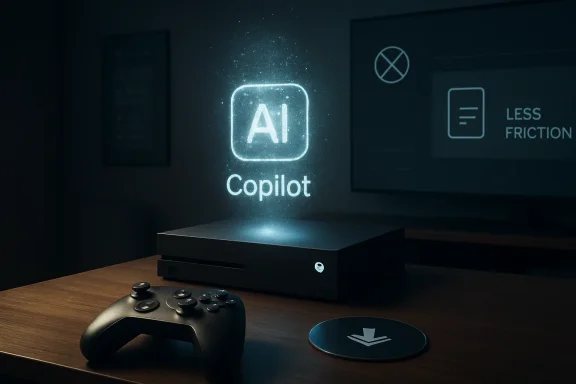 Xbox’s AI Retreat Is Really a Strategy Reset
The most important word in Microsoft’s move is not “Copilot.” It is “friction.” Xbox leadership is now talking less like a software division looking for places to insert Microsoft’s favorite brand and more like a gaming platform trying to stop irritating the people who actually use it.Gaming Copilot was pitched as a helper: a second-screen assistant on mobile, a guide for achievements, a memory aid for story-heavy games, and eventually a voice-driven companion on console. In the abstract, that sounds like the kind of feature a platform holder would love. It keeps players inside the ecosystem, gives Microsoft another personalization layer, and turns gameplay into data-rich context.
But the closer that idea gets to a living room, the more awkward it becomes. Console players do not generally boot up a $500 box hoping to chat with a productivity mascot. They want fast resume, reliable downloads, stable parties, fair subscriptions, usable stores, and games that justify the machine under the TV. AI can help with some of that backstage. As a front-of-house feature, it has to earn its place in a medium that already resists interruption.
That is why this cancellation matters. Microsoft has spent the last several years trying to turn Copilot into a unifying layer across Windows, Office, Edge, Bing, Teams, and consumer services. Xbox has now become the place where the company visibly says: not here, not like this.
Copilot for Gaming Was a Plausible Demo Looking for a Player Habit
When Microsoft announced Copilot for Gaming in 2025, the pitch was carefully tuned to the modern anxiety of big games. Players bounce among sprawling RPGs, live-service grinds, seasonal shooters, backlogs, battle passes, and half-finished campaigns. A helper that remembers where you were, explains mechanics, surfaces achievements, or nudges you toward the next objective is not a ridiculous idea.The problem is that “useful” and “wanted” are not the same thing. Many gamers already have highly developed rituals for help: YouTube walkthroughs, Reddit threads, Discord servers, Steam guides, wikis, friends, streamers, and achievement sites. These sources are social, searchable, opinionated, and often more trusted than an automated assistant embedded by the platform holder.
Microsoft’s early mobile beta had one advantage: it lived on a second screen. That meant it could be consulted without directly invading the game running on the TV or PC. Even so, the feature still had to persuade users that asking Xbox’s assistant was better than alt-tabbing, searching, or asking a community that had already solved the problem.
The console version faced a tougher test. A voice assistant in the living room has to be fast, context-aware, unobtrusive, and rarely wrong. If it gives generic advice, players ignore it. If it spoils a puzzle, players resent it. If it misunderstands a command during multiplayer, players mock it. If it feels like Clippy wandered into Elden Ring, the joke writes itself.
Microsoft had the technical ingredients to attempt the feature. What it apparently lacked was a strong enough reason to make the feature part of Xbox’s near-term identity.
Asha Sharma’s Xbox Is Cutting Before It Builds
The timing gives the cancellation its meaning. Asha Sharma’s arrival at the top of Xbox followed a period when Microsoft’s gaming strategy had become both ambitious and difficult to explain. Xbox was no longer merely a console business, but neither was it simply a PC storefront, a cloud service, a subscription bundle, or a publisher.Under that kind of sprawl, every new initiative has to answer a brutal question: does it clarify the platform, or does it add another layer of abstraction? Gaming Copilot increasingly looked like the latter. It was another Microsoft-wide initiative arriving inside Xbox at a moment when Xbox needed fewer slogans and more confidence.
Sharma’s public language about moving faster, deepening the connection with the community, and addressing friction for players and developers is executive-speak, but it points in a specific direction. The Xbox problem is not a lack of futuristic demos. It is that customers have spent years watching mixed messages pile up: console exclusives becoming less exclusive, Game Pass pricing changing, hardware strategy shifting, cloud gaming expanding unevenly, and marketing campaigns trying to make “Xbox” mean almost anything with a screen.
In that context, canceling Copilot on console is not anti-AI. It is anti-distraction. Xbox cannot ask players to believe in a helpful AI sidekick while the brand itself is still trying to resolve the larger question of what role dedicated Xbox hardware plays in Microsoft’s future.
The move also shows a willingness to kill a feature after public commitment. That is painful, but useful. Platform strategy often improves when companies stop defending every announcement as destiny.
The Console Was the Worst Place to Prove Microsoft’s AI Vision
The console interface is unforgiving because it is used at a distance, with a controller, often in a social room, and usually with a game already claiming the user’s full attention. Every extra panel, prompt, voice command, or notification competes with the reason the box exists.Windows can absorb AI clutter because Windows has always been cluttered. Office can justify Copilot because the work itself is textual, repetitive, and collaborative. Edge can wedge in summarization because the browser is already a mediator between user and information. Xbox is different. A console’s highest compliment is invisibility.
That makes visible AI a particularly difficult fit. A good console feature reduces the number of steps between intent and play. It does not ask the user to form a prompt, wait for a response, and evaluate whether the answer is useful. Even if the assistant is competent, it risks turning leisure into another micro-interaction with a chatbot.
There are exceptions. Accessibility tools, natural-language search, parental controls, store discovery, customer support, and troubleshooting could all benefit from AI if implemented carefully. But those are not quite the same as selling players on a branded assistant that joins them during gameplay.
The irony is that Xbox may eventually use AI more effectively by making it less visible. Developers could use AI-assisted workflows. The store could become better at surfacing relevant games. Support could become less painful. Game clips could be indexed more intelligently. Accessibility settings could be recommended based on player needs. None of that requires a mascot-like Copilot experience on the console dashboard.
If Xbox has learned anything from the broader Copilot rollout across Microsoft, it may be that AI becomes more acceptable when it solves a problem the user already recognizes.
The Backlash Was About Trust, Not Just Taste
It is tempting to frame this as gamers rejecting AI because gamers reject everything. That would be too easy. The stronger explanation is that gaming communities are unusually sensitive to the difference between features built for players and features built for corporate strategy.Players have spent the last decade watching monetization systems arrive wrapped in the language of convenience. Loot boxes were about surprise. Battle passes were about engagement. Always-online requirements were about connected experiences. Platform lock-in was about ecosystems. Against that history, an AI assistant promising to help users play can sound less like a service and more like another data-hungry layer being inserted between player and game.
Microsoft also faces a Copilot-specific trust problem. The Copilot brand has been pushed aggressively across products, sometimes ahead of clear utility. For enterprise users, Copilot can be a serious productivity tool. For consumers, it often feels like an omnipresent label attached to uneven experiences. That brand fatigue matters when the same name moves into gaming.
There is also the matter of authorship. Games are designed experiences, and players often care deeply about discovering those experiences on their own terms. A system that summarizes plot points, recommends next actions, or offers tactical advice may help some users, but it also changes the relationship among player, developer, and community.
The best walkthroughs and guides carry a human signal. They say: someone else got stuck here too, solved it, and wrote it down. An AI assistant can imitate the answer, but not always the legitimacy. For many players, that difference is not sentimental. It is practical.
Microsoft’s AI Ambition Has Not Gone Away
Nobody should mistake this cancellation for a Microsoft retreat from AI. The company has too much capital, infrastructure, and executive attention invested in generative AI for that. What is changing is the shape of deployment.Xbox is likely to become a more selective AI customer inside Microsoft rather than a billboard for Copilot. That distinction matters. AI as internal tooling, discovery infrastructure, moderation assistance, localization support, or developer workflow enhancement is easier to justify than AI as a player-facing companion with a name everyone already associates with Microsoft’s productivity stack.
The new Xbox leadership bench reportedly includes executives and product leaders with experience from Microsoft’s CoreAI organization and consumer growth backgrounds. That suggests AI knowledge is not leaving the building. It is being redirected away from one highly visible product surface.
For developers, that may be the more consequential story. If Xbox wants to reduce friction, it could focus on certification, porting, publishing workflows, store placement, analytics, cloud builds, cross-device testing, and performance tooling. Those are less glamorous than a chatbot telling a player how to beat a boss, but they are closer to the structural problems that determine whether a platform feels healthy.
For players, the same logic applies. The Xbox experience needs better basics before it needs a conversational companion. Library management, cross-buy clarity, cloud save reliability, subscription value, refund transparency, download behavior, social features, and dashboard performance will do more to rebuild goodwill than another AI promise.
In other words, the future of AI on Xbox may be boring. That would be an improvement.
Game Pass, Hardware, and the Burden of Explaining Xbox
The Copilot reversal lands inside a broader identity crisis that Microsoft has been trying to turn into a virtue. “Xbox” increasingly means a network rather than a box: console, PC app, cloud streaming, handheld experiences, smart TVs, mobile access, and games published across rival platforms. Strategically, that may be correct. Emotionally, it is messy.Console platforms have always sold more than silicon. They sell belonging, continuity, and a promise that buying into the platform will make sense for years. Microsoft’s more open approach can be consumer-friendly, especially when it frees games from hardware silos. But it also weakens the old reason to buy the console first.
That is why every Xbox feature now carries more symbolic weight. A price change is not just a price change. A marketing campaign is not just a campaign. A canceled AI assistant is not just a canceled assistant. Each becomes evidence in the ongoing trial over whether Xbox is becoming more coherent or less.
Game Pass complicates the picture further. The service remains one of Microsoft’s strongest gaming assets, but its value proposition depends on trust. Players need to believe the catalog, pricing, tiers, cloud options, and first-party release strategy will remain attractive enough to justify recurring payment. When that trust wobbles, experimental features look indulgent.
Hardware is the other half of the burden. Microsoft continues to discuss future Xbox devices and a broader hardware ecosystem, but dedicated consoles must now coexist with Windows handhelds, PC storefront aggregation, cloud streaming, and a world where Microsoft-published games can appear elsewhere. That makes the console interface more important, not less. It has to feel like the cleanest expression of Xbox, not a testing ground for corporate AI placement.
Seen that way, killing console Copilot is a small act of discipline. It tells the market that Xbox’s next phase may be measured by what Microsoft chooses not to ship.
The Best AI Features Will Be the Ones Players Stop Noticing
Gaming does not lack machine intelligence. Enemy behavior, matchmaking, procedural generation, upscaling, anti-cheat systems, recommendation engines, and accessibility aids already rely on complex computational systems. Players rarely object to those tools when they improve the experience without demanding attention.Generative AI is different because it arrives with a voice. It speaks, suggests, summarizes, and sometimes fabricates. That makes it socially present in a way older gaming technologies are not. The bar for acceptance is therefore higher.
A good Xbox AI system might quietly notice that a player repeatedly opens accessibility settings in shooters and make setup easier. It might help parents understand content settings without navigating a maze. It might summarize patch notes in plain language. It might improve search when a user remembers “that co-op vampire game” but not the title. It might help developers triage crash reports more efficiently.
Those are not keynote fantasies. They are product work. They also avoid the uncanny premise that a platform assistant should sit beside every player like a synthetic coach.
Microsoft’s mistake was not believing that AI could help gaming. The mistake was assuming the Copilot frame was the right way to introduce that help. For Xbox, the lesson is that the assistant should be subordinate to the play, the platform, and the community. The moment it becomes the story, it is probably in the way.
The Copilot Cancellation Says More Than the Copilot Demo Ever Did
This is one of those reversals that looks smaller than it is. A beta feature goes away. A console integration never ships. A few roadmap slides become historical curiosities. But the decision reveals where Xbox leadership thinks the immediate fight is.The fight is not to prove that Microsoft can attach AI to a console. Of course it can. The fight is to prove that Xbox can make sharper choices at a time when every platform holder is under pressure from development costs, subscription fatigue, hardware uncertainty, storefront competition, and players who are increasingly skeptical of corporate roadmaps.
The most concrete read is simple:
- Microsoft is ending the mobile Gaming Copilot rollout and canceling the planned console version rather than forcing a weakly aligned feature into Xbox’s next phase.
- The decision suggests Xbox leadership sees player trust and platform usability as more urgent than showcasing Microsoft-wide AI branding.
- AI is still likely to appear in Xbox services, but the most useful implementations may be infrastructure, developer tooling, search, support, accessibility, and discovery rather than an obvious chatbot.
- The cancellation makes the Xbox console dashboard less likely to become another Copilot surface in the near term.
- The move gives Asha Sharma an early example of strategic pruning, which matters for a division that has often seemed overloaded with overlapping messages.
- Players should not read this as the end of AI in gaming, but as a sign that branded AI assistants will have to prove they belong before they get space on the couch.
Source: PCMag Your Xbox Won’t Get Microsoft Copilot AI Features After All
