

Microsoft scheduled the Xbox Games Showcase 2026 for Sunday, June 7 at 10 a.m. Pacific, 1 p.m. Eastern, and 6 p.m. UK time, with Gears of War: E-Day Direct following immediately after on the same official broadcast channels. The practical move is simple: treat it as one double feature, not two separate streams. Open the official Xbox YouTube channel, use the player’s gear icon for region or language options, and stay put when the main showcase ends.
That is the watch guide in its most useful form, and it matters because Microsoft has turned its June showcase into more than a trailer reel. This year’s Xbox Wire setup framed the event as a 25th-anniversary celebration, promising world premieres, new gameplay, and fresh updates while giving Gears of War: E-Day its own post-show Direct. For WindowsForum readers, the smartest way to follow it is not merely to watch live, but to sort announcements by platform impact, PC relevance, Game Pass implications, and what Microsoft is actually saying about the Xbox ecosystem in 2026.
The headline detail is the timing. Xbox Games Showcase 2026 begins on Sunday, June 7, at 10 a.m. Pacific, 1 p.m. Eastern, and 6 p.m. UK time. Microsoft’s official Xbox Wire post says the Gears of War: E-Day Direct follows immediately after, which means viewers should not hunt for a second starting time or assume there will be a meaningful gap.
That “immediately after” is doing a lot of work. In practice, it means Microsoft wants the audience to understand the showcase and the Direct as a single event with two editorial modes: a broad platform-wide reveal show first, then a focused deep dive into one of Xbox’s signature franchises. If you are planning your day around it, block out enough time for both rather than treating E-Day as optional bonus material.
The first action step is basic but important. Open the official Xbox YouTube channel before the scheduled start time, confirm you are on the live event page, and use the YouTube gear icon in the lower-right corner of the player to select available region or language options. Xbox Wire specifically points viewers to that gear icon as the simplest route for language selection on the official Xbox YouTube stream.
If you miss the start, do not waste time chasing clipped social posts in random order. Microsoft said a full show recap would be published immediately after the broadcast, and that is the cleanest way to reconstruct what happened without confusing teaser footage, reaction posts, and speculation for actual announcements.
For enthusiasts, YouTube also tends to be the most convenient place to pause, rewind, and cross-check a reveal while the stream is still moving. That matters during a showcase packed with world premieres and gameplay cuts, where a platform logo, availability line, or “coming to” slate can change the meaning of an announcement. The point is not just to be first; it is to avoid misreading a trailer’s final three seconds.
For sysadmins and IT pros who follow Xbox less as a fandom and more as part of Microsoft’s consumer-platform strategy, the official stream is also the least noisy feed. Microsoft’s gaming events increasingly intersect with Windows, cloud, accounts, storefronts, cross-device identity, and subscription positioning. Watching the canonical feed reduces the odds of mistaking streamer commentary for corporate messaging.
The same advice applies if you are watching in a shared workspace, on a living-room PC, or from a handheld. Set the stream early, check audio, verify captions or language options, and leave the player alone when the main showcase transitions into the Gears of War: E-Day Direct. The show has already been programmed as a double feature; the viewer’s job is to avoid breaking that continuity.
For long-time Xbox watchers, this is familiar stagecraft. The big June event is about momentum, but the post-show Direct is about confidence: Microsoft is saying this one title can sustain a deeper look once the montage energy fades. With Gears of War: E-Day, that confidence is especially visible because the franchise carries old Xbox identity into Microsoft’s modern, multi-device gaming pitch.
The Windows angle is not that every Gears announcement automatically becomes a PC strategy statement. The sharper point is that Xbox’s most important first-party brands now live in a world where Windows users, console players, cloud users, and subscription customers are often addressed in the same marketing breath. A focused Direct gives Microsoft room to clarify gameplay, tone, scope, and platform posture in ways a two-minute trailer cannot.
WindowsForum has followed this shift across recent Xbox events, especially as Microsoft’s showcases have leaned harder into PC gaming, cross-platform availability, and the idea of Xbox as a service layer rather than just a console brand. The 2026 double feature should be read in that lineage: not as one more livestream, but as another proof point in Microsoft’s long campaign to make Xbox feel native wherever Windows users play.
That is particularly important because gaming showcases generate a lot of low-quality information in real time. Social feeds will slice the show into out-of-context trailer captures, premature platform assumptions, and wish-list interpretation. The official recap will not be neutral in tone — it is Microsoft’s own packaging — but it should be authoritative on what was actually announced.
The right catch-up sequence is therefore straightforward. Read the full recap first, then watch the trailers or segments that matter to you, then compare community reaction afterward. Reversing that order is how viewers end up believing a rumor, a joke, or a clipped transition screen before they have seen the actual announcement.
For IT pros and serious enthusiasts, the recap also serves as a filtering tool. It lets you separate announcements that are merely exciting from announcements that require action: wish-listing a title, checking PC requirements later, watching for Game Pass details, or noting whether a Microsoft franchise is being positioned around console, PC, cloud, or some combination of all three. Microsoft’s recap should be the map; community debate can be the weather.
That makes the “world premieres, new gameplay, and fresh updates” promise worth reading carefully. World premieres create attention. Gameplay creates credibility. Updates reassure players that already-announced projects still exist and still fit into the release pipeline. The mix matters more than any single trailer because it tells us whether Microsoft is balancing spectacle with execution.
For Windows users, the most relevant announcements are often the ones that look least dramatic on stage. A platform availability line, a day-one subscription note, a PC feature mention, or a cross-save implication can matter more than a cinematic reveal. The showcase format rewards emotional reaction; the WindowsForum read should reward operational detail.
That is why older WindowsForum coverage of the 2025 showcase and partner-focused Xbox events remains useful context. Those events showed Microsoft continuing to define Xbox around PC reach, Game Pass placement, Play Anywhere-style convenience, and a broader device story. The 2026 show sits inside that same strategic arc, whether or not every trailer says the quiet part loudly.
A world premiere is useful only if it eventually turns into a coherent product. New gameplay matters because it is harder to fake than tone-setting cinematics. Fresh updates matter because they tell players which projects are still moving and which are close enough to talk about again. The show’s value is not the number of announcements; it is the number of announcements that survive contact with the calendar.
Viewers should also watch how Microsoft sequences its own franchises against partner projects. A 25th-anniversary framing naturally tempts the company to lean on legacy, but Xbox’s future depends on whether the old names can coexist with new bets, PC-first habits, and a less console-bound audience. The Gears of War: E-Day Direct gives Microsoft one obvious legacy anchor; the broader showcase has to show the rest of the machine.
That matters for administrators and power users because consumer gaming strategy often foreshadows Microsoft’s platform priorities. Account systems, storefront behavior, cloud services, controller support, handheld experiences, and Windows gaming polish all sit behind the splashy trailers. A showcase will not document those systems like a technical manual, but it can reveal where Microsoft wants attention to move.
This is especially true for language and accessibility options. Xbox Wire points viewers to official channels and the YouTube gear icon for region and language selection, which means the official player is the known baseline. A co-stream may add value, but it may also introduce delay, audio ducking, commentary over key lines, or incomplete captions.
For anyone posting summaries, moderating discussion, or updating a community thread, the best workflow is disciplined. Watch the official stream, jot down only confirmed details, wait for the recap, then revise. The few minutes saved by racing to post unverified claims are rarely worth the cleanup afterward.
WindowsForum readers know this pattern from update rollouts and preview builds as much as from game events. The first wave of chatter is useful for temperature; the official post is useful for facts. Treat the Xbox showcase the same way you would treat a Microsoft release note: interesting live, but not fully stable until the written record appears.
That is the watch guide in its most useful form, and it matters because Microsoft has turned its June showcase into more than a trailer reel. This year’s Xbox Wire setup framed the event as a 25th-anniversary celebration, promising world premieres, new gameplay, and fresh updates while giving Gears of War: E-Day its own post-show Direct. For WindowsForum readers, the smartest way to follow it is not merely to watch live, but to sort announcements by platform impact, PC relevance, Game Pass implications, and what Microsoft is actually saying about the Xbox ecosystem in 2026.
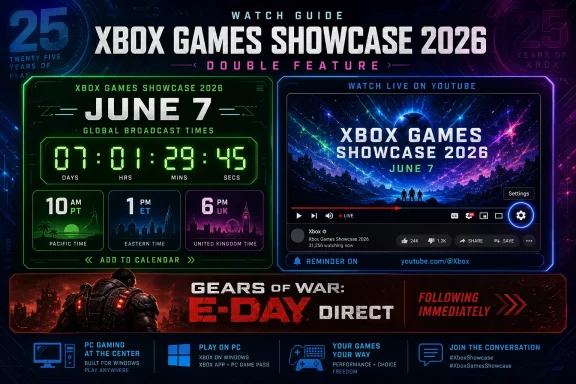 Microsoft Turns a Showcase Into a Two-Part Programming Block
The headline detail is the timing. Xbox Games Showcase 2026 begins on Sunday, June 7, at 10 a.m. Pacific, 1 p.m. Eastern, and 6 p.m. UK time. Microsoft’s official Xbox Wire post says the Gears of War: E-Day Direct follows immediately after, which means viewers should not hunt for a second starting time or assume there will be a meaningful gap.That “immediately after” is doing a lot of work. In practice, it means Microsoft wants the audience to understand the showcase and the Direct as a single event with two editorial modes: a broad platform-wide reveal show first, then a focused deep dive into one of Xbox’s signature franchises. If you are planning your day around it, block out enough time for both rather than treating E-Day as optional bonus material.
The first action step is basic but important. Open the official Xbox YouTube channel before the scheduled start time, confirm you are on the live event page, and use the YouTube gear icon in the lower-right corner of the player to select available region or language options. Xbox Wire specifically points viewers to that gear icon as the simplest route for language selection on the official Xbox YouTube stream.
If you miss the start, do not waste time chasing clipped social posts in random order. Microsoft said a full show recap would be published immediately after the broadcast, and that is the cleanest way to reconstruct what happened without confusing teaser footage, reaction posts, and speculation for actual announcements.
The Best Seat Is the One That Lets You Verify the Details
The official Xbox YouTube stream is the safest default because Microsoft explicitly names it and because it gives viewers the language-selection path through the player controls. That may sound pedestrian, but it is the difference between watching the show and watching a distorted version of the show filtered through someone else’s captions, compression, or commentary.For enthusiasts, YouTube also tends to be the most convenient place to pause, rewind, and cross-check a reveal while the stream is still moving. That matters during a showcase packed with world premieres and gameplay cuts, where a platform logo, availability line, or “coming to” slate can change the meaning of an announcement. The point is not just to be first; it is to avoid misreading a trailer’s final three seconds.
For sysadmins and IT pros who follow Xbox less as a fandom and more as part of Microsoft’s consumer-platform strategy, the official stream is also the least noisy feed. Microsoft’s gaming events increasingly intersect with Windows, cloud, accounts, storefronts, cross-device identity, and subscription positioning. Watching the canonical feed reduces the odds of mistaking streamer commentary for corporate messaging.
The same advice applies if you are watching in a shared workspace, on a living-room PC, or from a handheld. Set the stream early, check audio, verify captions or language options, and leave the player alone when the main showcase transitions into the Gears of War: E-Day Direct. The show has already been programmed as a double feature; the viewer’s job is to avoid breaking that continuity.
The Gears Direct Is the Signal, Not the Afterparty
A single-game Direct immediately after the main showcase tells us something about Microsoft’s priorities even before the footage rolls. The broad showcase is where Xbox can present the size of the portfolio; the Gears of War: E-Day Direct is where it can argue for depth. That split lets Microsoft satisfy two audiences without forcing one format to do everything.For long-time Xbox watchers, this is familiar stagecraft. The big June event is about momentum, but the post-show Direct is about confidence: Microsoft is saying this one title can sustain a deeper look once the montage energy fades. With Gears of War: E-Day, that confidence is especially visible because the franchise carries old Xbox identity into Microsoft’s modern, multi-device gaming pitch.
The Windows angle is not that every Gears announcement automatically becomes a PC strategy statement. The sharper point is that Xbox’s most important first-party brands now live in a world where Windows users, console players, cloud users, and subscription customers are often addressed in the same marketing breath. A focused Direct gives Microsoft room to clarify gameplay, tone, scope, and platform posture in ways a two-minute trailer cannot.
WindowsForum has followed this shift across recent Xbox events, especially as Microsoft’s showcases have leaned harder into PC gaming, cross-platform availability, and the idea of Xbox as a service layer rather than just a console brand. The 2026 double feature should be read in that lineage: not as one more livestream, but as another proof point in Microsoft’s long campaign to make Xbox feel native wherever Windows users play.
The Recap Is the Safety Net for Anyone Who Cannot Watch Live
The most useful detail for busy readers may be the recap plan. Microsoft said a full show recap would appear immediately after the broadcast, which means the official summary should become the fastest low-friction catch-up path once the stream ends. If you cannot watch live, that recap is where to start.That is particularly important because gaming showcases generate a lot of low-quality information in real time. Social feeds will slice the show into out-of-context trailer captures, premature platform assumptions, and wish-list interpretation. The official recap will not be neutral in tone — it is Microsoft’s own packaging — but it should be authoritative on what was actually announced.
The right catch-up sequence is therefore straightforward. Read the full recap first, then watch the trailers or segments that matter to you, then compare community reaction afterward. Reversing that order is how viewers end up believing a rumor, a joke, or a clipped transition screen before they have seen the actual announcement.
For IT pros and serious enthusiasts, the recap also serves as a filtering tool. It lets you separate announcements that are merely exciting from announcements that require action: wish-listing a title, checking PC requirements later, watching for Game Pass details, or noting whether a Microsoft franchise is being positioned around console, PC, cloud, or some combination of all three. Microsoft’s recap should be the map; community debate can be the weather.
A 25th Anniversary Show Carries More Than Nostalgia
Xbox Wire framed the 2026 showcase as part of Xbox’s 25th-anniversary moment, and that framing is not incidental. Anniversary shows invite nostalgia, but they also create pressure. Microsoft is not just reminding players what Xbox was; it is trying to demonstrate what Xbox means after years of platform expansion, studio acquisitions, subscription strategy, PC emphasis, and uneven hardware narratives.That makes the “world premieres, new gameplay, and fresh updates” promise worth reading carefully. World premieres create attention. Gameplay creates credibility. Updates reassure players that already-announced projects still exist and still fit into the release pipeline. The mix matters more than any single trailer because it tells us whether Microsoft is balancing spectacle with execution.
For Windows users, the most relevant announcements are often the ones that look least dramatic on stage. A platform availability line, a day-one subscription note, a PC feature mention, or a cross-save implication can matter more than a cinematic reveal. The showcase format rewards emotional reaction; the WindowsForum read should reward operational detail.
That is why older WindowsForum coverage of the 2025 showcase and partner-focused Xbox events remains useful context. Those events showed Microsoft continuing to define Xbox around PC reach, Game Pass placement, Play Anywhere-style convenience, and a broader device story. The 2026 show sits inside that same strategic arc, whether or not every trailer says the quiet part loudly.
The Smart Viewer Watches for Commitments, Not Just Trailers
The modern Xbox showcase is a marketing event, but it is also a commitment-management exercise. Every reveal implicitly asks players to believe that Microsoft and its partners can ship, support, and sustain what they are showing. That is why the details around timing, gameplay, and post-show coverage matter more than the hype language.A world premiere is useful only if it eventually turns into a coherent product. New gameplay matters because it is harder to fake than tone-setting cinematics. Fresh updates matter because they tell players which projects are still moving and which are close enough to talk about again. The show’s value is not the number of announcements; it is the number of announcements that survive contact with the calendar.
Viewers should also watch how Microsoft sequences its own franchises against partner projects. A 25th-anniversary framing naturally tempts the company to lean on legacy, but Xbox’s future depends on whether the old names can coexist with new bets, PC-first habits, and a less console-bound audience. The Gears of War: E-Day Direct gives Microsoft one obvious legacy anchor; the broader showcase has to show the rest of the machine.
That matters for administrators and power users because consumer gaming strategy often foreshadows Microsoft’s platform priorities. Account systems, storefront behavior, cloud services, controller support, handheld experiences, and Windows gaming polish all sit behind the splashy trailers. A showcase will not document those systems like a technical manual, but it can reveal where Microsoft wants attention to move.
Co-Streaming Is Convenient, but the Official Feed Is the Record
Co-streams are often the most fun way to experience a showcase, especially if you want live commentary and community energy. They are not, however, the best way to capture what Microsoft actually said. If you care about accuracy, keep the official Xbox feed open somewhere, even if your main screen is a creator’s reaction stream.This is especially true for language and accessibility options. Xbox Wire points viewers to official channels and the YouTube gear icon for region and language selection, which means the official player is the known baseline. A co-stream may add value, but it may also introduce delay, audio ducking, commentary over key lines, or incomplete captions.
For anyone posting summaries, moderating discussion, or updating a community thread, the best workflow is disciplined. Watch the official stream, jot down only confirmed details, wait for the recap, then revise. The few minutes saved by racing to post unverified claims are rarely worth the cleanup afterward.
WindowsForum readers know this pattern from update rollouts and preview builds as much as from game events. The first wave of chatter is useful for temperature; the official post is useful for facts. Treat the Xbox showcase the same way you would treat a Microsoft release note: interesting live, but not fully stable until the written record appears.
The Practical Plan for Watching Xbox’s 2026 Double Feature
The cleanest way to follow the Xbox Games Showcase 2026 is to plan around the double feature and avoid switching sources midstream. Microsoft has already provided the essential skeleton: the main showcase starts on June 7 at 10 a.m. Pacific, 1 p.m. Eastern, and 6 p.m. UK time; Gears of War: E-Day Direct follows immediately; the official Xbox YouTube stream includes language selection through the player’s gear icon; and a full recap follows the broadcast.- Open the official Xbox YouTube channel before the scheduled start time and confirm you are on the live Xbox Games Showcase 2026 stream.
- Use the gear icon in the lower-right corner of the YouTube player to choose the available region, language, caption, or audio options that best fit your viewing setup.
- Keep the stream running after the main showcase ends because Gears of War: E-Day Direct is scheduled to follow immediately rather than at a separately announced later time.
- If you cannot watch live, start with Microsoft’s full recap immediately after the broadcast before relying on social clips or commentary threads.
- When sorting the announcements, pay special attention to gameplay footage, platform wording, PC relevance, Game Pass implications, and whether Microsoft is making a firm commitment or simply setting a mood.
- Treat the 25th-anniversary framing as both celebration and strategy, because Microsoft is using nostalgia to support a broader Xbox identity across console, PC, and connected services.
References
- Primary source: pcgamer.com
How to watch the Xbox Games Showcase | PC Gamer
Here's when and where you can watch the Xbox livestream during SGF 2026.www.pcgamer.com - Independent coverage: windowscentral.com
Xbox Games Showcase 2026: Predictions, hopes, dreams — and what I think you should expect | Windows Central
The Xbox Games Showcase is pulling into view. Every year, people talk about how important these shows are for Microsoft, but with Xbox's 25th anniversary and a new direction ... there's a lot riding on this one.www.windowscentral.com - Independent coverage: gamesradar.com
How to watch the PlayStation State of Play for June 2026 – and what to expect from Sony's 60-minute showcase beyond Marvel's Wolverine | GamesRadar+
Bring back Ape Escapewww.gamesradar.com - Independent coverage: tomsguide.com
Summer Game Fest 2026 updates — Final Fantasy Revelation, Resident Evil Code Veronica Remake and every announcement | Tom's Guide
Summer Game Fest 2026 was packed with new reveals and trailerswww.tomsguide.com - Independent coverage: news.xbox.com
DMZ - New Intel on Call of Duty’s Extraction Shooter Experience - XBOX Wire
Today at #XBOXGamesShowcase, Activision and Infinity Ward revealed the first look at DMZ, the definitive Call of Duty extraction shooter experience. Learn more:news.xbox.com - Primary source: WindowsForum
Xbox Games Showcase 2024: What to Expect | Windows Forum
The thread centers on expectations for the June 9, 2024 Xbox Games Showcase, including timing, where to watch it, and what Microsoft and major publisher...windowsforum.com
