

Microsoft’s latest Xbox restructuring, announced July 6, 2026, will cut roughly 3,200 gaming jobs over the fiscal year, with Windows Central and Game Informer reporting that id Software, the DOOM studio behind DOOM: The Dark Ages, lost about half its staff. The timing could hardly be more brutal: id’s Revelations DLC arrived July 7, one day after the cuts began. That collision of launch-day marketing and layoff-day reality is why one id developer’s “We hope our pain was worth it” landed with such force. It crystallized the central contradiction of Microsoft’s gaming strategy: Xbox keeps buying prestige, then treating the people who create it as a line item to be optimized.
The grim symbolism is almost too neat. DOOM: The Dark Ages | Revelations was built to extend one of Microsoft’s strongest gaming properties, a franchise that still carries technical credibility, brand recognition, and cross-platform sales power. Instead, the expansion’s launch became inseparable from reports that id Software itself had been heavily reduced.
Windows Central reported that the cuts hit both game developers and staff working on id Tech, the in-house engine lineage that has powered not just modern DOOM but also adjacent Bethesda projects. Game Informer separately reported that id had lost roughly half its staff and noted that Bethesda and ZeniMax had been contacted for comment. Even allowing for the uncertainty that follows fast-moving layoff reporting, the picture is clear enough: this was not a trim around the edges.
That is what makes the response from gameplay animator Skai Chow so potent. Chow’s post was not a spreadsheet argument about margins or headcount allocation. It was a rebuke to the idea that layoffs become wise simply because executives call them a reset.
The line “We hope our pain was worth it” is devastating because it turns corporate abstraction back into human consequence. Xbox’s restructuring memo can speak in the language of overextension, margin pressure, and simplified systems. A developer who just watched colleagues lose jobs can speak in the language of injury.
The company’s case is not impossible to understand. Microsoft built one of the largest studio portfolios in the industry through Bethesda parent ZeniMax, Activision Blizzard, and a long list of internal and acquired teams. The Game Pass era encouraged a belief that content volume, subscription growth, and ecosystem lock-in would eventually justify the spending. That theory has been under pressure for years.
But the problem for Microsoft is that “reset” has become a recurring ritual rather than a turning point. Chow’s post highlighted previous rounds of Microsoft and Xbox cuts stretching back to 2023, including the 10,000 companywide layoffs in January 2023, the 1,900 gaming layoffs in early 2024, and the closure or disruption of several Bethesda-linked studios later that year. In 2025, Microsoft also shuttered The Initiative and canceled projects, according to contemporary coverage.
That history matters because each round was sold, implicitly or explicitly, as a step toward discipline. Each was supposed to sharpen focus, reduce duplication, and reposition Xbox for the next phase. The uncomfortable question is why the next phase keeps requiring another mass layoff.
DOOM 2016 restored the series with an unusually successful reboot. DOOM Eternal expanded that formula into a faster, more demanding combat puzzle. DOOM: The Dark Ages pushed the franchise into a heavier, medieval-flavored prequel while remaining one of the marquee Bethesda releases under Microsoft’s ownership. This is not a forgotten asset in the back of the catalog.
That is why the id Tech cuts sting beyond DOOM fandom. id Tech is not merely a development tool; it is part of id’s institutional advantage. In an industry increasingly dependent on Unreal Engine standardization, id Tech represents a rare, high-performance internal engine culture with decades of lineage.
Cutting into that capability suggests something deeper than ordinary project-based restructuring. It hints that Microsoft is not only deciding which games to make, but also which forms of technical independence it is willing to preserve. For Windows enthusiasts and PC gamers, that should set off alarms: the studios that make PC games feel exceptional often do so because they have stubborn, expensive, specialized engineering cultures.
There is a familiar online pattern after layoffs. Fans who are unhappy with a platform’s direction decide that mass firings are evidence of long-overdue seriousness. They imagine the cuts falling on nameless bureaucrats, bad managers, redundant staff, or the people responsible for games they did not like. The reality is messier and uglier.
Layoffs do not arrive with moral precision. They hit engineers maintaining tools, animators finishing content, producers keeping impossible schedules from collapsing, QA veterans who know where the bodies are buried, and junior developers who had no say in strategy. Even when a business case exists, the idea that outsiders should cheer the pain is grotesque.
The gaming industry has trained fans to think like miniature investors. They discuss attach rates, subscription growth, monthly active users, margins, and platform strategy as if they were sitting in the boardroom. But when the cost of those strategies arrives, it lands on workers first.
A subscription catalog needs regular content. Big first-party games need time, stability, and enormous budgets. Smaller studios need breathing room to make the kind of distinctive projects that justify their existence. Platform holders need profit. Those needs do not always point in the same direction.
The Bethesda and Activision acquisitions made Xbox bigger, but bigger is not the same as healthier. Microsoft suddenly had more franchises, more teams, more engines, more middle management, more overlapping publishing structures, and more projects competing for executive attention. If Xbox leadership now says the organization became overextended and overly complex, that is plausible.
But plausibility is not absolution. Microsoft chose this strategy. It spent the money, made the promises, and sold regulators and players on the idea that its stewardship would strengthen access to games. When the correction comes in the form of thousands of workers losing jobs, the company cannot pretend the overextension happened by accident.
That matters because divestiture is different from cancellation. It says Microsoft may no longer believe it is the best owner for certain types of studios, especially those making smaller, riskier, or less obviously scalable games. Axios reported language from Sharma’s memo suggesting Xbox had learned it was not the best home for every type of studio.
There is an argument that some teams may survive better outside Microsoft than inside it. If new ownership protects their projects and staff, that outcome is preferable to closure. But it also marks a retreat from the expansive vision Microsoft spent years promoting.
Xbox once positioned itself as the platform that could support creative breadth because it had the balance sheet to do so. The new message is narrower: Microsoft wants fewer bets, clearer margins, bigger franchises, and less internal friction. That may be rational business. It is also a smaller cultural proposition.
When a less visible team is cut, companies can imply that the work was redundant or strategically misaligned. With id, that argument is harder. The studio had just shipped a major game and a new expansion. The franchise remains one of Bethesda’s clearest success stories. The engine work has broader historical importance.
That does not mean id was immune to cost pressure. No studio is. But it does mean Microsoft’s cuts cannot be explained solely as pruning failure. If a studio like id can reportedly be halved immediately after delivering premium content, then success is not a shield.
That is the message developers across the industry will hear. Ship the game, hit the date, support the expansion, uphold the brand — and you may still be gone when the spreadsheet changes.
Modern id Tech has earned respect because DOOM games tend to run exceptionally well across a wide range of hardware. In an era when PC launches are too often defined by shader compilation stutter, bloated requirements, and uneven optimization, that matters. A studio with deep engine expertise is a hedge against industry sameness.
If Microsoft reduces the people maintaining that expertise, the consequence may not show up tomorrow. Revelations is already built. The next patch may still arrive. The next DOOM may still be greenlit.
The risk is longer-term erosion. Engine cultures depend on continuity. Lose enough people who understand the renderer, the tools, the asset pipeline, the profiling habits, the platform-specific compromises, and the studio’s unwritten rules, and you do not simply hire replacements next quarter. You rebuild memory, slowly and expensively, if you rebuild it at all.
But by 2026, the “pandemic hangover” explanation has become both true and insufficient. It explains the origin of overhiring. It does not explain why the burden keeps falling so heavily on workers while executive strategies reset again and again.
Microsoft is not a fragile publisher trying to survive one failed bet. It is one of the world’s largest technology companies, with cloud, enterprise software, AI infrastructure, and operating-system businesses that dwarf most entertainment companies. That scale does not make every gaming job economically sacred. It does make the repeated trauma harder to frame as unavoidable fate.
When a company with Microsoft’s resources buys aggressively, restructures repeatedly, and then asks workers to absorb the consequences, skepticism is not anti-business. It is basic accountability.
That strategic pivot may be necessary. Xbox hardware has faced pressure, and Microsoft’s broader gaming ambitions increasingly look like a content, services, and distribution business rather than a console-first operation. The problem is that this transition creates confusion about what Xbox is for.
If Xbox is a platform, it needs identity and loyalty. If Xbox is a publisher, it needs disciplined production and hit management. If Xbox is a subscription service, it needs steady content at sustainable cost. If Xbox is a Windows gaming ecosystem, it needs technical excellence and developer trust.
Trying to be all of those things at once is expensive. Cutting thousands of people may reduce costs, but it does not automatically resolve the identity problem. It may even deepen it if the cuts damage the very studios that gave Xbox cultural credibility.
Games are made through accumulated judgment. A combat designer learns why one enemy pressure pattern works and another feels cheap. An animator learns how to sell weight in a 12-frame transition. An engine programmer knows which optimization trick will break under a certain GPU driver. A producer knows which team combination can actually ship the impossible thing everyone has already promised.
When layoffs scatter that knowledge, the damage is not limited to payroll. It affects schedules, quality, morale, and institutional confidence. The people left behind have to keep shipping while absorbing survivor’s guilt and extra work. The people cut carry portfolios, severance anxieties, visa concerns, relocation problems, and the emotional whiplash of being told their labor mattered until it didn’t.
That is why Chow’s post resonated. It did not offer a grand theory of Xbox’s future. It punctured the fiction that layoffs are clean instruments of progress.
DOOM fans may be furious this week and still buy the next DOOM. Xbox subscribers may dislike the layoffs and still keep Game Pass because the library is useful. PC players may condemn the cuts and still judge each release by price, performance, and review scores. Consumer behavior rarely maps cleanly onto labor solidarity.
Microsoft’s challenge is that cumulative damage is harder to measure. Each round of layoffs teaches developers something about the company. Each studio closure changes how recruits evaluate an offer. Each abrupt pivot makes creative leaders more cautious. Each cut to a technical team risks future quality in ways that may not be obvious until years later.
Players may move on faster than workers do. But studios are built by workers, not sentiment dashboards.
But the launch now carries an unintended second meaning. It is a showcase for a studio whose future has reportedly been materially altered. Every polished arena and tuned encounter is evidence of the craft Microsoft just reduced.
That does not mean players should boycott the DLC or treat enjoyment as betrayal. Developers generally want people to play the work they made. The more honest response is to hold both truths at once: the game can be excellent, and the treatment of its makers can be unacceptable.
This is the adult version of fandom. It resists the lazy binary where loving a game means defending the company, and criticizing the company means rejecting the game. DOOM deserves better than that, and so do the people who built it.
That future would need more than better messaging. It would require a portfolio strategy that distinguishes between blockbuster bets, technical platform investments, experimental studios, and subscription fillers without pretending they all obey the same financial logic. It would require Microsoft to stop using acquisitions as a substitute for coherence. It would require leadership to explain what Xbox is becoming in terms that developers, not just investors, can believe.
There is also a trust problem. Developers looking at id Software will ask what counts as success. If shipping a major DOOM release and DLC does not protect a studio from deep cuts, then the bargain between labor and corporation becomes brutally thin.
Xbox’s defenders may argue that hard changes are necessary to avoid a worse collapse later. Perhaps. But a reset that destroys confidence in the organization’s judgment is not automatically renewal. Sometimes it is just contraction with better branding.
The industry will spend the next few weeks arguing over whether Sharma’s reset is strategically sound. That debate matters, but it should not bury the simpler lesson. A company can be right that its structure is broken and still be accountable for how it breaks people while fixing it.
For Windows users, PC gamers, and Xbox loyalists, the story is not just about sympathy. It is about product quality, technical depth, and whether Microsoft’s gaming division can preserve the human systems that make great software possible.
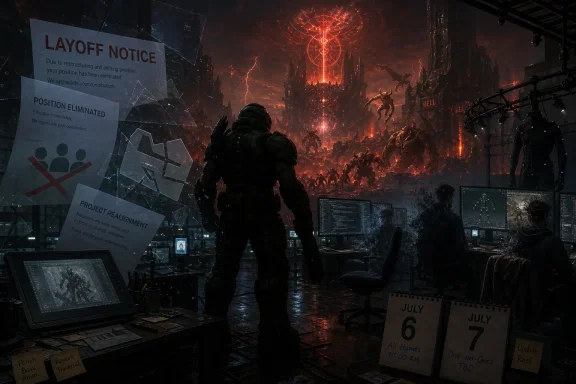 The Slayer Arrived Just as the Studio Was Cut Down
The grim symbolism is almost too neat. DOOM: The Dark Ages | Revelations was built to extend one of Microsoft’s strongest gaming properties, a franchise that still carries technical credibility, brand recognition, and cross-platform sales power. Instead, the expansion’s launch became inseparable from reports that id Software itself had been heavily reduced.Windows Central reported that the cuts hit both game developers and staff working on id Tech, the in-house engine lineage that has powered not just modern DOOM but also adjacent Bethesda projects. Game Informer separately reported that id had lost roughly half its staff and noted that Bethesda and ZeniMax had been contacted for comment. Even allowing for the uncertainty that follows fast-moving layoff reporting, the picture is clear enough: this was not a trim around the edges.
That is what makes the response from gameplay animator Skai Chow so potent. Chow’s post was not a spreadsheet argument about margins or headcount allocation. It was a rebuke to the idea that layoffs become wise simply because executives call them a reset.
The line “We hope our pain was worth it” is devastating because it turns corporate abstraction back into human consequence. Xbox’s restructuring memo can speak in the language of overextension, margin pressure, and simplified systems. A developer who just watched colleagues lose jobs can speak in the language of injury.
Microsoft’s Reset Sounds Familiar Because It Is Familiar
According to reporting from Axios, PC Gamer, Tom’s Hardware, GeekWire, and Windows Central, new Xbox chief Asha Sharma framed the cuts as a painful but necessary reset after years of expansion, internal complexity, and weak returns from parts of the studio portfolio. The numbers being reported are stark: 3,200 Xbox and gaming roles over the fiscal year, with about half cut immediately and the rest to follow later.The company’s case is not impossible to understand. Microsoft built one of the largest studio portfolios in the industry through Bethesda parent ZeniMax, Activision Blizzard, and a long list of internal and acquired teams. The Game Pass era encouraged a belief that content volume, subscription growth, and ecosystem lock-in would eventually justify the spending. That theory has been under pressure for years.
But the problem for Microsoft is that “reset” has become a recurring ritual rather than a turning point. Chow’s post highlighted previous rounds of Microsoft and Xbox cuts stretching back to 2023, including the 10,000 companywide layoffs in January 2023, the 1,900 gaming layoffs in early 2024, and the closure or disruption of several Bethesda-linked studios later that year. In 2025, Microsoft also shuttered The Initiative and canceled projects, according to contemporary coverage.
That history matters because each round was sold, implicitly or explicitly, as a step toward discipline. Each was supposed to sharpen focus, reduce duplication, and reposition Xbox for the next phase. The uncomfortable question is why the next phase keeps requiring another mass layoff.
id Software Was Supposed to Be the Safe Bet
If layoffs had hit only dormant projects, struggling experiments, or studios without a recent commercial identity, the backlash would still be fierce but easier to rationalize. id Software is different. It is one of the few studios in the Microsoft portfolio with a clean modern identity: technically sophisticated shooters, reliable brand recognition, and a visible role in Xbox’s premium catalog.DOOM 2016 restored the series with an unusually successful reboot. DOOM Eternal expanded that formula into a faster, more demanding combat puzzle. DOOM: The Dark Ages pushed the franchise into a heavier, medieval-flavored prequel while remaining one of the marquee Bethesda releases under Microsoft’s ownership. This is not a forgotten asset in the back of the catalog.
That is why the id Tech cuts sting beyond DOOM fandom. id Tech is not merely a development tool; it is part of id’s institutional advantage. In an industry increasingly dependent on Unreal Engine standardization, id Tech represents a rare, high-performance internal engine culture with decades of lineage.
Cutting into that capability suggests something deeper than ordinary project-based restructuring. It hints that Microsoft is not only deciding which games to make, but also which forms of technical independence it is willing to preserve. For Windows enthusiasts and PC gamers, that should set off alarms: the studios that make PC games feel exceptional often do so because they have stubborn, expensive, specialized engineering cultures.
The Fan Applause Was the Spark, Not the Fire
Chow’s criticism was aimed partly at people outside game development who were “celebrating and worshipping” the layoffs as necessary change. That detail is important. The post was not merely anti-Microsoft; it was anti-spectator cruelty.There is a familiar online pattern after layoffs. Fans who are unhappy with a platform’s direction decide that mass firings are evidence of long-overdue seriousness. They imagine the cuts falling on nameless bureaucrats, bad managers, redundant staff, or the people responsible for games they did not like. The reality is messier and uglier.
Layoffs do not arrive with moral precision. They hit engineers maintaining tools, animators finishing content, producers keeping impossible schedules from collapsing, QA veterans who know where the bodies are buried, and junior developers who had no say in strategy. Even when a business case exists, the idea that outsiders should cheer the pain is grotesque.
The gaming industry has trained fans to think like miniature investors. They discuss attach rates, subscription growth, monthly active users, margins, and platform strategy as if they were sitting in the boardroom. But when the cost of those strategies arrives, it lands on workers first.
Game Pass Did Not Kill the Old Business; It Complicated It
Microsoft’s gaming problem is not simply that it bought too many studios. It is that it layered a subscription-first ambition on top of an industry still built around premium launches, platform royalties, live-service operations, and increasingly expensive development cycles. Game Pass was marketed as a consumer miracle. Internally, it appears to have been a much more difficult bargain.A subscription catalog needs regular content. Big first-party games need time, stability, and enormous budgets. Smaller studios need breathing room to make the kind of distinctive projects that justify their existence. Platform holders need profit. Those needs do not always point in the same direction.
The Bethesda and Activision acquisitions made Xbox bigger, but bigger is not the same as healthier. Microsoft suddenly had more franchises, more teams, more engines, more middle management, more overlapping publishing structures, and more projects competing for executive attention. If Xbox leadership now says the organization became overextended and overly complex, that is plausible.
But plausibility is not absolution. Microsoft chose this strategy. It spent the money, made the promises, and sold regulators and players on the idea that its stewardship would strengthen access to games. When the correction comes in the form of thousands of workers losing jobs, the company cannot pretend the overextension happened by accident.
The Studio Divestitures Show a Platform Holder in Retreat
The layoff wave is only part of the story. Multiple outlets reported that several Xbox Game Studios teams would leave the organization or move to new management, including names such as Compulsion Games, Double Fine, Ninja Theory, and Undead Labs. Reporting also indicated that Arkane’s situation was subject to consultation in France, where labor rules complicate rapid cuts.That matters because divestiture is different from cancellation. It says Microsoft may no longer believe it is the best owner for certain types of studios, especially those making smaller, riskier, or less obviously scalable games. Axios reported language from Sharma’s memo suggesting Xbox had learned it was not the best home for every type of studio.
There is an argument that some teams may survive better outside Microsoft than inside it. If new ownership protects their projects and staff, that outcome is preferable to closure. But it also marks a retreat from the expansive vision Microsoft spent years promoting.
Xbox once positioned itself as the platform that could support creative breadth because it had the balance sheet to do so. The new message is narrower: Microsoft wants fewer bets, clearer margins, bigger franchises, and less internal friction. That may be rational business. It is also a smaller cultural proposition.
The DOOM Case Cuts Through the Corporate Fog
The reason id Software has become the emotional center of this story is not only that DOOM is beloved. It is that DOOM is legible. Players understand what id makes, why it matters, and why its technical culture is valuable.When a less visible team is cut, companies can imply that the work was redundant or strategically misaligned. With id, that argument is harder. The studio had just shipped a major game and a new expansion. The franchise remains one of Bethesda’s clearest success stories. The engine work has broader historical importance.
That does not mean id was immune to cost pressure. No studio is. But it does mean Microsoft’s cuts cannot be explained solely as pruning failure. If a studio like id can reportedly be halved immediately after delivering premium content, then success is not a shield.
That is the message developers across the industry will hear. Ship the game, hit the date, support the expansion, uphold the brand — and you may still be gone when the spreadsheet changes.
Windows and PC Gamers Should Care About the Engine Layer
For WindowsForum readers, the id Tech angle deserves special attention. PC gaming history is inseparable from engine history, and id Software has been central to that story since the 1990s. Engines are not just middleware; they encode assumptions about performance, input latency, rendering, modifiability, scalability, and hardware ambition.Modern id Tech has earned respect because DOOM games tend to run exceptionally well across a wide range of hardware. In an era when PC launches are too often defined by shader compilation stutter, bloated requirements, and uneven optimization, that matters. A studio with deep engine expertise is a hedge against industry sameness.
If Microsoft reduces the people maintaining that expertise, the consequence may not show up tomorrow. Revelations is already built. The next patch may still arrive. The next DOOM may still be greenlit.
The risk is longer-term erosion. Engine cultures depend on continuity. Lose enough people who understand the renderer, the tools, the asset pipeline, the profiling habits, the platform-specific compromises, and the studio’s unwritten rules, and you do not simply hire replacements next quarter. You rebuild memory, slowly and expensively, if you rebuild it at all.
The Industry’s Pandemic Hangover Became a Permanent Excuse
It is true that the games industry overexpanded during the pandemic. Demand spiked, engagement rose, capital was cheap, and executives across the sector extrapolated temporary conditions into permanent growth assumptions. When players returned to older habits and interest rates changed the financing environment, companies began cutting.But by 2026, the “pandemic hangover” explanation has become both true and insufficient. It explains the origin of overhiring. It does not explain why the burden keeps falling so heavily on workers while executive strategies reset again and again.
Microsoft is not a fragile publisher trying to survive one failed bet. It is one of the world’s largest technology companies, with cloud, enterprise software, AI infrastructure, and operating-system businesses that dwarf most entertainment companies. That scale does not make every gaming job economically sacred. It does make the repeated trauma harder to frame as unavoidable fate.
When a company with Microsoft’s resources buys aggressively, restructures repeatedly, and then asks workers to absorb the consequences, skepticism is not anti-business. It is basic accountability.
The New Xbox Is Starting to Look Less Like a Console Business
Another reason this restructuring feels bigger than a layoff story is that Xbox itself is changing shape. The traditional console platform model — sell hardware, collect royalties, publish exclusives, build identity around the box — has been weakening for years. Microsoft has pushed PC, cloud, Game Pass, and rival-platform releases because the old model no longer offers enough growth.That strategic pivot may be necessary. Xbox hardware has faced pressure, and Microsoft’s broader gaming ambitions increasingly look like a content, services, and distribution business rather than a console-first operation. The problem is that this transition creates confusion about what Xbox is for.
If Xbox is a platform, it needs identity and loyalty. If Xbox is a publisher, it needs disciplined production and hit management. If Xbox is a subscription service, it needs steady content at sustainable cost. If Xbox is a Windows gaming ecosystem, it needs technical excellence and developer trust.
Trying to be all of those things at once is expensive. Cutting thousands of people may reduce costs, but it does not automatically resolve the identity problem. It may even deepen it if the cuts damage the very studios that gave Xbox cultural credibility.
The Human Cost Is Not a Sentimental Footnote
Corporate coverage often treats layoffs as an unfortunate but secondary detail in the story of strategic change. In games, that is especially misleading. Talent is not an interchangeable input; it is the product.Games are made through accumulated judgment. A combat designer learns why one enemy pressure pattern works and another feels cheap. An animator learns how to sell weight in a 12-frame transition. An engine programmer knows which optimization trick will break under a certain GPU driver. A producer knows which team combination can actually ship the impossible thing everyone has already promised.
When layoffs scatter that knowledge, the damage is not limited to payroll. It affects schedules, quality, morale, and institutional confidence. The people left behind have to keep shipping while absorbing survivor’s guilt and extra work. The people cut carry portfolios, severance anxieties, visa concerns, relocation problems, and the emotional whiplash of being told their labor mattered until it didn’t.
That is why Chow’s post resonated. It did not offer a grand theory of Xbox’s future. It punctured the fiction that layoffs are clean instruments of progress.
Microsoft’s Bet Is That Players Will Move On
The cynical calculation behind most gaming layoffs is that players have short memories. Anger spikes, social media burns hot, the next trailer arrives, and the audience returns. Companies know this because it usually works.DOOM fans may be furious this week and still buy the next DOOM. Xbox subscribers may dislike the layoffs and still keep Game Pass because the library is useful. PC players may condemn the cuts and still judge each release by price, performance, and review scores. Consumer behavior rarely maps cleanly onto labor solidarity.
Microsoft’s challenge is that cumulative damage is harder to measure. Each round of layoffs teaches developers something about the company. Each studio closure changes how recruits evaluate an offer. Each abrupt pivot makes creative leaders more cautious. Each cut to a technical team risks future quality in ways that may not be obvious until years later.
Players may move on faster than workers do. But studios are built by workers, not sentiment dashboards.
The Revelations Launch Now Carries Two Meanings
Bethesda’s official framing for Revelations is all metal spectacle: new campaign content, new combat tools, more Slayer mythology, and the usual promise of excess. On its own terms, that is exactly what DOOM marketing should be. The franchise has always turned fury into forward motion.But the launch now carries an unintended second meaning. It is a showcase for a studio whose future has reportedly been materially altered. Every polished arena and tuned encounter is evidence of the craft Microsoft just reduced.
That does not mean players should boycott the DLC or treat enjoyment as betrayal. Developers generally want people to play the work they made. The more honest response is to hold both truths at once: the game can be excellent, and the treatment of its makers can be unacceptable.
This is the adult version of fandom. It resists the lazy binary where loving a game means defending the company, and criticizing the company means rejecting the game. DOOM deserves better than that, and so do the people who built it.
The Real Test Comes After the Apology Tour
Microsoft can survive this week’s outrage. It has survived worse headlines. The harder test is whether Xbox can articulate a credible future that does not require another “painful reset” every twelve months.That future would need more than better messaging. It would require a portfolio strategy that distinguishes between blockbuster bets, technical platform investments, experimental studios, and subscription fillers without pretending they all obey the same financial logic. It would require Microsoft to stop using acquisitions as a substitute for coherence. It would require leadership to explain what Xbox is becoming in terms that developers, not just investors, can believe.
There is also a trust problem. Developers looking at id Software will ask what counts as success. If shipping a major DOOM release and DLC does not protect a studio from deep cuts, then the bargain between labor and corporation becomes brutally thin.
Xbox’s defenders may argue that hard changes are necessary to avoid a worse collapse later. Perhaps. But a reset that destroys confidence in the organization’s judgment is not automatically renewal. Sometimes it is just contraction with better branding.
The Message From id’s Layoff Week Is Impossible to Unhear
The immediate facts are concrete enough, even while some details remain subject to ongoing reporting: Microsoft announced its largest Xbox restructuring, thousands of gaming workers are affected, several studios are being moved out of the organization, and id Software was reportedly hit hard just as new DOOM content shipped. Windows Central’s report on Chow’s response gave the story its defining line, while Axios, PC Gamer, Tom’s Hardware, GeekWire, and Game Informer filled in the broader restructuring picture.The industry will spend the next few weeks arguing over whether Sharma’s reset is strategically sound. That debate matters, but it should not bury the simpler lesson. A company can be right that its structure is broken and still be accountable for how it breaks people while fixing it.
For Windows users, PC gamers, and Xbox loyalists, the story is not just about sympathy. It is about product quality, technical depth, and whether Microsoft’s gaming division can preserve the human systems that make great software possible.
The Bill for Xbox’s Reset Is Being Paid in Studio Memory
This week’s clearest takeaways are not hidden in the corporate memo. They are visible in the collision between id’s launch calendar and Microsoft’s layoff calendar.- Microsoft’s July 2026 Xbox restructuring is being reported as the largest in the brand’s history, with roughly 3,200 gaming roles affected over the fiscal year.
- Windows Central and Game Informer reported that id Software, the studio behind modern DOOM, lost roughly half its staff, including cuts touching development and engine work.
- DOOM: The Dark Ages | Revelations launched July 7, 2026, turning what should have been a straightforward content release into a symbol of the industry’s labor instability.
- Skai Chow’s “We hope our pain was worth it” response resonated because it challenged both Microsoft’s reset narrative and the fans treating layoffs as entertainment.
- The most important long-term risk is not one delayed patch or one canceled project, but the loss of institutional knowledge inside studios and engine teams that make technically ambitious games possible.
References
- Primary source: Windows Central
Published: 2026-07-07T18:52:08.077056
"We hope our pain was worth it": As Microsoft's Xbox layoffs axe half of id Software, one DOOM dev has a scathing message for anyone "celebrating" them | Windows Central
One DOOM gameplay animator has biting words for those "celebrating" layoffs at Xbox and id Software.www.windowscentral.com - Related coverage: axios.com
Microsoft dashes game developer dreams
Microsoft's M&A ambitions might be changes, as it revamps Xbox.www.axios.com
- Related coverage: tomshardware.com
Microsoft 'resets' Xbox by cutting 3,200 jobs this year, divesting five game studios — firm cites 'margins that are 3-10x lower than comparable platform and publishing businesses' | Tom's Hardware
1,600 jobs will be eliminated today, the rest throughout FY27www.tomshardware.com - Related coverage: pcgamer.com
Xbox is laying off 3,200 people and dumping 4 studios in 'the most significant restructure in Xbox history' | PC Gamer
Compulsion, Double Fine, Ninja Theory, and Undead Labs are out, and the future doesn't sound very good for Arkane either.www.pcgamer.com - Related coverage: gematsu.com
DOOM: The Dark Ages DLC ‘Revelations’ announced - Gematsu
Publisher Bethesda Softworks and developer id Software have announced DOOM: The Dark Ages paid downloadable content “Revelations” and the free “Ripatorium 3.0”…www.gematsu.com - Related coverage: games.gg
Doom: The Dark Ages Revelations DLC arrives July 7 with free Ripato... | GAMES.GG
Doom: The Dark Ages gets the Revelations DLC on July 7 for $19.99, introducing the Chain Spear weapon and new story content, plus a free Ripatorium 3.0 ...games.gg
- Related coverage: techspot.com
Microsoft is cutting 3,200 Xbox jobs and spinning off four game studios | TechSpot
In a public memo to Xbox employees, CEO Asha Sharma confirmed that Microsoft will eliminate approximately 3,200 positions across the gaming division between now and July 2027,...www.techspot.com - Related coverage: store.steampowered.com
Steam DLC Page: DOOM: The Dark Ages
store.steampowered.com
- Related coverage: gamespot.com
Doom: The Dark Ages Swaps The Shield For An Awesome-Looking Spear In New Revelations DLC - GameSpot
A year after release, Doom: The Dark Ages is getting its first big expansion that sends you back to hell.www.gamespot.com - Related coverage: gameinformer.com
Doom Developer id Software Reportedly Loses Roughly Half Its Staff To Layoffs
Xbox's massive layoffs hit the legendary developer behind Wolfenstein, Doom, and Quake hard.gameinformer.com - Related coverage: otakustudy.com
DOOM: The Dark Ages | Revelations Campaign DLC Arrives 8 July | The Otaku's Study
During the Xbox Showcase, id Software revealed DOOM: The Dark Ages | Revelations, a campaign DLC continuing the story of the DOOM Slayer. It is set to releasewww.otakustudy.com - Related coverage: gamingpromax.com
DOOM: The Dark Ages Revelations DLC Announced
DOOM: The Dark Ages Revelations DLC launches July 7, 2026. New campaign, Chain Spear weapon, new demons, Ripatorium 3.0, and full pricing details explained.gamingpromax.com - Related coverage: slayersclub.bethesda.net
DOOM: The Dark Ages | Revelations Preview
Uncover dark truths and pierce the ranks of Hell in DOOM: The Dark Ages | Revelations, an all-new DLC campaign expansion available July 7.slayersclub.bethesda.net - Related coverage: geekwire.com
A ‘painful’ reset for Xbox: 3,200 job cuts, studio spinoffs, and a vow to return to growth in 2027 – GeekWire
Xbox CEO Asha Sharma calls it the most significant restructuring in Xbox history: 3,200 job cuts, four studio spinoffs, a new COO, and a flattened management structure — all aimed at turning around a division she says has been losing 64 cents on every dollar invested in its studios.www.geekwire.com - Related coverage: gamesradar.com
Hell freezes over in Doom: The Dark Ages - Revelations, the shooter's first expansion coming this July | GamesRadar+
With a sick new spearwww.gamesradar.com - Related coverage: techxplore.com