

Microsoft appears to be preparing the boldest reinvention of the Xbox platform in a generation: a living‑room device that boots like a console but is, by design, a full Windows 11 PC under the hood — powered by a custom AMD APU codenamed Magnus and deployed across a family of first‑ and third‑party devices. ://www.pcgamer.com/hardware/amd-ceo-suggests-next-gen-xbox-will-launch-in-2027-the-premium-consoles-chip-is-progressing-well/)
The narrative behind “Xbox Magnus” grew from several converging signals: public announcements about a multi‑year engineering partnership between Microsoft and AMD, the arrival of Windows‑based handhelds shipped with an Xbox‑style full‑screen shell, and investigative reporting that describes a Gen‑10 Xbox running full Windows 11 by default with a controller‑first TV interface layered on top. Those pieces together suggest May from the traditional “sealed appliance” console model toward a flexible, cross‑device Xbox ecosystem.
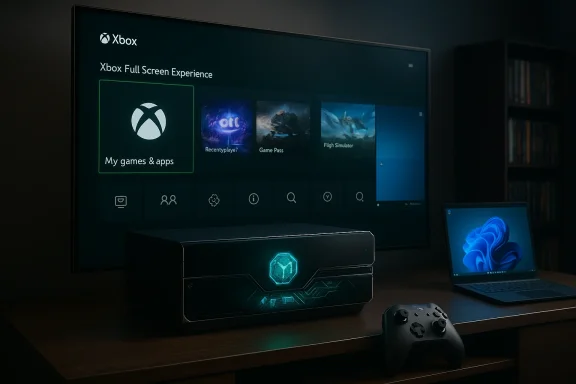
This is not mere speculation built on a single leak. Microsoft has already shipped and validated the idea of a controller‑first layer running over Windows: the Xbox Full Screen Experience (FSE) is now present on the ASUS ROG Xbox Ally handhelds and is expanding to other Windows 11 handheld and PC form factors as a preview of how a TV‑first front end can live on top of Windows. That practical testbed is central to the plausibility of a Windows‑rooted living‑room machine.
This duality is the headline innovation: a single SKU (and, critically, a family of SKUs) that can be both a living‑room console and a Windows workstation. For mainstream players the surface remains the familiar, frictionless Xbox experience; for power users and creators, the device becomes a versatile PC without changes to the hardware.
It’s important to be precise: the 2027 date comes from AMD’s public commentary and industry reporting, not a formal Microsoft product launch announcement. Industry timelines can slip, and Microsoft’s own software integration work — shaping Windows 11 to be sealed and polished in console mode — may be as big a gating factor as the chip supply chain. Treat the 2027 window as credible but provisional.
Caveat emptor: these leak numbers come from early engineering slides and enthusiast leaks and have a long history of shifting before retail silicon ships. Real‑world shipping parts are frequently trimmed for yield, power, or cost reasons. Treat the leaked Magnus specs as an engineering target, not a confirmed retail spec, until Microsoft or AMD publishes definitive documentation.
Think of this as an “Xbox family” strategy similar to Surface: Microsoft makes flagship products while partners expand the ecosystem with more differentiated, price‑segmented devices.
On timing, AMD’s public comment that development is “progressing well” and pointing to a 2027 horizon gives the clearest firm window available today. Multiple reputable outlets reported this same 2027 target after AMD’s investor remarks, making it the working industry timeline — again, subject to change. If Microsoft or AMD updates their guidance, the calendar may shift.
Yet the plan amplifies execution risk. Shipping a premium, Windows‑based living‑room machine requires Microsoft to solve hard problems in update reliability, driver QA, DRM/anti‑cheat cooperation, SKU parity, and consumer communications. The leaks about Magnus’ hardware promise significant capabilities, but leaked silicon targets and retail shipping parts often diverge. Until Microsoft and AMD publish final specs and a launch date, a balanced stance is prudent: this is a plausible and potentially transformative product idea — but one that hinges on flawless execution across hardware, operating system, and service layers.
Source: Letem světem Applem Xbox Magnus: Everything you need to know about the next generation of gaming console from Microsoftu
 Background
The narrative behind “Xbox Magnus” grew from several converging signals: public announcements about a multi‑year engineering partnership between Microsoft and AMD, the arrival of Windows‑based handhelds shipped with an Xbox‑style full‑screen shell, and investigative reporting that describes a Gen‑10 Xbox running full Windows 11 by default with a controller‑first TV interface layered on top. Those pieces together suggest May from the traditional “sealed appliance” console model toward a flexible, cross‑device Xbox ecosystem. This is not mere speculation built on a single leak. Microsoft has already shipped and validated the idea of a controller‑first layer running over Windows: the Xbox Full Screen Experience (FSE) is now present on the ASUS ROG Xbox Ally handhelds and is expanding to other Windows 11 handheld and PC form factors as a preview of how a TV‑first front end can live on top of Windows. That practical testbed is central to the plausibility of a Windows‑rooted living‑room machine.
What Microsoft is reportedly building: a console that is a PC
The two faces of the device
The design objective described in recent reporting is deceptively simple: when you power the device on, you arrive in a controller‑optimized, TV‑first Xbox interface that feels like a console — curated ot‑to‑game, and a simplified navigation model for players. Behind that shell, though, sits a full Windows 11 installation you can exit into at any time to access desktop apps, install third‑party PC stores, run creative software, or use the machine as a conventional PC. The experience is analogous in spirit to Valve’s desktop mode on the Steam Deck but implemented around Windows and Microsoft’s Xbox services.This duality is the headline innovation: a single SKU (and, critically, a family of SKUs) that can be both a living‑room console and a Windows workstation. For mainstream players the surface remains the familiar, frictionless Xbox experience; for power users and creators, the device becomes a versatile PC without changes to the hardware.
Why Microsoft would choose Windows 11
Windows is the obvious way to deliver that kind of flexibility. Windows already supports the major PC storefronts, a mature app ecosystem, and the desktop tools many creators and streamers depend on. Booting into a curated Xbox shell hides Windows’ complexity from casual players, while leaving the full Windows runtime available for users who want it. The Full Screen Experience (FSE) is Microsoft’s technical bridge: a controller‑first session posture that defers or disables non‑essentials so Windows behaves more like a console during gameplay.The Magnus SoC: AMD’s role and the leak landscape
AMD partnership and timeline
AMD’s involvement is a central pillar of the story. Public comments from AMD leadership indicate the company is co‑engineering a semi‑custom APU for Microsoft, and AMD has sairessing toward a 2027 timeframe — a statement many outlets interpreted as the first credible timeline for a retail launch. Those remarks are important: AMD has been Xbox’s historical silicon partner, and a confirmed co‑engineering relationship materially raises the plausibility of the Magnus roadmap.It’s important to be precise: the 2027 date comes from AMD’s public commentary and industry reporting, not a formal Microsoft product launch announcement. Industry timelines can slip, and Microsoft’s own software integration work — shaping Windows 11 to be sealed and polished in console mode — may be as big a gating factor as the chip supply chain. Treat the 2027 window as credible but provisional.
What the leaks say (and why to treat them cautiously)
Over the past year a series of leaks — many traced to the research of Moore’s Law Is Dead and amplified by tech outlets — have claimed detailed Magnus APU specifications. These numbers, if real, would represent a significant leap over current consoles:- A hybrid CPU cluster built on Zen‑class cores (reports suggest up to 3 high‑performance Zen 6 cores plus 8 Zen 6c efficiency cores).
- A next‑generation RDNA 5 GPU with roughly 68 compute units.
- A 192‑bit memory bus supporting up to 48 GB of GDDR7.
- An on‑chip Neural Processing Unit (NPU) with dual power modes (figures as high as 110 TOPS at peak in some leaks).
- A dual‑chiplet layout and estimated die area and TDP targets reported by leakers.
Caveat emptor: these leak numbers come from early engineering slides and enthusiast leaks and have a long history of shifting before retail silicon ships. Real‑world shipping parts are frequently trimmed for yield, power, or cost reasons. Treat the leaked Magnus specs as an engineering target, not a confirmed retail spec, until Microsoft or AMD publishes definitive documentation.
Software and UX: the Xbox Full Screen Experience and the “exit to Windows” promise
Xbox Full Screen Experience (FSE) as the console shell
Microsoft has already shipped FSE on handheld Windows devices — notably the ASUS ROG Xbox Ally and ROG Ally X — where the device boots directly into a controller‑first Xbox interface that defers non‑essential Windows services to prioritize gaming. Recent company announcements and platform updates show Microsoft is expanding FSE to more Windows handhelds and previewing the interface on other form factors. That rollout is not only a UX experiment but a technical proof that a Wiiven a console‑grade shell.How “exit to Windows” would work for players
Reports describe a one‑tap or one‑menu escape hatch from the console shell into the full Windows 11 desktop. Practically, that means:- Boot into the Xbox FSE and play with a streamlined, controller‑first UI.
- When ne” to run desktop apps, install non‑Xbox stores, or use productivity software.
- Return to FSE when you want a focused, console‑like experience.
Stores, libraries, and backward compatibility
Not a closed ecosystem
A major implications thread in all reporting is that a Windows‑rooted Xbox would not be restricted to a single storefront. In full Windows mode the device could run PC storefronts such as Steam, Epic Games Store, and the Microsoft Xbox Store. For gamers this means more choice: buy on Steam or Epic if you prefer, or use Xbox storefront and Game Pass for subscription access. The device’s ability to run PC titles broadens its immediate catalog beyond traditional console libraries.Backward compatibility without compromise?
Microsoft reportedly plans to preserve backward compatibility across generations: original Xbox, Xbox 360, Xbox One, and Xbox Series titles should run on Magnus devices. Because the platform would also be a Windows PC, traditional PC games and modware environment, giving users a significantly expanded library from day one. If implemented as described, that is one of the clearest consumer wins: your existing Xbox collection retains value, and you gain access to a huge catalog of PC titles.An “Xbox family” of devices: OEMs, handhelds, and the Surface analogy
Multiple SKUs and partner devices
Microsoft appears to be planning a portfolio approach rather than a single monolithic console SKU. Sources suggest a Microsoft‑designed premium baseline SKU and a validated module or certification program for OEM partners like ASUS, Lenovo, Razer, and others to produce Xbox‑branded Windows machines at various price points. The ASUS ROG Xbox Ally is already a real‑world demonstration of third‑party handheld hardware that uses Xbox’s FSE and brand integration.Think of this as an “Xbox family” strategy similar to Surface: Microsoft makes flagship products while partners expand the ecosystem with more differentiated, price‑segmented devices.
What this means for consumers
- More choice: buyers could select a Microsoft flagship console, a premium OEM “super‑console,” or budget and portable variants.
- Innovation at multiple price points: OEM competition can drive unique form factors and features.
- Fragmentation risks: different SKUs may have different thermal envelopes, GPU counts, and memory configurations, complicating expectations around performance parity.
Pricing, availability, and launch expectations
The price is unresolved. Industry chatter suggests Microsoft may position a premium Magnus‑based Xbox at a high price point (some speculation includes a $1,000 premium tier), while OEM partners and Microsoft’s continued support for the Xbox Series S would maintain an entry‑level path into the ecosystem. Those price figures remain spec treated as rumor until Microsoft confirms SKU pricing.On timing, AMD’s public comment that development is “progressing well” and pointing to a 2027 horizon gives the clearest firm window available today. Multiple reputable outlets reported this same 2027 target after AMD’s investor remarks, making it the working industry timeline — again, subject to change. If Microsoft or AMD updates their guidance, the calendar may shift.
Why this matters: players, creators, and developers
For players
- Choice and interoperability: access to Xbox services and PC stores on one device reduces friction to play across ecosystems.
- Library continuity: backward compatibility preserves player investments.
- Value for content creators: creators could plausibly record gameplay, then edit and publish from the same machine without transferring files to a separate PC, if Windows desktop access is as open as reported.
For developers
- One development target: studios that already build for Windows can more easily support an Xbox‑grade front end without a separate console port.
- Reduced platform lock‑in: non‑exclusive games won’t be forced into a single storefront unless developers choose otherwise.
- Middleware and tooling: shared PC tooling can speed ports and reduce QA complexity if Microsoft provides clear certification for OEM variants.
Risks, trade‑offs, and unanswered questions
No ambitious platform pivot is without hazard. Several practical and strategic risks deserve close attention.1) Complexity and reliability trade‑offs
Moving from a sealed console appliance to a full Windows platform raises the bar for integration and QA. Windows updates, driver stacks, third‑party apps, of the Windows ecosystem introduce many more variables than a locked console firmware. Microsoft’s promise of a finished “console mode” hides a huge software engineering challenge: ensuring the FSE and its deferred‑service model remain robust across thousands of apps and hardware permutations.2) Fragmentation and consumer confusion
A family of Xbox‑certified OEM devices with varying specs creates a richer choice landscape — and also the potential for confusion. Gamers may expect parity between Microsoft’s SKU and partner devices where it doesn’t exist, or assume all Xbox‑branded hardware runs titles identically. Clear SKU naming, transparent spec disclosure, and robust certification will be essential to avoid frustrated buyers.3) Pricing optics and market timing
A premium, PC‑grade living‑room console will be expensive to build. Memory budgets and a powerful APU increase BOM costs. If Microsoft prices a premium Magnus SKU aggressively high, it risks limiting mainstream adoption — a problem made worse if Sony and other competitors pursue different price strategies. Balancing a flagship product with accessible OEM variants will be politically and commercially delicate.4) DRM, anti‑cheat, and store politics
Running multiple storefronts and PC titles on console‑style hardware introduces friction points around anti‑cheat systems and DRM, especially for multiplayer titles. Microsoft must either broker technical compatibility with popular anti‑cheat vendors or define a developer policy that addresses cross‑store deployment. Store politics also matter: third‑party storefronts may work in Windows mode, but how those experiences integrate into the console shell and Xbox account system remains an open question.5) Privacy, telemetry, and update model
Windows carries a different update and telemetry model than traditional consoles. Players will want assurances about how updates are delivered, how telemetry is used, and how Microsoft will maintain a console‑grade update cadence without pushing disruptive desktop updates into the living room. Expect consumer and regulatory scrutiny on these fronts.Prat a typical user journey might look like
- Unbox a Magnus‑powered Xbox, plug it into the TV, and boot into the Xbox Full Screen Experience.
- Play Xbox Game Pass titles, enjoy fast resume and console overlays optimized for controllers.
- Open the Game Bar or a system menu and choose “Exit to Windows” to install a desktop video editor or a third‑party store client.
- Edit captured clips, upload to social platforms, or run a mod manager, then return to FSE and r. If you own a partner device (say an OEM “Xbox Pro” laptop), the experience is similar but may involve different thermal and performance trade‑offs.
Final analysis: opportunity vs. execution risk
Microsoft’s reported Magnus strategy is strategically coherent. It aligns with the company’s “Xbox Everywhere” ambition: make Xbox services ubiquitous, reduce artificial storefront lock‑in, and let hardware partners innovate on top of a shared software foundation. Technical proof points already exist — the Xbox Full Screen Experience on modern Windows handhelds is a functioning prototype of the core UX idea. The AMD partnership and public tcredibility.Yet the plan amplifies execution risk. Shipping a premium, Windows‑based living‑room machine requires Microsoft to solve hard problems in update reliability, driver QA, DRM/anti‑cheat cooperation, SKU parity, and consumer communications. The leaks about Magnus’ hardware promise significant capabilities, but leaked silicon targets and retail shipping parts often diverge. Until Microsoft and AMD publish final specs and a launch date, a balanced stance is prudent: this is a plausible and potentially transformative product idea — but one that hinges on flawless execution across hardware, operating system, and service layers.
What to watch next
- Formal confirmation from Microsoft about whether the next Xbox will ship with a full Windows 11 installation by default, and the exact consumer workflow for FSE vs. desktop mode.
- AMD or Microsoft release of validated Magnus APU specs, plus concrete TDP, memory, and NPU numbers to replace current leak‑level claims.
- Product announcements from OEM partners (ASUS, Lenovo, Razer) describing their own Xbox‑certified devices and pricing tiers.
- Microsoft’s roadmap for anti‑cheat, DRM, and update policies on Windows‑rooted Xbox devices to gauge multiplayer compatibility and long‑term maintenance.
Conclusion
Xbox Magnus, as described in recent reporting, would represent an industry‑level pivot: a console that is intentionally also a full Windows 11 PC, enabled by a bespoke AMD APU and an ecosystem of OEM partners. The promise is significant — a single device for living‑room play, PC gaming, and even creative work — but the engineering, operational, and market tests ahead are nontrivial. For players, the potential upside is enormous: broader choice, preserved libraries, and a new kind of hardware flexibility. For Microsoft, success will require turning a compelling prototype concept into a polished, predictable, and supported consumer product. Until we see retail SKUs, shipping specs, and Microsoft’s final software promises, the Magnus story is the most exciting rumor in gaming hardware today — and the one worth monitoring closely.Source: Letem světem Applem Xbox Magnus: Everything you need to know about the next generation of gaming console from Microsoftu
