

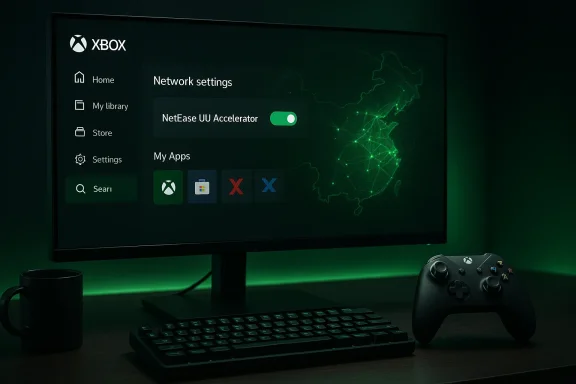
Microsoft’s Xbox division quietly shipped a meaningful — and regionally focused — quality-of-life update this week: the Xbox PC app in China now includes NetEase’s UU Accelerator as a built-in option, allowing users to route multiplayer and download traffic through NetEase’s gaming-optimized network without needing separate third‑party tools. The move is small in code but large in consequence: it removes a technical barrier that has frustrated Chinese PC players for years, while also formalizing a deeper commercial and operational alignment between two of the biggest players in global gaming.
China’s internet is fast on paper but complex in practice. Multiple backbone routes, congested international links, and the regulatory architecture often referred to as the Great Firewall create real-world routing quirks that raise latency, increase packet loss, and complicate matchmaking for games that rely on overseas or cross‑regional servers. For many Chinese players the simplest way to make online titles playable is to layer an optimization service — commonly called an “accelerator” — on top of the operating system. These services are widely used, well understood locally, and often sold as subscription products.
NetEase’s UU Accelerator is one of the most widely used products of this type. It works by intelligently routing game traffic via a network of optimized nodes, improving peering and avoiding congested paths so that round‑trip times and dropped connections fall. The dominant model in China has been third‑party accelerators running as separate apps or system‑level services that users must install, configure, and maintain themselves.
Embedding UU Accelerator directly inside the Xbox PC app changes that model. Instead of asking Chinese players to find, install, and trust a third‑party piece of software, Microsoft’s app now exposes acceleration as an integrated feature in the app’s UI. That means fewer support tickets, fewer setup errors, and a friendlier onboarding path for casual players who just want to join a match without worrying about whether the network will hold up.
Strategically, the move benefits both parties:
Privacy and data routing
This update also signals that Microsoft is willing to make pragmatic compromises: rather than building a bespoke accelerator or trying to abstract away local operator differences, it’s choosing to partner and let experts handle country‑specific plumbing. That can speed deployments and reduce time-to-experience for players, but it comes with the governance and transparency costs already discussed.
That said, the update raises important questions about transparency, dependence on paid third‑party services for a usable experience, and the long‑term implications of embedding commercial network services inside global platform software. Microsoft and NetEase can mitigate these risks with clear documentation, easy opt‑out controls, competitive openness, and defensible privacy practices.
For platform makers and publishers thinking about similar moves, the lesson is clear: regional integrations can deliver large user‑experience wins, but they must be executed with full visibility and a commitment to fairness. In markets where connectivity quirks materially affect playability, simply asking users to install third‑party tools is no longer acceptable. The future will reward platforms that solve those problems natively — while still protecting users’ choices, wallets, and privacy.
Source: Windows Central Xbox and NetEase deepen PC partnership in China
 Background: why a built-in accelerator matters in China
China’s internet is fast on paper but complex in practice. Multiple backbone routes, congested international links, and the regulatory architecture often referred to as the Great Firewall create real-world routing quirks that raise latency, increase packet loss, and complicate matchmaking for games that rely on overseas or cross‑regional servers. For many Chinese players the simplest way to make online titles playable is to layer an optimization service — commonly called an “accelerator” — on top of the operating system. These services are widely used, well understood locally, and often sold as subscription products.NetEase’s UU Accelerator is one of the most widely used products of this type. It works by intelligently routing game traffic via a network of optimized nodes, improving peering and avoiding congested paths so that round‑trip times and dropped connections fall. The dominant model in China has been third‑party accelerators running as separate apps or system‑level services that users must install, configure, and maintain themselves.
Embedding UU Accelerator directly inside the Xbox PC app changes that model. Instead of asking Chinese players to find, install, and trust a third‑party piece of software, Microsoft’s app now exposes acceleration as an integrated feature in the app’s UI. That means fewer support tickets, fewer setup errors, and a friendlier onboarding path for casual players who just want to join a match without worrying about whether the network will hold up.
Overview: what Microsoft actually did
- The Xbox PC app for China now includes NetEase’s UU Accelerator as an option inside the app interface.
- The integration allows the Xbox app to invoke UU services for in‑game traffic and for game downloads managed by the app.
- Early reports from users and Chinese outlets indicate the accelerator appears in sections such as the app’s “My Apps” or network settings, and that using the service may require a separate UU subscription — Microsoft does not sell or operate UU membership itself.
- The rollout was timed around the Lunar New Year season and accompanied by local branding that leans into regional messaging.
Technical primer: how network accelerators work (and what an integration can — and cannot — do
Network accelerators are not magic; they are practical engineering workarounds to imperfect internet topology. At a high level, these services:- Establish optimized multi‑hop paths between the player’s device and the target game server using a network of proxy/relay nodes.
- Select peers and routes based on real‑time measurements of latency, packet loss, and congestion.
- Use tunneling and protocol optimization to reduce retransmits and improve throughput for typical game patterns (small frequent packets, UDP streams).
- Offer local caching or parallel download channels to speed up large game downloads and resume interrupted transfers more reliably.
- Automatic activation based on game or server region without manual setup.
- Unified telemetry and error reporting that can help both Microsoft and NetEase diagnose issues.
- Streamlined user experience for subscription validation, node selection, and toggling acceleration on/off.
- Replace developer or server‑side optimizations that matter most for game responsiveness.
- Remove the need for regional network investments or edge servers for highly latency‑sensitive titles.
- Eliminate subscription costs if the accelerator remains a paid service.
The strategic context: why Xbox and NetEase are deepening ties
This integration comes on the heels of a broader thaw and renewed collaboration between Microsoft’s gaming arm and NetEase. After a high‑profile split and legal friction in earlier years over publishing arrangements, the two companies reached new agreements to relaunch major Blizzard titles in China and to explore bringing NetEase’s own games to Xbox platforms. The UU Accelerator integration is a concrete example of the two companies moving from negotiation to operational co‑delivery.Strategically, the move benefits both parties:
- Microsoft gains a localized capability that addresses one of the most visible everyday pain points for Chinese PC gamers, improving retention and reducing friction in the Xbox ecosystem.
- NetEase deepens its distribution footprint and reinforces UU Accelerator’s position as a standard local solution — and it benefits from the trust transfer that occurs when a global platform embeds a domestic provider.
- Players get an option that is less fiddly than the status quo: fewer separate installs, a single app to manage, and potentially better performance in multiplayer and downloads.
User experience: immediate benefits and practical details
From a player perspective, the value proposition is straightforward:- Lower friction: No more hunting for compatible accelerators, configuring kernel‑level drivers, or dealing with certificate warnings. Acceleration is discoverable in the Xbox app itself.
- Better day‑to‑day reliability: Players in congested or cross‑border routing scenarios should see fewer disconnects and more stable matchmaking.
- Smoother downloads: Large game downloads that fail or stall due to routing glitches can resume or run faster through optimized channels.
- The accelerator may require an existing UU subscription or membership to access premium nodes and routes.
- Microsoft’s app may surface the option and assist in enabling it, but billing for UU membership — if required — is still handled by NetEase.
- The integration is regionally limited: players outside mainland China are unlikely to benefit from this specific feature.
Strengths: why this is a smart, pragmatic move
- Localized problem, local solution: Microsoft recognized a geography‑specific pain point and chose to partner with the incumbent solution rather than forcing a one‑size‑fits‑all fix.
- Reduced user support burden: Fewer ad‑hoc accelerator setups means fewer help requests and less variability in player‑side environments.
- Faster time to benefit: Integrating an existing, mature network means Microsoft can improve user experience quickly without building infrastructure from scratch.
- Commercial alignment with long‑term goals: The partnership helps Microsoft accelerate engagement in China while supporting NetEase’s ecosystem play.
Risks, unknowns, and areas that require scrutiny
While the integration is promising, it opens a set of operational, privacy, and competition questions that deserve attention.Privacy and data routing
- What data flows through UU nodes? When a player enables acceleration, their game packets traverse NetEase’s network. Players should understand which metadata and payloads move through third‑party infrastructure and how long logs are retained.
- Transparency: Microsoft should clearly disclose what the integration does, whether traffic is proxied, and what telemetry is shared with NetEase.
- Cross‑border implications: For titles that communicate with services outside China, routing via UU may move traffic through different jurisdictions. Players — and regulators — will want clarity on where and how data is handled.
- Paywalling core functionality: If acceleration is essential to playing certain titles reliably in China, making it a paid add‑on effectively charges players to access a playable experience. Microsoft and NetEase must avoid creating a de facto pay‑to‑play dependency.
- Vendor lock‑in: Building platform‑level integrations with a single vendor risks creating lock‑in or privileging one domestic provider over others, which can have regulatory and market‑health implications.
- Single point of failure: Consolidating acceleration inside the Xbox app is convenient but could amplify the impact of outages or security incidents affecting UU.
- Supply chain trust: Embedded third‑party code/pathways must be audited and maintained; they add an operational surface for vulnerabilities.
- Compliance with local law: Any integration operating in China must meet local cybersecurity and content rules. Microsoft has demonstrated an appetite for localization, but the specifics of data handling will matter to both users and authorities.
- Antitrust/regulatory optics: Preferential integration with NetEase could attract scrutiny if competitors argue platform abuse or anti‑competitive practices.
- “First time” claims: Some commentary frames this as the first time a major platform integrated network acceleration at the app level. That assertion should be viewed carefully: other ecosystems have integrated performance and networking optimizations of various kinds, though this may be the most explicit consumer accelerator integration by a major console platform. It’s notable, but it’s prudent to avoid absolutist claims until a comprehensive survey of other platforms’ client‑level networking features is completed.
Implementation details Microsoft should publish (and why)
Transparency will be the best way to build user trust. Microsoft should publish a short, clear technical note that explains:- What traffic is routed through UU when the feature is enabled (game traffic, download traffic, both).
- Whether UU operates in a proxy/tunnel mode or through an SDK that accelerates selected flows.
- How subscription and billing works and whether trials or free tiers exist.
- What telemetry Microsoft collects and what it shares with NetEase.
- Failover behavior: What happens if UU nodes are unreachable? Does traffic fallback to native routing?
- How users can opt out or disable acceleration per app.
How other platforms should think about region-specific integrations
Region‑specific integrations are increasingly likely as major platforms chase growth in large, distinct markets. The Xbox‑NetEase example offers a template:- Partner with local incumbents to accelerate time to value.
- Keep the UX seamless and optional for users who prefer not to use the service.
- Be transparent about billing and data handling.
- Avoid hard dependencies where the integration becomes a requirement to play.
Practical advice for players and developers
For gamers in China- Try the accelerator with and without it for a few sessions to measure real‑world differences: latency, disconnect rates, and download stability.
- Check whether premium nodes or speed tiers are required to see meaningful improvement.
- Read Microsoft’s and NetEase’s published privacy and service notices before enabling the feature.
- Do not rely solely on client‑side acceleration to deliver acceptable latency. Server placement, authoritative tick rates, and region‑aware matchmaking remain critical.
- Use the integration as an opportunity: if your game experiences reduced latency for Chinese players, it can boost retention — but continue to invest in server‑side resilience.
- Consider telemetry hooks to detect whether players are using acceleration, and tailor match or server selection accordingly (but do so in a privacy‑respecting way).
Broader implications: localization as a multi‑layered strategy
Localization is often thought of as translation or culturally tuned marketing. The Xbox–NetEase integration shows localization can — and sometimes must — be infrastructure‑level. Platform providers that want sustainable, meaningful engagement in large markets must address operational realities: network topology, payment flows, regulatory constraints, and local trust models.This update also signals that Microsoft is willing to make pragmatic compromises: rather than building a bespoke accelerator or trying to abstract away local operator differences, it’s choosing to partner and let experts handle country‑specific plumbing. That can speed deployments and reduce time-to-experience for players, but it comes with the governance and transparency costs already discussed.
What to watch next
- Adoption metrics: How many Chinese Xbox PC app users enable UU, and does this translate into measurable engagement improvements?
- Pricing and bundling: Whether Microsoft, NetEase, or third parties offer bundled discounts or trials to smooth adoption.
- Expansion of integrations: Will Microsoft add other local partners in different regions, or will this model be rolled out to consoles as well as PC?
- Regulatory response: Whether Chinese regulators or consumer groups raise concerns about data routing, billing practices, or market competition.
- Technical disclosures: Will Microsoft publish the operational details needed to judge privacy and security impacts?
Final assessment
The integration of NetEase’s UU Accelerator into the Xbox PC app in China is a pragmatic, high‑impact move that directly addresses a persistent pain point for local players. It improves day‑to‑day usability and signals that Microsoft views localization as a deep, technical undertaking rather than a surface marketing effort. For NetEase, the partnership both legitimizes UU Accelerator further and tightens its role in the evolving Microsoft–NetEase relationship.That said, the update raises important questions about transparency, dependence on paid third‑party services for a usable experience, and the long‑term implications of embedding commercial network services inside global platform software. Microsoft and NetEase can mitigate these risks with clear documentation, easy opt‑out controls, competitive openness, and defensible privacy practices.
For platform makers and publishers thinking about similar moves, the lesson is clear: regional integrations can deliver large user‑experience wins, but they must be executed with full visibility and a commitment to fairness. In markets where connectivity quirks materially affect playability, simply asking users to install third‑party tools is no longer acceptable. The future will reward platforms that solve those problems natively — while still protecting users’ choices, wallets, and privacy.
Source: Windows Central Xbox and NetEase deepen PC partnership in China
