

S&P Global Market Intelligence’s Kagan unit forecasts worldwide console shipments will fall 19.5% in 2026, from 42.1 million units last year to 33.9 million. As reported by GamesIndustry.biz, the firm attributes the downturn to higher component costs, aging hardware, thin software calendars outside major releases, and little prospect of near-term price cuts.
Nintendo’s Switch 2 is still projected to lead the market with 17.1 million shipments in 2026. PlayStation 5 is forecast at 13.2 million, while Xbox Series X|S is expected to ship only 2.5 million units.
Kagan estimates Microsoft shipped 3.2 million Series X|S consoles in 2025, then dropped below 500,000 units in the first quarter of 2026—the lowest quarterly result in its dataset. The firm expects the current Xbox hardware line to wind down rapidly after this year.
Those are analyst estimates, not numbers Microsoft has published. Microsoft stopped regularly reporting Xbox hardware sales years ago, so they should be read as market-model projections rather than audited platform totals.
The forecast matters because it frames the next Xbox as a potentially narrower, more enthusiast-focused product. Kagan projects Microsoft’s reported next-generation effort, Project Helix, at roughly 2 million units in its launch year and 7.3 million annual units by 2030. The analyst cautioned that this is especially speculative because Microsoft’s final hardware design and distribution model remain unclear.
That distinction is important for Windows users. A PC-oriented Xbox could expand the market for games that run across Windows and a TV-friendly Xbox environment, but it would also place more pressure on pricing, drivers, storefront rules, and compatibility expectations than a traditional console refresh.
For now, the report is a warning that cheaper current-generation hardware is unlikely to be the engine of Xbox growth, leaving Microsoft’s next hardware strategy to carry more of the burden.
Nintendo’s Switch 2 is still projected to lead the market with 17.1 million shipments in 2026. PlayStation 5 is forecast at 13.2 million, while Xbox Series X|S is expected to ship only 2.5 million units.
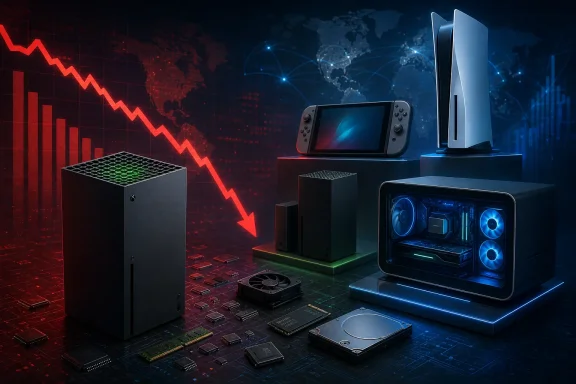 Xbox is the sharpest decline
Kagan estimates Microsoft shipped 3.2 million Series X|S consoles in 2025, then dropped below 500,000 units in the first quarter of 2026—the lowest quarterly result in its dataset. The firm expects the current Xbox hardware line to wind down rapidly after this year.Those are analyst estimates, not numbers Microsoft has published. Microsoft stopped regularly reporting Xbox hardware sales years ago, so they should be read as market-model projections rather than audited platform totals.
The forecast matters because it frames the next Xbox as a potentially narrower, more enthusiast-focused product. Kagan projects Microsoft’s reported next-generation effort, Project Helix, at roughly 2 million units in its launch year and 7.3 million annual units by 2030. The analyst cautioned that this is especially speculative because Microsoft’s final hardware design and distribution model remain unclear.
A PC-like Xbox complicates the count
Microsoft has been steadily reducing the distinction between Xbox and Windows gaming through Game Pass, Play Anywhere, cross-save support, PC storefront releases, and Xbox-branded handheld and PC partnerships. If Project Helix emerges as a conventional closed console, it fits easily into console shipment models. If it becomes a more open living-room PC platform with Xbox certification, the usual console-sales comparison becomes far less useful.That distinction is important for Windows users. A PC-oriented Xbox could expand the market for games that run across Windows and a TV-friendly Xbox environment, but it would also place more pressure on pricing, drivers, storefront rules, and compatibility expectations than a traditional console refresh.
Component costs remain the variable
Kagan’s recovery scenario depends on memory and storage supply easing enough by 2028 to support next-generation PlayStation and Xbox hardware at prices between $600 and $800. Its model forecasts total console shipments falling further to 27.1 million in 2027 before recovering later in the decade.For now, the report is a warning that cheaper current-generation hardware is unlikely to be the engine of Xbox growth, leaving Microsoft’s next hardware strategy to carry more of the burden.
References
- Primary source: NoobFeed
Published: 2026-07-15T00:00:00+00:00
NoobFeed
NoobFeed is your most up-to-date source for video game news, reviews, rumors, and the latest game guides.www.noobfeed.com
