

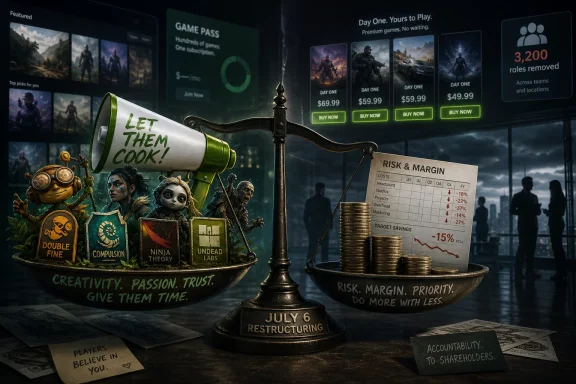
Xbox fans who argued that Microsoft should spare studios such as Compulsion Games, Double Fine, Ninja Theory, and Undead Labs now face a practical test after the July 6 Xbox restructuring removed 3,200 roles and pushed those teams outside Microsoft ownership. The emotional campaign to “let them cook” has collided with the economics of buying games in a market trained to wait for subscriptions, discounts, and day-one service drops. Windows Central framed the moment as a plea to fans, but the deeper story is less about fan loyalty than about whether Xbox’s audience can still behave like a retail market when the platform holder stops absorbing the risk.
Microsoft’s latest Xbox reset is not merely another round of layoffs with familiar corporate phrasing. According to reporting from Windows Central, The Verge, PC Gamer, Gematsu, and others, Xbox is cutting thousands of roles while moving Compulsion Games and Double Fine back toward independence and selling Ninja Theory and Undead Labs to new ownership. The Washington Post described the move as part of a broader reset under newly appointed Xbox chief executive Asha Sharma.
The notable part is not that Microsoft cut. The games industry has been cutting for years, and Microsoft has repeatedly shown that even beloved studios are not sacred if the spreadsheet turns ugly. The notable part is that these teams were not simply erased, at least not yet.
That “yet” matters. A divestiture is not salvation; it is a transfer of risk. Microsoft is no longer the deep-pocketed parent expected to carry niche projects, long production cycles, and uneven commercial performance. The studios may gain freedom from Xbox’s management layers, but they also lose the protective ambiguity that comes with being part of a trillion-dollar company.
Windows Central’s argument lands because it exposes a contradiction in modern fandom. Players often want independent creative studios to survive, but many have been conditioned to value those studios primarily when their games arrive as part of an existing subscription. The moral clarity of defending art gets fuzzier when the checkout page asks for $50, $60, or $70.
But Game Pass also rewired expectations. A first-party Xbox game became not merely a product but a benefit, part of the monthly rent paid to stay inside Microsoft’s ecosystem. That bargain felt generous when Microsoft was spending heavily to grow subscribers, acquire publishers, and persuade players that Xbox was becoming a platform rather than a box under the television.
The weakness of that model becomes obvious when Microsoft decides a studio no longer belongs inside the subsidy machine. If State of Decay 3 or a future Ninja Theory project is no longer guaranteed to launch into Game Pass, players have to make a decision they have not had to make for many Xbox first-party releases: is this specific game worth buying on its own?
That is a healthier question than it may first appear. Retail purchasing forces players to reveal preferences that subscription enthusiasm can blur. A game that thousands praise online but few buy is not a constituency; it is a vibe.
The less romantic version is that independence is expensive. Payroll does not become lighter because a studio gets its name back. Marketing does not become cheaper because fans are sentimental. Platform fees, QA, localization, certification, middleware, support, live operations, and post-launch patches still arrive with hard costs attached.
Microsoft’s ownership obscured those costs for players. When a studio sits inside Xbox Game Studios, the public sees trailers, showcase slots, and brand promises. It does not see the internal accounting that decides whether a project is building enterprise value or consuming it.
That opacity is gone. These teams now need audiences that convert. They need wishlists that turn into preorders, praise that turns into day-one revenue, and community goodwill that survives beyond the first social media cycle.
Still, the phrase has a hard truth inside it. The industry does not measure affection in quote posts. It measures sell-through, retention, attach rates, average revenue per user, wishlist conversion, and platform reach. That language is ugly, but it is the language that decides whether a studio gets another project.
There is a difference between being unable to buy a game and being unwilling to buy any game that is not bundled into a subscription. The first is a financial reality. The second is a market signal. If enough players fall into the second camp, Microsoft’s decision to move these studios out may look less like betrayal and more like recognition.
That is the uncomfortable part for Xbox fans. If players have spent years saying Microsoft should protect mid-sized creative teams, the next year or two may reveal whether those players meant “protect them with Microsoft’s money” or “protect them with ours.”
Under Xbox, that identity could be treated as ecosystem value. A subscriber might not have bought State of Decay 2 at full price but could still discover it through Game Pass, recommend it to friends, and keep the community alive. That kind of engagement matters, but it does not necessarily answer the retail question.
If State of Decay 3 skips Game Pass at launch, launches later into the service, or appears under new commercial terms, the audience will have to decide how much the franchise is worth outside the comfort of sunk subscription cost. That decision will be watched closely by publishers, platform holders, and every studio hoping to escape the binary of AAA blockbuster or tiny indie survival.
The danger is that fans may discover they liked the idea of State of Decay more than the act of paying for it. The opportunity is that Undead Labs may discover a broader audience beyond Xbox loyalists, particularly if new ownership embraces PC and PlayStation without the old console-war baggage.
But admiration for Double Fine has always existed alongside commercial uncertainty. The studio’s work tends to inspire intense devotion rather than mass-market inevitability. That is wonderful for culture and dangerous for budgets.
Microsoft’s decision to let Double Fine return to independence with its catalog and intellectual property, as reported by outlets covering the restructuring, is therefore unusually humane by recent industry standards. Compare that with the bitter memory of studios that were closed outright after delivering beloved work, and this outcome looks like a reprieve.
A reprieve is not a business model. If Double Fine’s next project arrives without the full umbrella of Xbox funding, fans who treat the studio as an industry treasure will need to act accordingly. Otherwise, “protect weird games” becomes another slogan that collapses the moment weird games ask to be purchased.
For Xbox, a studio like Compulsion helped tell a story: Game Pass was not just for shooters, sports, and tentpoles; it was also a home for authored, idiosyncratic projects. That story was useful when Microsoft wanted to sell the service as abundance. It is less useful when leadership decides abundance has become overextension.
Independence may suit Compulsion creatively. The studio’s sensibility arguably fits better outside the internal expectations of a platform holder trying to justify every team against global franchises. But commercial independence will demand clarity: what is the game, who is it for, and why should players buy it now rather than admire it from a distance?
That is the recurring theme of the Xbox divestitures. Creative freedom gives studios room to breathe. It also removes the oxygen mask.
That does not mean Xbox is abandoning creativity. It means creativity now has to justify itself inside a harsher framework. Halo, Fallout, Minecraft, Call of Duty, Forza, and other mega-franchises can be modeled, forecast, monetized, and extended across platforms. Smaller studios with uncertain hit rates cannot offer the same comfort.
This is where platform strategy and studio culture collide. Xbox spent years telling players that access mattered more than ownership, that the platform was wherever they played, and that Game Pass would make the economics of variety work. Now the company appears to be admitting that variety has limits when it is financed at Microsoft scale.
There is a brutal logic to that. Shareholders do not reward a gaming division for being beloved in theory. They reward growth, margins, and durable franchises. Xbox’s reset is the sound of that logic being applied to teams that fans often discussed as though they were exempt from it.
The more important question is whether mid-sized studios can still thrive when the old publishing middle has been hollowed out. The industry has become increasingly polarized between enormous service games and small independent projects built with radically lower overhead. Studios like Ninja Theory, Double Fine, Compulsion, and Undead Labs sit in the dangerous middle: too ambitious to be cheap, too distinctive to be guaranteed blockbusters.
Xbox once seemed to be building a shelter for that middle. Game Pass could, in theory, support games that did not need to sell 10 million copies at full price. Microsoft’s wallet could smooth over the volatility. The showcase could put odd projects in front of millions.
The July reset signals that shelter was conditional. If the economics do not work, the shelter closes. The studios may survive, but the experiment has been marked down.
But it is also too convenient to pretend players have no agency. Day-one purchases matter. Wishlists matter. Reviews matter. Talking a friend into buying a co-op game matters. Buying a game on the platform where the studio earns the best return can matter, especially for smaller teams watching early revenue curves with existential urgency.
The key is to abandon the fantasy that fandom is a substitute for commerce. A studio does not survive because it is frequently mourned in advance. It survives because enough people buy enough work at enough margin to fund the next project.
That sounds cold only because the subscription era softened the edges. For decades, this was the basic relationship between players and studios. If you wanted more of something, you bought it.
For Microsoft, that was acceptable while the strategic goal was growth. Game Pass could be subsidized as a land grab, a retention tool, a differentiator, and a way to keep Xbox relevant beyond hardware sales. The trouble begins when the same users who love the service become resistant to buying outside it.
That is not a moral failure. It is predictable consumer behavior. If a company trains customers to expect abundance for a monthly fee, customers will resist when parts of that abundance become separately priced again.
The divested studios are now caught in the aftershock of that training. They need Xbox fans to behave like patrons of specific creators, not merely subscribers to a platform bundle. That transition will be messy, uneven, and probably painful.
There are constructive ways to support without pretending money is infinite.
The Xbox reset has stripped away a useful illusion: that a platform holder can indefinitely subsidize every beloved creative bet while players enjoy the moral glow of support without the inconvenience of purchase. Compulsion, Double Fine, Ninja Theory, and Undead Labs now have a chance that many shuttered studios never received, but chance is not certainty. If the audience that demanded their survival shows up only in comment sections, Microsoft’s accountants will look vindicated; if it shows up at checkout, the industry may relearn that the middle of the market is not dead, merely waiting for customers willing to prove it.
 Xbox’s Studio Reset Turns Fan Sentiment Into a Balance-Sheet Problem
Microsoft’s latest Xbox reset is not merely another round of layoffs with familiar corporate phrasing. According to reporting from Windows Central, The Verge, PC Gamer, Gematsu, and others, Xbox is cutting thousands of roles while moving Compulsion Games and Double Fine back toward independence and selling Ninja Theory and Undead Labs to new ownership. The Washington Post described the move as part of a broader reset under newly appointed Xbox chief executive Asha Sharma.The notable part is not that Microsoft cut. The games industry has been cutting for years, and Microsoft has repeatedly shown that even beloved studios are not sacred if the spreadsheet turns ugly. The notable part is that these teams were not simply erased, at least not yet.
That “yet” matters. A divestiture is not salvation; it is a transfer of risk. Microsoft is no longer the deep-pocketed parent expected to carry niche projects, long production cycles, and uneven commercial performance. The studios may gain freedom from Xbox’s management layers, but they also lose the protective ambiguity that comes with being part of a trillion-dollar company.
Windows Central’s argument lands because it exposes a contradiction in modern fandom. Players often want independent creative studios to survive, but many have been conditioned to value those studios primarily when their games arrive as part of an existing subscription. The moral clarity of defending art gets fuzzier when the checkout page asks for $50, $60, or $70.
Game Pass Made Discovery Easy, Then Made Value Harder to See
Xbox Game Pass remains one of Microsoft’s most influential gaming ideas, and for consumers it has often been excellent. It lowered the friction of trying oddball games, made back catalogs feel alive, and gave smaller releases visibility they might never have earned in a crowded storefront. For studios like Double Fine or Compulsion, that kind of visibility can matter as much as marketing spend.But Game Pass also rewired expectations. A first-party Xbox game became not merely a product but a benefit, part of the monthly rent paid to stay inside Microsoft’s ecosystem. That bargain felt generous when Microsoft was spending heavily to grow subscribers, acquire publishers, and persuade players that Xbox was becoming a platform rather than a box under the television.
The weakness of that model becomes obvious when Microsoft decides a studio no longer belongs inside the subsidy machine. If State of Decay 3 or a future Ninja Theory project is no longer guaranteed to launch into Game Pass, players have to make a decision they have not had to make for many Xbox first-party releases: is this specific game worth buying on its own?
That is a healthier question than it may first appear. Retail purchasing forces players to reveal preferences that subscription enthusiasm can blur. A game that thousands praise online but few buy is not a constituency; it is a vibe.
The Studios Get Freedom, but Freedom Sends Invoices
The romantic version of this story says these developers have escaped corporate captivity. Double Fine can be Double Fine again. Compulsion can chase its off-kilter worlds without being forced to justify itself against Halo-scale expectations. Ninja Theory and Undead Labs can continue under owners that, in theory, see more direct value in their projects than Microsoft did.The less romantic version is that independence is expensive. Payroll does not become lighter because a studio gets its name back. Marketing does not become cheaper because fans are sentimental. Platform fees, QA, localization, certification, middleware, support, live operations, and post-launch patches still arrive with hard costs attached.
Microsoft’s ownership obscured those costs for players. When a studio sits inside Xbox Game Studios, the public sees trailers, showcase slots, and brand promises. It does not see the internal accounting that decides whether a project is building enterprise value or consuming it.
That opacity is gone. These teams now need audiences that convert. They need wishlists that turn into preorders, praise that turns into day-one revenue, and community goodwill that survives beyond the first social media cycle.
The “Vote With Your Wallet” Line Is Crude, but Not Wrong
“Vote with your wallet” is one of the most overused phrases in games discourse because it often arrives as a scold. It can flatten real economic differences between players and imply that every fan has spare cash ready for a symbolic purchase. Windows Central was careful to acknowledge that not everyone can drop full retail price on a new game, and that caveat is essential.Still, the phrase has a hard truth inside it. The industry does not measure affection in quote posts. It measures sell-through, retention, attach rates, average revenue per user, wishlist conversion, and platform reach. That language is ugly, but it is the language that decides whether a studio gets another project.
There is a difference between being unable to buy a game and being unwilling to buy any game that is not bundled into a subscription. The first is a financial reality. The second is a market signal. If enough players fall into the second camp, Microsoft’s decision to move these studios out may look less like betrayal and more like recognition.
That is the uncomfortable part for Xbox fans. If players have spent years saying Microsoft should protect mid-sized creative teams, the next year or two may reveal whether those players meant “protect them with Microsoft’s money” or “protect them with ours.”
State of Decay 3 Becomes the First Referendum
Undead Labs’ State of Decay 3 is now positioned as more than a sequel. It is a test case for whether a formerly first-party Xbox studio can carry its audience into a less subsidized future. The franchise has always had a strong identity: survival systems, base management, permadeath tension, and a scrappy simulation edge that distinguishes it from more cinematic zombie games.Under Xbox, that identity could be treated as ecosystem value. A subscriber might not have bought State of Decay 2 at full price but could still discover it through Game Pass, recommend it to friends, and keep the community alive. That kind of engagement matters, but it does not necessarily answer the retail question.
If State of Decay 3 skips Game Pass at launch, launches later into the service, or appears under new commercial terms, the audience will have to decide how much the franchise is worth outside the comfort of sunk subscription cost. That decision will be watched closely by publishers, platform holders, and every studio hoping to escape the binary of AAA blockbuster or tiny indie survival.
The danger is that fans may discover they liked the idea of State of Decay more than the act of paying for it. The opportunity is that Undead Labs may discover a broader audience beyond Xbox loyalists, particularly if new ownership embraces PC and PlayStation without the old console-war baggage.
Double Fine’s Independence Is a Gift With a Timer Attached
Double Fine occupies a special place in this discussion because it represents the kind of studio the industry claims to revere. It is funny, literate, strange, and historically willing to make games that do not look like market research in motion. Psychonauts 2 was the sort of creative success that reminds players why studio identity matters.But admiration for Double Fine has always existed alongside commercial uncertainty. The studio’s work tends to inspire intense devotion rather than mass-market inevitability. That is wonderful for culture and dangerous for budgets.
Microsoft’s decision to let Double Fine return to independence with its catalog and intellectual property, as reported by outlets covering the restructuring, is therefore unusually humane by recent industry standards. Compare that with the bitter memory of studios that were closed outright after delivering beloved work, and this outcome looks like a reprieve.
A reprieve is not a business model. If Double Fine’s next project arrives without the full umbrella of Xbox funding, fans who treat the studio as an industry treasure will need to act accordingly. Otherwise, “protect weird games” becomes another slogan that collapses the moment weird games ask to be purchased.
Compulsion Shows the Risk of Being Interesting but Not Inevitable
Compulsion Games is another revealing case because it has lived in the space between cult curiosity and mainstream certainty. The studio’s games have often been visually striking, narratively ambitious, and slightly askew from the center of the market. That makes it valuable to a platform trying to project range. It makes it vulnerable inside a corporation trying to restore margins.For Xbox, a studio like Compulsion helped tell a story: Game Pass was not just for shooters, sports, and tentpoles; it was also a home for authored, idiosyncratic projects. That story was useful when Microsoft wanted to sell the service as abundance. It is less useful when leadership decides abundance has become overextension.
Independence may suit Compulsion creatively. The studio’s sensibility arguably fits better outside the internal expectations of a platform holder trying to justify every team against global franchises. But commercial independence will demand clarity: what is the game, who is it for, and why should players buy it now rather than admire it from a distance?
That is the recurring theme of the Xbox divestitures. Creative freedom gives studios room to breathe. It also removes the oxygen mask.
Microsoft Is Narrowing Xbox Around Franchises That Can Carry the Math
The restructuring suggests Microsoft is no longer willing to treat Xbox Game Studios as an ever-expanding portfolio of experiments. Windows Central’s reporting has emphasized margin pressure, management complexity, and the sense that Xbox had become overextended. Other outlets have echoed the basic picture: Microsoft wants a leaner gaming operation with fewer ambiguous bets.That does not mean Xbox is abandoning creativity. It means creativity now has to justify itself inside a harsher framework. Halo, Fallout, Minecraft, Call of Duty, Forza, and other mega-franchises can be modeled, forecast, monetized, and extended across platforms. Smaller studios with uncertain hit rates cannot offer the same comfort.
This is where platform strategy and studio culture collide. Xbox spent years telling players that access mattered more than ownership, that the platform was wherever they played, and that Game Pass would make the economics of variety work. Now the company appears to be admitting that variety has limits when it is financed at Microsoft scale.
There is a brutal logic to that. Shareholders do not reward a gaming division for being beloved in theory. They reward growth, margins, and durable franchises. Xbox’s reset is the sound of that logic being applied to teams that fans often discussed as though they were exempt from it.
The Console-War Frame Is Too Small for This Moment
Some players will inevitably process these moves through the usual console-war machinery. Did Xbox lose? Will PlayStation get these games? Is Game Pass weaker? Are exclusives dead again? Those questions are not irrelevant, but they are too small.The more important question is whether mid-sized studios can still thrive when the old publishing middle has been hollowed out. The industry has become increasingly polarized between enormous service games and small independent projects built with radically lower overhead. Studios like Ninja Theory, Double Fine, Compulsion, and Undead Labs sit in the dangerous middle: too ambitious to be cheap, too distinctive to be guaranteed blockbusters.
Xbox once seemed to be building a shelter for that middle. Game Pass could, in theory, support games that did not need to sell 10 million copies at full price. Microsoft’s wallet could smooth over the volatility. The showcase could put odd projects in front of millions.
The July reset signals that shelter was conditional. If the economics do not work, the shelter closes. The studios may survive, but the experiment has been marked down.
Players Have More Power Than They Pretend, and Less Than They Imagine
It is easy to overstate consumer power. A few thousand enthusiastic purchases will not fix a broken budget. A passionate subreddit cannot solve rising development costs or compensate for weak marketing. Players do not control exchange rates, platform policy, investor demands, or the expense of modern game production.But it is also too convenient to pretend players have no agency. Day-one purchases matter. Wishlists matter. Reviews matter. Talking a friend into buying a co-op game matters. Buying a game on the platform where the studio earns the best return can matter, especially for smaller teams watching early revenue curves with existential urgency.
The key is to abandon the fantasy that fandom is a substitute for commerce. A studio does not survive because it is frequently mourned in advance. It survives because enough people buy enough work at enough margin to fund the next project.
That sounds cold only because the subscription era softened the edges. For decades, this was the basic relationship between players and studios. If you wanted more of something, you bought it.
The Xbox Audience Has to Unlearn Its Own Bargain
The hardest adjustment may be psychological. Xbox fans were sold a compelling bargain: subscribe, explore, and let Microsoft worry about the backend. That bargain encouraged experimentation, but it also weakened the habit of assigning a price to individual games.For Microsoft, that was acceptable while the strategic goal was growth. Game Pass could be subsidized as a land grab, a retention tool, a differentiator, and a way to keep Xbox relevant beyond hardware sales. The trouble begins when the same users who love the service become resistant to buying outside it.
That is not a moral failure. It is predictable consumer behavior. If a company trains customers to expect abundance for a monthly fee, customers will resist when parts of that abundance become separately priced again.
The divested studios are now caught in the aftershock of that training. They need Xbox fans to behave like patrons of specific creators, not merely subscribers to a platform bundle. That transition will be messy, uneven, and probably painful.
The One Purchase That Matters Is the Next One
The practical lesson of this reset is not that every fan must buy every game. That would be absurd. The lesson is that support has to become more deliberate. If a studio’s survival matters to you, waiting two years for a deep discount while posting about how much the studio deserves better is not neutral behavior; it is part of the market reality that determines what happens next.There are constructive ways to support without pretending money is infinite.
- Players who can afford to buy at launch should do so for the specific studios they claim are essential to the industry’s creative health.
- Players who cannot buy at launch can still help by wishlisting, reviewing, recommending, and keeping communities active in ways that convert attention into sales.
- Xbox fans should stop assuming that every former first-party project will be protected by Game Pass economics after ownership changes.
- Studios leaving Microsoft will need clearer communication about platforms, pricing, ownership, and post-launch plans to rebuild trust with players.
- Microsoft’s restructuring should be judged not only by jobs cut, but by whether the divested teams actually get enough runway to ship and survive afterward.
The Xbox reset has stripped away a useful illusion: that a platform holder can indefinitely subsidize every beloved creative bet while players enjoy the moral glow of support without the inconvenience of purchase. Compulsion, Double Fine, Ninja Theory, and Undead Labs now have a chance that many shuttered studios never received, but chance is not certainty. If the audience that demanded their survival shows up only in comment sections, Microsoft’s accountants will look vindicated; if it shows up at checkout, the industry may relearn that the middle of the market is not dead, merely waiting for customers willing to prove it.
References
- Primary source: Windows Central
Published: 2026-07-06T17:20:12.541495
Loading…
www.windowscentral.com - Related coverage: gamesradar.com
Loading…
www.gamesradar.com - Related coverage: gematsu.com
Loading…
www.gematsu.com - Related coverage: dexerto.com
Loading…
www.dexerto.com - Related coverage: beebom.com
Loading…
beebom.com - Related coverage: washingtonpost.com
Loading…
www.washingtonpost.com