

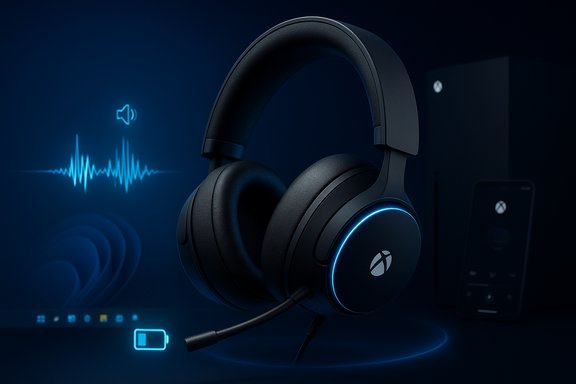
Microsoft has quietly pushed a free firmware update to the refreshed Xbox Wireless Headset (the 2024 model), adding Bluetooth Low Energy (LE) Audio support that brings lower latency, improved battery efficiency, and clearer voice chat—features that matter as Xbox’s audio strategy increasingly ties into Windows 11 and the broader PC/mobile ecosystem.
Background
Microsoft refreshed the Xbox Wireless Headset in October 2024 with upgrades that included Dolby Atmos at no extra charge, a redesigned mic with auto-mute and voice isolation, extended battery life, and Bluetooth 5.3 support. That hardware refresh established the baseline that this December 2025 firmware builds upon: the new update does not change the headset’s hardware, but it unlocks modern Bluetooth LE Audio features through firmware. Bluetooth LE Audio is a generational step forward for Bluetooth audio: it uses the LC3 codec, supports features such as multi-streaming and Auracast broadcast audio, and is designed for higher audio quality at lower bitrates and energy use compared to legacy Bluetooth Classic profiles. Microsoft’s firmware leverages these capabilities to deliver what it describes as lower latency, better battery life, and super wideband stereo voice during chat—especially when the headset is paired with LE-capable Windows 11 PCs and handhelds.What Microsoft shipped: a practical summary
- A free firmware update for the Xbox Wireless Headset (the 2024 refreshed model) that adds Bluetooth LE Audio support.
- New user-visible benefits marketed by Microsoft: lower latency, improved battery life, super wideband stereo voice (stereo audio that remains high quality while the mic is active), and broadcast/shared audio functionality on Windows 11 (currently a preview for Windows Insiders on supported PCs).
- Availability: the update is being delivered via the Xbox Accessories app on Xbox consoles and Windows 11 devices; Microsoft notes Windows 11 devices must support LE Audio to take advantage of all features.
Technical breakdown: what LE Audio actually brings
The LC3 codec and perceived audio quality
Bluetooth LE Audio relies on the LC3 codec, which is engineered to maintain audio fidelity at lower bitrates than the older A2DP/HFP split that dominated Bluetooth Classic. In practice, LC3 means devices can deliver clearer voice and music using less radio bandwidth and power—especially relevant when two-way voice (microphone) and stereo audio are required simultaneously. Microsoft specifically calls out super wideband stereo for voice chats, aiming to eliminate the old trade-off where enabling the mic dropped overall audio to muffled mono.Latency: better, but not magically zero
LE Audio reduces audio transmission latency compared with some Bluetooth Classic implementations by optimizing packet efficiency and codec processing. That said, vendors rarely publish consistent, apples-to-apples millisecond figures because latency depends on the headset’s internal processing, the Bluetooth stack on the host, wireless conditions, and software buffering. Microsoft’s messaging emphasizes noticeably lower latency for gaming scenarios, but exact ms gains were not published by Microsoft in the firmware announcement—so expectations should be calibrated: LE Audio can materially improve sync for many players, but it is not a substitute for purpose-built low-latency RF gaming links (2.4 GHz dongles) in every competitive setting.Battery life and energy efficiency
Bluetooth LE Audio is designed to be more energy-efficient; the LC3 codec allows similar or better quality at lower bitrates, which yields lower power draw during active Bluetooth sessions. Microsoft’s announcement promises improved battery life when using LE Audio, but the company did not publish a single percentage or hour-by-hour comparison for the headset after the firmware update. The 2024 headset’s hardware spec lists up to ~20 hours of playtime under certain conditions; LE Audio should extend real-world runtime for Bluetooth sessions but results will vary by use case and device. Flag: no concrete battery delta is provided by Microsoft.Shared audio, Auracast-style broadcast, and Windows 11 integration
Windows 11’s super wideband stereo implementation and new shared audio features (previewed for Windows Insiders) pair naturally with LE Audio. Microsoft is positioning the headset as one of the first to take advantage of a Windows-driven stack that can:- Keep stereo game audio when voice chat is active (no forced mono).
- Allow a PC to share a single audio source to multiple compatible LE devices (broadcast/shared audio preview).
These features rely on updated Windows 11 components (Windows 11 24H2 and later drivers) and OEM audio driver support. In short: Windows-level support is a gating factor for many of the new capabilities.
Compatibility and deployment details
Which headsets get the update
Microsoft’s firmware update targets the refreshed Xbox Wireless Headset launched in October 2024. The original 2021 edition is not included in this LE Audio rollout. Users should check the model/date stamp before assuming compatibility.How to get the update
Microsoft’s guidance is straightforward: connect the headset to an Xbox console or a Windows 11 PC and open the Xbox Accessories app; firmware updates should be available there. Some outlets report the update is rolling out automatically for many users, but having the Accessories app and a direct connection remains the reliable path to trigger and verify the firmware.Host device requirements: Windows 11 24H2 and drivers
To access super wideband stereo and the shared audio/preview features, Microsoft specifies Windows 11 24H2 or later and updated audio drivers from device manufacturers. In short, even if your headset runs LE Audio, your PC must have a compatible Bluetooth controller and drivers to unlock the new features. This is a common friction point in LE Audio adoption: hardware or driver mismatch on the PC side can prevent the new modes from appearing.Market and strategic implications
Why this matters for Microsoft
This firmware pushes the Xbox Wireless Headset from being a console-focused peripheral to a more cross-platform audio product. With game streaming, Play Anywhere, and an increasing number of Windows-based handhelds (like the ROG Xbox Ally family), better Bluetooth performance widens Microsoft’s accessory appeal beyond traditional Xbox console buyers. The update strengthens ecosystem lock-in: users who value Windows-Xbox interoperability now have a headset that benefits from both sides of Microsoft’s stack.Pricing context
When Microsoft refreshed the headset in October 2024 it carried an MSRP of $109.99, but the company implemented price increases across consoles and accessories effective May 1, 2025 in some regions—moving the Xbox Wireless Headset to $119.99 in the U.S. and Canada in that wave of adjustments. That historical pricing context matters because a free firmware upgrade can make the higher price feel better justified to buyers who owned or are considering the 2024 model.Market pressures and competition
Competitors like Sony and proprietary gaming-headset makers (SteelSeries, Razer, Turtle Beach, Logitech, etc. have tended to rely either on proprietary RF links for ultra-low latency or Bluetooth Classic for multi-device convenience. By adding LE Audio to a mainstream gaming headset, Microsoft narrows the gap between convenient multi-device use and acceptable gaming latency/voice quality. As Bluetooth LE Audio adoption grows (Auracast and LC3 adoption are cited by Bluetooth SIG and industry analysts as the major trend for 2024–2026), this move signals Microsoft’s desire not to cede the multi-platform headset market.User feedback, rollout experience, and early issues
Early community responses have leaned positive: players report clearer voice chat and noticeably better battery behavior under Bluetooth when paired to updated Windows 11 systems. Some users noted update hiccups—brief connectivity interruptions or the need to re-pair after the firmware install—but most reports indicate those were resolved by simple restarts and re-connections. Microsoft support channels have been active in helping users who encounter the occasional update glitch. That mirrors typical firmware rollouts for peripherals: broadly beneficial, with small numbers of transient edge-case failures. Caveat: anecdotal early impressions are useful but not a substitute for controlled testing. Expect variability depending on the PC’s Bluetooth chipset, driver maturity, and environmental RF conditions. If you need guaranteed sub-20 ms latency for competitive play, a dedicated low-latency RF dongle or wired connection remains a safer bet.Known limitations and risks
- Device support fragmentation: Not all existing devices will immediately benefit. LE Audio requires host-side support—many laptops and phones ship with Bluetooth 5.x chipsets but lack LE Audio-capable stacks or drivers yet. This means owners of older machines or those with vendor-delayed driver updates may not see LE features.
- No quantified latency/battery guarantees: Microsoft’s statements are qualitative (lower latency, better battery life). Exact figures (ms saved or percentage battery improvement) were not published in the firmware notes—so expectations should be conservative when judging measurable gains.
- Model scope: the update applies to the 2024 refreshed headset only; owners of the original 2021 headset are not included. That leaves a class-split in the install base, and could frustrate users of older hardware.
- Competitive fidelity: for professional streamers, content producers, or esports pros who demand deterministic latency, Bluetooth—even LE Audio—may still be inferior to wired or 2.4 GHz proprietary solutions. Microsoft’s move improves convenience and quality for most users, but it does not eliminate the trade-offs inherent to shared wireless links.
Broader industry trends and context
Bluetooth LE Audio is accelerating as a platform-level improvement across devices. Microsoft’s embrace of LE Audio in the Xbox Wireless Headset follows parallel moves in Windows 11 to support super wideband stereo and Auracast-style features that change how voice and game audio are handled on PCs. Industry bodies and chip vendors view Auracast and LC3 as gateways to new markets (assistive listening, silent TV experiences in venues, multi-listener broadcast), with analysts projecting the LE Audio ecosystem to grow substantially over the remainder of the decade. For Microsoft, integrating LE Audio aligns the Xbox brand with those larger wireless-audio trends rather than isolating it within proprietary RF ecosystems. Analyst forecasts and Bluetooth SIG research point to an inflection point around 2025 for Auracast and LE Audio deployments—meaning Microsoft’s timing positions the company to benefit as the installed base of compatible devices grows. This matters not only for consumer convenience but for broader platform features (shared audio in classrooms, venues, or multi-user gaming scenarios).Practical guidance for users
- Check your headset model: confirm you have the 2024 refreshed Xbox Wireless Headset, not the 2021 model.
- Update your console or PC: open the Xbox Accessories app on Xbox Series X|S or Windows 11 to check for and apply firmware. If the update appears stalled, reconnect the headset and retry the update procedure.
- Ensure your Windows PC supports LE Audio: install the latest Windows 11 cumulative updates and vendor audio/Bluetooth drivers (some features require Windows 11 24H2 or later and OEM driver support).
- Test latency-sensitive titles: if you play competitively, compare wired vs LE Audio audio latency in the specific titles you play; do not assume parity with wired connections.
- Report issues: if you encounter glitches, note the host device make/model and Bluetooth chipset, then contact Microsoft Support—logs help vendors accelerate driver fixes.
What this means for buyers and the accessory market
For buyers, the firmware dramatically improves the value proposition of the 2024 Xbox Wireless Headset: a no-cost upgrade that reduces some long-standing Bluetooth pain points (mono chat, poor mic+stereo interaction, inefficient battery use) makes the headset more attractive for hybrid console/PC/mobile users.For the accessory market, Microsoft’s move raises the bar: mainstream, first-party console accessories now ship and are supported with software updates that can enable modern wireless standards. Competitors will face pressure to deliver similar LE Audio support or else emphasize other differentiators (ultra-low-latency RF links, richer feature suites, or niche ergonomics). Over time, this dynamic should accelerate LE Audio adoption across premium gaming headsets as host device support matures. Economically, the gaming headset segment is already a large multi-billion-dollar space and continues to grow as wireless, multi-platform use becomes the norm. Microsoft’s firmware is a low-cost way to capture more of that market by improving cross-device utility without a new hardware release. Market research forecasts and Bluetooth SIG commentary suggest LE Audio will be a major theme for audio gear makers over the next several years.
Future prospects and what to watch
- Broader host support: expect major PC OEMs and chipset vendors to ship LE Audio-enabled drivers and stacks more widely through late 2025 and into 2026; that will widen the number of users who can access Microsoft’s LE features.
- Feature parity on handhelds: Microsoft notes some handset/handheld support (ROG Xbox Ally, ROG Xbox Ally X) is coming soon—watch for these rollouts as they will be important for portable ambient gaming experiences.
- Expanded firmware updates: Microsoft could port LE Audio to other accessories or expand the headset feature set (spatial audio enhancements, more granular codec controls, or AI-driven voice processing) through future firmware if the hardware is capable. The company’s pattern of iterative firmware enhancements suggests more value will be delivered in software over time.
- Industry consolidation around Auracast: as Auracast deployments in public venues grow, expect new use cases—shared game audio in public settings, assistive listening integrations, and more ubiquitous broadcast audio in entertainment venues. Microsoft’s early alignment with LE Audio positions it well for these ecosystems.
Final analysis and verdict
Microsoft’s firmware update for the Xbox Wireless Headset is a high-leverage, low-cost move that meaningfully increases the headset’s practical usefulness across platforms. The company did the smart thing: rather than ship new hardware, it used firmware to align an existing product with emerging industry standards—Bluetooth LE Audio and Windows 11 super wideband stereo—delivering real user benefits that include better voice clarity, lower Bluetooth latency in many scenarios, and improved energy efficiency.Strengths:
- Cross-platform value: improves the headset for PC, mobile, and handheld use, not just Xbox consoles.
- Forward-looking standards alignment: moves Microsoft into the LE Audio ecosystem and Auracast possibilities.
- Low friction: firmware rollout and Windows integration lower barriers to user adoption.
- Host-side dependency: Windows 11 and driver updates are required for feature parity; not all PCs will be ready immediately.
- No hard performance numbers: Microsoft’s claims are qualitative; independent testing will be needed to quantify latency and battery gains in specific scenarios.
- Fragmented install base: original 2021 headsets are excluded, leaving some users without the upgrade path.
Microsoft’s LE Audio update for the Xbox Wireless Headset is a pragmatic, ecosystem-savvy upgrade: it tightens the link between Xbox hardware and Windows software, plugs long-standing Bluetooth gaps for many users, and signals that the company will continue to invest in improving peripherals through firmware rather than fast hardware churn. For anyone using the 2024 headset with a modern Windows 11 PC, the update is worth applying and testing—especially for longer play sessions and mixed game/chat use—while competitive players should still validate latency against wired or dedicated RF options for their specific needs.
Source: WebProNews Microsoft Xbox Headset Update Adds Bluetooth LE, Cuts Latency
