

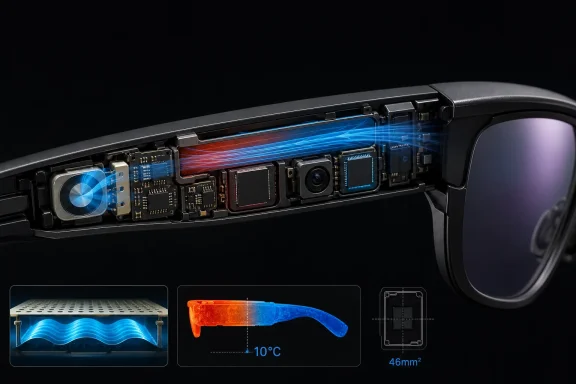
xMEMS Labs has unveiled the XMC-1200, a solid-state micro fan designed to squeeze active cooling into the temple arms of smart glasses, augmented reality headsets, and other wearables that are too thin for a conventional rotary fan. Measuring just 46 square millimeters and consuming around 70mW when paired with the company’s Astra2 drive ASIC, the device is claimed to reduce temperatures by as much as 10°C under a 1W thermal load. If those figures translate from controlled demonstrations into shipping hardware, the XMC-1200 could help wearable manufacturers sustain on-device AI, longer video recording, brighter displays, and more comfortable skin-contact temperatures without making their glasses substantially heavier or bulkier.
Smart glasses have repeatedly run into the same collection of engineering constraints: limited battery capacity, restricted internal volume, delicate optical alignment, wireless connectivity demands, and the need to remain comfortable enough for prolonged use. Heat sits at the center of almost every one of those problems because nearly all electrical power consumed inside a wearable eventually becomes thermal energy that must be moved away from components and the wearer’s skin.
Early smart glasses could reduce the problem by relying heavily on a connected smartphone or remote computer. The glasses acted more like a peripheral, capturing inputs and presenting information while leaving demanding computation to another device.
That model is becoming less satisfactory as manufacturers add cameras, image signal processors, neural processing units, high-resolution displays, microphones, speakers, and always-on sensors. Newer devices are expected to understand their surroundings, process natural-language requests, recognize objects, translate conversations, stabilize video, and present contextual information with minimal delay.
The current generation has benefited from smaller semiconductor packages, more efficient mobile processors, better wireless radios, and improved cameras. Even so, efficiency gains do not eliminate heat when manufacturers use them to support more intensive workloads instead of simply lowering power consumption.
The trade-off is sustained power consumption. A short voice command may create only a temporary thermal spike, but continuous visual analysis, live translation, spatial mapping, or video encoding can keep several parts of the system active simultaneously. In an eyeglass frame, there is little material, surface area, or airflow available to absorb that heat.
Their electronics must fit into narrow temple arms positioned directly against the user’s head. The components also sit close to batteries, microphones, speakers, hinges, antennas, cameras, and optical systems, all of which impose their own placement restrictions.
Passive heat spreaders can move some of that energy along the frame, but spreading heat is not the same as removing it. The energy may merely migrate from the processor toward another area that touches the wearer’s temple or ear.
Heat can be particularly noticeable because the device maintains continuous contact with sensitive areas of skin. Even moderate warmth may become distracting over a long session, undermining the promise of all-day wear before the hardware reaches a formal safety threshold.
Engineers must consequently design for more than an ideal room-temperature workload. They need margin for hot ambient conditions, aging batteries, manufacturing variation, blocked vents, and software updates that may introduce more demanding features after launch.
That membrane movement creates a stream of air pulses through microscopic valve structures. The package can then direct airflow toward a hotspot or into a small channel thermally coupled to the component that needs cooling.
Microscopic silicon membranes flex rapidly to displace air. This architecture allows the device to be manufactured at semiconductor scale and shaped for spaces that would be impractical for even the smallest traditional blower.
Together, the cooling chip and driver reportedly consume about 70mW under typical operation. The controller gives device manufacturers a way to coordinate cooling with workload, component temperatures, battery condition, and the operating mode of the glasses.
These are manufacturer claims rather than independent product-review measurements. The eventual result will depend on vent geometry, heat-spreader design, ambient temperature, component placement, control software, and where temperature is measured.
Those techniques will not disappear if solid-state cooling succeeds. The XMC-1200 is better understood as another element in a thermal system rather than a replacement for every passive component.
Even a small amount of precisely directed airflow may therefore deliver a meaningful benefit when it is applied close to a processor, display engine, camera subsystem, or other hotspot. This targeted approach is different from trying to ventilate the entire frame uniformly.
A micro fan potentially allows engineers to intervene nearer the source. If heat can be transferred into moving air or into a ventilated microchannel before it reaches the exterior frame, the device may preserve both processor performance and wearer comfort.
A practical design may combine several elements:
Active cooling could allow the processor to remain at a higher performance level for longer. The most important improvement may therefore be sustained capability rather than a higher benchmark score during a brief test.
Sustaining that intelligence requires the neural processor, memory, image pipeline, and supporting power circuitry to remain within their operating ranges. A cooler system could handle longer visual-analysis sessions before reducing frame rates or transferring work to a companion device.
For accessibility applications, consistency may be more important than peak performance. A device that begins quickly but slows after several minutes would be less dependable than one engineered around a stable long-term thermal limit.
xMEMS argues that the XMC-1200 could extend recording times by reducing thermal throttling and the risk of heat-related shutdowns. Whether it does so in a commercial product will depend on how effectively the manufacturer routes airflow around the complete imaging pipeline.
Keeping those components within a narrower temperature range can protect image quality. It may also reduce the amount of software compensation needed as the display warms during use.
That additional power generates more heat at the same time that the surrounding ambient temperature may already be elevated. Active cooling could help sustain brightness, although it cannot remove the underlying battery cost of driving the display harder.
More stable operating temperatures could preserve color consistency and brightness uniformity. This matters in consumer navigation and entertainment, but it may be even more important in medical, industrial, design, or remote-assistance scenarios where visual interpretation has practical consequences.
Designers may therefore prefer sealed or semi-isolated microchannels that transfer heat without passing unfiltered outside air over sensitive optical surfaces. That requirement could make the surrounding mechanical engineering as important as the cooling chip itself.
Every cubic millimeter used for cooling competes with the battery, antenna, speaker, microphone, hinge, camera wiring, and cosmetic shell. Integration will require a system-level redesign rather than simply attaching the XMC-1200 to an existing pair of glasses.
Useful integration will require engineers to answer several questions:
xMEMS says its piezoMEMS architecture operates at ultrasonic frequencies and avoids the motor noise and bearing vibration of rotary fans. Even so, commercial validation will need to examine harmonics, structural resonance, airflow noise through vents, and interactions with the glasses’ microphones and speakers.
Manufacturers may use the cooling hardware as part of a broader balancing strategy, placing batteries in one temple and processing or cooling components in the other. That arrangement must also account for heat transfer across the bridge and electrical connections through hinges.
Continuous operation could shorten runtime. The central engineering question is whether the performance and efficiency recovered through cooling outweigh the fan’s own energy cost.
Those gains are workload-dependent. If the fan runs when the system does not need it, active cooling simply becomes another battery drain.
Cooling policy may include:
Manufacturers will need telemetry and testing procedures that treat cooling behavior as a platform feature. Poor fan-control firmware could cause unnecessary power consumption, fluctuating performance, or distracting changes in acoustic behavior.
A successful implementation could reduce the gap between eyewear that demonstrates impressive features for a few minutes and a product capable of performing those features throughout a commute, work shift, trip, or event.
That does not guarantee thin products. Manufacturers might spend the thermal margin on greater performance instead of reducing size, just as improvements in smartphone efficiency have often enabled brighter screens and faster processors rather than dramatically longer battery life.
Brands may eventually promote maximum skin-contact temperature or sustained workload duration alongside battery life and display brightness. Independent testing will be necessary because a component-level temperature reduction does not automatically reveal what the wearer experiences.
Eyewear is exposed to sweat, rain, hair products, sunscreen, makeup, and frequent handling. The XMC-1200 is listed with IP68 protection, but the durability of the complete glasses will depend on the manufacturer’s venting and enclosure design rather than the chip’s rating alone.
For Windows-centered organizations, smart glasses may operate as companion endpoints connected to cloud services, Windows workstations, virtual desktops, device-management systems, or specialized line-of-business applications. The cooling hardware will not determine software compatibility, but it could expand the workloads that are practical at the edge.
Reducing throttling could improve stream stability and visual quality. Cooler exterior surfaces could also make the equipment more tolerable during a full maintenance operation rather than a short demonstration.
Active cooling could help sustain these local workloads, although organizations would still need strong identity controls, encryption, application governance, and transparent recording indicators. Better thermals do not solve the privacy and security questions created by wearable cameras.
The XMC-1200 addresses a narrower but important hardware constraint. It will matter most if combined with efficient processors, useful applications, manageable devices, mature development tools, and form factors employees are willing to wear.
That would pressure competitors in thermal materials, micro-blowers, heat spreaders, and wearable system design to demonstrate comparable performance in similarly constrained spaces.
This may change how chipmakers specify wearable processors. Instead of assuming a fully passive thermal envelope, platform designers could offer higher sustained-performance profiles for products equipped with approved active cooling.
If active cooling raises the practical limit of local compute, manufacturers gain more flexibility. They can choose which tasks remain on the glasses based on privacy, responsiveness, and energy efficiency rather than being forced to offload them because of temperature alone.
That schedule means the component is unlikely to transform retail smart glasses in the near term. Products using it at scale would more plausibly appear after manufacturers complete design, validation, certification, software integration, and production ramping, potentially placing significant commercial adoption in 2028 or later.
Independent measurements will also be needed to distinguish hotspot reduction from broader system and skin-temperature improvements.
Experience with the XMC-2400 should help establish manufacturing reliability, controller behavior, and OEM familiarity before the XMC-1200 reaches its planned production-readiness point. It may also reveal whether device makers prefer a larger cooling component with more capability or the smallest possible footprint.
If the answer is yes, active micro-cooling could become one of the enabling technologies that moves smart glasses beyond intermittent accessories. If integration is too complex or the energy cost is too high, it may remain a specialized option for premium and enterprise devices.
The XMC-1200 does not remove every obstacle facing smart glasses, and its planned fourth-quarter 2027 production readiness means the market will have to wait before judging it in mass-produced hardware. It nevertheless attacks one of wearable computing’s most stubborn physical limits with an approach tailored to the dimensions of ordinary eyewear rather than scaled down from a laptop or phone. If xMEMS and its manufacturing partners can turn the claimed 10°C cooling improvement into quieter, longer-running, and genuinely comfortable products, the smallest fan in the system may become one of the most consequential components in the next generation of AI glasses.
 Background
Smart glasses have repeatedly run into the same collection of engineering constraints: limited battery capacity, restricted internal volume, delicate optical alignment, wireless connectivity demands, and the need to remain comfortable enough for prolonged use. Heat sits at the center of almost every one of those problems because nearly all electrical power consumed inside a wearable eventually becomes thermal energy that must be moved away from components and the wearer’s skin.Early smart glasses could reduce the problem by relying heavily on a connected smartphone or remote computer. The glasses acted more like a peripheral, capturing inputs and presenting information while leaving demanding computation to another device.
That model is becoming less satisfactory as manufacturers add cameras, image signal processors, neural processing units, high-resolution displays, microphones, speakers, and always-on sensors. Newer devices are expected to understand their surroundings, process natural-language requests, recognize objects, translate conversations, stabilize video, and present contextual information with minimal delay.
From Google Glass to AI eyewear
Google Glass demonstrated more than a decade ago that a head-worn computer could provide notifications, photography, navigation, and hands-free interaction. It also exposed challenges that remain relevant: battery endurance, social acceptance, privacy, limited performance, awkward industrial design, and the difficulty of fitting computing hardware into something resembling ordinary eyewear.The current generation has benefited from smaller semiconductor packages, more efficient mobile processors, better wireless radios, and improved cameras. Even so, efficiency gains do not eliminate heat when manufacturers use them to support more intensive workloads instead of simply lowering power consumption.
The shift toward local intelligence
Modern wearable platforms increasingly emphasize on-device artificial intelligence. Running AI locally can reduce cloud dependence, improve response times, support operation during intermittent connectivity, and keep some sensitive camera or microphone data on the device.The trade-off is sustained power consumption. A short voice command may create only a temporary thermal spike, but continuous visual analysis, live translation, spatial mapping, or video encoding can keep several parts of the system active simultaneously. In an eyeglass frame, there is little material, surface area, or airflow available to absorb that heat.
Why Smart Glasses Face a Thermal Wall
A smartphone can spread heat across a large internal chassis, battery enclosure, display assembly, graphite sheet, or vapor chamber. A laptop can use heat pipes, broad metal surfaces, and one or more fans. Smart glasses have no comparable thermal reservoir.Their electronics must fit into narrow temple arms positioned directly against the user’s head. The components also sit close to batteries, microphones, speakers, hinges, antennas, cameras, and optical systems, all of which impose their own placement restrictions.
Small volume, concentrated heat
The issue is not simply total power consumption. Power density and hotspot location matter just as much. A processor consuming one watt in a tiny package can create a localized temperature rise even if the overall device appears to have a modest energy budget.Passive heat spreaders can move some of that energy along the frame, but spreading heat is not the same as removing it. The energy may merely migrate from the processor toward another area that touches the wearer’s temple or ear.
Skin contact changes the standard
A computer component may operate reliably at a temperature that would feel unpleasant in a device worn on the face. Smart-glasses designers therefore have to satisfy component limits and a much tighter human-comfort envelope.Heat can be particularly noticeable because the device maintains continuous contact with sensitive areas of skin. Even moderate warmth may become distracting over a long session, undermining the promise of all-day wear before the hardware reaches a formal safety threshold.
Environmental conditions make matters worse
A pair of glasses tested in a cool laboratory may behave differently outdoors in direct sunlight, inside a warm industrial facility, or during physical activity. The wearer’s own body heat and reduced airflow around hair, hats, or protective equipment can further constrain dissipation.Engineers must consequently design for more than an ideal room-temperature workload. They need margin for hot ambient conditions, aging batteries, manufacturing variation, blocked vents, and software updates that may introduce more demanding features after launch.
How the XMC-1200 Works
The XMC-1200 is part of xMEMS’ µCooling platform, which uses piezoelectric MEMS technology to generate airflow without the motor, shaft, bearings, and rotating blades found in a conventional fan. Thin-film piezoelectric material deposited on silicon changes shape in response to an electrical signal, driving a membrane at ultrasonic frequencies.That membrane movement creates a stream of air pulses through microscopic valve structures. The package can then direct airflow toward a hotspot or into a small channel thermally coupled to the component that needs cooling.
Solid-state does not mean motionless
The term solid-state fan can be confusing because the cooling mechanism still depends on physical movement. The distinction is that it does not use a conventional rotating assembly with a motor and impeller.Microscopic silicon membranes flex rapidly to displace air. This architecture allows the device to be manufactured at semiconductor scale and shaped for spaces that would be impractical for even the smallest traditional blower.
Why the Astra2 drive ASIC matters
The XMC-1200 does not operate alone. It is paired with xMEMS’ Astra2 drive ASIC, which generates and controls the electrical signals required by the piezoelectric actuator.Together, the cooling chip and driver reportedly consume about 70mW under typical operation. The controller gives device manufacturers a way to coordinate cooling with workload, component temperatures, battery condition, and the operating mode of the glasses.
The published performance target
xMEMS says the XMC-1200 can produce airflow of up to 10 cubic centimeters per second and achieve up to a 10°C temperature reduction with a 1W thermal load. Its footprint is only 46 square millimeters, while its approximately 1mm-thin construction is intended to permit placement inside an eyeglass temple.These are manufacturer claims rather than independent product-review measurements. The eventual result will depend on vent geometry, heat-spreader design, ambient temperature, component placement, control software, and where temperature is measured.
Active Cooling Versus Passive Thermal Design
Passive cooling remains attractive because it consumes no direct electrical power and typically has no control electronics. Smart-glasses manufacturers can use graphite, conductive frame materials, thermal interface compounds, miniature heat spreaders, and careful component placement to distribute energy.Those techniques will not disappear if solid-state cooling succeeds. The XMC-1200 is better understood as another element in a thermal system rather than a replacement for every passive component.
Breaking the boundary layer
A hot surface surrounded by relatively still air develops a boundary layer that limits the rate at which heat can escape. Forced airflow disrupts that layer and increases convective heat transfer.Even a small amount of precisely directed airflow may therefore deliver a meaningful benefit when it is applied close to a processor, display engine, camera subsystem, or other hotspot. This targeted approach is different from trying to ventilate the entire frame uniformly.
Cooling the source instead of the enclosure
Conventional wearable design often spreads heat throughout the enclosure to avoid one extremely hot point. That strategy can protect silicon performance but may warm a larger skin-contact area.A micro fan potentially allows engineers to intervene nearer the source. If heat can be transferred into moving air or into a ventilated microchannel before it reaches the exterior frame, the device may preserve both processor performance and wearer comfort.
Passive cooling still carries the baseline load
An active device drawing 70mW cannot be expected to operate continuously without affecting battery life. Manufacturers are likely to use it dynamically, activating cooling during demanding workloads and relying on passive structures at idle.A practical design may combine several elements:
- A thermal interface transfers heat from the processor or display engine.
- A graphite sheet or metal spreader reduces the intensity of the hotspot.
- The XMC-1200 moves air across the target area or through an isolated channel.
- Vents provide an intake and exhaust path without exposing sensitive components.
- Firmware adjusts cooling intensity according to temperatures and user activity.
Performance Implications for AI Glasses
Thermal throttling occurs when a processor lowers its clock speed, voltage, or workload to prevent temperatures from exceeding a defined limit. This protects the hardware, but it can produce inconsistent performance during precisely the tasks for which advanced smart glasses are being developed.Active cooling could allow the processor to remain at a higher performance level for longer. The most important improvement may therefore be sustained capability rather than a higher benchmark score during a brief test.
On-device AI and computer vision
AI assistants built into glasses may need to analyze camera frames, recognize speech, interpret environmental context, and generate a response. Some of those operations can be sent to a phone or cloud service, but local execution offers lower latency and can reduce the amount of personal data transmitted elsewhere.Sustaining that intelligence requires the neural processor, memory, image pipeline, and supporting power circuitry to remain within their operating ranges. A cooler system could handle longer visual-analysis sessions before reducing frame rates or transferring work to a companion device.
Translation and accessibility
Live translation, scene description, object identification, text reading, and navigational assistance are among the most compelling uses for AI eyewear. They are also workloads where unexpected throttling can have a visible effect on responsiveness.For accessibility applications, consistency may be more important than peak performance. A device that begins quickly but slows after several minutes would be less dependable than one engineered around a stable long-term thermal limit.
Video capture and streaming
Camera-equipped glasses place sustained demand on image sensors, image signal processors, memory, storage, wireless radios, and video encoders. Continuous recording can heat multiple subsystems at once, making it more difficult to solve the problem by cooling only the main processor.xMEMS argues that the XMC-1200 could extend recording times by reducing thermal throttling and the risk of heat-related shutdowns. Whether it does so in a commercial product will depend on how effectively the manufacturer routes airflow around the complete imaging pipeline.
Display Quality and Optical Stability
AR glasses with integrated displays create a second major heat source beyond the application processor. Microdisplays, illumination engines, laser or LED sources, display drivers, and projection optics all have operating conditions that influence brightness, color accuracy, and efficiency.Keeping those components within a narrower temperature range can protect image quality. It may also reduce the amount of software compensation needed as the display warms during use.
Brightness under outdoor conditions
See-through displays have to compete with the real world. In bright environments, manufacturers may increase display or illumination power to keep virtual content legible.That additional power generates more heat at the same time that the surrounding ambient temperature may already be elevated. Active cooling could help sustain brightness, although it cannot remove the underlying battery cost of driving the display harder.
Color shift and calibration
Display characteristics can change with temperature. A system can compensate through calibration tables and sensor feedback, but wide or rapidly changing thermal conditions complicate that process.More stable operating temperatures could preserve color consistency and brightness uniformity. This matters in consumer navigation and entertainment, but it may be even more important in medical, industrial, design, or remote-assistance scenarios where visual interpretation has practical consequences.
Optics impose airflow restrictions
Cooling a display engine is not as simple as blowing air across an exposed desktop component. Optical assemblies may need protection from dust, moisture, condensation, and contamination that could affect image clarity.Designers may therefore prefer sealed or semi-isolated microchannels that transfer heat without passing unfiltered outside air over sensitive optical surfaces. That requirement could make the surrounding mechanical engineering as important as the cooling chip itself.
The Design Challenge Inside a Temple Arm
A 46-square-millimeter fan is small, but it does not create free space. Manufacturers must still accommodate the drive ASIC, electrical connections, thermal coupling, intake and exhaust paths, structural reinforcement, and any filters or protective membranes.Every cubic millimeter used for cooling competes with the battery, antenna, speaker, microphone, hinge, camera wiring, and cosmetic shell. Integration will require a system-level redesign rather than simply attaching the XMC-1200 to an existing pair of glasses.
Airflow needs somewhere to go
Active cooling only works when air can reach the fan and carry heat away. A poorly designed enclosure could recirculate warm air, create excessive flow resistance, or exhaust heat toward the wearer.Useful integration will require engineers to answer several questions:
- Where does cooler air enter the frame?
- Which hotspot receives the airflow first?
- How is heated air prevented from recirculating?
- Where does exhaust leave without irritating the wearer?
- How are the openings protected against sweat, rain, cosmetics, and dust?
- What happens when a vent is partially covered?
Acoustics are unusually sensitive
A fan inside a laptop can be audible without making the computer unusable. A cooling device positioned centimeters from the ear faces a much stricter requirement.xMEMS says its piezoMEMS architecture operates at ultrasonic frequencies and avoids the motor noise and bearing vibration of rotary fans. Even so, commercial validation will need to examine harmonics, structural resonance, airflow noise through vents, and interactions with the glasses’ microphones and speakers.
Weight balance still matters
The XMC-1200 itself is tiny, but the complete thermal system adds parts and may influence where other components are placed. Uneven weight between the left and right temples can affect comfort and how securely the frame sits.Manufacturers may use the cooling hardware as part of a broader balancing strategy, placing batteries in one temple and processing or cooling components in the other. That arrangement must also account for heat transfer across the bridge and electrical connections through hinges.
Battery Life and Intelligent Thermal Control
The quoted 70mW typical power figure is low compared with the thermal load the XMC-1200 is intended to manage, but it is not trivial in an all-day wearable. Smart glasses have much smaller batteries than phones because heavy frames create pressure on the nose and ears.Continuous operation could shorten runtime. The central engineering question is whether the performance and efficiency recovered through cooling outweigh the fan’s own energy cost.
Cooling can sometimes save power indirectly
A processor operating at a lower temperature may require less leakage power, and completing a task quickly can allow parts of the system to return to idle sooner. Stable temperatures can also avoid inefficient oscillation between boost and throttled states.Those gains are workload-dependent. If the fan runs when the system does not need it, active cooling simply becomes another battery drain.
Firmware will determine efficiency
The best implementation will probably use a closed-loop controller linked to several thermal sensors rather than a basic on-or-off rule. The system could account for processor load, display brightness, camera activity, battery temperature, ambient conditions, and the estimated skin-contact temperature.Cooling policy may include:
- A silent or minimal-cooling mode for calls and audio recording.
- A performance mode for local AI, navigation, or spatial computing.
- A camera mode optimized for long recording sessions.
- A comfort mode that prioritizes exterior frame temperature.
- A battery-saving mode that allows earlier processor throttling.
- A protective mode for blocked vents or unusually hot surroundings.
Software updates become part of thermal design
A future operating-system update could add a more demanding AI model or increase background camera analysis. That change may alter the thermal profile long after the physical product has left the factory.Manufacturers will need telemetry and testing procedures that treat cooling behavior as a platform feature. Poor fan-control firmware could cause unnecessary power consumption, fluctuating performance, or distracting changes in acoustic behavior.
Consumer Impact
For consumers, the most visible benefit would not be the presence of a microscopic cooling component. It would be glasses that remain comfortable, responsive, and visually stable during longer sessions.A successful implementation could reduce the gap between eyewear that demonstrates impressive features for a few minutes and a product capable of performing those features throughout a commute, work shift, trip, or event.
More natural-looking hardware
Thermal limitations can force manufacturers to use thick frames, separate computing pucks, neck-worn batteries, or phone tethering. More effective local cooling might give designers additional freedom to build powerful glasses that look closer to conventional eyewear.That does not guarantee thin products. Manufacturers might spend the thermal margin on greater performance instead of reducing size, just as improvements in smartphone efficiency have often enabled brighter screens and faster processors rather than dramatically longer battery life.
Comfort could become a competitive specification
Wearable comfort includes frame pressure, total weight, balance, nose-pad design, optical alignment, visual fatigue, and heat. Cooling addresses only one part of that equation, but warmth near the temple can quickly make an otherwise lightweight device unpleasant.Brands may eventually promote maximum skin-contact temperature or sustained workload duration alongside battery life and display brightness. Independent testing will be necessary because a component-level temperature reduction does not automatically reveal what the wearer experiences.
Maintenance and durability
The XMC-1200’s solid-state construction avoids conventional fan bearings and rotating blades, which should reduce some familiar failure modes. The surrounding air path can still collect dust, oils, and other debris, however.Eyewear is exposed to sweat, rain, hair products, sunscreen, makeup, and frequent handling. The XMC-1200 is listed with IP68 protection, but the durability of the complete glasses will depend on the manufacturer’s venting and enclosure design rather than the chip’s rating alone.
Enterprise and Windows Ecosystem Implications
Enterprise smart glasses have long been used or tested for remote assistance, guided assembly, warehouse workflows, inspections, training, and hands-free access to documentation. These applications can involve long shifts and warm industrial environments, making predictable thermals more valuable than short bursts of benchmark performance.For Windows-centered organizations, smart glasses may operate as companion endpoints connected to cloud services, Windows workstations, virtual desktops, device-management systems, or specialized line-of-business applications. The cooling hardware will not determine software compatibility, but it could expand the workloads that are practical at the edge.
Remote assistance and spatial workflows
A technician wearing smart glasses may stream video while receiving diagrams, instructions, or annotations from a remote expert. That combination activates the camera, encoder, radio, display, and processor for an extended period.Reducing throttling could improve stream stability and visual quality. Cooler exterior surfaces could also make the equipment more tolerable during a full maintenance operation rather than a short demonstration.
Local processing and privacy
Enterprises often have good reasons to keep images of factories, laboratories, patients, customers, or proprietary equipment off public cloud infrastructure. More capable on-device processing can filter, redact, classify, or interpret data before transmission.Active cooling could help sustain these local workloads, although organizations would still need strong identity controls, encryption, application governance, and transparent recording indicators. Better thermals do not solve the privacy and security questions created by wearable cameras.
Lessons from Windows Mixed Reality
Microsoft’s history with HoloLens and Windows Mixed Reality showed both the potential and difficulty of head-worn computing. Enterprise users valued hands-free spatial information, but weight, cost, field of view, battery life, comfort, application availability, and deployment complexity limited broader adoption.The XMC-1200 addresses a narrower but important hardware constraint. It will matter most if combined with efficient processors, useful applications, manageable devices, mature development tools, and form factors employees are willing to wear.
Competitive and Industry Implications
The XMC-1200 could influence more than one product generation. If a major eyewear manufacturer adopts it successfully, active cooling may become a design option across AI glasses rather than a feature associated only with bulky headsets.That would pressure competitors in thermal materials, micro-blowers, heat spreaders, and wearable system design to demonstrate comparable performance in similarly constrained spaces.
A new component category
Traditional active cooling has generally been excluded from normal-looking glasses because rotary fans are too thick, noisy, or mechanically awkward. A silicon micro fan creates a component category that can be considered much earlier in product architecture.This may change how chipmakers specify wearable processors. Instead of assuming a fully passive thermal envelope, platform designers could offer higher sustained-performance profiles for products equipped with approved active cooling.
Competition with off-device computing
Cooling also affects the architectural contest between local and remote processing. Glasses can send workloads to a phone, a pocket computer, a nearby PC, or the cloud, reducing heat in the frame but adding latency, radio usage, and dependency on another device.If active cooling raises the practical limit of local compute, manufacturers gain more flexibility. They can choose which tasks remain on the glasses based on privacy, responsiveness, and energy efficiency rather than being forced to offload them because of temperature alone.
Production timing limits immediate impact
Engineering samples of the XMC-1200 are available to selected manufacturers and technology partners under non-disclosure agreements. Production readiness is targeted for the fourth quarter of 2027.That schedule means the component is unlikely to transform retail smart glasses in the near term. Products using it at scale would more plausibly appear after manufacturers complete design, validation, certification, software integration, and production ramping, potentially placing significant commercial adoption in 2028 or later.
Strengths and Opportunities
The XMC-1200’s appeal comes from addressing several constraints simultaneously rather than maximizing airflow in isolation.- Its compact footprint opens a path to active cooling inside a temple arm. Conventional fans generally require more thickness and mechanical clearance than eyewear can provide.
- Its low reported power consumption may permit dynamic cooling without overwhelming the battery budget. Intelligent control will still be essential.
- Targeted airflow could suppress hotspots before heat spreads toward the skin. That may improve sustained performance and comfort at the same time.
- Solid-state construction removes bearings and a rotary motor. This could improve durability and reduce vibration in a device worn close to the ear.
- Better thermal stability may support brighter and more color-consistent displays. Optical engines are particularly sensitive to tightly constrained industrial design.
- Sustained camera and AI workloads could become more practical. Longer recording, translation, object recognition, and contextual assistance are all limited by thermal as well as battery budgets.
- Semiconductor-style manufacturing may support consistency at scale. Uniform parts are valuable when OEMs need predictable airflow and control behavior across large production runs.
- The technology could encourage a broader active-cooling ecosystem. Processor vendors, frame designers, and operating-system developers may begin treating miniature cooling as a coordinated platform capability.
Risks and Concerns
The announcement is promising, but it does not yet prove that the XMC-1200 will deliver the same benefits in a finished consumer product.- The headline temperature reduction is conditional. Results will vary with enclosure geometry, airflow restrictions, ambient temperature, heat-source placement, and measurement methodology.
- The cooling system consumes battery power. A poorly tuned control policy could reduce runtime more than the recovered performance justifies.
- Vent design may compromise sealing. Manufacturers must preserve resistance to sweat, rain, dust, and everyday contamination while maintaining usable airflow.
- Airflow can create acoustic side effects. Ultrasonic actuation does not guarantee that vents, frame panels, or nearby structures will remain inaudible.
- Local cooling may move heat rather than eliminate every comfort issue. Exhaust placement and heat distribution across the frame will determine what the wearer actually feels.
- The driver and surrounding thermal hardware require additional space. The 46-square-millimeter fan specification does not represent the entire integration footprint.
- Long-term reliability must be demonstrated in real eyewear. Drops, flexing temples, clogged vents, sweat exposure, and repeated temperature cycles create conditions that component-level tests may not fully reproduce.
- Production remains more than a year away. Manufacturing schedules can move, and OEM evaluation does not guarantee adoption in a shipping product.
- Active cooling may encourage higher power consumption. Manufacturers could use the thermal margin to add more demanding features, leaving battery life and external temperature largely unchanged.
- Privacy concerns may grow with capability. Longer recording and more powerful visual analysis could make camera-equipped glasses more socially and institutionally contentious.
What to Watch Next
The next important milestone will not be another component demonstration but evidence of integration in realistic eyewear. Reference designs and OEM prototypes should reveal how xMEMS expects manufacturers to route air, position vents, isolate optical components, and control the fan across changing workloads.Independent measurements will also be needed to distinguish hotspot reduction from broader system and skin-temperature improvements.
Five indicators of real-world progress
- OEM design wins will show whether major manufacturers consider the technology mature enough for product planning. Anonymous evaluations are encouraging, but named partnerships would carry more weight.
- Complete system power figures will clarify the battery trade-off. Testing should include the drive ASIC, sensors, control overhead, and any effect on processor efficiency.
- Acoustic measurements near the wearer’s ear will test the silent-cooling claim. Evaluation must cover multiple fan speeds, workloads, and frame materials.
- Ingress and contamination testing will reveal whether useful vents can coexist with wearable durability. Sweat, dust, cosmetics, and rain are unavoidable operating conditions.
- Sustained workload benchmarks will show whether the user sees a practical benefit. Longer video sessions, stable AI inference rates, consistent display brightness, and lower temple temperatures matter more than an isolated laboratory temperature reading.
The role of the XMC-2400
xMEMS says its larger XMC-2400 cooling device is already in production and being deployed in commercial smart-glasses applications. That product provides an earlier test of the company’s broader µCooling concept, although the smaller XMC-1200 is more specifically optimized for severely constrained eyewear designs.Experience with the XMC-2400 should help establish manufacturing reliability, controller behavior, and OEM familiarity before the XMC-1200 reaches its planned production-readiness point. It may also reveal whether device makers prefer a larger cooling component with more capability or the smallest possible footprint.
Proof must move from silicon to the face
Component specifications are only the beginning because wearables are judged as complete human-facing systems. The meaningful questions are whether the glasses remain comfortable after an hour, whether the display stays stable outdoors, whether AI features remain responsive, and whether battery life is still acceptable.If the answer is yes, active micro-cooling could become one of the enabling technologies that moves smart glasses beyond intermittent accessories. If integration is too complex or the energy cost is too high, it may remain a specialized option for premium and enterprise devices.
The XMC-1200 does not remove every obstacle facing smart glasses, and its planned fourth-quarter 2027 production readiness means the market will have to wait before judging it in mass-produced hardware. It nevertheless attacks one of wearable computing’s most stubborn physical limits with an approach tailored to the dimensions of ordinary eyewear rather than scaled down from a laptop or phone. If xMEMS and its manufacturing partners can turn the claimed 10°C cooling improvement into quieter, longer-running, and genuinely comfortable products, the smallest fan in the system may become one of the most consequential components in the next generation of AI glasses.
References
- Primary source: New Electronics
Published: 2026-07-22T11:30:00+00:00
Micro fan to improve cooling in smart glasses - New Electronics
xMEMS Labs has introduced a new solid-state cooling solution aimed at addressing thermal challenges in AR devices. www.newelectronics.co.uk
- Related coverage: xmems.com
- Related coverage: technav.ieee.org
Smart Glasses | IEEE Technology Navigator
Smart Glasses: Browse IEEE resources including conferences, journals, standards, courses, and Xplore articles. Curated by IEEE Technology Navigator.technav.ieee.org - Related coverage: engadget.com
xMEMS Unveils Super Tiny Cooling Fan That Fits Inside Smart Glasses
The XMC-1200 won't be in production for another year, so we might see smart glasses with it in 2028.www.engadget.com - Related coverage: tech.yahoo.com
xMEMS Unveils Super Tiny Cooling Fan That Fits Inside Smart Glasses
The XMC-1200 won't be in production for another year, so we might see smart glasses with it in 2028.tech.yahoo.com
