

YASH Technologies will be on the FABCON & SQLCON 2026 expo floor in Atlanta to demonstrate a packaged approach for building an “AI‑ready data foundation” powered by Microsoft Fabric — a move that crystallizes how systems integrators are positioning themselves around Fabric’s OneLake, Fabric databases, and the new real‑time + AI capabilities that Microsoft has rolled into its unified analytics platform.
Microsoft Fabric has been marketed as a single, SaaS‑style analytics platform that unifies lakehouse storage (OneLake), data engineering, warehousing, real‑time ingestion, and business intelligence with native AI capabilities and a new SQL database workload. Fabric’s design goal is to reduce copy sprawl, shorten time to insight, and provide a governed surface for retrieval‑augmented and agentic AI patterns. Microsoft’s technical documentation and product blogs describe OneLake as a tenant‑level data lake (backed by ADLS Gen2), with shortcuts, mirroring, and Delta/Parquet storage formats to enable zero‑copy sharing across Fabric workloads. FABCON & SQLCON 2026 runs March 16–20, 2026 in Atlanta, and combines Fabric‑focused sessions with a SQL community program, making it a natural venue for partners who sell Fabric implementations and database modernization services. The joint conference program explicitly highlights topics such as SQL in Fabric, Real‑Time Intelligence, Power BI, Microsoft Purview governance, and Azure AI Foundry — the very building blocks YASH cites in its announcement. YASH’s public release positions the company as a Microsoft Fabric Featured Partner that will demonstrate reference architectures, Fabric accelerators, and implementation frameworks designed to jumpstart enterprise Fabric adoption. The company says it will focus on OneLake‑based data foundations, telemetry/event pipelines, Purview‑led governance, Power BI medallion patterns, and Fabric accelerators that codify semantic models and data quality standards. YASH intends to be on the expo floor at Booth 637 and will deliver sessions and demos during the conference. These are the claims made in the YASH press materials and distributed via news services.
Attendees at FABCON & SQLCON 2026 will be able to see these tradeoffs in real time: vendor booths like YASH’s will demo speed and reusability; breakout sessions will unpack the platform primitives; and workshops will surface the operational details that ultimately determine success. Approach the show with clear questions, validated success criteria, and a plan to convert demos into measurable production outcomes.
YASH’s announcement confirms one thing: enterprises are no longer debating if they need an AI‑ready data foundation; they are debating how to build one. FABCON & SQLCON 2026 will be one of the first major industry stages where systems integrators and Microsoft will show how that “how” can be operationalized — and whether the promise of OneLake, Fabric databases, real‑time intelligence and integrated governance can deliver predictable, auditable value at enterprise scale.
Source: fox5sandiego.com https://fox5sandiego.com/business/p...soft-fabric-at-fabcon-sqlcon-2026-in-atlanta/
 Background
Microsoft Fabric has been marketed as a single, SaaS‑style analytics platform that unifies lakehouse storage (OneLake), data engineering, warehousing, real‑time ingestion, and business intelligence with native AI capabilities and a new SQL database workload. Fabric’s design goal is to reduce copy sprawl, shorten time to insight, and provide a governed surface for retrieval‑augmented and agentic AI patterns. Microsoft’s technical documentation and product blogs describe OneLake as a tenant‑level data lake (backed by ADLS Gen2), with shortcuts, mirroring, and Delta/Parquet storage formats to enable zero‑copy sharing across Fabric workloads. FABCON & SQLCON 2026 runs March 16–20, 2026 in Atlanta, and combines Fabric‑focused sessions with a SQL community program, making it a natural venue for partners who sell Fabric implementations and database modernization services. The joint conference program explicitly highlights topics such as SQL in Fabric, Real‑Time Intelligence, Power BI, Microsoft Purview governance, and Azure AI Foundry — the very building blocks YASH cites in its announcement. YASH’s public release positions the company as a Microsoft Fabric Featured Partner that will demonstrate reference architectures, Fabric accelerators, and implementation frameworks designed to jumpstart enterprise Fabric adoption. The company says it will focus on OneLake‑based data foundations, telemetry/event pipelines, Purview‑led governance, Power BI medallion patterns, and Fabric accelerators that codify semantic models and data quality standards. YASH intends to be on the expo floor at Booth 637 and will deliver sessions and demos during the conference. These are the claims made in the YASH press materials and distributed via news services. What YASH is Showcasing at FABCON & SQLCON
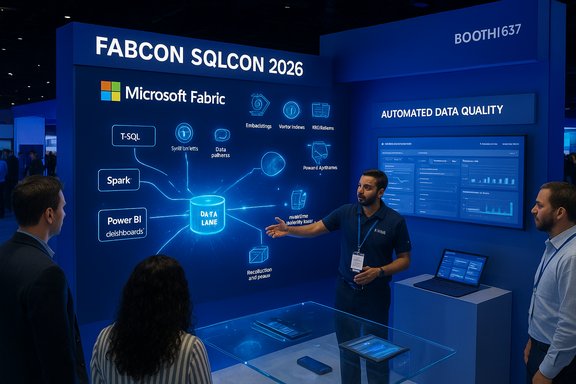
YASH’s messaging centers on five interlocking capabilities that form a practical pattern for Fabric adoption:- OneLake‑based foundation and Fabric Shortcuts — building a governed analytics layer that avoids needless data copies while enabling multiple consumption engines (T‑SQL endpoints, Spark, Power BI).
- Telemetry and event processing — use of Fabric Real‑Time Intelligence and streaming patterns to support IoT, fraud detection, and operational programs that require low latency.
- Enterprise governance with Microsoft Purview — fine‑grained access control, auditing, and policy enforcement integrated across Fabric workloads.
- Power BI + medallion architecture for analytics — prebuilt semantic models, curated datasets and self‑service BI patterns that power dashboards and operational reports.
- Fabric accelerators and semantic models — reusable templates and automation that standardize data quality, lineage, and AI‑readiness (embeddings, vector indexes, RAG patterns).
Technical anatomy: how the pieces fit
OneLake as the single logical lake
OneLake is designed to be the tenant‑wide lake for Fabric: a logical ADLS Gen2 surface where all Fabric artifacts (lakehouses, warehouses, SQL databases) store tabular data in Delta/Parquet formats. OneLake shortcuts and mirroring let teams create lightweight references to external or on‑prem data without copying terabytes, enabling governed sharing across workspaces and engines. This reduces data duplication and gives BI, data engineering and data science teams a common, discoverable store.SQL database in Fabric and the SQL analytics endpoint
Fabric’s SQL database provides an operational, OLTP‑capable experience based on Azure SQL technologies and is automatically replicated into OneLake in an analytics‑ready format. The SQL analytics endpoint exposes OneLake tables via T‑SQL for analytics and read‑only queries — enabling cross‑database joins across SQL databases, mirrored sources and warehouses. That means transactional data can be made analytically useful with near real‑time replication to OneLake without complex hand‑built ETL.Real‑Time Intelligence and event pipelines
Fabric’s Real‑Time workloads let teams ingest streaming telemetry and apply low‑latency processing and routing to downstream analytics or alerting systems. For operational scenarios (manufacturing, energy, fraud, IoT fleets), a Real‑Time hub feeding curated OneLake objects plus streaming indexes enables near‑real‑time dashboards and AI models that act on fresh events. YASH’s use cases — telemetry pipelines, fraud analytics and operational optimization — are precisely the kinds of scenarios Fabric’s real‑time and indexing features were designed to accelerate.AI readiness: embeddings, RAG and Copilot integration
Fabric supports vector data and retrieval‑augmented generation workflows. SQL databases in Fabric can host embedding metadata and Fabric + Azure OpenAI can power Copilot or custom agents that combine vector retrieval for contextual relevance and SQL for deterministic numerical or transactional queries. That hybrid approach — vectors for semantic retrieval, SQL for exact counts — is a commonly recommended pattern for production copilot features and appears across Microsoft documentation and partner case narratives.Governance: Purview, identity, and auditability
Microsoft positions Purview (the governance plane) as the enforcement layer for data sensitivity and access policies across Fabric workloads. Row/column level policies, tenant‑wide cataloging, and identity integration (Microsoft Entra) underpin many enterprise requirements for regulated industries. YASH emphasizes governance in its materials; this aligns with Fabric’s documented controls and the compliance use cases Microsoft highlights in its product literature.YASH’s credentials and market position
YASH has promoted itself as a Microsoft Fabric Featured Partner and has public statements that position the company as an early implementer and systems integrator for Fabric deployments. The firm’s corporate press materials assert more than 30 Fabric implementations and hundreds of cloud data platforms delivered across industries; those claims are consistent with YASH’s previous Fabric and Microsoft partner announcements. However, implementation counts and claimed outcomes in vendor materials should be treated as company‑reported metrics unless corroborated through independent case studies or customer references. Being a Fabric Featured Partner does carry practical weight: partners in this category typically receive early product access, technical enablement, and co‑sell opportunities with Microsoft — advantages that can accelerate project delivery and reduce integration friction. Customers evaluating partners should validate partner claims with references, architecture deep dives, and proof‑of‑value pilots.Event specifics and what to expect at Booth 637
FABCON & SQLCON 2026 (March 16–20, Atlanta) merges Fabric and SQL community programs into a single conference experience. Attendees can expect:- Workshops and preconference training on March 16–17, focused sessions and keynotes March 18–20.
- Microsoft keynotes covering SQL roadmap and Fabric innovations plus community‑led talks on ingestion, governance, and agentic AI.
- A sizable expo hall where partners — including YASH — will demo accelerators, reference architectures, and migration frameworks. YASH will be available to discuss practical modernization pathways and Fabric implementation best practices at Booth 637, and has signaled both demos and speaking sessions for its experts.
Independent verification and technical claims — a checklist
Key product and platform claims in YASH’s announcement align with Microsoft’s public documentation and event materials. To be precise:- Microsoft documents OneLake as a tenant‑level, ADLS Gen2–backed lake with Delta/Parquet storage and shortcut/mirroring capabilities.
- The SQL database in Fabric is documented as an operational database that automatically replicates data to OneLake and exposes a SQL analytics endpoint for read‑only analytic queries.
- Fabric’s Real‑Time Intelligence and OneLake security features are publicly described by Microsoft as core to its “AI‑ready data foundation” narrative.
Strengths and practical benefits
- Friction reduction for analytics: A OneLake‑centric approach reduces copying and ETL duplication, enabling multiple engines to read the same canonical artifacts. This drives faster analytics time‑to‑value for cross‑team projects.
- Near‑real‑time operational intelligence: Combining streaming ingestion with Fabric’s Real‑Time components lets enterprises detect anomalies and act quickly — crucial for OT/IoT, fraud detection, and customer experience use cases. YASH’s demos are framed around exactly these scenarios.
- Integrated AI patterns: Fabric’s support for vectors, RAG and integrated Azure AI tooling makes it possible to build copilots and retrieval‑grounded assistants that use governed data as the truth layer. The hybrid pattern (vector for retrieval; SQL for determinate answers) reduces hallucination risk compared with pure‑RAG designs.
- Partner accelerators and repeatability: Prebuilt accelerators (semantic models, medallion pipelines, governance templates) shorten delivery cycles and help standardize engineering practices across projects — a clear commercial advantage for an integrator like YASH.
Risks, limitations, and what to watch for
- Vendor concentration and lock‑in
Consolidating ingestion, storage, governance and AI operations inside Fabric and OneLake offers operational simplicity, but it increases reliance on Microsoft’s ecosystem. Enterprises should evaluate exit strategies, cross‑cloud portability of data formats (Delta/Iceberg vs closed formats), and how easily critical services could be migrated if needed. - Cost and capacity planning
Fabric’s capacity model, mirroring compute and analytics endpoints may introduce new cost dynamics. Real‑time ingestion at scale, vector index storage and AI inference can all drive consumption spikes. Proper forecasting, telemetry‑based cost controls, and chargeback models are essential. Microsoft’s docs and partners warn that mirroring, storage formats and query patterns can impact total cost of ownership. - Governance complexity and data sprawl (if poorly run)
OneLake reduces copies but does not remove the need for governance discipline. Poorly defined semantic models, inconsistent metadata tagging, or lax access policies can still create confusion and compliance exposures. Implementing Purview rules, semantic model governance, and automated data quality checks is non‑negotiable. - Skill and organizational readiness
Fabric introduces new primitives (shortcuts, OneLake, Fabric databases, Real‑Time Intelligence) that teams must learn. Enterprises with entrenched ETL, SQL Server, or Snowflake practices will need focused skilling programs, platform runbooks, and governance playbooks. Conferences like FABCON are useful, but ongoing operational readiness is a multi‑quarter commitment. - Security and residency constraints
While Microsoft provides region controls and Purview integration, some regulated customers may need strict data residency or specialized on‑prem patterns. Validate whether Fabric features you plan to use (mirroring, data virtualization, SQL database location) meet regulatory constraints in your geography. - Unverifiable vendor outcomes
Implementation counts, specific performance improvements, or percentage reductions cited in vendor announcements should be validated via customer references or technical proof‑of‑value pilots — these represent vendor claims unless independently audited.
Recommended approach for enterprises evaluating YASH’s offering
- Start with a focused proof of value (POV). Select a high‑impact use case (e.g., real‑time fleet telemetry or a fraud detection pilot) and validate ingestion, transformation, query performance, and governance flows end‑to‑end. Use the POV to test capacity and cost models.
- Validate data governance and lineage early. Require a governance sprint that maps Purview policies to OneLake artifacts and includes role‑based access tests, row/column restrictions, and audit logging.
- Demand technical deep dives and customer references. Ask YASH for architecture diagrams, a list of customers (subject to NDAs where applicable), and a staged migration plan that includes rollback scenarios.
- Model costs conservatively. Include sample query workloads and peak ingestion scenarios in cost estimates. Consider using reserved capacity or predictable capacity models to mitigate consumption volatility.
- Plan for hybrid operations. Define how on‑prem data or cross‑cloud sources will be mirrored or accessed via shortcuts, and validate latency and security constraints for those flows.
- Insist on knowledge transfer and internal enablement. Require that partner engagements include runbooks, automation scripts, and a training plan to ensure internal teams can operate the platform after delivery.
Why this matters for WindowsForum readers and IT leaders
The YASH announcement is part of a larger industry inflection: partners and system integrators are pivoting from discrete migration services to packaged Fabric‑first modernization playbooks. This matters because enterprises no longer need to stitch together five different vendors and dozens of bespoke pipelines to get AI‑ready data; with Fabric + OneLake + Purview, the technical ingredients for governance, near‑real‑time analytics, and retrieval‑grounded AI live under one vendor umbrella — and that changes procurement, operations, and technical strategy. The practical tradeoffs are familiar: faster time to insight and simpler governance versus larger platform dependency and new cost patterns.Final verdict: pragmatic optimism with disciplined due diligence
YASH’s presence at FABCON & SQLCON 2026 is a logical and timely move: it gives the company a platform to demonstrate repeatable Fabric patterns and accelerators to an audience actively evaluating Fabric for mission‑critical workloads. Microsoft’s documentation supports the core platform capabilities YASH claims to use — OneLake, SQL in Fabric, Real‑Time Intelligence and Purview are real features with documented behaviors and integration patterns. At the same time, buyers should treat vendor metrics and implementation counts as part of the conversation rather than the conclusion. Concrete validation — proof‑of‑value pilots, reference checks, and cost modeling — will separate successful, repeatable Fabric rollouts from expensive experiments. For organizations that prioritize governed, AI‑ready data estates and have a roadmap for operationalizing generative AI, the YASH approach offers a pragmatic acceleration path. For organizations with strict sovereignty, budget constraints, or a need to avoid single‑vendor lock‑in, the decision requires extra scrutiny.Attendees at FABCON & SQLCON 2026 will be able to see these tradeoffs in real time: vendor booths like YASH’s will demo speed and reusability; breakout sessions will unpack the platform primitives; and workshops will surface the operational details that ultimately determine success. Approach the show with clear questions, validated success criteria, and a plan to convert demos into measurable production outcomes.
YASH’s announcement confirms one thing: enterprises are no longer debating if they need an AI‑ready data foundation; they are debating how to build one. FABCON & SQLCON 2026 will be one of the first major industry stages where systems integrators and Microsoft will show how that “how” can be operationalized — and whether the promise of OneLake, Fabric databases, real‑time intelligence and integrated governance can deliver predictable, auditable value at enterprise scale.
Source: fox5sandiego.com https://fox5sandiego.com/business/p...soft-fabric-at-fabcon-sqlcon-2026-in-atlanta/
