

Microsoft Is Trying to Win the Stack Before the Startup Has One
The old startup cloud pitch was easy to understand: here are credits, here is compute, please do not think too hard about the bill until you have product-market fit. That bargain worked well enough in the SaaS era, when a young company could postpone the most painful infrastructure decisions until users, revenue, or venture money arrived. AI startups have broken that sequencing.
A company building with large models, inference pipelines, agents, vector search, evaluation tooling, data governance, and enterprise integrations does not get to treat infrastructure as a late-stage concern. The architecture is the product, or close enough that the distinction becomes academic. If the model is slow, expensive, hard to monitor, or impossible to govern, the startup does not have a scaling problem; it has a product problem.
That is why Microsoft’s expanded relationship with Y Combinator matters. YC remains one of the most influential funnels in technology, not because every company it funds becomes Airbnb, Stripe, Coinbase, or OpenAI, but because the program shapes founder defaults at the moment defaults are being formed. A cloud platform that gets embedded at that stage is not merely hosting workloads. It is teaching the company what “normal” looks like.
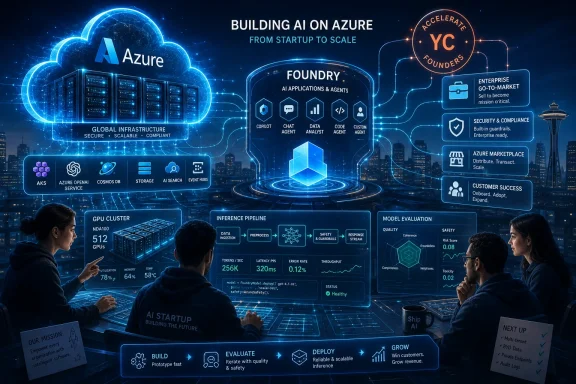
Microsoft’s pitch is that YC founders can move from experimentation to enterprise readiness without rebuilding the house around them. Azure provides the infrastructure, Microsoft Foundry provides a unified platform for building and operating AI apps and agents, and Microsoft for Startups adds the credits, technical support, and sales machinery. It is a full-stack courtship aimed at companies that may be small in headcount but unusually large in compute appetite.
The Credit Is the Hook, but the Platform Is the Sale
Startup credits are the visible part of the arrangement because they are easy to explain and immediately useful. Microsoft says eligible founders can access startup credits to offset the cost of building and scaling on Azure, with its broader startup program advertising the possibility of up to $150,000 in credits for qualified startups. In a market where GPU time can become a company’s largest early operating expense, that is not a symbolic perk.
But credits are not charity. They are a customer acquisition strategy with a long memory. A startup that builds its training jobs, inference endpoints, observability stack, identity model, and customer procurement flow around one cloud provider is not impossible to move later, but it is expensive to move. The switching cost arrives quietly, then all at once.
Microsoft knows this because every hyperscaler knows it. Amazon Web Services built a generation of startups by being available, familiar, and generous before procurement departments got involved. Google Cloud has long tried to convert AI research credibility into commercial default status. Microsoft’s advantage is different: it can offer cloud infrastructure and the enterprise sales channel in the same conversation.
That combination is particularly relevant for AI startups. Many of these companies are not trying to sell $19-a-month productivity widgets to individuals. They are trying to sell automation, copilots, compliance-sensitive workflows, developer tools, analytics, and agentic systems to businesses that already live in Microsoft 365, Teams, Entra, GitHub, Dynamics, and Azure. The credit helps a founder start building; the channel promises a route into the customer base that might actually pay.
This is the real commercial logic behind the YC partnership. Microsoft is not only subsidizing compute. It is trying to turn young AI companies into future Azure consumption, future Marketplace listings, future co-sell motions, and future dependencies in the Microsoft enterprise ecosystem.
Foundry Gives Microsoft a Cleaner AI Story Than Azure Alone
The inclusion of Microsoft Foundry is important because “build on Azure” is no longer specific enough. Azure is a continent, and founders do not have time to become cartographers. They need models, orchestration, evaluation, safety systems, deployment tooling, monitoring, and enough governance to survive a serious enterprise buyer’s questionnaire.
Microsoft Foundry is the company’s attempt to package that sprawl into something closer to an AI application factory. The branding has shifted as Microsoft’s AI stack has evolved, but the strategic direction is clear: give developers one place to build, ground, manage, and scale AI applications and agents across models and enterprise contexts. That matters because the center of gravity in AI development is moving from demos to operations.
A startup can impress investors with a prototype that chains a model to a database and returns a plausible answer. A customer, especially a large customer, wants to know how the system handles permissions, data boundaries, hallucination risk, audit trails, latency, cost spikes, and failure modes. Those are not glamour features, but they decide whether a product can graduate from pilot to deployment.
Foundry gives Microsoft a way to tell founders that they do not need to assemble every layer themselves. They can experiment with different models, connect systems, build agents, and operate with enterprise controls without treating governance as an afterthought. That does not remove complexity, but it moves some of it into a platform where Microsoft can claim maturity.
For YC founders, that may be valuable even when they do not intend to be “Microsoft startups” in any ideological sense. Most founders are pragmatic. They will use what saves time, reduces burn, and helps them close customers. If Foundry can shorten the path from demo to production, Microsoft gets a chance to become infrastructure of record before the startup’s own engineering culture has fully congealed.
Model Choice Is the New Cloud Neutrality
Microsoft’s announcement leans heavily on flexibility: founders can choose models across providers, build within a unified platform, and avoid rebuilding as the AI market changes. That language is doing a lot of work. It acknowledges a truth founders already understand, which is that no one wants to bet the company on a single model provider in 2026.
The AI market is moving too quickly for that. OpenAI, Anthropic, Google, Meta, Mistral, Microsoft’s own models, and specialized open-weight systems all occupy different parts of the cost, performance, context, latency, licensing, and safety landscape. The “best” model for coding may not be the best model for extraction, customer support, reasoning over private documents, or generating structured actions inside a workflow.
For startups, model flexibility is not a philosophical preference; it is a survival tactic. A sudden price change, rate limit, benchmark leap, licensing shift, or customer compliance requirement can turn yesterday’s architecture into tomorrow’s liability. The ability to route different workloads to different models, test alternatives, and preserve some abstraction from the underlying provider is becoming as basic as multi-region deployment once was.
Microsoft’s claim is that Foundry and Azure can provide that abstraction while still giving founders enterprise-grade infrastructure underneath. It is a clever position because it lets Microsoft benefit from the AI boom even when the winning model is not Microsoft’s own. If the control plane, deployment surface, identity layer, and procurement channel sit with Microsoft, the company can remain central even as model preferences churn.
That does not make the platform neutral in the purest sense. Every platform has defaults, incentives, and integrations that guide behavior. But it does reflect the new cloud reality: the fight is no longer only over whose data center runs the workload. It is over who provides the place where models, tools, agents, data, and business process meet.
YC Is Still a Taste-Maker, Even When Its Startups Are Not Yet Customers
Y Combinator’s influence can be overstated in lazy ways. Not every YC company becomes a category leader. Not every founder copies the tooling choices of the batch around them. The startup world is bigger than one accelerator, and the AI wave has produced important companies from research labs, university groups, open-source communities, big tech spinouts, and independent hackers.
Still, YC remains unusually good at creating early consensus. It gathers ambitious founders at a specific formative moment, compresses learning cycles, and sends signals to investors, customers, and vendors about where the next wave might be forming. When YC’s internal tooling and founder-facing systems use Azure and Microsoft Foundry, and when Microsoft makes a stronger bid for YC founders, that changes the ambient recommendation.
Startups are social organisms. They copy working patterns, especially when those patterns appear to reduce friction. If a batchmate gets GPU access, architecture help, a Marketplace path, or an enterprise intro through Microsoft’s program, that becomes part of the informal operating manual. The deal’s formal terms matter, but the whispered version of the deal may matter more.
Microsoft is also buying proximity to the questions founders ask before they have polished answers. What is the cheapest way to run inference at scale? How should an agent respect customer permissions? Which model should handle a regulated workflow? How do we pass security review at a Fortune 500 company? The provider that helps answer those questions has influence beyond the initial credit balance.
That proximity is valuable because AI startups are being forced into enterprise seriousness earlier than previous generations. A photo-sharing app could scale socially before it had mature compliance practices. An AI system that reads corporate documents, writes code, triggers business actions, or handles support workflows will encounter trust concerns almost immediately. Microsoft’s entire enterprise brand is built around selling into that anxiety.
The GPU Promise Is About Scarcity as Much as Performance
Microsoft says eligible YC founders can access high-performance AI infrastructure, including GPU resources launched with Y Combinator to support demanding workloads such as model training, inference, and high-throughput applications. That language will sound familiar to anyone following the AI infrastructure market. The bottleneck is not only software elegance; it is access to the machines.
GPU availability has become one of the defining constraints of the AI startup cycle. The companies with the most convincing technical roadmaps can still find themselves negotiating for capacity, optimizing around scarcity, or choosing between model ambition and burn rate. Cloud credits are helpful only if the compute is actually available when needed, in the right region, with the right performance profile and cost structure.
This is where Microsoft’s scale matters. Azure is one of the few platforms with the capital expenditure, supply-chain relationships, and data-center footprint to make credible promises about AI infrastructure at serious scale. That does not mean every startup will get all the compute it wants, or that Azure will always be the cheapest option. But it does mean Microsoft can make a stronger capacity argument than most would-be startup infrastructure providers.
For founders, the practical issue is less romantic than “training the next frontier model.” Many YC companies will not train large foundation models from scratch. They will fine-tune, distill, retrieve, orchestrate, evaluate, and serve model-powered products under real latency and reliability constraints. Inference at scale can become just as strategically important as training, particularly when customers expect AI features to feel instant and dependable.
The GPU portion of the partnership should therefore be read as both a performance promise and a scarcity hedge. Microsoft is telling founders that if their AI product works, the infrastructure path will not immediately collapse under demand. For a startup, that reassurance can shape architecture choices long before the first enterprise contract arrives.
Enterprise Distribution Is the Part Founders Cannot Build Overnight
The go-to-market portion of Microsoft’s offer may be less exciting to engineers than GPUs and models, but it could be the most important part of the package. Microsoft Marketplace and co-sell channels are not magic growth machines. They can be bureaucratic, competitive, and uneven. But for the right startup, they solve a real problem: enterprise buyers do not purchase software the way early adopters try products.
Procurement friction is a killer. Security review, vendor onboarding, contract terms, privacy documentation, data processing agreements, billing setup, and internal approval chains can slow a promising startup to a crawl. Marketplace availability does not erase those steps, but it can make the purchase feel more familiar to customers already committed to Microsoft’s ecosystem.
This is especially relevant for AI companies because trust is now part of the product surface. A buyer evaluating an AI startup is not only asking whether the tool works. The buyer is asking where data goes, how access is controlled, whether logs can be audited, how models are governed, and whether the vendor will survive long enough to support the deployment. Microsoft’s platform halo can help answer some of those concerns, or at least make the conversation easier to start.
That creates an incentive for founders to build in ways that align with Microsoft’s enterprise expectations. Use Azure identity. Package for Marketplace. Integrate with Teams, Microsoft 365, GitHub, or Dynamics where relevant. Think about compliance before the sales cycle demands it. Those choices may improve enterprise readiness, but they also deepen the startup’s relationship with Microsoft’s stack.
The tension is obvious. A founder wants distribution without dependence. Microsoft wants to offer distribution in a way that reinforces dependence. The partnership works best for startups whose customers are already Microsoft-heavy and whose products benefit from enterprise adjacency. It may be less compelling for companies whose advantage depends on cloud portability, consumer distribution, or infrastructure that is radically optimized outside the hyperscaler model.
The AI-Native Startup Is Becoming Expensive Earlier
Microsoft’s announcement frames the partnership around the next generation of AI startups, and the phrase is more than marketing. AI-native companies really do look different from their SaaS predecessors. They often begin with higher infrastructure costs, more complex dependency chains, and a greater need for security and governance before revenue has caught up.
That changes startup economics. The classic advice to stay lean, ship fast, and avoid premature scaling becomes harder to interpret when a product’s basic functionality depends on expensive inference, model evaluation, and data pipelines. A small team can now build something that looks enterprise-grade in a demo, but running it reliably for real customers can expose costs that are not obvious during the pitch.
Cloud providers are eager to soften that landing because they know infrastructure anxiety can shape product ambition. If every model call feels like lighting venture money on fire, founders will constrain their products around cost instead of capability. Credits and technical guidance let startups explore more aggressively, at least for a while.
But the bill eventually arrives. Microsoft’s own note that committed balances may be invoiced if they remain at the end of a term is a reminder that credits are governed by terms, expiration rules, eligibility, and usage boundaries. Founders should treat cloud credits as financing, not free money. They extend runway, but they can also disguise unit economics until a startup is already committed to a path.
The best founders will use this kind of partnership to learn their cost structure earlier, not later. They will measure inference margins, test model substitutions, design graceful degradation, and avoid building products that only work under subsidy. Microsoft can provide the platform, but it cannot repeal the economics of compute.
Microsoft’s Startup Strategy Mirrors Its Larger AI Strategy
This partnership also fits a broader Microsoft pattern. The company has spent the past several years positioning itself not merely as a model partner, but as an AI infrastructure and application platform provider. It has leaned on OpenAI, broadened access to other model families, invested in its own AI capabilities, and wrapped the whole thing in Azure, GitHub, Copilot, and enterprise governance.
That is a defensible strategy because the model layer is both critical and unstable. Models improve, prices shift, and customer preferences change. The platform that hosts, orchestrates, secures, and sells AI systems may prove more durable than any single model advantage. Microsoft wants Foundry to be the place where that durability lives.
YC gives Microsoft a way to push that strategy upstream. Instead of waiting for a startup to become successful and then competing for its infrastructure business, Microsoft can meet the company when it is deciding how to build. That is cheaper than winning a migration later, and it aligns with the company’s long-standing developer playbook: get into the workflow, become the default, and let usage compound.
There is a Windows angle here too, even if the announcement is about cloud infrastructure rather than desktop operating systems. Microsoft’s modern platform is increasingly a continuum: Windows for local development and endpoint deployment, GitHub for code, Azure for compute, Foundry for AI systems, Entra for identity, Microsoft 365 and Teams for distribution, and Marketplace for procurement. The company’s AI startup pitch is strongest when those pieces reinforce one another.
For WindowsForum readers, that means the story is not just about Silicon Valley founders getting credits. It is about the enterprise Windows ecosystem becoming one of the default homes for AI applications that will eventually land inside corporate workflows, developer environments, admin consoles, and productivity suites. Today’s YC prototype can become tomorrow’s Teams app, Copilot extension, Azure service dependency, or security review headache.
Founders Should Read the Fine Print and the Strategy
The attractive version of the partnership is easy to state. A YC founder building an AI product gets Azure credits, access to GPU infrastructure, Microsoft Foundry, technical support, and a path toward enterprise customers. That is a strong bundle, especially for a small team trying to move faster than its burn rate would normally allow.
The cautious version is just as important. Founders should understand eligibility, credit duration, committed spend obligations, data residency requirements, GPU availability, model pricing, support expectations, and the practical realities of Marketplace selling. A platform partnership can accelerate a company, but it can also make architectural assumptions feel inevitable when they are merely convenient.
This is not an argument against the deal. It is an argument for treating infrastructure as strategy. In the AI era, the choice of cloud, model platform, identity layer, and distribution channel is not a back-office decision. It shapes product velocity, margins, compliance posture, hiring, and customer trust.
Microsoft is betting that many AI startups will prefer an integrated path over stitching together specialized vendors. Some will. Others will choose a more modular stack, a different cloud, open-source-first infrastructure, or a multi-cloud posture from the beginning. The important point is that the decision now arrives early, and it carries more weight than startup cloud decisions used to carry.
YC founders should take the money if it helps them build, but they should also model the world after the credits expire. They should ask whether the architecture still makes sense at scale, whether customers benefit from Microsoft alignment, and whether the platform’s abstractions preserve enough room to move as the AI market changes. The best use of a subsidy is not to avoid hard questions; it is to buy enough time to answer them properly.
The YC-Azure Deal Turns Early Infrastructure Into a Board-Level Decision
The practical lesson from the announcement is that the startup stack is becoming strategic earlier than investors, founders, and IT buyers may be used to admitting. Microsoft is offering a serious package, and YC gives that package cultural leverage. The question is not whether the deal is good or bad in the abstract, but whether founders understand what they are accepting when infrastructure, AI tooling, and enterprise distribution arrive as one bundle.
- Microsoft and Y Combinator are expanding their relationship to give YC founders building on Azure access to Microsoft Foundry, startup credits, GPU-oriented AI infrastructure, technical guidance, and enterprise go-to-market support.
- The partnership is designed for AI-native startups whose infrastructure needs can appear at company formation rather than after years of SaaS-style growth.
- Microsoft Foundry is central to the pitch because it gives Microsoft a platform story around building, grounding, governing, and operating AI applications and agents beyond basic cloud hosting.
- The deal strengthens Microsoft’s ability to influence startup architecture before companies become large enough for cloud migration to be painful and politically difficult.
- Founders should treat credits and platform support as strategic financing, because the post-credit cost structure, model flexibility, and enterprise dependency risks will eventually matter.
- For Microsoft’s enterprise customers, the partnership could mean more AI startups arriving pre-aligned with Azure, Marketplace procurement, Microsoft identity, and the broader Microsoft 365 ecosystem.
The future Microsoft is chasing is one in which the next breakout AI company does not merely run on Azure, but grows up inside Microsoft’s assumptions about identity, governance, deployment, procurement, and scale. That may be exactly what some founders need to survive the expensive transition from demo to durable business. It also means the next generation of AI startups will be shaped not only by better models, but by the platform bargains they strike before anyone outside the batch has heard their names.
References
- Y Combinator and Microsoft partner to support the next generation of AI startups - Microsoft Microsoft · Wed, 17 Jun 2026 12:30:00 GMT