

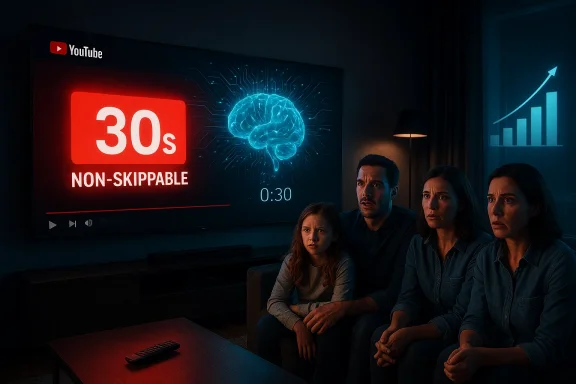
YouTube is rolling out 30‑second unskippable ads on TV apps globally — a change Google says will be served selectively and optimized by its ad systems, but one that threatens to make the living‑room YouTube experience notably more intrusive and that could push more viewers toward paid tiers such as YouTube Premium and Premium Lite.
YouTube’s presence on living‑room screens has been a defining shift in the platform’s evolution: watch time on TVs has surged in recent years and YouTube itself has framed the living room as a core battleground for creators, advertisers, and streaming platforms. The company has repeatedly highlighted dramatic growth in TV watch time and connected‑TV engagement as reasons to build new features and ad products geared specifically for that environment.
Officially, Google’s ad product updates describe a family of non‑skippable formats — short bumpers (6s), standard non‑skippable (15s), and a new 30‑second CTV‑only non‑skippable format — with AI‑driven optimization that dynamically chooses which format to serve for a campaign. That same product announcement marks the new option as “generally available” for advertisers buying through Google Ads and programmatic channels.
Mainstream tech outlets that cover streaming and TV platforms now report the rollout of 30‑second unskippable ads to smart‑TV apps, consoles, and other big‑screen YouTube clients, confirming the move beyond experimentation on a small set of publishers or devices.
Key technical points Google published or that appear in the announcement:
YouTube’s ad ecosystem is a major revenue engine for Alphabet, and the company has introduced features to grow advertiser demand and yield — including AI optimization, advanced targeting, and programmatic availability of TV‑grade ad units. Alphabet’s ad and YouTube revenues are massive, and product moves that increase monetizable impressions on premium inventory directly impact the top line. Recent reporting notes YouTube’s ad contribution to Alphabet’s revenue is large and growing, which provides the macroeconomic pull toward monetizing prime viewing moments more assertively.
That history matters because it shows Google has toggled between prioritizing viewer experience and maximizing ad yield in response to market conditions, advertiser demand, and internal strategy — and the re‑introduction of 30s unskippables on TV can be read as the company leaning toward yield in the connected‑TV era.
Those community threads also document how users experienced periods when ad‑blockers stopped working reliably on YouTube, and how perceived anti‑ad‑block measures have pushed users to consider paid tiers. Community sentiment is not the same as market data, but it is an important real‑world signal about viewer annoyance and churn risk.
Advertisers and platform operators are unlikely to acknowledge “we want to force subscriptions,” but the market logic is evident: increasing ad friction increases the incremental value of ad‑free tiers and may lift conversion rates. Whether that is the primary motivation is impossible to prove from outside Google, but the observed effect is clear and predictable: harder ad experiences correlate with higher uptick in paid, ad‑free subscriptions. That relationship has been noted in coverage and in consumer behavior signals.
Short‑term signal to watch:
If you value a calmer TV YouTube experience, the practical choices are few and straightforward: pay for ad‑free tiers, push for better frequency control through in‑app feedback, or pick other apps for TV‑style viewing. The tradeoffs are now explicit: free, ad‑supported YouTube will be more television‑like; ad‑free YouTube requires a monthly fee. For creators and advertisers, the new environment is a test of whether platform power, creative fidelity, and smarter targeting can be balanced without alienating the viewers who made YouTube a living‑room staple in the first place.
In any transition like this, watch the data, watch the feedback channels, and prepare contingency plans: creators should diversify revenue, advertisers should A/B test placements and creatives, and viewers should decide whether the convenience of free, ad‑supported access is still worth the increasing ad friction. The next few quarters will tell whether 30‑second unskippable ads on TV were a necessary evolution — or a misstep that accelerates the migration from ad‑funded attention economies toward paid, curated experiences.
Source: Windows Central Unskippable YouTube ads are about to hit my TV at 30 seconds a piece
 Background / Overview
YouTube’s presence on living‑room screens has been a defining shift in the platform’s evolution: watch time on TVs has surged in recent years and YouTube itself has framed the living room as a core battleground for creators, advertisers, and streaming platforms. The company has repeatedly highlighted dramatic growth in TV watch time and connected‑TV engagement as reasons to build new features and ad products geared specifically for that environment.Officially, Google’s ad product updates describe a family of non‑skippable formats — short bumpers (6s), standard non‑skippable (15s), and a new 30‑second CTV‑only non‑skippable format — with AI‑driven optimization that dynamically chooses which format to serve for a campaign. That same product announcement marks the new option as “generally available” for advertisers buying through Google Ads and programmatic channels.
Mainstream tech outlets that cover streaming and TV platforms now report the rollout of 30‑second unskippable ads to smart‑TV apps, consoles, and other big‑screen YouTube clients, confirming the move beyond experimentation on a small set of publishers or devices.
What Google announced — the technical specifics
The new ad mix and AI optimization
Google’s recent product announcement for VRC (non‑skip) ad products states the platform will “dynamically optimize between 6‑second Bumpers, 15‑second standard and 30‑second CTV‑only non‑skippable ad formats,” using AI to choose formats that will deliver the intended reach and impact for advertisers. That means, on paper, advertisers can buy campaigns that rely on AI to decide whether a viewer should see a bumper, a 15s spot, or a full 30s CTV‑only non‑skippable creative.Key technical points Google published or that appear in the announcement:
- 30‑second non‑skippable units are marked as CTV‑only (intended for TV apps and other connected television environments).
- The ad system will “optimize” delivery across formats to improve reach and efficiency for advertisers, rather than give media buyers manual control over which length runs where.
Rollout scope and where you’ll see them
Reporting indicates the 30‑second CTV non‑skip option is being rolled out broadly across YouTube apps on TV platforms — smart TVs, set‑top devices that run the YouTube app, and console clients — not just limited testbeds. Mainstream tech press coverage has framed this as a global rollout rather than a limited regional pilot.Why Google is doing this (the business logic)
From Google’s perspective the logic is straightforward: advertisers pay more for guaranteed attention and longer creative lengths generally command higher CPMs. With streaming and connected TV commanding more of viewers’ time, advertisers want ad‑length options that resemble traditional TV spots; 30‑second creatives are a familiar standard in TV advertising and remain a creative sweet spot for many campaigns.YouTube’s ad ecosystem is a major revenue engine for Alphabet, and the company has introduced features to grow advertiser demand and yield — including AI optimization, advanced targeting, and programmatic availability of TV‑grade ad units. Alphabet’s ad and YouTube revenues are massive, and product moves that increase monetizable impressions on premium inventory directly impact the top line. Recent reporting notes YouTube’s ad contribution to Alphabet’s revenue is large and growing, which provides the macroeconomic pull toward monetizing prime viewing moments more assertively.
Historical context: this isn’t the first time 30‑second unskippables have been controversial
YouTube’s ad format strategy has evolved in fits and starts. The platform introduced six‑second “Bumper” ads in 2016 as a short, non‑skippable format designed for mobile snackable viewing. Over the years Google has experimented with ad lengths and placement rules; at times the company publicly emphasized the user experience and moved away from longer non‑skippable pre‑rolls, while at other times its ad products have favored advertiser demand. Historical reporting documented a period where YouTube scaled down some 30‑second pre‑roll placements in favor of shorter units, emphasizing bumpers and shorter formats as part of improving viewer experience.That history matters because it shows Google has toggled between prioritizing viewer experience and maximizing ad yield in response to market conditions, advertiser demand, and internal strategy — and the re‑introduction of 30s unskippables on TV can be read as the company leaning toward yield in the connected‑TV era.
What users are saying — community reaction and ad‑blocker friction
User communities and forums have long expressed frustration with long unskippable ads and with YouTube’s responses to ad‑blocking tools. Discussion threads and community posts capture consistent complaints: longer unskippable ads (including 30s units), ad redundancy, and behavior that feels like an engineered nudge toward paid membership. Those complaints frequently mention frustration when watching short or medium‑length content that becomes disproportionally interrupted by long ads, and they underscore the perception that the platform has been gradually increasing the pressure to subscribe to ad‑free tiers.Those community threads also document how users experienced periods when ad‑blockers stopped working reliably on YouTube, and how perceived anti‑ad‑block measures have pushed users to consider paid tiers. Community sentiment is not the same as market data, but it is an important real‑world signal about viewer annoyance and churn risk.
The user experience tradeoffs (why 30s on TV is different from 30s on mobile)
Watching YouTube on a TV is often a passive, lean‑back experience shared in living rooms. The same 30‑second unskippable ad that a viewer might accept on a desktop or mobile session feels different on a big screen for several reasons:- Attention and expectation: On TVs, users typically expect a continuous viewing experience. A 30s unskippable pre‑roll interrupts that flow and imposes a TV‑style ad break on content that was historically “on demand.”
- Context of the content: Many YouTube TV viewers use the platform to play longform creator videos, documentaries, or music playlists. A 30s pre‑roll before a 4‑minute clip or a short vignette can feel extremely disproportionate.
- Perceived fairness: Viewers used to skipping after 5 seconds on desktop or getting bumpers on mobile may perceive the TV experience as more punitive when forced to watch longer ads.
- Cumulative irritation: If AI optimization serves a 30s unit at scale to users who habitually watch on TV, the resulting frequency of long interruptions could drive churn, complaints, or more conversions to paid plans.
Is this a push toward more paid subscriptions? (Premium vs Premium Lite)
A major strategic side effect of more intrusive ad formats is that they make paid, ad‑free tiers more attractive. YouTube now offers multiple paid options, including the standard YouTube Premium and the lower‑priced Premium Lite. Premium Lite — which returned to broader markets and has been priced around $7.99 per month in key markets — was explicitly designed as a cheaper, mostly ad‑free option for viewers who don’t need the full music bundle or some other Premium features. Recent product messaging and press coverage confirms that Premium Lite is positioned precisely as the lower‑friction path for viewers who want to avoid ads.Advertisers and platform operators are unlikely to acknowledge “we want to force subscriptions,” but the market logic is evident: increasing ad friction increases the incremental value of ad‑free tiers and may lift conversion rates. Whether that is the primary motivation is impossible to prove from outside Google, but the observed effect is clear and predictable: harder ad experiences correlate with higher uptick in paid, ad‑free subscriptions. That relationship has been noted in coverage and in consumer behavior signals.
Risks and downsides — for viewers, creators, and advertisers
For viewers
- Ad fatigue and churn: More long, non‑skippable interruptions on TVs can make YouTube feel closer to linear TV in annoyance, triggering cancellations of the app on certain devices or pushing viewers to other platforms.
- Perceived value erosion: If the app becomes dominated by ad breaks, the perceived value of creator content (and of YouTube as a platform) could decline.
- Accessibility and attention: Some viewers (elderly, neurodivergent) find abrupt, long unskippable ads especially disruptive.
For creators
- Audience loss on short content: Creators who publish short or medium‑length content may suffer discovery friction if viewers abandon videos rather than sit through long pre‑rolls.
- impact:** If viewers migrate off ad‑supported viewing or subscribe to Premium, creator ad revenue mixes will shift — possibly positively for longer watch times but negatively for short clips whose CPMs rely on ad impressions. The net effect depends on viewer behavior and RPM changes.
For advertisers
- Diminishing returns if served incorrectly: Running long creatives where viewers are likely to bail damages campaign effectiveness and brand sentiment. AI optimization reduces but does not eliminate this risk.
- Brand safety and context: Ads placed in inappropriate or low‑quality contexts (e.g., pre‑roll before polarizing creator content) still carry brand risk; longer ad lengths amplify that risk because they demand sustained attention.
Platform & regulatory risk
- Consumer pushback and regulatory attention: Where a platform uses dominant distribution power to steer users toward paid tiers, regulators and consumer advocates sometimes raise questions about anti‑competitive behavior or unfair practices. Increased friction and complaints can attract attention in multiple jurisdictions. Evidence of systematic anti‑ad‑block measures has already provoked community ire.
What advertisers should know and how to adapt
Advertisers planning to use the new 30s CTV non‑skippable units should do three things:- Test, don’t assume: A campaign that works on linear TV does not automatically translate to YouTube TV inventory. Run small, controlled tests and measure view‑through, brand lift, and downstream conversions.
- Segment creatives by platform: Use shorter, high‑impact bumpers for mobile and some TV contexts, reserve 30s CTV units for premium, appointment‑style placements (streaming premieres, longform content where viewers expect ad breaks).
- Leverage AI optimization thoughtfully: Google’s AI will choose formats dynamicalhould monitor frequency capping and audience overlap to avoid overexposure and wasted spend.
What viewers can do (practical, lawful choices)
- Consider paid tiers: If uninterrupted viewing is a priority, YouTube Premium or Premium Lite are official, supported optioneen offered at about $7.99 in major markets and has recently been enhanced with additional features in some rollouts. These tiers remain the most straightforward solution for ad‑free viewing.
- Switch platforms when feasible: For specific content types, competitors or alternative apps may offer better ad‑load economics or cleaner UX. That said, YouTube’s scale and breadth of content make it hard to fully replace for many viewers.
- Provide feedback: Use in‑app feedback mechanisms to flag poor experiences. Aggregate signals of dissatisfaction matter to platform product teams even when advertiser economics favor more aggressive monetization. Community posts and threads show users are actively complaining and seeking recourse; that consumer pressure has influenced past product decisions.
For creators: what this could mean for your channel
Creators should prepare for several possible short‑ and medium‑term effects:- Audience behavior shifts: Expect some viewers to convert to Premium (good for creator RPM on Premium revenue shares) and others to churn away from certain types of short content. Monitor your analytics closely for watch‑through and viewer retention changes after rollout.
- Monetization mix changes: If ad yields per impression rise because advertisers pay more for guaranteed attention, creators could earn more from ad RPMs per view. Conversely, if view counts drop or watch sessions shorten because of ad irritation, creators may see revenue declines.
- Creative strategy: Lean into formats that reward long watch time and living‑room viewing (longform documentaries, episodic content, playlist‑friendly videos). These formats are more naturally compatible with TV ad breaks and can be more resilient to pre‑roll annoyance.
How regulators and advertisers should watch this
- Regulators: Pay attention to whether systemic UX changes primarily designed to extract subscription revenue from users could raise antitrust or consumer protection scrutiny. A platform combining dominant distribution, mandatory ad exposure, and incentives to convert users into paid subscribers is an area regulators often monitor.
- Advertisers and agencies: Demand transparency around delivery and brand‑safety controls, and insist on campaign-level protections that prevent long, non‑skippable creative from being served in contexts that reduce effectiveness. Test results and independent measurement partners will be crucial.
The balance Google must strike
YouTube is balancing three competing aims: maximizing ad revenue for Google and creators, keeping viewers on platform, and maintaining advertiser confidence by offering premium TV‑grade units. Historically, Google has swung between short ad formats (like bumpers) that favor user tolerance and longer formats that favor advertiser creative needs. The reintroduction and expansion of 30s unskippables on TV is an instance of the platform shifting toward TV‑style monetization at a time when TV watch time on YouTube is at record levels. But that strategy carries risks: increased user annoyance, potential churn, and reputational costs if the system misapplies long units at scale.Bottom line: a pragmatic view for viewers, creators, and advertisers
- For viewers: These 30‑second unskippable ads on TV will be noticeable and may meaningfully degrade the big‑screen YouTube experience in some scenarios. If uninterrupted viewing matters to you, paid tiers like YouTube Premium or Premium Lite are the official escape hatch.
- For creators: Expect a short adjustment period. Watch analytics closely, adapt creative strategies for TV audiences, and diversify monetization so you’re not fully dependent on ad impressions that may be affected by viewing habit shifts.
- For advertisers: Use the new 30s CTV units where they fit the audience and content context; don’t assume they will outperform shorter formats in every placement. Test and measure, and use frequency caps and contextual controls aggressively.
Final analysis — tradeoffs, likelihoods, and what to watch next
This initiative is both logical and risky. It is logical because advertisers historically pay premiums for long‑form, guaranteed attention on TV, and YouTube’s TV audience is large and growing; adding 30‑second non‑skip inventory allows Google to productize that value for buyers. It is risky because the edge cases (short videos, high ad frequency, misapplied AI optimization) can create disproportionate viewer annoyance — exactly the kind of experience that drives people to complain, seek workarounds, or pay for premium tiers and could invite regulatory scrutiny if large numbers of users feel forced into paying.Short‑term signal to watch:
- How quickly those 30s units appear in front of short versus long content (frequency and placement distribution).
- Any measurable uptick in Premium or Premium Lite conversions correlated to the rollout.
- Advertiser uptake and performance signals: do brands see better outcomes from the format, or does view‑through and recall suffer where the creative/context mismatch?
If you value a calmer TV YouTube experience, the practical choices are few and straightforward: pay for ad‑free tiers, push for better frequency control through in‑app feedback, or pick other apps for TV‑style viewing. The tradeoffs are now explicit: free, ad‑supported YouTube will be more television‑like; ad‑free YouTube requires a monthly fee. For creators and advertisers, the new environment is a test of whether platform power, creative fidelity, and smarter targeting can be balanced without alienating the viewers who made YouTube a living‑room staple in the first place.
In any transition like this, watch the data, watch the feedback channels, and prepare contingency plans: creators should diversify revenue, advertisers should A/B test placements and creatives, and viewers should decide whether the convenience of free, ad‑supported access is still worth the increasing ad friction. The next few quarters will tell whether 30‑second unskippable ads on TV were a necessary evolution — or a misstep that accelerates the migration from ad‑funded attention economies toward paid, curated experiences.
Source: Windows Central Unskippable YouTube ads are about to hit my TV at 30 seconds a piece
