

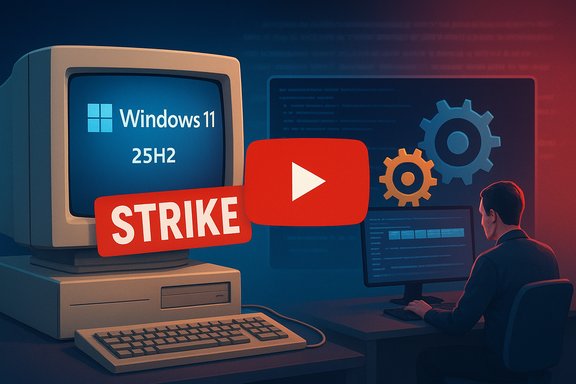
YouTube’s sudden removal of several Windows 11 tutorial videos — including popular walkthroughs showing how to bypass the Microsoft account requirement and how to install Windows 11 version 25H2 on unsupported PCs — has touched off a public backlash from creators and reignited a broader debate over automated moderation, platform power, and the future of technical education on big video sites. Major tech YouTubers say their videos were flagged under YouTube’s “harmful or dangerous content” rules, strikes were issued, and appeals were rejected in minutes by automated systems. The dispute exposes a collision between legitimate, widely shared PC-repair and upgrade guidance and an enforcement regime that increasingly relies on AI detection with minimal human oversight.
Windows 11 version 25H2 is the latest annual feature update from Microsoft, rolled out as an enablement package for eligible devices and reflecting the company’s continued push to refine platform security and update mechanisms. Microsoft’s hardware and account requirements for Windows 11 — including TPM 2.0, Secure Boot, and stricter CPU compatibility lists — have led many users to seek how-to guides for installing or updating Windows on older or “unsupported” machines. Those tutorials range from safe, manual registry tweaks and use of official tools to more advanced ISO modifications and bypass scripts that Microsoft explicitly classifies as unsupported.
At the same time, platforms such as YouTube have tightened enforcement of content policies tied to “harmful or dangerous” activities and expanded automated review systems. Creators who publish step-by-step technical tutorials now find themselves operating inside an enforcement environment where educational context can be overlooked by automated classifiers designed to catch genuinely dangerous or malicious instruction.
The central tension here is interpretation:
Regulatory frameworks and industry self-regulation should encourage platform transparency, clear appeals pathways, and human accountability for decisions that materially impact creators’ livelihoods and public access to expertise.
At the same time, platforms face a real trade-off. Automation is the only practical means to police billions of uploads and protect vulnerable viewers. The solution is not to abandon automated systems but to rearchitect the checks and balances — better context-aware models, mandatory human review for context-heavy appeals, and clearer behavioral examples that separate “dangerous instruction” from “technical how-to.” Without those fixes, the platform risks stifling the very community it depends on: knowledgeable creators who teach and troubleshoot the devices billions of people use every day.
The immediate imperative for creators is practical: document your work, add clear educational framing, and preserve copies of your content. For platforms, the imperative is structural: make enforcement explainable, appeals meaningful, and policy boundaries explicit. The long-term public-interest imperative is democratic: the technical literacy that keeps millions of devices secure and working should not become collateral damage in an era of automated moderation.
Source: reclaimthenet.org YouTube Faces Backlash After AI Removes Windows 11 Tutorials for Unsupported PCs
 Background / Overview
Windows 11 version 25H2 is the latest annual feature update from Microsoft, rolled out as an enablement package for eligible devices and reflecting the company’s continued push to refine platform security and update mechanisms. Microsoft’s hardware and account requirements for Windows 11 — including TPM 2.0, Secure Boot, and stricter CPU compatibility lists — have led many users to seek how-to guides for installing or updating Windows on older or “unsupported” machines. Those tutorials range from safe, manual registry tweaks and use of official tools to more advanced ISO modifications and bypass scripts that Microsoft explicitly classifies as unsupported.At the same time, platforms such as YouTube have tightened enforcement of content policies tied to “harmful or dangerous” activities and expanded automated review systems. Creators who publish step-by-step technical tutorials now find themselves operating inside an enforcement environment where educational context can be overlooked by automated classifiers designed to catch genuinely dangerous or malicious instruction.
What happened: timeline and the creators involved
- Late October: Several creators, including CyberCPU Tech (Rich White) and Britec09, reported that videos demonstrating how to:
- install Windows 11 25H2 on older hardware, and
- bypass the Microsoft account requirement to create a local account during setup
were removed by YouTube and labeled as violating the platform’s harmful-or-dangerous rules. - Creators reported that appeals were processed and rejected in extremely short timeframes — sometimes within a minute — which strongly suggests automated appeal rejections or cursory human review unable to evaluate a long, context-rich tutorial.
- Channels impacted included well-known Windows/PC repair and upgrade creators with audiences in the hundreds of thousands. A number of other tech channels reported similar fears about older videos being rescanned and struck under the same logic.
Why this matters: the practical and societal stakes
Educational value vs. policy enforcement
Technical tutorials about operating systems have a long history on open platforms because they provide real value: troubleshooting, extending hardware life, and enabling users who cannot or will not buy new devices to keep working systems secure. Removing or chilling that content threatens a large swath of user education and the informal tech support ecosystem that many non-experts rely on.Chilling effects on creators
When enforcement is unpredictable and appeals are quick and non-transparent, creators adjust behavior to avoid strikes. That leads to fewer in-depth tutorials, simpler content, and a significant loss of long-form educational resources. For many creators these videos are income-generating and form the core of a channel’s identity; strikes can mean demonetization, reduced reach, or even termination after repeated violations.Platform governance and public expectations
YouTube, as the dominant host of video tutorials and repair guides, occupies gatekeeper status. How it balances safety against the legitimate need for technical instruction sets a precedent for other platforms and for the public’s expectations of access to technical knowledge.The policy and the apparent mismatch
YouTube’s policies include a “Harmful or Dangerous Content” category that targets videos that instruct on activities likely to cause serious physical harm, illegal acts, or instructions that facilitate wrongdoing. The platform also recognizes educational, documentary, scientific, or artistic (EDSA) exceptions for content that gives context and intent. However, the written guidelines also explicitly disallow instructions that use information technology to “compromise personal data or cause serious harm to others.”The central tension here is interpretation:
- A video showing how to create a local account or how to install an OS on unsupported hardware is, by common understanding, an educational tech tutorial.
- Automated classifiers can misread phrases, code snippets, or on-screen prompts as instructions for misuse, especially when policies include broad language like “instructions on how to use computers to cause serious harm.”
- The EDSA exception requires that context be present in the video or audio, but automated systems often rely on metadata (title, description, transcript) and visual pattern detection to make quick enforcement decisions.
Technical context: Windows 11, 25H2, and why tutorials proliferate
- Windows 11 version 25H2 has been distributed as an enablement package and annual feature update for devices meeting Microsoft’s requirements. Because the update is a “seeker” experience (optional to install) and Microsoft narrows which devices are offered upgrades via Windows Update, many users seek manual upgrade paths.
- Common workarounds to install Windows 11 on unsupported hardware include editing registry values to bypass compatibility checks, using patched ISOs that remove appraiser checks, or leveraging third-party scripts and installer tools. Microsoft labels these methods as “unsupported,” and has in some instances published guidance or removed official documentation that described such bypasses.
- The technical risk for an individual user following a tutorial is usually: broken installations, loss of driver support, and potential lack of future updates from Microsoft. The security risk is generally low compared with instructions that teach cybercrime, but it is non-zero — particularly for users who perform risky modifications without backups or who run altered system images.
Automation, human-in-the-loop, and the appeals paradox
Automation’s scale advantage — and its blunt edges
YouTube’s enforcement systems flag and take down enormous volumes of content. Automation enables fast responses at map-scale: catching genuinely dangerous tutorials (e.g., bomb-making, lethal challenges, doxing tutorials) or scaling protections for children. But automation produces a high rate of false positives for nuanced, context-dependent content like technical tutorials.Appeals processed in minutes
When appeals are rejected in one to forty-five minutes for long tutorials, it indicates an appeals process driven by fast heuristics or automated reruns rather than careful manual review. A meaningful appeals resolution for a 15–30 minute tutorial requires reviewing the video’s audio and context — something that an automated pipeline or an overworked human reviewer cannot do in a minute.Contradictions inside platform AI
Creators reported that the same platform’s AI suggestion tools recommend topics identical to those that later earn strikes. That contradiction reveals a mismatch between recommendation models (optimizing engagement) and enforcement models (optimizing safety/risk reduction). A content idea promoted by one internal AI and punished by another creates legitimate confusion about permissible content.Organizational context: YouTube’s AI pivot
YouTube has been reorganizing to center AI across product and moderation flows while offering voluntary buyouts to segments of its workforce. That strategic pivot reduces available human moderation capacity in certain teams and increases reliance on automated systems — a structural factor contributing to the incidents.Strengths and legitimate reasons for enforcement
- Automated moderation scales protection for minors and the general public where human review is infeasible given upload volumes.
- The “harmful or dangerous” policy is necessary: without it, detailed malicious instructions and content that could cause physical harm or facilitate serious illegal acts would spread unchecked.
- The EDSA exception and contextual requirements demonstrate the platform’s intent to preserve legitimate educational content, at least on paper.
Risks and weaknesses exposed by the takedowns
- Overbroad enforcement: Treating benign Windows tutorials as potentially life-threatening instructions stretches the policy beyond its intended scope.
- Opaque appeals: Appealing a strike should be a pathway to human consideration for context-rich content. Quick rejections undermine trust in the process.
- Chilling effect: Creators may self-censor or stop producing technical content — depriving millions of users of practical help and forcing them to less reliable channels.
- Inconsistent policy signals: When platform tools recommend topics that enforcement subsequently punishes, creators receive contradictory guidance.
- Potential for misuse: Broad enforcement categories can be weaponized by bad-actors who mass-report or trigger automated flags to silence criticism or competition.
- Dependence on heuristics: Automated classifiers often depend on keywords, code snippets, or phrases that appear in both benign and malicious contexts; false positives are inevitable without better context understanding.
Practical guidance for creators and viewers
- For creators:
- Provide clear, explicit educational framing in the first 30–60 seconds of any potentially sensitive tutorial. State the intent, limitations, and safety/disclaimer language on-screen and in audio.
- Add detailed descriptions and timestamps that explain context and safety considerations.
- Avoid sensational or ambiguous titles that could be matched to disallowed content. Use precise language: “educational,” “for advanced users,” “backup first.”
- Keep working copies of your uploads and local backups of channel content to guard against unexpected removals.
- If you use community or automation tools from the platform, cross-check recommendations against policy guidance before publishing.
- For viewers who rely on tutorials:
- Backup critical data before following any OS or registry changes.
- Prefer tutorials that include a clear “risk and rollback” section and that explain how to recover from common failure modes.
- Recognize the difference between “unsupported” and “malicious”: unsupported installs may lack future OS fixes; they are not typically criminal.
What platforms must fix: policy and process recommendations
- Publish clearer, category-specific examples that explain how policy applies to technical tutorials (e.g., “Installing an OS on unsupported hardware” vs. “Using software to break encryption”).
- Require human review for appeals of contextual, educational content that runs longer than a few minutes or that includes complex sequences (setup flows, code). Automated triage can still prioritize cases, but humans must adjudicate.
- Improve transparency around why a decision was made — not just a policy label. Explain which specific segment or pattern in the video violated the rule.
- Reconcile internal AI tools: Make sure that content recommendation models and enforcement models share a common policy interpretation layer to avoid contradictory guidance.
- Offer a creator remediation pathway: when a video is borderline, provide options to edit, re-upload with clarifying context, or age-gate rather than issuing strikes that immediately threaten long-term standing.
Broader implications: censorship, education, and platform power
This episode is part of a larger pattern where AI-driven moderation reshapes who can speak and what technical knowledge is easily available. Platforms are no longer neutral conduits; their enforcement choices shape the public technical commons. That power must be exercised with proportionate safeguards because the cost of error is the erosion of practical knowledge and the narrowing of public discourse around technology.Regulatory frameworks and industry self-regulation should encourage platform transparency, clear appeals pathways, and human accountability for decisions that materially impact creators’ livelihoods and public access to expertise.
Final analysis and takeaways
YouTube’s removal of Windows 11 tutorials demonstrates a classic policy implementation problem: clear and defensible intent at the policy level (stop instructive, harmful behavior) versus blunt, error-prone enforcement at scale (automated removal of benign, educational content). The affected creators make a persuasive case that the flagged videos were educational and low-risk, and the ultra-fast appeal rejections underscore systemic failings in the human-review pipeline.At the same time, platforms face a real trade-off. Automation is the only practical means to police billions of uploads and protect vulnerable viewers. The solution is not to abandon automated systems but to rearchitect the checks and balances — better context-aware models, mandatory human review for context-heavy appeals, and clearer behavioral examples that separate “dangerous instruction” from “technical how-to.” Without those fixes, the platform risks stifling the very community it depends on: knowledgeable creators who teach and troubleshoot the devices billions of people use every day.
The immediate imperative for creators is practical: document your work, add clear educational framing, and preserve copies of your content. For platforms, the imperative is structural: make enforcement explainable, appeals meaningful, and policy boundaries explicit. The long-term public-interest imperative is democratic: the technical literacy that keeps millions of devices secure and working should not become collateral damage in an era of automated moderation.
Source: reclaimthenet.org YouTube Faces Backlash After AI Removes Windows 11 Tutorials for Unsupported PCs
