

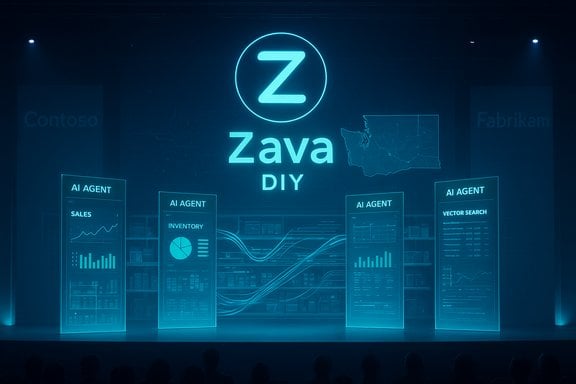
Microsoft’s keynote narrative at Ignite and the company’s demo artifacts show a clear tonal shift: the familiar sample firms Contoso and Fabrikam — fixtures of Microsoft demos, training modules and example data for decades — are no longer the only poster children for Microsoft scenarios. In their place, a new set of fictional businesses led by the name Zava has been rolled out across workshops, GitHub repos and product demos to illustrate agentic AI, retail scenarios and unified data estates. That shift is subtle in one sense — Microsoft still uses Contoso and Fabrikam in many Learn examples — but explicit in another: the company’s recent conference storytelling and ready-made demo datasets lean heavily on Zava as the illustrative “frontier” retailer for agent-first architectures.
For IT leaders and partner engineers, the right approach is pragmatic: use Zava artifacts to learn and prototype, but treat those artifacts as pedagogical tools — not production blueprints — and continue to draw on Contoso and Fabrikam resources where they remain relevant. The real technical work remains the same: unify messy data, harden governance, and design agent lifecycles with observability and safety in mind before declaring your organization a “frontier” firm.
Conclusion: Microsoft’s narrative shift to Zava is a useful update for agent-focused demos and hands-on labs, but it’s a change of emphasis rather than a full replacement. The community should welcome fresher, more cloud-native scenarios while maintaining the rigor — data governance, security, and operational discipline — that turns conference magic into real, reliable production systems.
Source: theregister.com Microsoft replaces loyal ‘customers’ Contoso and Fabrikam
 Background
Who were Contoso and Fabrikam — and why they mattered
For more than two decades Microsoft has used fictional companies as teaching and demo scaffolding. Contoso became the canonical multinational: a manufacturing, sales and support conglomerate (often described in Microsoft documentation as “a multinational business with its headquarters in Paris” and “more than 100,000 products”) that let Microsoft engineers, partners and trainers construct realistic scenarios without pointing at a real customer. Those Contoso artifacts run through Microsoft Learn samples, Azure demos and countless code samples across Microsoft documentation. Fabrikam has a similar pedigree, particularly inside Dynamics, ERP and finance training — it long served as the canned sample company used by Dynamics GP and related learning content, complete with test transactions, dates and prebuilt datasets. The name appears repeatedly in product samples and in community lore (including an annual tongue-in-cheek “#FabrikamDay” idea in the Dynamics community). Those examples made it straightforward for trainers to show realistic workflows — journal entries, invoices, HR records — without risking real customer data. These fictional brands mattered because:- They provided consistent, repeatable demo data across product teams.
- They insulated real customers from being used as examples.
- They formed a shared shorthand in documentation, training and partner enablement.
How Microsoft uses fictional companies today
Microsoft’s documentation and sample repos still include Contoso and Fabrikam broadly — from Windows Server/IIS examples to Azure AI and Microsoft 365 code samples. Those examples are not purely historical: many Learn pages and code samples published in 2024 and 2025 still include Contoso-based templates and sample connectors. This creates continuity for the developer and IT community: if you know Contoso, you can follow a tutorial platform-to-platform.The newcomer: Zava — what Microsoft is using now
Where Zava shows up
At Ignite and on Microsoft’s event and workshop pages, Zava appears as the illustrative company for agentic AI and retail/data modernization scenarios. The firm’s profile is flexible: in some materials Zava is an “intelligent athletic apparel” brand used in keynote demos; in others, Microsoft provides a richer dataset called Zava DIY — a fictional Washington State-based home‑improvement retailer with seven stores plus online presence, seasonal buying patterns and a full product catalog. Those artifacts appear in Microsoft workshop materials and GitHub repositories that attendees and partners can clone for hands-on labs. Concrete traces include:- Microsoft AI Tour and workshop materials that use Zava as the workshop scenario for Model Context Protocol (MCP) and Azure AI Foundry agents.
- A GitHub session delivery resources site and workshop pages referencing Zava DIY sample datasets and prebuilt PostgreSQL/SQL data stacks for demos.
- Microsoft Learn and developer blog examples that reference customer support scenarios or RAG (retrieval-augmented generation) agents for fictional Zava brands.
The official framing: “frontier” companies and agentic narratives
Microsoft has been explicit about the thematic reason for the new demo brand: the company is telling a different story. At Ignite the keynote focused on the “frontier” firm — organizations that go “all‑in” on agentic AI architectures, multiagent orchestration and data fabrics designed for autonomous workflows. Zava functions as the storyteller’s canvas for those agentic, cloud‑native, AI‑first narratives. Demos showed Zava fulfilling orders, agents analyzing sales and customer behavior, and agent-controlled supply chains — all meant to make Microsoft’s agent portfolio (Agent 365, Copilot Studio, Fabric IQ, MCP integrations) feel tangible.What changed — a fact check
- Microsoft showcased Zava prominently in Ignite demos and workshop materials. The company’s conference resources, AI Tour pages and GitHub session materials contain multiple Zava artifacts used to teach Fabric integrations, agent workflows and Copilot scenarios.
- Contoso and Fabrikam are not officially “retired” in the sense of a formal Microsoft press statement announcing their end. Contoso and Fabrikam still appear across Microsoft Learn and product samples as live examples, templates and connectors. The evidence therefore supports a narrative shift at high-profile events, not a corporate purge of older examples. That subtlety matters: the presence of Zava in demos does not mean Contoso and Fabrikam are gone from Microsoft documentation.
- Independent coverage and community chatter (blogs, trade coverage and conference write-ups) picked up Zava immediately and treated it as the new demo brand — but those writeups are descriptions, not an authoritative corporate policy change. Community recaps and analyst content explicitly call Zava Microsoft’s new demo company for Ignite’s agent-focused message.
Why this matters to IT pros, partners and documentarians
Practical advantages of a new demo brand
- Contemporary scenarios: Zava’s retail and DIY profiles are closer to modern cloud problems — omnichannel retail, seasonal inventory, multiagent customer support — and map cleanly to services like Microsoft Fabric, Copilot Studio and Azure AI Foundry.
- Data realism for AI: Zava DIY datasets include richer time series, customer behavior signals and product catalogs that are useful for training RAG pipelines, testing vector search and building demonstrator agents.
- Event alignment: Having one up‑to‑date story world simplifies conference demos and hands‑on labs, making story beats (order flows, returns, supply chain) reproducible on stage and in workshops.
The downsides and risks
- Fragmentation of examples: When Microsoft’s surface-level demos use Zava while many Learn docs continue to use Contoso/Fabrikam, newcomers face inconsistency. A developer following a GitHub sample may use Zava, while a training module references Contoso — that friction increases onboarding time.
- Overfitting demos to product messaging: Zava scenarios are purpose-built to show agentic outcomes. There’s a risk of demonstrations becoming marketing-first rather than reality-first, glossing over cost, governance and operational complexity required for production agent deployments.
- Operational realism vs. narrative convenience: Sample datasets are simplified; they mask messy integration problems (siloed source systems, data-quality debt, long migration tails). Over-reliance on demo artifacts can lead to underestimating the implementation work required to achieve the same results for a real customer.
- Vendor lock‑in optics: Deeply coupling agent workflows with Microsoft-only services in demo narratives makes multi‑vendor escape hatches feel harder to imagine; customers should treat demo outcomes as platform-specific references, not prescriptive architecture.
Technical verification: what the demos actually provide
Datasets, workshop artifacts and repositories
- Zava DIY datasets in Microsoft session repositories include PostgreSQL and Fabric-friendly artifacts designed to be used with Model Context Protocol (MCP) workshops and Azure AI Foundry agent services. Those artifacts are structured for quick ingestion and to allow attendees to build conversational agents that can answer sales and inventory questions. The GitHub-backed workshop materials include SQL backups and sample config tailored to Fabric and Agent services.
- Microsoft’s AI Tour and workshop catalog explicitly lists sessions using Zava as a demo dataset — e.g., WRK540 “Unlock your agents potential with MCP” and other Fabric workshops use Zava scenarios and emphasize security, RLS and pgvector-backed semantic search. Those workshop descriptions make clear the intended learning outcomes: data unification, secure agent access to operational data, and building production-ready agent observability.
What Microsoft still uses Contoso for
- Contoso remains heavily used in Learn samples across DevOps, Teams, Azure AI showcases and retail sample bots. Recent Contoso-based templates demonstrate RAG patterns, Shops/Copilot integrations and Teams-scenarios. That confirms Contoso is still a living example in the Learn ecosystem even as Zava appears in event materials.
Analysis: marketing, pedagogy and risk — what this change reveals about Microsoft
A marketing and pedagogy pivot, not a code-level purge
Microsoft’s product storytelling has evolved. Zava is engineered to showcase modern agentic narratives: multiagent orchestration, product/ customer embeddings, and Fabric-based semantic layers. That makes Zava a better stage prop for agents than Contoso’s older enterprise‑IT-focused scripts. The strategic choice is clever: a single, cohesive demo narrative maps naturally to agent-first features and helps marketing show “real outcomes” live on stage. But the corporate documentation ecosystem is vast, and the continued presence of Contoso and Fabrikam in Learn samples shows this is an additive — not strictly eliminative — change.The governance and security implications of agent demo data
If Zava datasets are distributed and reused widely, partners and customers must treat them as test artifacts, not production blueprints. Reusing demo datasets in production without adjusting for governance, telemetry and privacy controls risks leaking patterns and expectations that won’t scale. Microsoft’s own workshop guidance stresses responsible AI controls, RLS and entitlements when agents access enterprise data — a tacit admission that demo artifacts are intentionally simplified.Community reaction and the vendor ecosystem
The ecosystem reaction is mixed: some practitioners celebrate the freshness of Zava’s scenarios (it’s closer to the types of problems modern cloud-native teams face), while others decry the loss of shared cultural artifacts — Contoso and Fabrikam were common reference points across generations of Microsoft admins and partners. Analysts and community posts captured this ambivalence during Ignite — excitement about the agent message tempered with pragmatism about what it will take to make agentic workflows safe and sustainable.Practical takeaways for WindowsForum and enterprise readers
- Treat Zava as a useful demo scaffold, not a migration map. Use the Zava artifacts to learn patterns (RAG, vector search, agent orchestration), but bake your own governance and monitoring strategies before moving to production.
- Keep Contoso/Fabrikam familiarity in your toolbox. Many Learn pages, connectors and sample templates still reference those brands — they remain useful for cross-checking older tutorials or compatibility guides.
- Validate assumptions in any agent demo: confirm model routing, data retention, SCUs or compute unit costs, and the presence (or absence) of SLAs for preview features. Don’t assume a conference demo equals production readiness.
- If you reuse Microsoft-provided datasets for internal PoCs, run a short compliance and privacy audit: check for synthetic PII, RLS readiness, and whether the sample workflows assume permissive agent access models that you won’t permit in production.
Final verdict: evolution, not erasure
Microsoft’s adoption of Zava is a clear storytelling evolution that aligns demo assets to the company’s agentic AI vision. It is not, however, an abrupt retirement of Contoso and Fabrikam from Microsoft’s docs and samples. What we are seeing is a pragmatic pivot: event and workshop storylines now emphasize frontier/agentic narratives better embodied by a modern retailer like Zava, while Microsoft’s Learn corpus continues to contain the historical Contoso and Fabrikam examples that millions of practitioners rely on.For IT leaders and partner engineers, the right approach is pragmatic: use Zava artifacts to learn and prototype, but treat those artifacts as pedagogical tools — not production blueprints — and continue to draw on Contoso and Fabrikam resources where they remain relevant. The real technical work remains the same: unify messy data, harden governance, and design agent lifecycles with observability and safety in mind before declaring your organization a “frontier” firm.
Conclusion: Microsoft’s narrative shift to Zava is a useful update for agent-focused demos and hands-on labs, but it’s a change of emphasis rather than a full replacement. The community should welcome fresher, more cloud-native scenarios while maintaining the rigor — data governance, security, and operational discipline — that turns conference magic into real, reliable production systems.
Source: theregister.com Microsoft replaces loyal ‘customers’ Contoso and Fabrikam
