

Zenity’s recent announcement that its inline prevention platform is now generally available for Microsoft Copilot Studio and entering preview for Microsoft Foundry marks a notable escalation in how enterprises can govern agentic AI — but the practical effectiveness of that promise depends on careful tenant validation, adversarial testing, and integration discipline.
Agentic AI — systems composed of configurable agents that chain prompts, tools, connectors, and services to perform multi-step tasks — has shifted the enterprise threat model. Agents can read enterprise data, invoke APIs, and take actions that change state across systems; that makes them powerful productivity tools and high‑impact attack surfaces at the same time. Microsoft’s two most visible offerings in this space, Microsoft Copilot Studio (targeting low-code, citizen-maker workflows) and Azure AI Foundry (targeting professional, production-grade agent orchestration), have added primitives such as Model Context Protocol (MCP), identity-bound agents, and richer telemetry to make scale possible — but runtime enforcement remains an open problem.
TipRanks’ recap framed Zenity’s disclosure as both a product milestone and a market signal: demand for agent-aware security — especially runtime, deterministic controls — is growing, and vendors are racing to supply enforcement that sits inline with agent execution rather than merely detecting risks after the fact. That investor-focused perspective highlights the commercial angle while security practitioners must still ask hard operational questions.
That said, the difference between a promising integration and a production‑grade control is operational testing and tenant validation. False positives, latency, partial visibility, and integration SLAs are non‑trivial risks that will determine whether inline prevention reduces enterprise risk without impairing business workflows. Organizations should adopt a pragmatic posture: pilot narrowly, measure explicitly (prevention accuracy, telemetry fidelity, latency, business impact), and negotiate contractual protections before rolling inline enforcement widely.
Zenity’s move signals a broader market pivot: security vendors must now address the agent execution layer, not just models and static policies. For Windows and enterprise IT teams, the right response is not an instant vendor swap but a structured program: inventory agents, run adversarial tests, pilot inline enforcement with clear metrics, and bake agent‑aware controls into the SOC’s normal operating rhythm. Done with rigor, runtime, deterministic enforcement can materially reduce the risk posed by agentic AI while enabling organizations to safely scale the productivity benefits of Copilot Studio and Foundry.
Conclusion: Zenity’s announcement is both a tactical product step and a strategic market signal — promising, technically plausible, and worth pilots now, but subject to tenant‑level verification and careful operationalization before you bet your production workloads on it.
Source: TipRanks Zenity – Weekly Recap - TipRanks.com
 Background / Overview
Agentic AI — systems composed of configurable agents that chain prompts, tools, connectors, and services to perform multi-step tasks — has shifted the enterprise threat model. Agents can read enterprise data, invoke APIs, and take actions that change state across systems; that makes them powerful productivity tools and high‑impact attack surfaces at the same time. Microsoft’s two most visible offerings in this space, Microsoft Copilot Studio (targeting low-code, citizen-maker workflows) and Azure AI Foundry (targeting professional, production-grade agent orchestration), have added primitives such as Model Context Protocol (MCP), identity-bound agents, and richer telemetry to make scale possible — but runtime enforcement remains an open problem. TipRanks’ recap framed Zenity’s disclosure as both a product milestone and a market signal: demand for agent-aware security — especially runtime, deterministic controls — is growing, and vendors are racing to supply enforcement that sits inline with agent execution rather than merely detecting risks after the fact. That investor-focused perspective highlights the commercial angle while security practitioners must still ask hard operational questions.
What Zenity announced — the essentials
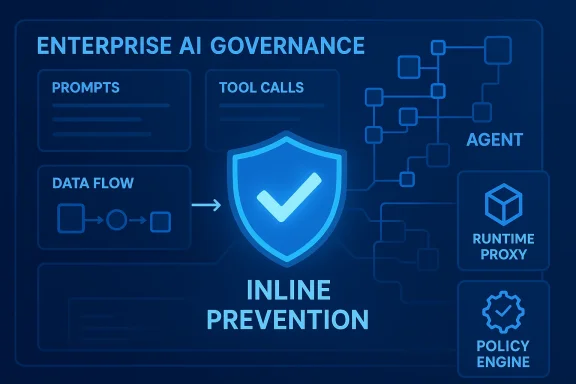
Zenity’s announcements (publicized in vendor and press materials) emphasize three core capabilities now applied to Microsoft’s agent platforms:- Deterministic inline prevention: policy checks that can block or hard‑stop agent actions (tool calls, exports, command execution) in realtime before they complete. Zenity positions these as “hard boundaries” inside the agent execution path.
- Step‑level visibility: granular telemetry that correlates prompts, tool invocations, and data flows into discrete execution steps for faster triage and forensic reconstruction.
- Agent lifecycle posture and governance: linking build‑time posture (who built the agent, permissions and connectors used) to runtime behavior so security teams can detect drift or misuse.
Verifying the claims: what’s corroborated, and what needs tenant validation
Several elements of Zenity’s announcement are verifiable through independent sources:- Microsoft’s Copilot Studio now supports MCP and offers richer tool tracing and runtime telemetry — features that make inline enforcement technically feasible. Microsoft’s Copilot blog and Learn documentation confirm MCP’s wider availability and improved activity tracing.
- Zenity’s press release and its product blog explicitly state Copilot Studio GA for inline prevention and previewing Foundry support; BusinessWire and Zenity’s own blog post are consistent on the public messaging.
- Independent analyst summaries (including investor‑oriented writeups) have interpreted the announcement as evidence that the AI‑agent security market is maturing and attracting enterprise interest. These summaries also recommend pilots and red‑team testing rather than blind rollouts.
- The operational detail about exactly how Zenity enforces policies inline (agent‑side SDK, runtime proxy, control‑plane hook, or service mesh integration) is not fully disclosed in public materials. Implementation may vary by tenant, and the integration surface with Foundry in particular is described as preview; customers should confirm architecture details in their test environments.
- Claims about default telemetry completeness, “zero‑gap” tracing between invoking and invoked agents, or specific reduction percentages in data‑exfiltration risk are operationally sensitive and depend on tenant configuration, region, and Microsoft product version. These should be treated as hypotheses to be measured in‑tenant, not guarantees.
Why runtime, deterministic enforcement matters (technical context)
Traditional security tooling is often log‑centric and post‑hoc: it alerts after an action completes, or it relies on network/endpoint signatures that are ill‑suited to the reasoning and orchestration layer an agent represents. Agents, by design, can:- Chain actions across multiple tools and connectors
- Adapt prompts and actions at runtime, which can circumvent build‑time guardrails
- Synthesize and export sensitive content (files, API calls, emails) as part of normal flows
Strengths: what Zenity’s approach brings to the table
- Real‑time disruption of risky workflows: Blocking a tool call or export inline can prevent immediate exfiltration or a cascade of downstream actions, reducing dwell time dramatically versus reactive detection.
- Actionable step‑level observability: Tying prompts to their resulting tool calls and data outputs makes investigations and compliance audits faster and more precise. Security teams can reconstruct a full execution chain rather than trying to stitch together disparate logs.
- Policy consistency across lifecycle: Combining build‑time posture controls with runtime enforcement reduces the risk of configuration drift, where an agent authorized at build time later takes actions outside intended boundaries.
- Strategic Microsoft alignment: For enterprises standardizing on Microsoft’s agent stack, a vendor-validated integration with Copilot Studio (GA) and Foundry (preview) lowers the friction for adoption compared with custom or generic controls.
Limitations and operational risks — where the promise meets reality
- False positives can be business‑critical. Deterministic blocks are powerful, but they can also break legitimate workflows. Every block that interrupts a business process carries a potential operational cost; policy tuning and human‑approval gates are essential.
- Integration complexity and SLAs matter. Inline prevention requires platform hooks and may introduce latency. Vendors and customers must clarify performance SLAs, telemetry retention policies, and support responsibilities before production deployment.
- Partial visibility remains possible. Some attack paths — for example, supply‑chain compromises of signed agents or out‑of‑band MCP servers — may not be fully addressable by a third‑party inline layer without deep coordination with Microsoft and other platform vendors.
- Claims depend on tenant configuration. Statements about default‑on protections or complete audit coverage are environment‑specific; customers should not assume identical behavior across tenants or regions. Independent validation in a test tenant is required.
A practical PoC checklist for Windows and enterprise IT leaders
To move from vendor claim to production confidence, run a targeted proof‑of‑concept (PoC) that measures security, operational impact, and integration quality:- Define scope and success criteria
- Select a narrow set of agents (citizen-maker Copilot Studio agents and one Foundry service agent).
- Define measurable outcomes: blocked malicious calls, false positive rate, average prevention latency, and business impact (failed workflows).
- Test adversarial prompt‑injection and encoded exfiltration
- Pair the PoC with red‑team exercises designed to replicate indirect prompt injection and multi‑agent exfil flows.
- Measure telemetry fidelity
- Confirm end‑to‑end traces that link requester → agent flow → invoked tool and preserved artifacts for forensic replay.
- Quantify latency and reliability
- Measure worst‑case and p95 latency introduced by inline checks for user‑facing agents and batch processes.
- Validate SIEM/SOAR integration and runbooks
- Ensure events map cleanly to existing SOC playbooks and that automated remediation (token revocation, agent quarantine) can be triggered.
- Tune policies with business owners
- Balance safety and availability via allowlists, denylists, and human approval gates for state‑changing actions.
- Define contractual SLAs and support paths
- For enterprise rollouts, negotiate clear SLAs for uptime, latency, false‑positive remediation, and telemetry retention with the vendor.
Technical possibilities: how inline enforcement might be implemented
Zenity’s public materials describe placement of enforcement “inside” the agent execution path but do not publish a single implementation blueprint. Possible architectures include:- Runtime proxy/sidecar: a service in the execution path that inspects planned tool calls and enforces policy before dispatch. This can provide strong control but requires a reliable placement in the agent runtime.
- Agent SDK hooks: a library embedded into agent runtimes that calls into policy engines before invoking tools; this approach needs agent builders to adopt the SDK.
- Control‑plane integration: embedding enforcement into the platform control plane (Copilot Studio or Foundry) where possible, allowing enforcement without modifying agent binaries — but vendor and platform coordination is necessary.
Incident response and operational playbooks — agent‑specific changes
Agent incidents differ from traditional endpoint or network incidents. Update IR playbooks with agent-specific controls:- Add rapid chain reconstruction procedures to reconstruct prompt → step → tool invocation sequences.
- Prepare token revocation and agent quarantine workflows to cut a malicious agent off from enterprise connectors quickly.
- Maintain backups and versioning for any state or documents agents modify, so rollbacks are possible if an agent performs destructive actions.
- Run tabletop exercises that simulate agent-enabled exfiltration and privilege abuse, and drill SOC teams on the new telemetry and alerts the inline enforcement will produce.
Business and investor considerations
TipRanks and other investor‑oriented writeups position Zenity’s announcement as a market signal: specialized AI‑agent security is emerging as a distinct niche, and early vendor advantage matters. From an investor or procurement perspective, consider:- Execution risk: vendor claims are one thing; reference customers, pilot metrics, and contract terms matter more. Badge counts and press releases are not a substitute for measurable outcomes.
- Platform concentration risk: deep integration with Microsoft’s agent stack is valuable but creates concentration exposure; if Microsoft were to expand native runtime controls, third‑party value could shrink.
- Competitive landscape: other security vendors and the clouds themselves are rapidly developing agent‑aware controls. Differentiation will hinge on demonstrable low‑false‑positive enforcement, SIEM/SOAR integration, and multi‑platform support.
Recommended short-term actions for Windows/Enterprise IT teams
- Treat runtime guardrails as part of a layered defense, not a single‑point solution. Combine build‑time posture management, DLP, Purview classification, and runtime enforcement.
- Start with limited pilots focused on high‑risk agent classes (agents with access to HR data, financial systems, or privileged APIs).
- Require adversarial testing as part of procurement and acceptance criteria.
- Demand clear telemetry guarantees and SIEM/SOAR connectors so the SOC can act on inline events without blind spots.
- Update policies and IR playbooks to include agent chain reconstruction, token revocation, and agent quarantine steps.
Final analysis — measured optimism with operational rigor
Zenity’s GA announcement for Copilot Studio inline prevention and preview for Foundry is an important product milestone in the maturation of agentic AI security. It aligns with Microsoft’s roadmap — MCP, richer telemetry, and agent identity primitives — and it addresses a real gap between build‑time governance and runtime safety. Vendor materials, independent platform documentation, and analyst coverage converge on the same broad narrative: agents expand threat surfaces, and runtime enforcement is a required control plane.That said, the difference between a promising integration and a production‑grade control is operational testing and tenant validation. False positives, latency, partial visibility, and integration SLAs are non‑trivial risks that will determine whether inline prevention reduces enterprise risk without impairing business workflows. Organizations should adopt a pragmatic posture: pilot narrowly, measure explicitly (prevention accuracy, telemetry fidelity, latency, business impact), and negotiate contractual protections before rolling inline enforcement widely.
Zenity’s move signals a broader market pivot: security vendors must now address the agent execution layer, not just models and static policies. For Windows and enterprise IT teams, the right response is not an instant vendor swap but a structured program: inventory agents, run adversarial tests, pilot inline enforcement with clear metrics, and bake agent‑aware controls into the SOC’s normal operating rhythm. Done with rigor, runtime, deterministic enforcement can materially reduce the risk posed by agentic AI while enabling organizations to safely scale the productivity benefits of Copilot Studio and Foundry.
Conclusion: Zenity’s announcement is both a tactical product step and a strategic market signal — promising, technically plausible, and worth pilots now, but subject to tenant‑level verification and careful operationalization before you bet your production workloads on it.
Source: TipRanks Zenity – Weekly Recap - TipRanks.com
