

ZeroBounce said Wednesday, July 8, 2026, that it has updated its email-validation service to classify many catch-all addresses hosted on Microsoft 365, Google Workspace, and major secure email gateways as valid or invalid during standard checks, reducing the need for a slower second verification pass.
The Santa Barbara company announced the change in a PR Newswire release carried by Bastille Post. ZeroBounce says the update is available now to all customers and is aimed mainly at sales and marketing teams working with B2B contact lists.
Catch-all domains are configured to accept mail for addresses that may or may not exist. That behavior is useful for some organizations, but it makes email validation messy: a verifier can see that the domain accepts mail without knowing whether a specific mailbox is real.
For list owners, that usually means uncertainty. A contact may be marked “catch-all” rather than clearly valid or invalid, forcing a choice between suppressing a potentially good lead or sending to an address that could bounce and hurt sender reputation.
ZeroBounce says many of those addresses previously needed additional verification that could take up to 48 hours. With the new process, the company says many catch-all addresses on Microsoft 365, Google Workspace, and secure email gateway-backed domains can now be resolved during normal validation.
That figure is vendor-supplied, not independently audited in the announcement, so admins should treat it as a product claim rather than a benchmark. Still, the direction matters: Microsoft 365 and Google Workspace account for a large share of business email, so reducing ambiguous results there could simplify lead-list hygiene and campaign prep.
The company says users will still be able to see whether a domain is configured as catch-all. The change is that many individual addresses on those domains may now receive a more decisive valid or invalid result earlier in the process.
For teams already using ZeroBounce, the practical move is to review recent validation exports and automation rules that treat catch-all results as a special category. If a CRM, marketing automation platform, or sales engagement tool routes catch-all contacts into a manual review queue, those workflows may now see fewer records.
For WindowsForum readers managing Microsoft 365 tenants, the security angle is limited. This does not change mail flow, Exchange Online behavior, DMARC, SPF, DKIM, or tenant-level anti-spam policy. It affects how a third-party validation vendor interprets address status before a sender launches a campaign.
ZeroBounce says it validates close to 1 billion email addresses per month and serves more than 600,000 customers. The company also markets deliverability tools including inbox placement testing, blacklist monitoring, DMARC monitoring, email scoring, and email validation.
The short version: if your organization relies on ZeroBounce to clean B2B lists, Microsoft 365 and Google Workspace catch-all contacts may now produce clearer results faster, but campaign owners should still monitor bounce rates after sending.
The Santa Barbara company announced the change in a PR Newswire release carried by Bastille Post. ZeroBounce says the update is available now to all customers and is aimed mainly at sales and marketing teams working with B2B contact lists.
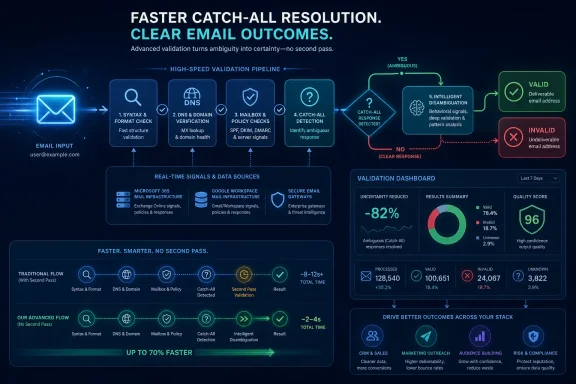 Why catch-all addresses are a problem
Catch-all domains are configured to accept mail for addresses that may or may not exist. That behavior is useful for some organizations, but it makes email validation messy: a verifier can see that the domain accepts mail without knowing whether a specific mailbox is real.For list owners, that usually means uncertainty. A contact may be marked “catch-all” rather than clearly valid or invalid, forcing a choice between suppressing a potentially good lead or sending to an address that could bounce and hurt sender reputation.
ZeroBounce says many of those addresses previously needed additional verification that could take up to 48 hours. With the new process, the company says many catch-all addresses on Microsoft 365, Google Workspace, and secure email gateway-backed domains can now be resolved during normal validation.
Microsoft 365 is the headline case
ZeroBounce claims the biggest measured improvement was on Microsoft 365-hosted addresses. During internal production testing, the company says the average number of Microsoft 365 addresses returned as catch-all dropped by more than 99.98%.That figure is vendor-supplied, not independently audited in the announcement, so admins should treat it as a product claim rather than a benchmark. Still, the direction matters: Microsoft 365 and Google Workspace account for a large share of business email, so reducing ambiguous results there could simplify lead-list hygiene and campaign prep.
The company says users will still be able to see whether a domain is configured as catch-all. The change is that many individual addresses on those domains may now receive a more decisive valid or invalid result earlier in the process.
What users should do
There is no Microsoft 365 admin action required. This is a ZeroBounce-side service update, not a Microsoft configuration change.For teams already using ZeroBounce, the practical move is to review recent validation exports and automation rules that treat catch-all results as a special category. If a CRM, marketing automation platform, or sales engagement tool routes catch-all contacts into a manual review queue, those workflows may now see fewer records.
For WindowsForum readers managing Microsoft 365 tenants, the security angle is limited. This does not change mail flow, Exchange Online behavior, DMARC, SPF, DKIM, or tenant-level anti-spam policy. It affects how a third-party validation vendor interprets address status before a sender launches a campaign.
ZeroBounce says it validates close to 1 billion email addresses per month and serves more than 600,000 customers. The company also markets deliverability tools including inbox placement testing, blacklist monitoring, DMARC monitoring, email scoring, and email validation.
The short version: if your organization relies on ZeroBounce to clean B2B lists, Microsoft 365 and Google Workspace catch-all contacts may now produce clearer results faster, but campaign owners should still monitor bounce rates after sending.
References
- Primary source: bastillepost.com
Published: Wed, 08 Jul 2026 13:12:00 GMT
Loading…
www.bastillepost.com - Related coverage: prnewswire.com
Loading…
www.prnewswire.com - Related coverage: zerobounce.net
Loading…
www.zerobounce.net - Related coverage: zerobounceai.com
Loading…
zerobounceai.com - Official source: workspace.google.com
Loading…
workspace.google.com - Related coverage: ro.linkedin.com
Loading…
ro.linkedin.com
- Related coverage: issuewire.com
Loading…
www.issuewire.com