

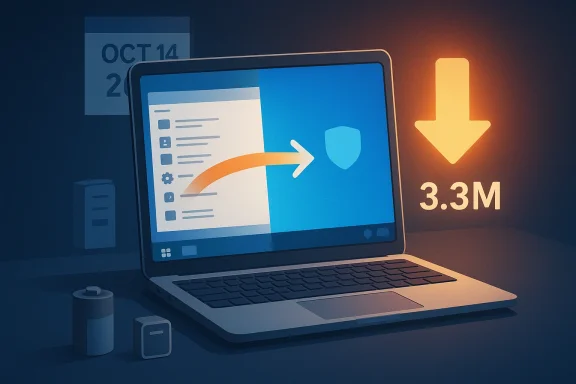
The latest evidence suggests that Zorin OS is no longer just a niche Windows replacement for tinkerers; it is becoming a credible migration path for mainstream users frustrated by Windows 11, Windows 10’s end-of-support shock, and Microsoft’s broader product direction. Zorin says its newest release, Zorin OS 18.1, arrived just six months after Zorin OS 18 and pushed the distro past 3.3 million downloads, while Microsoft’s own lifecycle pages confirm that Windows 10 support ended on October 14, 2025. At the same time, StatCounter’s March 2026 data still shows Windows dominating desktops overall, but Linux remains a real presence, which means small shifts in sentiment can matter more than they used to.
For years, Linux advocates have argued that the desktop market was less a competition and more a waiting game. Users generally tolerated Windows because of software compatibility, IT familiarity, and the inertia of existing hardware fleets. That arrangement began to weaken when Microsoft made Windows 11 more demanding than many older PCs could support, then compounded the frustration by pushing users toward new hardware and cloud services instead of a simpler path forward.
Zorin OS has spent years building exactly the kind of “bridge distro” that can exploit that frustration. Its value proposition is not just that it is Linux, but that it deliberately imitates the comfort zone of Windows and macOS while preserving the openness, customization, and privacy story that draws users away from proprietary platforms. The result is a distro that feels less like a hobbyist playground and more like a managed exit ramp from Microsoft’s ecosystem.
The timing could hardly be better for Zorin. Microsoft’s end-of-support deadline for Windows 10 created a mass migration moment, and Zorin’s own launch messaging framed the event as an opportunity to rescue older PCs that do not meet Windows 11’s requirements. That pitch resonates with anyone who views the upgrade cycle as increasingly coercive, especially when the alternative is replacing hardware that still works perfectly well.
What makes this story notable is that Zorin is not trying to win by brute force. It is winning by reducing friction. The distro’s success comes from a series of small design decisions that collectively make the switch feel less risky, less foreign, and much more reversible than a traditional Linux installation. That is the kind of product strategy that can change behavior, particularly among users who are curious about Linux but wary of pain.
The strongest evidence of that traction is the download growth. Zorin says Zorin OS 18 has crossed 1 million downloads, then 2 million, and now 3.3 million downloads after the release of 18.1. Even allowing for the fact that download counts are not the same thing as active installs, the pace suggests a genuine surge in interest rather than a one-off publicity spike.
Zorin’s messaging turns that discomfort into an opening. The company explicitly positions Zorin OS as a way to keep using the current machine, rather than paying for a new one just to stay inside Microsoft’s support envelope. That is a powerful argument in an era when consumers are more sensitive to upgrade fatigue and planned obsolescence narratives. Whether or not one agrees with that framing, the perception itself is commercially useful.
Key reasons Zorin is finding new users include:
One of the headline changes is the expanded database for detecting Windows installer files. Zorin says the system now supports over 240 apps, allowing it to identify when a user tries to run a Windows installer and suggest a more appropriate route, often steering them toward a native Linux version or a closer native alternative. That is a significant usability move because it converts ambiguity into guidance at the exact moment users are most likely to need help.
This approach also reflects a deeper philosophical shift in desktop Linux. For years, the ecosystem often asked users to adapt to Linux’s terminology and workflow. Zorin is asking the opposite: it adapts the system’s presentation to the user’s pre-existing expectations. That makes the distro far easier to recommend to ordinary people, not just enthusiasts.
Those may sound like incremental changes, but incremental improvements are often what separate a promising Linux distro from a daily-driver OS. In practice, users judge operating systems on small frustrations: can I find my app? does the tray behave? can I tile windows the way I want? Those micro-interactions are where loyalty is won or lost.
The update to Zorin Lite 17.3 is equally important for a different audience. By adding fingerprint reader support, refreshed themes, and a redesigned file manager, Zorin is making its low-spec edition less like an emergency fallback and more like a legitimate second life for aging machines. That could prove especially attractive to schools, community organizations, and households with older laptops.
The irony is that Windows 10’s end-of-support moment should have been an easy conversion opportunity for Microsoft. Instead, it created a comparative stress test. Users now compare the cost of a Windows 11 upgrade, a new machine, a consumer ESU program, or a switch to Linux. In that matrix, Zorin does not need to beat Windows on enterprise manageability or app ecosystem depth; it only needs to look like the least painful option.
To its credit, Microsoft has tried to soften the edges. It has reduced some Copilot surface area, offered more control during setup, and signaled that it wants to improve user sentiment around Windows 11. But the core identity of Windows 11 remains tied to Microsoft’s cloud-first, service-heavy direction, and that continues to create friction among privacy-conscious or budget-conscious users.
That dynamic matters more now because desktop operating systems are no longer judged only on features. They are judged on the cost of staying loyal. If one platform demands new hardware, more account integration, and more structured migration work while another offers a near-zero-cost reprieve, the latter becomes psychologically powerful even if the former remains functionally superior in some areas.
Privacy is part of the same story. Users who are uneasy about telemetry, ads, or account-heavy operating systems often frame Linux as the cleaner alternative. Even when they cannot articulate every technical difference, they respond to the broader feeling that the platform is working for them rather than harvesting data from them. That feeling is not trivial; it is often decisive.
The open-source angle also matters because it allows communities to inspect, discuss, and improve the software in public. That transparency can create a sense of trust that proprietary systems struggle to match, even when the average user never reads a line of code. Trust is a product feature, and Linux distributions have learned how to market it.
That makes Zorin a particularly strong competitor in the post-Windows-10 era because it removes the need for a philosophical leap. Users do not have to become open-source evangelists. They only have to decide that their current Windows experience is no longer worth the hassle.
Enterprises are a different story. Businesses care about application compatibility, fleet management, support contracts, identity integration, and standardization. Zorin can still matter there, especially in education, nonprofits, kiosks, labs, and smaller organizations, but the adoption curve is slower and more dependent on internal IT confidence. That is not a weakness so much as a different market reality.
The biggest consumer growth driver is probably not ideological conversion, but frustration conversion. People who are irritated by Windows 11, uninterested in buying a new PC, or unhappy about data collection will now see a polished alternative that looks less risky than Linux used to. That is a powerful combination.
Still, there are areas where Zorin can gain ground indirectly. Schools, training centers, and local government departments with older hardware are exactly the sort of environments that feel pressure from end-of-support dates but lack the budget for rapid replacement. In those settings, a well-supported Linux rollout can be pragmatic, not ideological.
That competition matters because desktop Linux is increasingly about packaging rather than invention. Most distros can ship the same major open-source foundations, but not all can turn them into a guided, confidence-building experience. Zorin’s advantage is that it has spent years refining that packaging layer, which is exactly where mainstream adoption happens.
At the same time, rivals like Linux Mint, Ubuntu-based spins, and other newcomer-friendly distributions can point to their own advantages in community size, package availability, or hardware support. Zorin’s challenge is to keep its identity sharp enough that it remains the first Linux name that Windows refugees remember.
That middle position can be a strength, but it can also be a trap if the product tries to please everyone at once. Zorin has done well by keeping the core promise simple: make Linux feel familiar enough that switching does not feel like a leap into uncertainty.
The most important opportunity may be symbolic. Every successful migration story weakens the assumption that Windows is the only “normal” PC operating system. Once that assumption cracks, Linux distributions with strong UX start winning not by miracle, but by momentum.
There is also the possibility of inflated expectations. When a distro is praised as a Windows replacement, some users assume it will handle every task they previously performed in Microsoft’s ecosystem without compromise. When that proves untrue, they blame the operating system rather than their assumptions.
That dominance does not erase Zorin’s opportunity, but it does put it in perspective. The real competitive battle is not whether Linux overtakes Windows tomorrow. It is whether enough users decide that the old assumptions about desktop computing no longer apply.
Microsoft, meanwhile, cannot ignore the optics of users looking elsewhere. The company is still dominant, but it is also managing a reputation problem that smaller rivals can exploit. If Microsoft keeps improving Windows 11 without losing focus on user choice, it can blunt some of that appeal. If it slips back into a pattern of pushing service integrations and hardware transitions too aggressively, it risks feeding the very migration story Zorin is built to exploit.
Source: Windows Central "An even better computing experience": This Linux alternative to Windows 11 is stealing Microsoft's users
 Overview
For years, Linux advocates have argued that the desktop market was less a competition and more a waiting game. Users generally tolerated Windows because of software compatibility, IT familiarity, and the inertia of existing hardware fleets. That arrangement began to weaken when Microsoft made Windows 11 more demanding than many older PCs could support, then compounded the frustration by pushing users toward new hardware and cloud services instead of a simpler path forward.Zorin OS has spent years building exactly the kind of “bridge distro” that can exploit that frustration. Its value proposition is not just that it is Linux, but that it deliberately imitates the comfort zone of Windows and macOS while preserving the openness, customization, and privacy story that draws users away from proprietary platforms. The result is a distro that feels less like a hobbyist playground and more like a managed exit ramp from Microsoft’s ecosystem.
The timing could hardly be better for Zorin. Microsoft’s end-of-support deadline for Windows 10 created a mass migration moment, and Zorin’s own launch messaging framed the event as an opportunity to rescue older PCs that do not meet Windows 11’s requirements. That pitch resonates with anyone who views the upgrade cycle as increasingly coercive, especially when the alternative is replacing hardware that still works perfectly well.
What makes this story notable is that Zorin is not trying to win by brute force. It is winning by reducing friction. The distro’s success comes from a series of small design decisions that collectively make the switch feel less risky, less foreign, and much more reversible than a traditional Linux installation. That is the kind of product strategy that can change behavior, particularly among users who are curious about Linux but wary of pain.
Why Zorin Is Gaining Traction
Zorin OS benefits from a simple truth: many users do not want to become Linux experts, they just want a computer that works better for them. The distro’s Windows-like interface, familiar menu structure, and built-in migration aids lower the psychological barrier that normally keeps people on Windows. In a market where the default is often “stay put,” that matters more than raw technical elegance.The strongest evidence of that traction is the download growth. Zorin says Zorin OS 18 has crossed 1 million downloads, then 2 million, and now 3.3 million downloads after the release of 18.1. Even allowing for the fact that download counts are not the same thing as active installs, the pace suggests a genuine surge in interest rather than a one-off publicity spike.
The Windows 10 effect
Microsoft’s October 14, 2025 end-of-support date was always going to create a migration wave. Microsoft itself tells users that Windows 10 no longer receives feature updates, security fixes, or technical assistance after that date, and recommends Windows 11, a new PC, or consumer Extended Security Updates as the main options. That framing leaves a meaningful share of users feeling as if they are being nudged, not persuaded.Zorin’s messaging turns that discomfort into an opening. The company explicitly positions Zorin OS as a way to keep using the current machine, rather than paying for a new one just to stay inside Microsoft’s support envelope. That is a powerful argument in an era when consumers are more sensitive to upgrade fatigue and planned obsolescence narratives. Whether or not one agrees with that framing, the perception itself is commercially useful.
Frictionless switching
The strongest Linux distributions for Windows migrants are the ones that anticipate fear. Zorin’s desktop layouts, app suggestions, and compatibility prompts are designed to answer the user’s first question before it is even asked: “Can I still do my work here?” That is a better sales strategy than boasting about kernels, package managers, or desktop environments.Key reasons Zorin is finding new users include:
- Familiar visual layout that reduces retraining.
- Native app suggestions that replace Windows-only habits with Linux alternatives.
- Hardware re-use that extends the life of older PCs.
- Privacy positioning that appeals to users uneasy about telemetry.
- No license fee that makes experimentation low-risk.
What Zorin OS 18.1 Actually Changes
Zorin OS 18.1 is not a radical redesign, and that is precisely why it matters. The update focuses on the kinds of refinements that improve day-to-day confidence: better hardware support, desktop polish, smarter app detection, and more useful out-of-box behavior. For an operating system trying to convert skeptics, those are the right kinds of improvements because they reduce the chance that a first impression will go wrong.One of the headline changes is the expanded database for detecting Windows installer files. Zorin says the system now supports over 240 apps, allowing it to identify when a user tries to run a Windows installer and suggest a more appropriate route, often steering them toward a native Linux version or a closer native alternative. That is a significant usability move because it converts ambiguity into guidance at the exact moment users are most likely to need help.
Smarter app matching
The app-matching layer is the most strategically interesting part of the update. If a user launches a Windows installer for something like Plex, Zorin can display guidance that pushes them toward the best supported version of the software, rather than leaving them to wrestle with emulation or compatibility hacks. That is not just convenience; it is a subtle effort to retrain habits before they harden.This approach also reflects a deeper philosophical shift in desktop Linux. For years, the ecosystem often asked users to adapt to Linux’s terminology and workflow. Zorin is asking the opposite: it adapts the system’s presentation to the user’s pre-existing expectations. That makes the distro far easier to recommend to ordinary people, not just enthusiasts.
Desktop refinements
Zorin OS 18.1 also adds new options to Advanced Window Tiling, which should appeal to users who like productivity features but do not want to install half a dozen extra tools to get them. Meanwhile, more apps can now show their own indicator icons in the panel tray, making it easier to see status changes or access quick functions without hunting through menus.Those may sound like incremental changes, but incremental improvements are often what separate a promising Linux distro from a daily-driver OS. In practice, users judge operating systems on small frustrations: can I find my app? does the tray behave? can I tile windows the way I want? Those micro-interactions are where loyalty is won or lost.
Out-of-box polish
Zorin also says it updated its pre-installed apps “for a more feature-rich experience out of the box.” That phrase may sound marketing-heavy, but it points to a real challenge for desktop Linux: the first hour matters enormously. Users migrating from Windows often judge a distro by whether they can immediately browse, print, edit documents, and connect peripherals without a scavenger hunt.The update to Zorin Lite 17.3 is equally important for a different audience. By adding fingerprint reader support, refreshed themes, and a redesigned file manager, Zorin is making its low-spec edition less like an emergency fallback and more like a legitimate second life for aging machines. That could prove especially attractive to schools, community organizations, and households with older laptops.
The Windows 11 Pressure Problem
Microsoft’s biggest challenge is not that Windows 11 is bad in every respect. It is that Windows 11 arrived with enough friction, design inconsistency, and hardware gatekeeping to make dissatisfaction linger long after the initial launch. The system has improved over time, but many users still remember the early compromises and the feeling that Microsoft was asking them to tolerate more than before.The irony is that Windows 10’s end-of-support moment should have been an easy conversion opportunity for Microsoft. Instead, it created a comparative stress test. Users now compare the cost of a Windows 11 upgrade, a new machine, a consumer ESU program, or a switch to Linux. In that matrix, Zorin does not need to beat Windows on enterprise manageability or app ecosystem depth; it only needs to look like the least painful option.
Microsoft’s messaging gap
Microsoft still frames the transition in terms of support, security, and modern computing, which is rational from a corporate standpoint. The problem is that many consumers hear, “Your current PC is fine, but you should replace it.” That message is increasingly out of step with the way households think about devices they have already paid for. When support policy feels like pressure, alternatives become emotionally attractive.To its credit, Microsoft has tried to soften the edges. It has reduced some Copilot surface area, offered more control during setup, and signaled that it wants to improve user sentiment around Windows 11. But the core identity of Windows 11 remains tied to Microsoft’s cloud-first, service-heavy direction, and that continues to create friction among privacy-conscious or budget-conscious users.
The hardware issue
Hardware requirements remain one of the biggest structural advantages for Linux distribution marketing. A distro like Zorin can breathe new life into older systems that fail Windows 11 checks, making the old machine feel relevant again. That turns an involuntary replacement cycle into an optional choice, and optionality is what many users actually want.That dynamic matters more now because desktop operating systems are no longer judged only on features. They are judged on the cost of staying loyal. If one platform demands new hardware, more account integration, and more structured migration work while another offers a near-zero-cost reprieve, the latter becomes psychologically powerful even if the former remains functionally superior in some areas.
Why Open Source Keeps Winning the Conversation
Open source has a remarkably durable pitch: freedom from lock-in, freedom from forced monetization, and freedom from a single vendor’s hardware roadmap. Zorin embodies that pitch while smoothing away much of the friction that once made Linux feel like an acquired taste. That combination is why open-source desktop projects continue to outperform their market share in mindshare.Privacy is part of the same story. Users who are uneasy about telemetry, ads, or account-heavy operating systems often frame Linux as the cleaner alternative. Even when they cannot articulate every technical difference, they respond to the broader feeling that the platform is working for them rather than harvesting data from them. That feeling is not trivial; it is often decisive.
Why Linux feels safer to many users
The privacy argument works best when it is concrete and immediate. Zorin does not need to promise a perfect threat model or zero data collection to make the case; it only needs to feel less invasive than Windows 11 in everyday use. That is especially persuasive for users who have watched Microsoft fold more services, suggestions, and promotions into the desktop experience.The open-source angle also matters because it allows communities to inspect, discuss, and improve the software in public. That transparency can create a sense of trust that proprietary systems struggle to match, even when the average user never reads a line of code. Trust is a product feature, and Linux distributions have learned how to market it.
The commercial paradox
What is interesting is that Zorin is not trying to make Linux feel ideologically pure. It is trying to make it feel useful. That is the commercial paradox at the heart of modern desktop Linux: the more approachable it becomes, the less it looks like the stereotypical Linux experience, and the more likely mainstream users are to adopt it.That makes Zorin a particularly strong competitor in the post-Windows-10 era because it removes the need for a philosophical leap. Users do not have to become open-source evangelists. They only have to decide that their current Windows experience is no longer worth the hassle.
Enterprise Versus Consumer Impact
For consumers, the attraction of Zorin is obvious: it is free, familiar, and capable of extending the useful life of aging hardware. That equation makes the distro a compelling choice for home users who mainly want web browsing, streaming, email, office work, and casual creative tasks. For many of those people, the decision is less about operating systems and more about economics and convenience.Enterprises are a different story. Businesses care about application compatibility, fleet management, support contracts, identity integration, and standardization. Zorin can still matter there, especially in education, nonprofits, kiosks, labs, and smaller organizations, but the adoption curve is slower and more dependent on internal IT confidence. That is not a weakness so much as a different market reality.
Consumer adoption drivers
Consumers are likely to be persuaded by the immediate benefits first. A smoother desktop, no license fee, and the ability to keep using a machine they already own are easy-to-understand advantages. Zorin’s Windows-oriented design shortens the learning curve enough that casual users can imagine the switch without panic.The biggest consumer growth driver is probably not ideological conversion, but frustration conversion. People who are irritated by Windows 11, uninterested in buying a new PC, or unhappy about data collection will now see a polished alternative that looks less risky than Linux used to. That is a powerful combination.
Enterprise caution
For businesses, the question is not whether Linux can work, but whether the migration cost is worth it. In organizations heavily invested in Microsoft 365, Active Directory, endpoint management, and line-of-business Windows software, Zorin is a harder sell. The desktop may look friendly, but the back-end compatibility story is where many projects stall.Still, there are areas where Zorin can gain ground indirectly. Schools, training centers, and local government departments with older hardware are exactly the sort of environments that feel pressure from end-of-support dates but lack the budget for rapid replacement. In those settings, a well-supported Linux rollout can be pragmatic, not ideological.
The Competitive Landscape Beyond Microsoft
Zorin is not competing only with Microsoft. It is also competing with every other “easy Linux” distribution that wants to become the default recommendation for Windows switchers. That means it has to stand out not just as Linux, but as the Linux distro that best understands how ordinary users think about Windows.That competition matters because desktop Linux is increasingly about packaging rather than invention. Most distros can ship the same major open-source foundations, but not all can turn them into a guided, confidence-building experience. Zorin’s advantage is that it has spent years refining that packaging layer, which is exactly where mainstream adoption happens.
Against other Linux distros
Compared with more traditional distributions, Zorin’s edge is obvious: fewer decisions, fewer setup headaches, and a more obvious path from Windows workflows. A distro can be powerful without being approachable, but that approachability is what moves it from “recommended by enthusiasts” to “installed by regular people.”At the same time, rivals like Linux Mint, Ubuntu-based spins, and other newcomer-friendly distributions can point to their own advantages in community size, package availability, or hardware support. Zorin’s challenge is to keep its identity sharp enough that it remains the first Linux name that Windows refugees remember.
Against macOS and ChromeOS
Zorin’s market opportunity is also shaped by alternatives outside Windows. macOS remains attractive to users who are willing to pay for Apple hardware, while ChromeOS is compelling in education and low-maintenance environments. Zorin’s value lies in sitting between those worlds: it is more open than macOS, more capable than ChromeOS, and less expensive than both.That middle position can be a strength, but it can also be a trap if the product tries to please everyone at once. Zorin has done well by keeping the core promise simple: make Linux feel familiar enough that switching does not feel like a leap into uncertainty.
Strengths and Opportunities
Zorin’s current run is not accidental. It is the result of a product philosophy that treats migration as a user experience problem, not a technical bragging contest. That opens several paths for future growth, especially as the Windows 10 installed base continues to age out and as more users look for a sustainable way to keep older hardware useful.- Clear migration story for Windows users who want a low-friction transition.
- Strong hardware reuse appeal for older PCs that cannot run Windows 11.
- Privacy-first positioning that resonates with skeptical consumers.
- Polished defaults that reduce the need for post-install tinkering.
- Broader app compatibility guidance that minimizes confusion.
- Growing brand recognition among reviewers and first-time Linux adopters.
- Potential education and nonprofit adoption where budgets are tight and stability matters.
Why the fit is so good now
The timing is unusually favorable because Zorin’s strengths align with what users now value most: affordability, familiarity, and control. Those are not niche preferences anymore. They are mainstream concerns in a world where software support cycles, cloud integration, and hardware requirements increasingly feel synchronized to the vendor’s convenience rather than the user’s.The most important opportunity may be symbolic. Every successful migration story weakens the assumption that Windows is the only “normal” PC operating system. Once that assumption cracks, Linux distributions with strong UX start winning not by miracle, but by momentum.
Risks and Concerns
Zorin’s rise should not be mistaken for a guaranteed desktop revolution. Download numbers are encouraging, but they do not automatically translate into sustained daily use, and Linux still faces real barriers in app availability, gaming edge cases, corporate compatibility, and user support. The challenge now is to convert curiosity into long-term retention.- Download counts are not the same as active users or long-term adopters.
- Windows app compatibility remains uneven for specialized software.
- Gaming and anti-cheat support can still frustrate some users.
- User support expectations may exceed what a distro team can easily deliver.
- Fragmentation in the Linux ecosystem can confuse new users.
- Enterprise adoption is constrained by management and software standards.
- Success could attract copycat messaging from rival distros and vendors.
The adoption cliff
Many users try Linux once, like it in principle, and then return to Windows because of one stubborn missing workflow. That risk is especially acute for people who migrate under duress after hardware changes or support deadlines. If the transition feels reactive rather than deliberate, frustration can outweigh the benefits. Good onboarding helps, but it is not magic.There is also the possibility of inflated expectations. When a distro is praised as a Windows replacement, some users assume it will handle every task they previously performed in Microsoft’s ecosystem without compromise. When that proves untrue, they blame the operating system rather than their assumptions.
Market headwinds
Zorin also has to contend with Microsoft’s scale. Even when users are dissatisfied, Windows still owns the default position on most PCs and dominates desktop market share worldwide. StatCounter’s March 2026 data shows Windows at 60.8% of desktop operating systems globally and Windows 11 at 67.14% of Windows desktop versions worldwide, which is a reminder that displacement remains an uphill climb.That dominance does not erase Zorin’s opportunity, but it does put it in perspective. The real competitive battle is not whether Linux overtakes Windows tomorrow. It is whether enough users decide that the old assumptions about desktop computing no longer apply.
Looking Ahead
The next phase for Zorin will be less about headline download milestones and more about proving durability. The distro needs to show that it can keep absorbing Windows refugees after the initial emotional wave fades, and that it can translate launch interest into a stable, expanding user base. That means continued polish, better app guidance, and a clear path for upgrades across versions.Microsoft, meanwhile, cannot ignore the optics of users looking elsewhere. The company is still dominant, but it is also managing a reputation problem that smaller rivals can exploit. If Microsoft keeps improving Windows 11 without losing focus on user choice, it can blunt some of that appeal. If it slips back into a pattern of pushing service integrations and hardware transitions too aggressively, it risks feeding the very migration story Zorin is built to exploit.
What to watch next
- Whether Zorin OS 18.1 translates into higher retention, not just more downloads.
- Whether Microsoft’s next Windows updates ease or intensify migration frustration.
- Whether Linux app vendors continue improving native support for mainstream programs.
- Whether older PCs become a bigger secondary market for Linux installs.
- Whether Zorin’s app-detection and compatibility guidance expands further.
- Whether other distros copy Zorin’s Windows-first onboarding strategy.
Source: Windows Central "An even better computing experience": This Linux alternative to Windows 11 is stealing Microsoft's users
Last edited:
