
For Windows users, IT professionals, developers, administrators, analysts, and other knowledge workers, that distinction matters. A person who can describe how they used Microsoft Copilot, a coding assistant, an internal chatbot, or an automation workflow to improve a task—while explaining the checks they applied before acting on the output—can demonstrate more than familiarity with a trend. They can demonstrate judgment.
That is increasingly what an AI job interview question is trying to uncover.
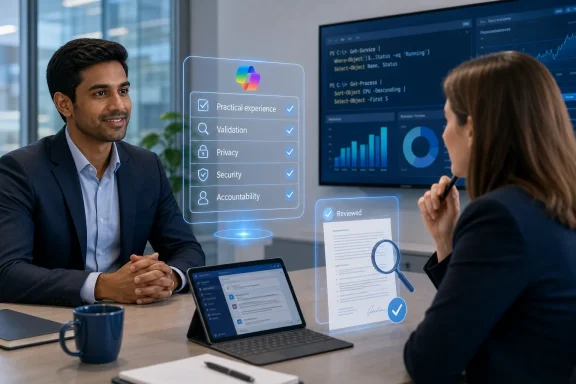 Overview: AI Is Now Part of the Workplace Conversation
Workplace AI adoption is no longer confined to experimental teams or technology-first companies. Gallup reported in July that 52% of U.S. employees use AI in their roles at least a few times per year, while 30% use it a few times a week or more and 15% use it daily. The same research found that 47% of employees say their organization has integrated AI tools to improve productivity, efficiency, or quality. Gallup’s findings explain why a question about AI is increasingly likely to surface even in interviews for roles that are not labeled “AI jobs.”
The shift is visible in the kinds of tasks employees report using AI for. Writing and editing, research, and general problem-solving are the most common uses, according to Gallup. Coding assistance and process automation are less common, but the employees who use AI in those task-specific ways are especially likely to report productivity improvements. Gallup’s breakdown suggests that hiring managers may be less interested in whether someone has experimented with a chatbot and more interested in whether they understand where a tool can contribute measurable value.
That distinction should shape interview preparation. “I use AI all the time” is not a strong answer on its own. Neither is “I refuse to use it.” Both statements leave the interviewer without the practical detail needed to assess capability.
A more effective answer establishes four things:
- What problem existed
- What tool or workflow was used
- What the candidate personally did
- How the result was checked, improved, or applied
This is not merely an AI literacy test. It is a test of work habits, decision-making, communication, and accountability.
Why Employers Are Asking About AI in Interviews
Hiring managers have a rational reason to bring AI into the interview. They are trying to understand whether candidates can operate effectively in a workplace where AI is present, unevenly deployed, and still evolving.
According to Business Insider’s report, Kareem Osman, vice president and market director of technology talent solutions at Robert Half, advises candidates to prepare a story around a workplace challenge, the use of AI to address it, and the outcome. The emphasis is on practical application and business impact—not empty excitement about the technology.
That advice closely aligns with Robert Half’s wider view of AI-driven hiring. The staffing firm says employers need people who can learn quickly, apply sound judgment, and connect their contributions to business goals, even as AI changes the pace and shape of work. Its guidance for tech hiring emphasizes three related signals: depth of understanding, ownership of responsibilities, and impact of the work performed. Robert Half’s tech hiring analysis frames AI as a reason to validate skills more carefully, not as a substitute for skilled professionals.
For an interviewer, a candidate’s answer to “How have you used AI?” can reveal several things at once:
- Whether the candidate understands AI’s real capabilities and limitations.
- Whether they can distinguish a plausible output from a correct one.
- Whether they protect confidential information and follow policy.
- Whether they improve workflows instead of merely adding another tool.
- Whether they can explain technical work to managers, colleagues, or customers.
- Whether they retain ownership of the finished work.
That last point is especially important. AI can accelerate drafting, research, coding, classification, summarization, and automation. It cannot transfer responsibility for a decision away from the person who makes or approves it.
The Best Interview Position: Practical, Curious, and Accountable
The most durable interview posture is neither boosterism nor hostility. It is informed pragmatism.
An informed pragmatist can say: “I see where this tool is useful, I understand where it can fail, and I know how to use it responsibly.” That is a much stronger position than pretending every AI feature is transformative—or treating every use case as unacceptable.
Candidates should avoid framing the conversation around whether AI is “good” or “bad” in the abstract. Employers are normally asking a narrower question: can this person work effectively within our operating environment?
That does not mean skepticism must be hidden. It means skepticism should be connected to a professional practice.
For example, a systems administrator might say that generative AI is useful for converting rough incident notes into a postmortem outline, drafting PowerShell starting points, or summarizing vendor documentation. However, the administrator should also explain that scripts touching identities, production systems, permissions, or backups are reviewed and tested before execution.
A developer could describe using an AI assistant to explore an unfamiliar API, produce a first pass at unit tests, or identify edge cases. The candidate should then explain how they verified the code, evaluated dependencies, reviewed security implications, and ensured the implementation matched the project’s conventions.
An analyst might use AI to help classify feedback themes, create a preliminary summary of meeting notes, or suggest formulas for a spreadsheet. The professional value comes from validating the data, correcting false assumptions, and translating findings into a business recommendation.
In each case, the AI tool is not the hero. The candidate’s judgment is the hero.
How to Answer “How Have You Used AI?” Without Sounding Generic
The best AI interview answers use the same disciplined structure as any behavioral interview response. A variation of the familiar STAR framework—Situation, Task, Action, Result—works well, with one vital addition: validation.
A five-part framework for AI experience
- Describe the situation.
Identify a real work problem, bottleneck, or recurring task. Keep it specific: a backlog of support tickets, a documentation gap, a slow reporting process, an unfamiliar codebase, or an overloaded communications workflow. - Explain the task.
State what had to improve. Perhaps the goal was faster response time, clearer documentation, fewer manual steps, or more complete test coverage. - Describe the AI-assisted action.
Name the type of tool and what it did. Do not overstate the tool’s contribution. Explain what you prompted, queried, generated, compared, or automated. - Show human validation.
Explain how you checked the output. This may include verifying sources, testing a script in a non-production environment, reviewing data, seeking peer feedback, or editing the final deliverable. - State the result.
Use a measurable outcome where one exists: time saved, faster completion, improved consistency, reduced rework, better documentation quality, or fewer handoffs.
A concise example for an IT support candidate might sound like this:
“In my previous role, recurring ticket notes were inconsistent, which made trend analysis difficult. I used an approved AI tool to generate a first-pass summary and categorize common issues from redacted ticket data. I reviewed every category against the source records and adjusted the taxonomy with the support lead. That gave the team a cleaner monthly report and helped us identify a repeated VPN configuration issue that we could address through documentation.”
This answer works because it is credible. It identifies the problem, makes the AI role proportionate, and shows that the candidate did not blindly accept generated output.
What not to say
Several common answers create avoidable risk:
- “AI does everything for me now.”
- “I use it to write all my code.”
- “I have not used it, but I am sure I could figure it out.”
- “I do not believe in AI.”
- “I use whatever free tool is available.”
- “I cannot remember exactly what it did, but it saved a lot of time.”
These answers either suggest dependency, lack of experience, weak security awareness, or a rigid attitude toward changing workplace tools.
The goal is not to make AI sound magical. The goal is to make your working method sound reliable.
What to Say If You Are Skeptical of AI
Skepticism is not inherently a weakness. In many roles, especially in IT, security, healthcare, finance, legal work, education, public service, and creative fields, skepticism can reflect a healthy awareness of risk.
The problem begins when skepticism becomes the candidate’s entire professional identity.
Business Insider’s coverage highlights advice from career expert Vicki Salemi: candidates who have limited AI experience do not need to apologize or pretend otherwise. They can be honest, brief, and willing to learn. They can also focus on AI uses that align with their professional standards, such as administrative work, scheduling, logistics, summarization, or other lower-risk tasks.
That creates a useful interview formula:
“I have been selective about AI use because accuracy, confidentiality, and ownership matter in my work. I am comfortable using approved tools for tasks such as drafting outlines, organizing information, and reducing repetitive administrative effort. For customer-facing, high-impact, or sensitive decisions, I believe human review and clear accountability are essential. I am interested in learning how your team defines appropriate use.”
This does several things well. It does not misrepresent experience. It does not dismiss the employer’s AI strategy. It also puts forward a mature professional principle: the level of review should match the level of risk.
Skepticism is strongest when it becomes a safeguard
A candidate can articulate concerns without becoming combative by grounding them in recognized work responsibilities:
- Accuracy: Generated material can be incomplete, outdated, or wrong.
- Security: Sensitive company, customer, employee, or source-code information must not be entered into unapproved systems.
- Privacy: Personal data may require strict handling and retention controls.
- Copyright and ownership: Generated text, imagery, and code can introduce uncertainty that must be addressed through policy and review.
- Bias and fairness: Automated recommendations can reproduce patterns that deserve scrutiny.
- Accountability: A human professional remains responsible for the finished work and the decision that follows.
These are not objections to modernization. They are the conditions of responsible modernization.
Why Judgment Matters More Than Ever in Technical Interviews
For technical candidates, AI has changed the meaning of a polished answer. A piece of code that runs is no longer enough proof that a candidate understands the system, tradeoffs, limitations, or maintenance burden behind it.
Karat, a technical interviewing platform, argues that modern engineering interviews increasingly assess problem-solving, engineering judgment, communication, systems thinking, and the ability to work effectively with AI tools. Its analysis also notes that interviewers are looking more closely at how engineers validate AI-generated code, reason through technical tradeoffs, and apply foundational skills in realistic workflows. Karat’s explanation of AI-era technical interviews captures why a candidate should expect more questions about how they think, not simply what they can produce.
That change has major implications for developers, cloud engineers, Windows administrators, and security professionals.
For developers
Be prepared to discuss:
- How you review AI-generated code for correctness.
- How you test for edge cases and regressions.
- How you confirm that code follows security and dependency standards.
- How you decide whether generated code belongs in a production codebase.
- How you explain the underlying logic without relying on the tool.
A strong answer shows that AI may accelerate the first draft, but it does not eliminate engineering responsibility.
For IT administrators and support professionals
Be prepared to discuss:
- How you use AI to accelerate documentation, triage, knowledge-base searches, or repetitive scripting.
- How you protect credentials, logs, inventory data, and user information.
- How you test generated PowerShell, configuration changes, or remediation steps.
- How you distinguish an AI suggestion from an approved operational procedure.
- How you document changes for the next technician or audit.
For a Windows-focused role, this may mean explaining that an assistant can help draft a PowerShell function or suggest diagnostic paths for an issue, but that commands are reviewed, tested in a lab or controlled environment, and aligned with change-management procedures before use.
For cybersecurity candidates
The interview conversation may be even more sensitive. An AI tool can help summarize alerts, organize threat-intelligence notes, or draft a report, but it must not become an uncontrolled channel for data leakage or a replacement for incident-response judgment.
Candidates should emphasize:
- Approved-tool usage.
- Data classification awareness.
- Human verification of findings.
- Auditability of decisions.
- Escalation when uncertainty remains.
This is the language of a trusted professional, not an AI skeptic standing outside the organization’s future.
The Authenticity Problem Is Raising the Bar
Candidates should also understand why interviewers may probe their AI claims more deeply than before. AI has made it easier to produce highly polished resumes, cover letters, portfolio descriptions, and prepared responses. That convenience has also made it harder for employers to know whether a candidate can independently explain the work presented.
Robert Half reported in March that 67% of U.S. HR leaders said AI-generated applications had slowed hiring, while 65% of hiring managers said the increase in AI-enhanced applications had made it harder to verify candidates’ skills. The survey, conducted in November 2025, included more than 2,000 U.S. hiring managers. Robert Half’s survey release should be read carefully as employer-sponsored research, but its central observation reflects a broader reality: polished application materials now need stronger proof behind them.
That is why specific stories matter. Candidates who can walk an interviewer through a real task, their decision points, the constraints they faced, and what happened afterward will stand out from candidates repeating generic AI vocabulary.
Authenticity also means acknowledging limits. It is perfectly acceptable to say:
- “I have experimented with it, but I have not used it extensively in production.”
- “My prior employer limited use because of data-handling requirements.”
- “I used it for first drafts, not final decisions.”
- “I can describe what I learned, but I would not claim deep expertise.”
- “I would want to understand your approved tools and policies before using it with internal data.”
Those answers are more trustworthy than inflated claims.
Questions Candidates Should Ask Employers About AI
An interview is also an opportunity to assess the employer’s AI maturity. If AI becomes a substantial topic, candidates should ask intelligent questions that reveal how the company approaches governance, training, security, and expectations.
Useful questions include:
- Which AI tools are approved for this team, and what problems are they intended to solve?
- How does the organization handle confidential, customer, employee, or proprietary data when using AI systems?
- Are there documented guidelines for reviewing AI-assisted work before it is used in production or shared externally?
- What AI-related expectations are built into this role during the first six to twelve months?
- Does the team provide training or time to learn the tools and the relevant policies?
- Where has AI delivered the most value for this department so far, and where has it created challenges?
- How does the organization measure whether an AI workflow is actually improving quality or productivity?
These questions do more than signal curiosity. They help a candidate determine whether “AI experience required” means thoughtful enablement or vague pressure to do more work with fewer resources.
Gallup’s research makes that distinction important. While AI use is rising, adoption is not uniform, and a notable share of employees remain unsure whether their organization has integrated AI tools at all. Gallup’s workplace data indicates that many employers are still working out how AI should fit into everyday operations. Candidates should not assume the interviewer has every answer—nor should they assume a company mentioning AI has a complete strategy.
A Better Way to Prepare for AI Interview Questions
Preparation should focus less on learning fashionable terminology and more on organizing real examples. Before an interview, candidates should develop two or three concise stories.
Story one: A practical productivity win
Choose an example where AI helped reduce repetitive work, accelerate research, create an initial draft, categorize information, or speed up a workflow.
Include:
- The original problem.
- The tool’s limited but useful role.
- Your validation process.
- The outcome.
Story two: A quality-control moment
Choose an example where you caught an AI error, rejected an unsuitable suggestion, or decided that the tool was not appropriate.
This is an especially valuable story because it demonstrates independent thinking. It shows the interviewer that efficiency did not override accuracy, privacy, security, or professional standards.
Story three: A learning example
If AI use has been limited in your previous role, prepare an example that shows how you learn new tools responsibly. You might describe training on an approved platform, testing a feature in a low-risk environment, creating a small proof of concept, or studying the organization’s acceptable-use policy.
The key is to connect willingness to learn with a disciplined rollout mindset.
Conclusion: The Interview Is About More Than AI
The new AI interview question is not really asking whether a candidate loves artificial intelligence. It is asking whether the candidate can adapt without losing rigor.
The most convincing answer combines practical evidence, intellectual honesty, and human accountability. Candidates should explain what they have used, what they learned, how they verified results, and where they draw professional boundaries. Those who are skeptical should turn that skepticism into a clear explanation of quality control, privacy, security, and responsible decision-making.
AI may be changing the tools people use to write, code, research, automate, and communicate. But the qualities employers are trying to identify remain recognizable: sound judgment, curiosity, technical depth, clear communication, and the ability to own the final result.
