

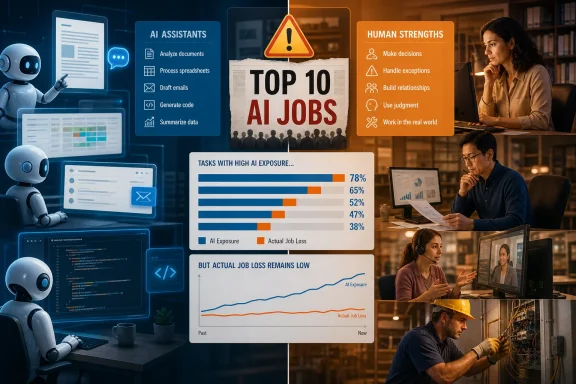
The most defensible warning applies to the entry-level task layer in jobs such as translation, basic writing, research support, data processing, first-line customer service, bookkeeping and document review. AI tools can already generate a first pass at much of that work. What the published research does not show is that a named occupation is about to be eliminated wholesale, or that every role involving these tasks has the same exposure.
Microsoft Research’s July 2025 study is the source most often used to make the “jobs at risk” claim. Its researchers examined 200,000 anonymized Bing Copilot conversations, matched the work activities in those conversations to occupational tasks, and calculated an “AI applicability score.” The study found the greatest overlap in knowledge work, office and administrative support, and sales-related work that involves gathering and communicating information.
That is an important result for Windows users and IT professionals because Copilot-style assistants are already embedded in the work tools that create this pressure: Microsoft 365, Teams, Outlook, Excel, Power Platform and a growing collection of third-party agent products. The question for employers is no longer whether software can draft the email, summarize the ticket history, translate the product page or reconcile a spreadsheet. It can. The operational question is whether the company reduces headcount, raises output expectations, redeploys staff to exception handling, or simply lets fewer junior roles open.
Microsoft’s study measures task fit, not job destruction
The supplied ranking puts telemarketers first, claims more than 95% automation exposure, and presents translators, copywriters, paralegals and junior financial analysts as the next wave of disappearing work. Several of those occupations are plainly exposed to disruption, but the list overstates what Microsoft actually measured.
Microsoft’s paper did not attempt to forecast layoffs, wage declines, vacancy reductions or the probability that an occupation will be replaced. It measured how closely work activities seen in Copilot conversations align with activities associated with an occupation, adjusted for task success and how broadly those activities affect the role. The paper itself warned against treating high applicability as proof that AI can perform an entire occupation.
That distinction changes the reading of the data. An interpreter may use AI for first-pass translation, terminology lookup and transcript preparation, but a medical, legal or diplomatic interpreter still bears context, accuracy and confidentiality burdens that a fluent-looking output does not remove. A junior accountant may hand routine reconciliation to accounting software, but someone still has to resolve mismatches, validate source records, understand policy exceptions and stand behind the submitted result.
The study’s own highest-overlap occupations also do not cleanly match the circulated list. Independent coverage of the Microsoft research identified interpreters and translators, historians, writers and authors, journalists, editors, proofreaders, public-relations specialists and customer-facing sales work among the roles with high chatbot-task overlap. It also identified nursing assistants, massage therapists, machinery operators, roofers, cleaners and similar physical roles as low-overlap occupations.
That mismatch is not a minor editorial detail. It shows that the popular “top 10” is a composite assembled from different reports and labor-market assumptions, rather than a single verified ranking.
The World Economic Forum’s 92 million figure is broader than AI
The World Economic Forum’s Future of Jobs Report 2025 projects 170 million jobs created and 92 million displaced worldwide by 2030, for a net gain of 78 million. Those numbers are real, but they are routinely summarized incorrectly as an AI-only forecast.
The Forum’s estimate covers macrotrend-driven labor-market change: technological development, demographic shifts, economic conditions, geoeconomic fragmentation and the green transition. Artificial intelligence is one driver, alongside factors such as aging populations, digitization, energy investment and slower growth in some regions. The report is based on employer expectations combined with International Labour Organization employment data; it is not a measurement of jobs already removed by generative AI.
The same issue applies to the often-cited 39% skills figure. The Forum reports that employers expect 39% of workers’ core skills to change by 2030. That is a large transformation, but “skills changed” includes learning to use new tools, revised workflows, new compliance requirements and changing business priorities. It does not mean 39% of workers will be rendered unemployable.
The Forum does provide a more concrete warning about the clerical layer. Cashiers and ticket clerks, administrative assistants and executive secretaries, printing workers, accountants and auditors are among the roles employers expect to decline most quickly through 2030. Yet the report also says the fastest-growing roles include big-data specialists, fintech engineers, AI and machine-learning specialists, software and applications developers, security-management specialists and information-security analysts.
For the Windows and enterprise IT crowd, that makes the practical divide clearer. Work that consists mainly of moving standardized information between systems is exposed. Work that designs, secures, governs, integrates and audits those systems is expanding—though AI will change the composition of that work as well.
Anthropic’s data undercuts the simple “low-skill jobs first” story
Anthropic’s Economic Index adds a complication the popular ranking tends to miss. Its February 2025 analysis of roughly one million Claude conversations found AI use concentrated in software development and technical writing, with computer and mathematical work accounting for a disproportionate share of use. In that initial data, AI was more prevalent in tasks tied to mid- and higher-wage occupations than at either the low or very high end of the wage range.
That is why the reassuring story that “blue-collar workers are safe while office workers are doomed” is too neat. Many manual occupations have a physical moat: messy environments, fine motor work, mobility, safety exposure and the need to manipulate objects in the real world. A plumber diagnosing an intermittent leak inside a finished wall, an electrician tracing a fault in an old building and a home health aide physically caring for a patient are difficult to automate with a text-and-image model.
But white-collar exposure is task-specific, not a verdict on intelligence or value. Generative AI currently has an unusual advantage in work performed inside documents, spreadsheets, inboxes, knowledge bases and source-code repositories—the exact places where a trained user can hand it the context it needs. That puts pressure on people whose early career value has traditionally come from producing drafts, summaries, basic models, research notes, routine test cases and formatted reports.
Anthropic’s more recent January 2026 Economic Index report reinforces the need for caution. It found that task coverage and effective impact do not always point to the same occupations: data-entry keyers and radiologists appeared more affected after the company adjusted for task success, while teachers and software developers appeared less affected than task coverage alone implied. Anthropic also states plainly that its data is limited to tasks performed with Claude and does not establish how those conversations translate into changes in real-world employment.
That is the central reporting point: AI-use data is a leading indicator, not a redundancy notice.
“Safe” occupations have human constraints, not immunity
The 20-job list gets its underlying pattern right. Surgeons, emergency physicians, nurse anesthetists, therapists, judges, pilots, firefighters, electricians, plumbers, HVAC technicians, childcare workers and home health aides share features that current general-purpose AI does not independently supply: physical presence, real-time adaptation, licensing, liability and human trust.
Yet calling CEOs and judges “safe from AI” requires more precision. Their positions may retain a legally required human decision-maker, but their staffing models, research workflows, drafting processes and administrative support can still be heavily automated. A senior executive can remain accountable while needing fewer analysts to assemble slide decks and routine market reports. A judge can retain sole authority while courts use AI-assisted research, transcription, triage and document processing.
Likewise, the healthcare occupations on the low-risk list are unlikely to be replaced by chatbots, but they are already being reshaped by clinical documentation tools, imaging support, scheduling systems, ambient transcription and decision-support software. The enduring part of the job is not every task performed in it; it is the human who examines the patient, makes the accountable judgment and takes responsibility when circumstances turn atypical.
The protected trait is therefore not job title. It is control of the work that remains when standardized digital production is automated.
The workforce risk is greatest at the career entry point
The most immediate consequence may be less visible than a mass layoff announcement. Organizations can shrink an entry-level pipeline gradually by hiring fewer junior writers, help-desk agents, QA testers, analysts, researchers, paralegals and operations staff when AI allows experienced employees to complete routine production work faster.
That creates a training problem. Senior staff do not emerge fully formed; they historically gained judgment by doing the repetitive work now easiest to automate. If employers strip out too much of that apprenticeship layer, they may save on short-term labor while weakening the next generation of people capable of reviewing AI output, handling failures and taking responsibility for high-stakes decisions.
Workers should respond by identifying the parts of their role that are already well-specified enough to hand to Copilot, Claude or another assistant, then deliberately building capability beyond them. For an IT professional, that may mean moving from basic ticket resolution to incident ownership, automation design, security validation, stakeholder communication and architecture. For a writer, it may mean reporting, source evaluation, editorial judgment and subject-matter expertise instead of high-volume first drafts.
The usable conclusion is not to flee every profession that appears on an AI-exposure list. It is to recognize that the market is pricing routine digital output differently now. In Microsoft’s own research, AI is strongest at providing information, writing, teaching and advising; in the World Economic Forum’s forecast, clerical roles are among the clearest expected decliners; and in Anthropic’s usage data, higher-skill white-collar tasks are already heavily represented.
The jobs most likely to endure will still use AI. The workers most likely to be squeezed are those whose employer decides the AI can produce their current output without also needing their judgment.