

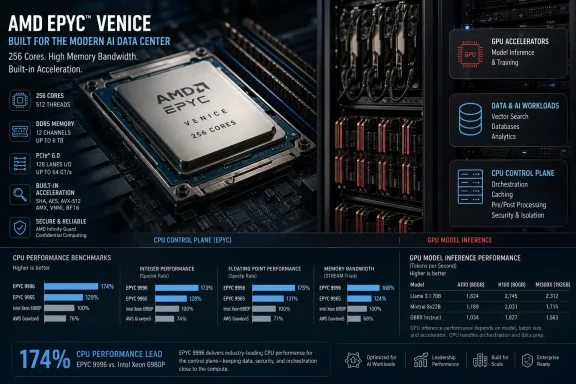
EE Times Asia’s August 12 article reproduces AMD’s benchmark case for 5th Gen EPYC 9005 and newly announced 6th Gen EPYC 9006 processors. The underlying AMD blog was published on July 23, following the company’s Advancing AI event, where AMD formally introduced the EPYC 9006 family. Independent coverage from Phoronix confirms that Venice is an announced platform rather than a rumor, with up to 256 cores, 16 memory channels, DDR5-8000 and MRDIMM-12800 support, PCIe 6.0, and an SP7 rollout expected in the fourth quarter of 2026.
The important correction is timing and scope. This is not a fresh August processor launch, and it is not proof that a Venice server will make every enterprise agent twice as fast. It is AMD’s early performance framing for a CPU generation that remains ahead of broad independent testing and, for at least some platform variants, broad availability.
AMD’s 82% and 174% figures are internally measured composite scores
AMD says its 192-core EPYC 9965, part of the 9005 “Turin” generation, achieved a 1.82-times geometric-mean result against Intel’s 128-core Xeon 6980P across five CPU-centric groups of agent-related tasks. That is the basis for the “82%” uplift. The 256-core EPYC 9996 Venice result is 2.74 times the Xeon score, producing the advertised 174% lead.
Those numbers are not fabricated shorthand; AMD’s appendix provides the underlying ratios. Against the Xeon 6980P baseline of 1.00, AMD reports:
- EPYC 9755 at 1.36 times the composite score.
- EPYC 9965 at 1.82 times the composite score.
- EPYC 9996 at 2.74 times the composite score.
- AWS Graviton5 at 1.08 times the composite score.
The result has a straightforward hardware explanation before any architectural conclusions are drawn. The tested EPYC 9996 carries 256 cores and 512 threads, compared with 192 cores and 384 threads for the EPYC 9965, 192 cores and threads for Graviton5, and 128 cores and 256 threads for Intel’s Xeon 6980P. AMD also tested the 9996 with DDR5-8000 memory and a stated 600W Default CPU Power setting, while its Intel configuration used DDR5-6400.
That does not invalidate the test. High core count, memory bandwidth, and platform power are precisely the resources that determine how many concurrent CPU-side services a server can sustain. But it does mean that the result is a measure of specific one-socket server configurations, not a normalized per-core, per-watt, per-dollar, or equal-core comparison.
“Agentic AI” in this test leaves out the model’s main compute stage
AMD divides an agent workflow into gateway handling, context assembly, planning and routing, retrieval, reasoning, enterprise tools, short-lived tools, verification, and response streaming. Its comparison then explicitly excludes the Reasoning tier, which it describes as predominantly GPU-accelerated inference.
That boundary is more consequential than the headline suggests. In a real retrieval-augmented agent, the GPU or accelerator serving the model often controls the throughput and latency users notice. The CPU still does substantial work: API routing, tokenization, vector search, database calls, cache handling, sandboxed scripts, document processing, queues, and orchestration. But a CPU benchmark cannot by itself establish how fast the full agent will answer, how reliably it will call a business system, or how many model sessions a rack can serve.
AMD’s test is best read as a benchmark of the supporting control plane around model inference. For organizations running large internal agent fleets, that is useful. A deployment with thousands of tool calls, retrieval queries, short-lived Python processes, database lookups, and web requests can indeed become CPU-bound even when the language model itself runs on accelerators.
For Windows-heavy enterprises, the practical relevance is likely to be indirect. The systems in AMD’s reported comparison ran Ubuntu 24.04.4 LTS with Linux kernel 6.17.0-29, and the included tools are Linux-native workloads such as NGINX, Redis, MySQL, MongoDB, FAISS, OpenSSL, GNU Bash, Python libraries, and command-line utilities. That resembles the Linux and container infrastructure frequently used underneath Azure-connected, Kubernetes-based, or hybrid AI services. It does not establish equivalent performance for Windows Server application stacks, Hyper-V-heavy virtualization estates, SQL Server workloads, Active Directory-integrated tools, or Windows-based AI agents.
The benchmark is transparent enough to inspect, but not independent enough to settle procurement
AMD deserves credit for publishing more methodology than many AI infrastructure claims receive. The company identifies the test OS, kernel, governor, main software versions, processor models, core counts, memory speeds, several BIOS settings, and the workloads used in each category.
The planning and verification group uses IREE tokenization, vLLM inference for Llama-3.1-8B-Instruct, and a TPCx-AI-derived workload. Retrieval uses a FAISS IVF4096,PQ128x4fs index with the sift1m dataset. Enterprise tools combine MySQL workloads derived from TPC-C and TPC-H, Redis, and MongoDB-YCSB inside 32-vCPU virtual machines. The ephemeral-tools category replays fixed traces built around development commands, compression, cryptographic work, document parsing, media handling, and RAG ingestion.
Those are credible building blocks for studying CPU pressure in an AI service. They are also selectively controlled building blocks. AMD says network and disk I/O were removed from the measurements, while the workloads were run as self-contained modules. That helps isolate processor throughput, but it removes many of the components that routinely dominate response time in enterprise agents: remote vector stores, object storage, API gateways, identity checks, databases on separate hosts, rate-limited SaaS applications, and cross-region traffic.
The geometric mean also compresses five substantially different workload classes into one headline. AMD’s own table shows the Venice EPYC 9996 leading the Xeon 6980P by 2.38 times in retrieval, 2.50 times in ephemeral tools, 2.65 times in enterprise tools, 2.83 times in gateway and streaming, and 3.45 times in its plan-route-verification group. Those individual results are more useful to a capacity planner than the 2.74-times aggregate because they reveal where a deployment might benefit most.
A team bottlenecked on vector search and document ingestion may care about the retrieval score. A team running SQL, Redis, MongoDB, and application services alongside agents should scrutinize the enterprise-tools methodology. An organization with agents that spend most of their time awaiting external APIs should not expect either result to translate directly into user-visible speed.
AWS Graviton5 is a cloud-instance comparison, not a like-for-like server trial
AMD’s inclusion of AWS Graviton5 needs an additional warning label. The Xeon and EPYC systems were physical single-socket machines using specified server and reference platforms. Graviton5 was tested through an AWS m9gd.metal-48xl bare-metal instance with default cloud-side system configuration.
AMD explicitly says cloud results can be affected by regional deployment, cloud configuration, availability, Nitro or hypervisor behavior, and storage or network variables. The test design attempts to avoid disk and network as direct bottlenecks, but cloud instances still are not a clean substitute for a locally tuned server with known firmware, DIMM population, cooling, and power settings.
The data does show a significant difference in the selected workload mix. AMD reports Graviton5 ahead of the Xeon 6980P overall at 1.08 times the composite score, while the EPYC 9965 reaches 1.82 times and the EPYC 9996 2.74 times. But no procurement team should convert that into a conclusion about AWS instance economics. AMD does not provide comparable hourly cloud pricing, reserved-instance costs, software licensing effects, or a per-request cost model.
Venice has the platform features enterprise AI hosts will want
The broader Venice announcement is more durable than AMD’s composite benchmark. Phoronix reports that EPYC 9006 adds support for up to 16 memory channels per socket, DDR5-8000, second-generation MRDIMMs at up to 12,800 MT/s, and PCIe 6.0. Those upgrades target problems that show up around AI accelerators and CPU-heavy data services: feeding GPUs, keeping large vector indexes and databases in memory, running more VMs or containers, and attaching faster storage and networking.
The 256-core top-end configuration also matters to consolidation. A large agent platform may split work among gateway services, retrieval workers, workflow engines, policy checks, databases, sandbox runners, and observability services. A denser CPU can reduce node count for workloads that scale cleanly across cores, although the operational gain depends on memory capacity, NUMA design, licensing, and whether the software can avoid shared-resource contention.
What AMD has not yet provided is the information buyers need to turn the announcement into a deployment decision: system pricing, validated OEM configurations, broad availability dates by socket family, power measurements under this specific agentic test suite, and independent replication. Phoronix has said it plans unrestricted Venice testing once hardware is available; that work will be more useful for testing AMD’s broad performance framing across conventional Linux server, HPC, and real application workloads.
For now, the defensible conclusion is narrower: AMD has shown that its 256-core EPYC 9996 can produce a large vendor-measured lead in a carefully selected set of CPU-side agent infrastructure tasks. Enterprises planning 2027 AI server refreshes should treat Venice as a serious platform candidate, but keep the 174% figure in the capacity-planning spreadsheet—not in the business case until independent systems, prices, and production software results arrive.