
MarkTechPost’s August 1 report describes the release as a fully open MoE model trained from scratch on AMD Instinct MI300X and MI325X hardware. AMD’s Hugging Face collection and the company’s ROCm materials confirm the core release: six checkpoints cover pre-training, mid-training, 64K-context extension, supervised fine-tuning, Direct Preference Optimization, and a final reinforcement-learning “Think” model.
The more consequential release is the reproducibility package around it. AMD has published intermediate checkpoints, data-mixture details, configuration material, the Primus training framework, Miles reinforcement-learning framework, and code for FarSkip-Collective, its communication-overlap method. That makes Instella-MoE unusually useful to academic labs and infrastructure teams seeking to reproduce an end-to-end MoE training recipe on AMD hardware.
For Windows enthusiasts and enterprise IT teams, however, the dividing line is clear: this is a research artifact and ROCm showcase, rather than a ready-made local assistant or hosted-service foundation.
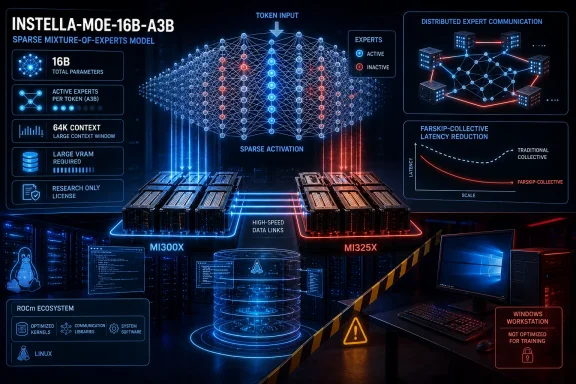 The “fully open” label has a licensing limit
AMD calls Instella-MoE “fully open,” and that is accurate in one important sense: the company has exposed much more of the development process than model vendors normally do. Users can inspect checkpoints from every major stage instead of receiving only a polished final model, and the public code reveals training and serving choices that are usually hidden behind a paper or API.
But the weights are licensed under ResearchRAIL, which AMD’s own model card says is for academic and research purposes. The same card explicitly says the models are research-only and are not intended for safety-critical, medical, or high-factual-accuracy work. That makes the distinction consequential for a business: downloading a checkpoint and putting it behind a paid product endpoint is not the simple commercial path associated with permissive model licenses.
AMD’s software repositories tell a different story. Primus, the large-scale training framework used for Instella-MoE, is MIT licensed. The FarSkip-Collective implementation is also MIT licensed. Those licenses permit commercial use, modification, redistribution, and sale subject to the standard notice requirements.
That creates a split release:
- The weights are constrained research assets.
- The training and systems code is broadly reusable open-source infrastructure.
- The published recipe lets researchers investigate how AMD trained the model, but does not turn the released checkpoints into a no-strings commercial base model.
This is not a semantic complaint about openness. Licensing determines whether an AI team can move a promising benchmark model from evaluation into a production service without a separate legal review or a retraining effort. AMD has opened its method more freely than its finished weights.
The release also leaves one critical document pending. AMD’s model card says that a dedicated Instella-MoE technical report is still forthcoming. Until it appears, the benchmark charts, throughput claims, and training details should be treated as vendor-published results, not as findings independently reproduced in a peer-reviewed paper.
A 2.8B-active model still needs 16B-model memory planning
Instella-MoE’s design is straightforward for an MoE model but easy to misunderstand in capacity planning. It has 16 billion total parameters across 27 decoder layers, with 64 routed experts plus two shared experts in each MoE layer. For each token, its router selects six routed experts while the shared experts remain active, yielding AMD’s stated 2.8 billion active parameters.
Sparse activation reduces the compute performed for a token. It does not mean only 2.8 billion parameters must be resident in memory. The model’s experts must remain available to the router, so a BF16 deployment still needs space for the whole parameter set.
A simple 16B-parameter BF16 calculation lands near 32 GB before the operating environment, attention and MoE workspaces, allocator overhead, and key-value cache are counted. AMD’s DPO checkpoint repository itself lists a 31.7 GB model payload. A 32 GB accelerator is therefore a knife-edge fit for weights alone, not evidence that it offers usable production headroom.
The 64K-context claim raises the practical requirement further. Gated Multi-head Latent Attention reduces attention-state pressure compared with conventional multi-head attention, but it does not make a 64K prompt free. Any real server also needs cache capacity for concurrent requests, context windows, and output generation. A system that can merely load the model will not necessarily support the advertised long-context behavior at an acceptable batch size or latency.
Community quantizations have already appeared for the Think checkpoint, including an AWQ INT4 variant and a GGUF conversion indexed by Hugging Face. Those can make experimentation more attainable on local hardware, but they are third-party conversions rather than AMD’s supported BF16 deployment path. Teams should also assume the original weight license remains relevant when assessing a derivative checkpoint.
In short, Instella-MoE’s sparse design can lower token-generation compute, particularly at scale, but it does not make this a lightweight 2.8B local model. The active-parameter figure is useful for performance comparison; it is a poor purchasing guide for VRAM.
FarSkip-Collective is the infrastructure story
AMD’s most distinctive technical claim is not the 16B-A3B configuration itself. It is FarSkip-Collective, a technique designed to hide the latency of expert-parallel communication by sending stale or partial activations ahead while computation continues. In MoE serving, tokens often need to be dispatched to experts on different accelerators and returned, making interconnect traffic a primary source of delay.
AMD reports that FarSkip-Collective produced a 12.7% pre-training speedup and reduced time to first token by as much as 39.2% under expert-parallel SGLang serving. IT Home independently summarized the same July 24 AMD announcement and reported those figures as originating from AMD’s blog material. They should be read within that context: these are AMD’s measurements in its implementation, not a cross-vendor serving benchmark.
The qualification matters. Expert parallelism is a multi-accelerator deployment strategy. A workstation loading one quantized checkpoint does not get a 39.2% time-to-first-token improvement from a mechanism aimed at overlapping collective communication between GPUs. The claimed benefit becomes meaningful to a data-center team operating distributed MoE inference, where communication can dominate both prompt processing and first-token latency.
Gated MLA, the other architectural change, adds an input-conditioned gate to Multi-head Latent Attention before the output projection. AMD presents it as a lightweight improvement that helps the model retain quality while maintaining a compact attention-state design. For operators, it primarily means Instella-MoE is not a generic drop-in architecture: the published model depends on custom modeling code, and AMD’s own Transformers examples use trust_remote_code=True.
That flag warrants normal supply-chain caution. It is common for newly released architectures, but administrators should pin a reviewed revision rather than treating a mutable model repository as an unattended production dependency.
Windows support exists, but the preferred serving path is Linux
Windows users can run portions of ROCm and PyTorch on supported Radeon hardware, but Instella-MoE arrives ahead of a complete native Windows ROCm serving stack. AMD’s current Windows compatibility documentation supports PyTorch on Windows 11 with a defined set of Radeon GPUs, including Radeon RX 7900 XTX, Radeon RX 9070-series cards, Radeon AI PRO R9700, and Radeon PRO W7900 variants. The same documentation says plainly that the entire ROCm stack is not yet supported on Windows.
That gap shows up in AMD’s own preferred serving instructions. The Instella-MoE model cards provide commands for Transformers, vLLM, and SGLang. AMD’s SGLang-on-ROCm guidance is centered on a Linux Docker environment using Linux GPU devices such as /dev/kfd and /dev/dri; its documented container is Ubuntu-based. AMD has not published a Windows-specific Instella-MoE deployment guide or validated Windows serving matrix for this model.
The practical options divide accordingly. A Windows 11 machine with a supported Radeon GPU may be useful for basic PyTorch experimentation or a compatible community GGUF build in a local application. Researchers trying to reproduce AMD’s intended ROCm, SGLang, expert-parallel, or multi-GPU path should plan for Linux or Windows Subsystem for Linux, then verify each relevant GPU, ROCm version, PyTorch build, and framework release before committing hardware.
Even on Linux, AMD’s SGLang documentation notes that Radeon support is still initial and identifies known failures for certain MoE workloads. Instella-MoE is an MoE workload, so a Radeon deployment cannot be assumed to inherit the smooth experience AMD demonstrated on MI300X and MI325X Instinct accelerators.
The released checkpoints are more valuable than the headline score
AMD reports that Instella-MoE-16B-A3B-Base averages 76.7 across its standard benchmark collection, above several named open competitors but below Qwen3.5-4B-Base at 79.5 in AMD’s comparison. The Think checkpoint reaches a reported 73.22 in AMD’s post-training table, following gains from SFT and DPO. The company also reports 41.5 on HELMET and 79.4 on RULER for long-context evaluation.
Those results make the model worth testing, especially for AMD-focused labs that need a compact expert-parallel target. But the release’s lasting value lies in the staircase of checkpoints: a team can examine whether mid-training improved a task, whether long-context extension affected it, and how DPO and reinforcement learning changed behavior. That is a more useful research asset than another final-chat-model leaderboard position.
AMD has made a credible argument that its Instinct hardware, ROCm stack, Primus framework, and Miles post-training tooling can take an MoE model from corpus ingestion through reinforcement learning. What it has not released is a permissively licensed production model, a complete Windows serving solution, or evidence that the reported performance transfers unchanged to commodity Radeon systems.
For organizations with MI300X- or MI325X-class capacity, Instella-MoE is an unusually transparent ROCm research platform. For a Windows workstation owner with a 16 GB or 32 GB card, it is presently a model to watch through quantized community ports—not a model whose 2.8B-active label should be mistaken for a simple local deployment target.
