

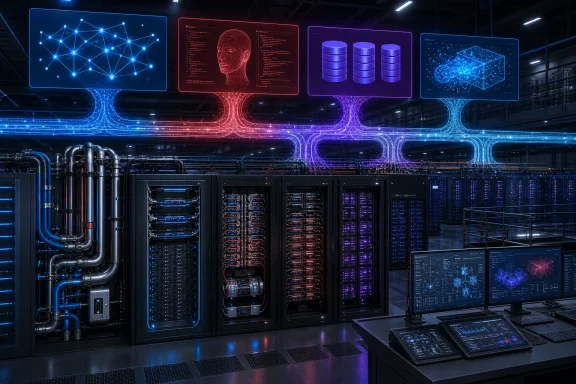
EE Times Asia framed the July event as seven infrastructure takeaways for 2027 planning. The supplied text actually develops six themes, with its final AT&T example combining cost control and governance into one section; it does not include a distinct seventh takeaway. The larger point still holds: AMD’s July 23 event was not a conventional chip launch. AMD used it to position EPYC “Venice” CPUs, Instinct accelerators, Pensando networking and ROCm software as parts of a system decision.
Microsoft’s own announcement supports that framing. Azure is preparing separate offerings for AI data processing, electronic-design automation and production inference, using next-generation EPYC processors and, for the inference service, MI455X hardware. That is a more practical model for IT buyers than treating “AI infrastructure” as one homogeneous pool of GPUs.
Agentic workloads make the CPU plan a first-order decision
The most credible takeaway from AMD’s agentic-AI pitch is not that every organization suddenly needs a new CPU fleet. It is that agents create work outside the model’s forward pass: API calls, permission checks, retrieval, vector and relational database queries, task queues, sandbox execution, observability, retries and policy enforcement. Those operations are generally CPU-, memory- and network-intensive even when the model inference itself stays on an accelerator.
AMD’s 6th Generation EPYC 9006 series, code-named Venice, is designed around that opportunity. AMD describes separate roles for the processors as agent sandboxes, GPU host nodes and general-purpose enterprise servers. Whether Venice proves superior in each role will require independent benchmarks on real applications, but the workload distinction is sound.
For a 2027 design, the practical change is to model the full request path before assigning an accelerator count. Measure concurrent agent runs, tool-call rate, tokens per request, retrieval fan-out, database latency, memory capacity per host and the percentage of GPU time spent idle awaiting data or work. A GPU deployment that is starved by its host CPUs, storage or control plane will not be rescued by buying a faster GPU.
This also argues against enforcing one server configuration across every AI-adjacent workload. GPU hosts need high I/O throughput, memory bandwidth and network capacity. Agent execution nodes may benefit more from dense CPU cores, large memory footprints and strong workload isolation. The databases and line-of-business systems the agents call need their own availability and security design, rather than becoming an afterthought inside an “AI cluster” budget.
MI350P, MI430X and MI455X solve different problems
AMD’s accelerator lineup is less a single generation than three different procurement paths, and buyers should resist comparing their peak throughput as though they were substitutes.
The MI350P is the near-term enterprise option. It is a dual-slot PCIe card built for air-cooled, standard servers and is aimed at inference, retrieval-augmented generation and smaller-to-large on-premises models. AMD says systems can use up to eight cards without requiring the liquid-cooling and power redesign associated with dedicated accelerator platforms. For organizations that have rack capacity, existing virtualization and Kubernetes operations, and strict data-location requirements, this is the part of AMD’s portfolio that can fit a conventional refresh cycle.
The MI430X belongs in scientific computing and sovereign-AI discussions. AMD positions it around native FP64 performance, simulation, modeling and memory-intensive workloads, while retaining AI training, tuning and inference capabilities. Those requirements differ materially from enterprise chatbot deployment. A buyer whose main need is CAD, weather, genomics, defense research or digital-twin simulation should ask for FP64 and application-specific evidence; an enterprise inference buyer should not pay for that profile merely because it carries a newer model number.
The MI455X is AMD’s frontier AI accelerator, with 432 GB of HBM4 memory and an enhanced accelerator-module form factor designed for direct liquid cooling. It is the component inside Helios, AMD’s rack-scale system. Tom’s Hardware’s event reporting described Helios as AMD’s first rack-scale architecture built to compete directly with Nvidia’s NVL72-class systems, which explains why individual-card specifications tell only part of the story.
The correction worth making here is about customer names. AMD and Anthropic announced a plan for up to 2 gigawatts of MI450 Series GPUs in Helios systems, with the first gigawatt scheduled for the first half of 2027. AMD’s earlier Meta agreement likewise describes a custom MI450-based platform. Those are substantial commitments to AMD’s rack-scale direction, but they are not evidence that every named customer has deployed the specific MI455X configuration described at Advancing AI.
Helios changes the buying unit—and raises the bar for due diligence
Helios packages 72 MI455X GPUs with 18 EPYC 9006 CPUs, Pensando networking, cooling and ROCm software. For buyers at that tier, the procurement unit is no longer a GPU server or even a pod. It is a rack with a defined electrical draw, cooling design, network topology, service model and software qualification path.
That integration can reduce deployment risk when compared with assembling accelerators, NICs, switches, host nodes and software from several vendors. It can also concentrate risk. A rack-scale platform demands answers on floor loading, power delivery, liquid-cooling operations, spare strategy, firmware ownership, cluster telemetry and the boundaries between AMD, an OEM, the network vendor and the customer’s own operations team.
AMD claims Helios can provide up to 30% more tokens per dollar than a leading competing solution. That is a vendor comparison, not an independently established operating-cost result. It should be treated as a request for workload-specific proof, including model, sequence length, batch size, precision, power assumptions, software versions and whether prefill, decode and host-side work were measured together.
Microsoft’s planned Azure deployment is more meaningful than a performance slide because it puts Helios into a cloud operator’s product roadmap. But it does not remove the need for enterprise validation. Azure customers may eventually consume MI455X-backed inference as a service without operating a Helios rack; organizations considering on-premises hardware will still face the full facility and operational burden.
ROCm.ai is a deployment story, not proof of software parity
AMD introduced ROCm.ai as an AI-assisted development environment intended to help developers install, deploy, troubleshoot and optimize workloads on AMD platforms. AMD also says common tools and frameworks, including PyTorch, Hugging Face, vLLM and SGLang, are enabled for MI455X.
This is important because software readiness decides whether hardware arrives as usable capacity or as a months-long migration project. Yet framework support is not the same as production parity. A platform evaluation should test the organization’s actual model architecture, inference server, quantization method, custom operators, distributed-training stack, observability tooling and incident response procedures. The relevant question is not whether a framework logo appears on a compatibility page; it is whether the complete workload can be upgraded, reproduced and supported by the team that will own it.
Organizations already standardized on CUDA-centric libraries should also budget migration engineering explicitly. ROCm’s openness may offer advantages in portability and access to source code, but no procurement claim removes the work of validating kernels, containers, drivers and performance regressions across a changing stack.
Cost control and governance belong in the same design review
The AT&T example offers a useful operational lesson despite being presented as a customer success story. According to AMD’s event material, AT&T has routed more than one trillion tokens through Microsoft Azure-hosted models on AMD Instinct GPUs and uses a cache-aware gateway to send tasks to the model appropriate for each job. AMD says the approach can reduce AI costs by as much as 80%.
The number is customer- and workload-specific, so it should not become a generic savings assumption. The design principle is more durable: route simple classification, extraction and retrieval tasks away from the largest reasoning model; cache safely; limit tool permissions; and keep detailed logs of which agent called which system with which authority.
That is also where infrastructure planning becomes a security decision. As agents gain access to internal databases and business systems, capacity planning must include identity boundaries, secrets management, egress control, sandboxing, audit retention and the ability to stop a misbehaving workflow without taking down the entire inference service.
AMD’s event supplies a credible case for planning AI as a full stack rather than a GPU purchase. The concrete 2027 consequence is that enterprises should divide their designs into at least three tracks now: drop-in inference for existing data centers, specialized HPC or sovereign-AI systems, and rack-scale frontier infrastructure. Mixing those tracks into one accelerator scorecard is how organizations overbuy hardware, underfund integration and discover too late that their agent platform’s bottleneck was never the model.