Microsoft and AMD are expanding their cloud partnership with three specialized Azure virtual machine families aimed at some of the fastest-growing and most demanding computing markets: AI data processing, semiconductor design, scientific simulation, and production-scale AI inference. The forthcoming
Azure HDv2, Azure HXv2, and Azure ND MI455X v7 instances represent more than a routine hardware refresh. They show Microsoft dividing the AI infrastructure stack into purpose-built layers while using AMD CPUs, accelerators, networking silicon, and software to reduce bottlenecks across the entire workflow.
 Overview
Microsoft announced the expanded partnership on July 20, 2026, presenting it as part of Azure’s broader strategy to support heterogeneous computing rather than betting on one processor architecture or accelerator supplier. The company is combining AMD technology with hardware from other partners and Microsoft’s own custom silicon, including its Maia AI accelerators and Cobalt server processors.
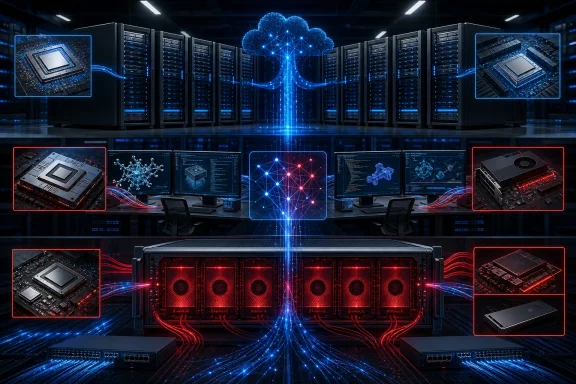
The three new VM families serve distinctly different roles. HDv2 is intended to feed and coordinate AI systems, HXv2 focuses on electronic design automation and technical computing, and ND MI455X v7 provides rack-scale acceleration for large AI inference deployments.
Three VM families, three infrastructure layers
The division reflects how modern AI services operate in practice. A production AI platform needs far more than GPUs: data must be retrieved and transformed, agent processes must be scheduled, prompts and context must be assembled, and results must be filtered, stored, or passed to other systems.
Microsoft’s new AMD-powered offerings therefore address three interconnected layers:
- Azure HDv2 handles CPU-intensive data preparation, search, reinforcement learning support, and AI agent coordination.
- Azure HXv2 targets semiconductor verification, RTL simulation, engineering analysis, and scientific computing.
- Azure ND MI455X v7 brings AMD’s Helios rack-scale platform to Azure for reasoning, search, and agentic AI inference.
This separation should let customers select infrastructure according to workload behavior instead of treating every AI problem as an accelerator problem.
An expansion rather than an abrupt change
Azure already offers numerous AMD-based VM families, including general-purpose, memory-optimized, storage-focused, confidential-computing, HPC, and accelerated-computing instances. Microsoft has also deployed AMD Instinct MI300X accelerators for AI workloads and AMD Pensando data processing units within its cloud infrastructure.
The latest announcement deepens that relationship. AMD is no longer supplying only individual CPUs or GPUs; its technology now spans the compute, acceleration, networking, and software layers of a forthcoming Azure platform.
Why AI Infrastructure Is Becoming More Specialized
The first wave of generative AI infrastructure was often described primarily in terms of accelerator quantity. Organizations wanted access to as many high-end GPUs as possible, while cloud providers raced to build clusters capable of training increasingly large models.
That remains important, but deployment economics are changing. Training creates a model periodically, whereas inference may run continuously for millions of users, applications, automated processes, and software agents.
Inference changes the cost equation
Inference workloads can be extremely sensitive to latency, memory capacity, memory bandwidth, network performance, and utilization. A system that produces impressive benchmark throughput may still be commercially unattractive if it wastes accelerator cycles while waiting for data or cannot maintain predictable response times under variable demand.
Reasoning models complicate the equation further because they may generate substantially more intermediate and output tokens than conventional conversational models. Agentic applications can multiply that work by invoking models repeatedly, calling tools, searching data sources, evaluating results, and handing tasks between specialized agents.
The result is an infrastructure problem involving CPUs, accelerators, storage, software, and networking simultaneously. Microsoft’s new VM families reflect that reality.
GPUs cannot solve every bottleneck
Accelerators excel at highly parallel mathematical operations, but they do not independently manage every stage of an AI service. Data loading, document parsing, retrieval, preprocessing, scheduling, orchestration, security checks, and application logic may remain CPU-intensive.
If those supporting stages cannot keep pace, expensive accelerators remain underutilized. The HDv2 design is especially significant because it treats the CPU side of AI as a first-class infrastructure category rather than an accessory attached to GPU clusters.
Purpose-built systems improve utilization
Specialized VM families can improve efficiency by matching processor design, memory capacity, cache configuration, local storage, and networking to a defined workload. They can also reduce the number of compromises created by general-purpose instances.
For Azure customers, the potential benefit is not simply faster hardware. It is better utilization of every component involved in a distributed AI or HPC application, which may translate into lower completion times and more predictable operating costs.
Azure HDv2 and the Data Engine Behind AI
Azure HDv2 is designed for the CPU-heavy stages that prepare, organize, and move information through AI systems. Microsoft identifies data preparation, search, reinforcement learning, and agent coordination as primary use cases.
Each VM is expected to provide
nearly 500 physical sixth-generation AMD EPYC cores, up to
4TB of memory,
32TB of local NVMe storage, and
400Gbps Azure Boost networking. Those specifications place HDv2 well beyond the scale of a conventional application server.
Why nearly 500 physical cores matter
Large core counts allow one system to process many parallel tasks without immediately distributing them across numerous smaller VMs. That can benefit indexing, tokenization, filtering, data transformation, simulation, batch processing, and the execution of many independent agent workers.
The reference to physical cores is also notable. Cloud specifications are frequently expressed in virtual CPUs, which can represent hardware threads rather than complete cores. Physical-core density may provide more consistent behavior for workloads that consume substantial execution resources per thread.
It will still be important to examine Azure’s final VM topology, available sizes, processor frequencies, non-uniform memory access characteristics, and licensing model. Core count alone does not guarantee application performance, particularly when software is sensitive to memory latency or cannot parallelize efficiently.
Memory and local NVMe reduce data friction
Four terabytes of RAM gives customers room to hold large indexes, feature stores, graph structures, intermediate datasets, and in-memory analytical workloads. Meanwhile, 32TB of local NVMe storage should provide high-throughput scratch space for temporary files, preprocessing pipelines, local caches, and checkpoint data.
Local NVMe capacity is not a substitute for durable Azure storage. Data normally disappears when an instance is deallocated, replaced, or fails, depending on the service configuration. Applications will therefore need to copy important results to persistent storage and treat the local drives as a performance tier.
Used correctly, however, local storage can prevent every intermediate operation from traversing a remote storage service. That reduces latency and may lower pressure on the network.
Agent orchestration becomes infrastructure-intensive
The phrase
agent coordination at scale deserves attention. A single AI agent may appear lightweight, but a production system can involve thousands of concurrent workflows, each maintaining state, querying databases, calling APIs, evaluating responses, and applying governance policies.
HDv2 could act as the operational layer around accelerator-backed inference. It might host retrieval services, workflow engines, policy enforcement, tool execution, or preprocessing jobs while separate ND instances run the models.
This architecture could help organizations avoid placing ordinary application work on scarce accelerator nodes. It also reinforces the idea that the AI data center is becoming a pipeline of specialized systems rather than one giant pool of interchangeable compute.
Azure HXv2 Targets Chip Design and Technical Computing
Azure HXv2 is the successor to the AMD-powered HX-series instances introduced in 2023. It is optimized for electronic design automation, or EDA, alongside scientific and engineering workloads that benefit from strong single-threaded performance, large memory configurations, and substantial cache capacity.
The instances will use sixth-generation AMD EPYC processors, code-named Venice, and continue employing AMD’s 3D V-Cache technology. Microsoft says HXv2 will improve single-threaded performance and memory capabilities compared with the previous generation.
Why chip design needs specialized CPUs
Semiconductor development includes many tasks with different computational profiles. Some stages scale across thousands of cores, while others depend heavily on the speed of individual threads, cache behavior, memory latency, or synchronization between processes.
RTL simulation, for example, does not always scale as cleanly as a highly parallel AI training workload. A faster core with access to a large cache may deliver more practical value than a higher aggregate core count whose resources cannot be used efficiently.
EDA applications also manipulate enormous and highly interconnected datasets. Keeping frequently accessed information closer to the processor can reduce time spent retrieving it from main memory.
The role of 3D V-Cache
AMD’s 3D V-Cache technology vertically stacks additional cache on processor components, increasing the amount of data that can remain close to the CPU cores. The benefit depends on the workload, but cache-sensitive simulation and analysis tools can see meaningful improvements when they avoid repeated trips to slower memory.
Microsoft previously used this capability to differentiate the original Azure HX family for silicon design. Continuing the approach in HXv2 suggests that customers valued workload-specific optimization rather than simply requesting the newest general-purpose server CPU.
The final performance will depend on processor frequency, cache topology, software optimization, and VM configuration. Microsoft has not yet published enough detailed benchmark data to determine how HXv2 will compare with every existing Azure HPC option.
Cloud computing shortens design cycles
Semiconductor companies have traditionally operated large on-premises compute farms because EDA workloads require substantial capacity and involve sensitive intellectual property. Cloud infrastructure offers burst capacity when projects approach verification milestones or tape-out deadlines.
Instead of purchasing hardware for a temporary peak, a design team can provision additional Azure resources and release them afterward. The economic benefit depends on software licensing, data-transfer costs, security controls, and sustained utilization, but the operational flexibility can be valuable.
Microsoft’s collaboration with Synopsys also matters here. Hardware optimization has limited value if leading EDA applications do not run reliably or efficiently on the platform, so joint engineering and validated software configurations may prove as important as the processors themselves.
ND MI455X v7 Brings AMD Helios to Azure
The headline offering is
Azure ND MI455X v7, which will expose AMD’s Helios rack-scale AI platform through Azure. The platform combines AMD Instinct MI455X accelerators, sixth-generation EPYC Venice CPUs, Pensando networking technology, and the ROCm software ecosystem.
Microsoft positions the VM family for production-scale inference, particularly reasoning, search, and agentic AI. AMD describes Helios more broadly as an integrated rack-scale system for large AI training and inference, although Azure’s initial emphasis is clearly on inference.
Rack-scale design replaces isolated servers
AI infrastructure increasingly has to be engineered at the rack level. Power delivery, cooling, accelerator interconnects, host processors, network adapters, cabling, and management software all affect the useful performance of a deployment.
A rack-scale platform defines those elements as a coordinated system rather than asking operators to assemble them one server at a time. This approach can improve deployment consistency and make it easier to scale a known design across multiple data centers.
For cloud customers, the details may be hidden behind Azure’s VM and managed-compute interfaces. Nevertheless, the physical architecture will influence cluster availability, network topology, performance variability, and the maximum size of supported deployments.
MI455X is AMD’s next major cloud challenge
AMD has become a credible supplier of data-center AI accelerators, but Nvidia retains substantial advantages in market share, developer familiarity, software maturity, and the breadth of its supporting ecosystem. MI455X and Helios represent AMD’s effort to compete at the platform level rather than offering a GPU as an isolated alternative.
Azure gives AMD an important route to enterprise adoption. Customers can test AMD accelerators without building their own data center, negotiate hardware procurement, or maintain a specialized cluster.
Microsoft also gains leverage from a more diverse accelerator fleet. Greater supplier choice can improve capacity planning, reduce dependence on a single road map, and give Azure more options when balancing cost, power consumption, availability, and workload characteristics.
Reasoning and search demand balanced systems
Large-scale inference is not one uniform task. Model serving may include prompt ingestion, cached context, retrieval, speculative decoding, routing between models, safety evaluation, and the generation of long responses.
Search-oriented applications can place particularly heavy demands on supporting infrastructure because they combine vector retrieval, ranking, databases, and model inference. Agentic systems may repeatedly perform these operations during one user request.
The best-performing platform will therefore be the one that sustains useful application throughput, not merely the highest theoretical accelerator performance. Microsoft and AMD will need to demonstrate how Helios performs under realistic multi-user workloads with strict latency targets.
Azure Boost and Pensando Move Networking Into Focus
The expanded partnership extends beyond CPUs and GPUs. Microsoft plans to deploy AMD Pensando data processing units more broadly across Azure and integrate AMD networking technology with Azure Boost.
This is a strategically important part of the announcement because networking overhead can consume CPU cycles, increase latency, and limit the scale of distributed applications. Offloading infrastructure functions allows host processors to spend more time running customer workloads.
What a DPU contributes
A DPU is a programmable processor designed to handle infrastructure services such as networking, traffic processing, storage operations, telemetry, security policies, and virtualization-related tasks. The exact responsibilities vary by implementation.
Without offload hardware, host CPUs may need to process packet flows, virtual switching, encryption, and other platform functions. That creates competition between customer code and cloud-control tasks.
Moving suitable operations to a DPU can improve isolation and produce more predictable VM performance. It may also help Azure manage very large clusters without allowing infrastructure overhead to grow at the same rate as application compute.
Azure Boost separates tenants from infrastructure work
Azure Boost is Microsoft’s architecture for shifting virtualization and networking functions away from the host CPU and onto dedicated hardware and software components. Its purpose is to increase storage and network performance while reducing the resources consumed by the Azure hypervisor and host services.
Integrating Pensando technology with Azure Boost could deliver benefits across multiple VM families, not only the new AI instances. However, Microsoft has not yet detailed the deployment schedule, regional reach, or precise performance improvements associated with the expanded integration.
Administrators should therefore distinguish architectural potential from guaranteed VM-level results. Published bandwidth figures, latency measurements, service-level agreements, and application benchmarks will matter once the products approach availability.
Networking determines cluster efficiency
Distributed AI inference and HPC applications exchange large quantities of data between nodes. If the network cannot keep pace, additional accelerators or CPU cores produce diminishing returns.
The same issue appears at smaller scales when data travels between compute, storage, databases, and managed AI services. High nominal bandwidth helps, but congestion control, topology, software libraries, and consistent latency can be equally important.
Microsoft’s focus on DPUs demonstrates that cloud competition is moving deeper into data-center architecture. The winning platform may be the one that minimizes invisible overhead as much as the one that buys the fastest processors.
ROCm Becomes a Critical Part of the Azure Proposition
Hardware availability alone will not determine whether ND MI455X v7 succeeds. AMD’s ROCm software platform must give developers, model providers, and enterprise customers a practical route to deploying production workloads.
The software layer includes drivers, compilers, communication libraries, optimized mathematical libraries, profiling tools, and integrations with AI frameworks. These components determine whether an application can use the accelerator efficiently and reliably.
Portability is improving, but it is not automatic
Many AI applications are built using high-level frameworks, which can reduce direct dependence on a specific accelerator architecture. That does not mean a workload can move between platforms without testing or engineering effort.
Custom kernels, framework extensions, quantization libraries, distributed inference engines, and monitoring tools may behave differently across hardware. Performance tuning that works on one accelerator can be ineffective on another.
Organizations evaluating ND MI455X v7 should plan a structured validation process:
- Confirm framework, model, and library compatibility with the supported Azure ROCm environment.
- Establish a functional baseline before attempting aggressive performance tuning.
- Measure latency, throughput, memory use, and error rates using representative prompts and traffic patterns.
- Test multi-node scaling rather than extrapolating from a single accelerator or VM.
- Calculate total application cost, including CPU support, storage, networking, idle capacity, and engineering work.
- Validate observability and recovery procedures before moving production traffic.
A successful benchmark is not sufficient if the operations team cannot diagnose failures, apply updates, or maintain predictable service behavior.
Azure Foundry can reduce exposure to hardware complexity
AMD says enterprise customers will be able to deploy and scale production AI workloads through Azure Foundry Managed Compute. A managed layer could make AMD infrastructure accessible to customers that want performance and capacity without directly configuring every driver or cluster component.
This can also help Microsoft schedule workloads across a diverse fleet. Customers may care less about the underlying accelerator if the managed service meets their requirements for performance, reliability, security, and price.
However, abstraction creates trade-offs. Managed services can simplify deployment while limiting low-level control, portability, or the ability to apply custom optimizations. Azure customers will need to decide whether they want infrastructure-level access or a higher-level AI platform experience.
Microsoft’s Heterogeneous Silicon Strategy
Microsoft’s deeper adoption of AMD does not signal that Azure is abandoning Nvidia or Microsoft-designed processors. It confirms that Azure intends to operate a mixed fleet in which different silicon serves different workload classes.
That strategy resembles the broader evolution of hyperscale computing. General-purpose processors remain essential, but accelerators and offload engines increasingly handle specialized functions.
Choice can become a cloud advantage
A diverse hardware catalog gives customers more ways to balance compatibility, performance, availability, and cost. It can also give Microsoft alternatives when one supplier’s products are constrained or when a workload runs more efficiently on another architecture.
The strategy may be especially attractive to large AI developers that already maintain hardware abstraction layers. Such organizations can benchmark several platforms and route workloads according to economics or capacity.
Smaller customers may find the choice more complicated. Selecting among GPU families, CPU architectures, VM shapes, managed services, and software stacks requires expertise that many conventional IT teams do not yet possess.
Custom silicon and partner silicon can coexist
Microsoft’s Maia accelerators and Cobalt CPUs give the company more control over design priorities and supply planning. Partner hardware from AMD and Nvidia provides broader software support, proven product road maps, and access to technologies that Microsoft does not need to develop independently.
The combination reduces the risk of relying exclusively on either model. Custom silicon can target Azure-specific requirements, while merchant silicon supports customer choice and familiar development environments.
The challenge is operational complexity. Microsoft must qualify more hardware, maintain more software images, optimize more frameworks, and help customers understand which platform fits each application.
Competition shifts from chips to complete systems
AMD’s Helios platform competes not only through accelerator specifications but through the integration of CPUs, GPUs, networking, and ROCm. Nvidia has long emphasized a similarly broad platform approach involving accelerators, interconnects, networking, systems, and software.
Cloud providers add another layer through orchestration, storage, identity, security, billing, and managed AI services. As a result, buyers are no longer comparing chips in isolation.
They are comparing complete systems and the operational ecosystems surrounding them. Microsoft’s ability to integrate Helios with Azure services will be more consequential than any single component specification.
Enterprise Impact
Enterprises could benefit from greater availability of specialized AI compute, particularly if Microsoft prices the new VMs competitively or makes them accessible through managed services. The strongest use cases will likely appear where organizations already operate substantial Azure data platforms and want to keep AI processing near existing information.
The announcement also creates new infrastructure-planning questions. Enterprises must consider accelerator portability, regional capacity, software support, procurement commitments, governance, and cost controls.
AI platform teams gain another deployment target
Organizations with centralized AI engineering groups can add AMD-based Azure infrastructure to their benchmarking and capacity strategies. This may provide negotiating leverage and reduce the operational risk associated with depending on one accelerator family.
Potential enterprise uses include:
- Serving internal reasoning models for research, customer support, software development, or document analysis.
- Running retrieval and search systems alongside Azure-hosted corporate data.
- Coordinating large numbers of automated agents that interact with approved enterprise tools.
- Processing and transforming proprietary datasets before training, fine-tuning, or inference.
- Bursting engineering simulations into Azure when on-premises clusters reach capacity.
These benefits are most realistic for organizations prepared to evaluate the full application stack rather than selecting hardware based only on peak performance claims.
Governance must scale with agent infrastructure
HDv2’s focus on agent coordination highlights an emerging enterprise concern. As organizations move from chat interfaces to autonomous or semi-autonomous workflows, infrastructure capacity can translate directly into a larger number of machine-initiated actions.
Identity, authorization, logging, data-loss prevention, and human approval mechanisms must scale alongside compute. Faster orchestration is useful only if an enterprise can control what agents are permitted to do.
Azure’s identity and policy services may give Microsoft an advantage with existing customers, but implementation remains the customer’s responsibility. Agentic infrastructure can amplify poorly designed permissions just as easily as it can accelerate legitimate work.
Impact on Developers, Researchers, and Windows-Centered IT Teams
Although the new VM families are data-center services, their effects will extend to developers and administrators who build and operate applications from Windows environments. Azure remains closely integrated with Visual Studio, Visual Studio Code, GitHub, PowerShell, Windows Server, Microsoft Entra, and the broader Microsoft management stack.
Windows-based teams will not need local AMD AI accelerators matching the cloud hardware. They can develop through frameworks, containers, remote environments, and managed Azure interfaces, then deploy to the appropriate VM family.
Developers need hardware-aware testing
Cloud abstraction does not eliminate architectural differences. Developers should test model behavior, library versions, container images, and performance characteristics on the actual target platform.
A development workflow might use modest local hardware for application logic, smaller Azure instances for integration testing, and ND MI455X v7 capacity for scale validation. HDv2 resources could support preprocessing, indexing, or agent execution around the accelerated inference layer.
Reproducible containers and infrastructure-as-code will become increasingly important. Teams should be able to rebuild an environment when Azure updates drivers, ROCm packages, operating-system images, or VM generations.
Researchers gain access without owning clusters
Scientific groups and universities may benefit from HXv2 if Azure provides flexible access and suitable grant or reservation models. Cloud capacity can help researchers run simulations that exceed departmental hardware without maintaining a permanent supercomputing environment.
The limitations remain familiar: data movement, software licenses, budgets, and the risk of unexpected charges. HPC workloads can consume resources at a rate that surprises teams accustomed to fixed on-premises equipment.
Clear quotas, automated shutdown policies, and cost telemetry should be considered part of the technical design rather than administrative afterthoughts.
Strengths and Opportunities
The expanded Microsoft-AMD partnership has several potential advantages, although many will require real-world validation after the services enter preview or general availability.
- The portfolio addresses the complete AI pipeline. HDv2 can prepare and coordinate data-intensive workloads, while ND MI455X v7 handles accelerator-heavy inference.
- HXv2 continues workload-specific HPC optimization. Large caches and stronger single-threaded performance could shorten semiconductor and engineering workflows that do not scale efficiently across ordinary cloud instances.
- AMD gives Azure another advanced accelerator supplier. Increased competition can improve capacity, pricing pressure, and customer choice.
- Helios integrates more than the GPU. EPYC processors, Instinct accelerators, Pensando networking, and ROCm create a coordinated platform rather than a collection of unrelated components.
- Azure Boost can reduce infrastructure overhead. DPU-assisted networking may make more host resources available to customer workloads and improve performance consistency.
- Managed compute can widen adoption. Azure Foundry could let enterprises use AMD acceleration without managing every low-level software component.
- Cloud access lowers the entry barrier. Customers can evaluate next-generation AMD hardware without purchasing and operating a dedicated rack-scale system.
- The partnership supports supply-chain diversification. Microsoft can distribute demand across custom and partner silicon instead of depending on one processor road map.
The largest opportunity is architectural flexibility. If Azure can route each stage of an AI service to an efficient resource class, customers may achieve better economics than they would by running the entire application on expensive accelerator nodes.
Risks and Concerns
The announcement leaves several important questions unanswered. Microsoft has described the intended workloads and some hardware characteristics, but customers still need availability, pricing, benchmark, and service-level details.
- No complete rollout schedule has been published. Regional availability, preview timing, quotas, and general-availability dates will determine whether customers can use the services for near-term projects.
- Pricing remains unknown. Powerful instances can reduce job duration while still increasing total cost if hourly rates, networking charges, or reservation terms are unfavorable.
- ROCm compatibility requires validation. Framework support has improved, but custom libraries and production inference stacks may still need engineering work.
- Headline specifications do not guarantee application performance. Memory locality, frequency, topology, scheduling, and software optimization can outweigh raw core or accelerator counts.
- Large VM shapes can create utilization problems. Customers may pay for resources they cannot use continuously if Azure does not provide appropriately granular configurations.
- Local NVMe storage introduces durability concerns. HDv2 applications must protect important data through persistent storage and recovery workflows.
- A heterogeneous fleet increases operational complexity. Enterprises may need separate images, tuning profiles, monitoring baselines, and support procedures for different accelerators.
- Agentic scale can magnify security mistakes. More compute enables more automated actions, making strong identity, audit, and approval controls essential.
- Cloud-based chip design raises sovereignty and confidentiality questions. Semiconductor firms will require strict assurances about isolation, encryption, access control, and regional data handling.
- Benchmark comparisons may be difficult. Vendor-selected tests rarely capture the diversity of production reasoning, retrieval, and engineering workloads.
None of these risks invalidates the platform. They indicate that procurement decisions should wait for measurable service characteristics rather than relying solely on architectural promises.
What to Watch Next
The next phase will determine whether these VM families become broadly useful Azure products or remain scarce premium infrastructure. Microsoft and AMD must turn the announcement into deployable capacity, stable software, transparent performance data, and predictable economics.
Availability, regions, and quotas
The first question is when customers can provision each VM family. Early access may be limited to selected Azure regions, strategic customers, or managed-service deployments.
Capacity allocation will be especially important for ND MI455X v7. Demand for advanced inference infrastructure can exceed supply, and a technically available SKU offers limited value if ordinary customers cannot obtain quota.
Microsoft should also clarify whether HDv2 and HXv2 will launch simultaneously with the accelerator platform or follow separate schedules tied to sixth-generation EPYC availability.
Detailed configurations and pricing
Customers need the full VM size tables, including core counts, memory ratios, local storage layouts, network limits, processor topology, and supported operating systems. HXv2 users will want precise cache and frequency information, while HDv2 customers will need to understand memory locality across hundreds of physical cores.
Pricing will reveal Microsoft’s intended market. On-demand rates favor temporary experiments and burst workloads, while reservations or capacity commitments can make sustained production deployments more economical.
For AI inference, customers should calculate cost per useful request or token rather than cost per accelerator hour. For EDA and HPC, cost per completed simulation or shortened design cycle will be more meaningful.
Independent application benchmarks
Vendor benchmarks will provide an initial reference, but independent testing should examine complete workloads. For HDv2, that includes indexing, data transformation, graph processing, retrieval, and multi-agent coordination.
HXv2 testing should cover EDA simulation, computational fluid dynamics, finite-element analysis, and other cache- or memory-sensitive applications. ND MI455X v7 evaluations should include realistic model sizes, quantization methods, prompt lengths, concurrency levels, and latency targets.
Scaling efficiency is particularly important. A rack-scale system must prove that adding nodes produces useful throughput instead of simply increasing theoretical capacity.
Software maturity and operational tooling
ROCm version support, framework certification, container availability, debugging tools, telemetry, and update policies will heavily influence adoption. Enterprise customers will also look for integration with Azure Monitor, managed identities, private networking, policy controls, and established deployment pipelines.
Microsoft must explain how driver and firmware maintenance works for infrastructure-level customers. Unexpected platform changes can alter performance or compatibility, so organizations need stable release channels and sufficient notice before upgrades.
Support responsibilities must also be clear. Customers should know when an issue belongs to Microsoft, AMD, a framework provider, or an application vendor.
Competitive responses
Nvidia will continue advancing its own rack-scale systems, networking, and software platform, while other accelerator vendors and cloud providers pursue competing architectures. Amazon Web Services and Google Cloud are also investing in custom silicon and diversified accelerator fleets.
Microsoft’s advantage will depend on execution rather than catalog breadth alone. If Azure can offer meaningful AMD capacity with strong managed services, it may attract customers seeking alternatives without forcing them to abandon familiar Microsoft tooling.
AMD, meanwhile, must demonstrate that Helios can compete as an operational platform. Success in Azure would strengthen its credibility with other hyperscalers, enterprises, and model developers.
Microsoft’s new AMD-powered Azure VMs illustrate the next stage of cloud AI, in which infrastructure is divided into specialized systems for data processing, orchestration, technical computing, networking, and inference.
HDv2, HXv2, and ND MI455X v7 could give Azure customers valuable alternatives across the AI and HPC lifecycle, while Helios gives AMD a prominent opportunity to prove that it can compete at rack scale. The specifications are promising, but availability, software maturity, independent benchmarks, and total workload cost will decide whether this deeper partnership materially changes how enterprises build AI—or simply adds another impressive set of options to an already complex cloud marketplace.

 Azure HDv2 targets the CPU bottleneck behind AI systems
 siliconangle.com
 www.kaohooninternational.com