AMD is preparing to ship systems based on its first rack-scale artificial intelligence architecture, Helios, in the second half of 2026, and Microsoft has now joined the platform’s growing customer roster. The agreement moves AMD beyond selling accelerators as individual components and into direct competition with Nvidia’s tightly integrated AI infrastructure, while giving Microsoft another production-scale option for Azure inference, agentic AI, data processing, and semiconductor engineering workloads.
Helios is therefore more than another Instinct GPU launch: it is AMD’s attempt to become a full-platform supplier for the AI factory era.
 Background
AMD’s rise in the data center began primarily with EPYC server processors. Starting with the original Naples generation in 2017, the company exploited chiplet design, aggressive core counts, and competitive pricing to rebuild a server CPU business that had become almost irrelevant during the previous decade.
Successive Rome, Milan, Genoa, Turin, and now next-generation Venice processors established AMD as a credible alternative to Intel in cloud computing, enterprise virtualization, high-performance computing, and technical workloads. That CPU recovery created the relationships, engineering expertise, and financial foundation needed for a much larger push into accelerated computing.
From EPYC servers to Instinct accelerators
AMD’s Instinct GPU family has taken a more difficult route. Nvidia entered the generative AI boom with a mature CUDA software environment, a broad developer base, established networking products, and years of experience integrating accelerators into supercomputers.
AMD nevertheless gained a foothold through systems based on the MI200 and MI300 families. The MI300X was especially significant because its large high-bandwidth memory capacity made it attractive for running large language models, particularly inference workloads in which model weights, attention caches, and batched requests place heavy demands on memory.
Microsoft was already an important Instinct customer before the Helios announcement. Azure introduced MI300X-based services, giving AMD practical experience operating inside a hyperscale cloud and giving Microsoft leverage in a market otherwise dominated by Nvidia.
Why the industry moved to rack-scale systems
The meaning of an “AI product” has changed. A fast accelerator is still essential, but customers increasingly purchase or qualify complete assemblies consisting of processors, network interfaces, switches, cooling, power distribution, firmware, management tools, and software.
As clusters grow, the performance of an individual chip matters less unless hundreds or thousands of accelerators can communicate efficiently. A theoretically faster GPU can lose its advantage if data movement, collective communication, memory access, thermal limits, or software orchestration prevent the wider system from using it effectively.
Nvidia recognized this transition early with integrated platforms such as Grace Blackwell and its evolving Vera Rubin roadmap. Helios is AMD’s answer to the same architectural reality:
the rack, rather than the chip, is becoming the minimum meaningful unit of AI infrastructure.
What AMD Helios Actually Is
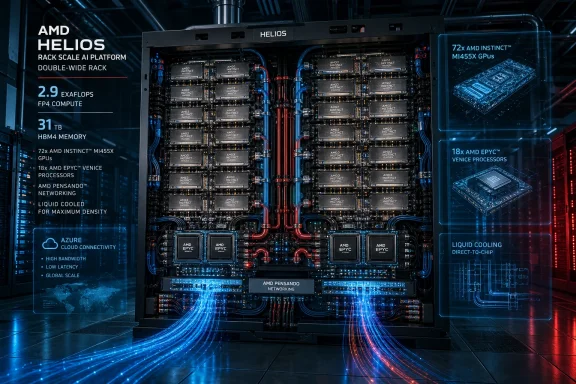
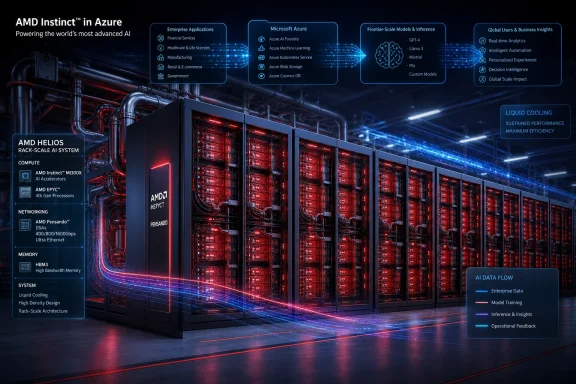
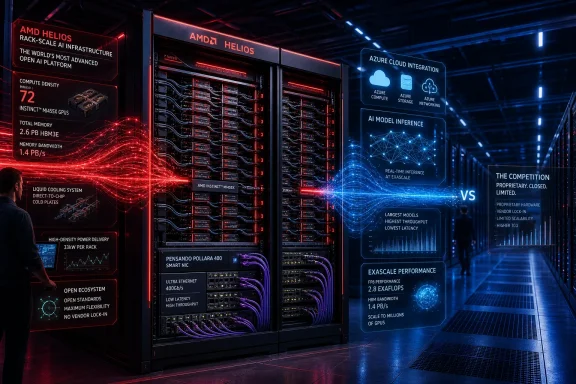
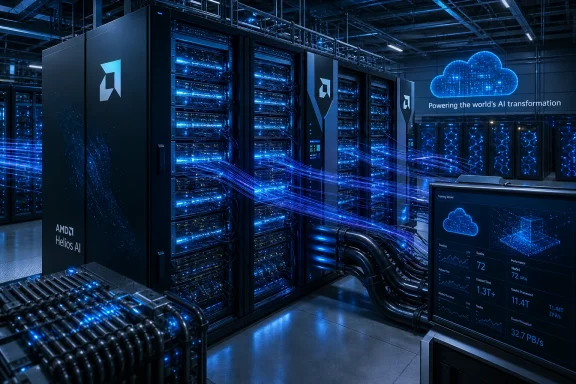
Helios is AMD’s first comprehensive rack-scale AI reference design. It combines Instinct MI455X accelerators, sixth-generation EPYC processors codenamed Venice, Pensando networking technology, the ROCm software stack, power delivery, liquid cooling, and serviceable compute trays in a coordinated architecture.
AMD expects volume deployments of partner-built Helios systems during the second half of 2026. The distinction between a reference design and a finished retail product is important: AMD supplies the architectural blueprint and core technologies, while original equipment manufacturers and original design manufacturers can build branded systems around it.
A 72-GPU rack
A full Helios configuration contains
72 Instinct MI455X GPUs connected as a large scale-up domain. AMD lists aggregate performance of up to 1.4 exaFLOPS at FP8 precision and 2.9 exaFLOPS at FP4, although these figures are theoretical and depend on workload characteristics, utilization, sparsity assumptions, and software optimization.
Each MI455X includes 432GB of HBM4 memory, giving the complete rack approximately 31TB of high-bandwidth memory. AMD also specifies up to 19.6TB/s of memory bandwidth per GPU, a particularly relevant metric for inference workloads that repeatedly move model weights and cached data through memory.
Those figures are intended to support very large models, long context windows, high request concurrency, and distributed training. More importantly, the shared rack architecture is designed to make those resources usable as one coordinated system rather than as 72 isolated accelerators.
Open Rack Wide construction
Helios uses Meta’s Open Rack Wide, or ORW, specification, submitted through the Open Compute Project. Unlike conventional single-width racks, the double-wide format creates more physical room for high-density accelerator trays, liquid cooling, network components, cabling, and power infrastructure.
The wider format is not merely cosmetic. Modern accelerator racks can draw extraordinary amounts of power and generate heat densities that traditional air-cooled data centers were never designed to handle.
ORW gives operators a standardized mechanical foundation for deploying these systems. It may also help equipment manufacturers avoid reinventing enclosures, manifolds, busbars, and maintenance procedures for every customer.
A blueprint rather than a sealed appliance
AMD’s reference-design strategy differs from selling one fixed appliance directly to every data center. Partners can customize implementation details while retaining compatibility with the Helios architecture and its key interfaces.
That approach offers flexibility, but it also creates a coordination challenge. A platform assembled by several manufacturers must deliver predictable performance, reliability, firmware behavior, and serviceability across different deployments.
AMD will therefore need strong validation programs and disciplined partner qualification. An open rack becomes valuable only if openness does not produce operational inconsistency.
Microsoft’s Azure Deployment
Microsoft said it will bring Helios and AMD’s next-generation EPYC processors into Azure through three forthcoming infrastructure offerings. These cover production AI inference, data-intensive CPU computing, and electronic design automation rather than treating every workload as a candidate for the same accelerator-heavy virtual machine.
The strategy reflects Microsoft’s increasingly heterogeneous cloud. Azure now combines hardware from AMD, Intel, Nvidia, Arm suppliers, and Microsoft’s own internal silicon programs, allowing the company to match infrastructure to workload economics and supply availability.
ND MI455X v7 for production inference
The Helios-based Azure offering will appear as
ND MI455X v7 virtual machines, aimed primarily at production-scale AI inference. Microsoft also expects the platform to support frontier-model workloads, Azure AI services, and customer deployments that require large pools of accelerator memory.
Inference has become the critical commercial battleground because it represents the recurring cost of serving AI applications. Training a model may be expensive, but every prompt, agent action, search request, generated image, or software-assistance session consumes inference resources after deployment.
A platform that lowers cost per generated token can influence the economics of an entire cloud service. That is why AMD repeatedly emphasizes memory bandwidth, utilization, energy efficiency, and total cost of ownership rather than relying only on peak arithmetic performance.
HDv2 for AI data systems
Microsoft is also introducing Azure HDv2 virtual machines, co-designed with AMD for data preparation, search, reinforcement learning, and large-scale agent coordination. Microsoft says these instances will offer nearly 500 physical sixth-generation EPYC cores, 4TB of memory, 32TB of local NVMe storage, and 400Gb Azure Boost networking.
These specifications illustrate an often-overlooked reality: GPUs cannot operate effectively without a substantial CPU and storage pipeline. Models require cleaned datasets, indexes, embeddings, retrieval services, policy checks, message queues, databases, and orchestration systems.
Agentic AI increases those requirements because an agent may perform many tool calls, searches, database operations, and verification steps for a single user request. HDv2 is meant to handle that surrounding computational work, keeping expensive accelerators supplied with useful data rather than leaving them idle.
HXv2 for chip design and technical computing
Azure HXv2 will target electronic design automation, scientific simulation, engineering analysis, and other high-performance computing applications. Microsoft says the virtual machines will feature 176 sixth-generation EPYC cores running above 5GHz, increased cache per core, memory configurations approaching 2TB or 4TB, and 800Gb InfiniBand.
Electronic design automation is strategically important because chip development itself has become one of the most demanding computing workloads. Simulation, verification, physical design, and timing analysis can consume enormous CPU resources for months before a processor reaches manufacturing.
AMD is also an Azure HX customer, creating an unusual feedback loop in which AMD processors help design future AMD processors and accelerators. Microsoft gains a demanding internal-style customer, while AMD gains access to elastic infrastructure for workloads that may spike during important design milestones.
Why Microsoft Is Adding Another AI Platform
Microsoft’s decision should not be interpreted as abandoning Nvidia. Azure will continue to operate a vast Nvidia fleet, and Nvidia hardware remains central to Microsoft’s relationship with OpenAI and its wider cloud strategy.
The significance lies in diversification. Microsoft has strong incentives to avoid depending on one supplier for every accelerator, network fabric, software layer, and system architecture used across a rapidly expanding AI business.
Capacity is as important as preference
AI infrastructure demand remains constrained by several factors:
- Advanced packaging capacity limits how quickly high-end accelerators can be manufactured.
- High-bandwidth memory supply affects the volume and configuration of complete systems.
- Power availability can delay deployments even after chips have been delivered.
- Liquid cooling and electrical upgrades can determine which data center halls can accept a new rack.
- Network switches, optical modules, and cables can become cluster-level bottlenecks.
A second viable supplier gives Microsoft access to another supply chain and another product roadmap. Even if AMD remains smaller than Nvidia, the additional capacity can be commercially valuable when Azure customers are waiting for scarce AI instances.
Negotiating leverage and cost control
Hyperscalers typically prefer multiple suppliers because competition improves pricing, contract flexibility, and roadmap influence. Microsoft’s scale allows it to negotiate system features, software priorities, delivery schedules, and workload-specific optimizations that smaller buyers could not easily obtain.
AMD benefits from having Microsoft validate Helios in a public cloud, while Microsoft gains leverage in negotiations throughout the AI hardware ecosystem. This does not require AMD to replace Nvidia; it only requires AMD to become credible enough that purchasing decisions are no longer automatic.
Matching hardware to workloads
Not every model needs the same architecture. Some deployments prioritize maximum training performance, others need large memory capacity, while high-volume inference services may optimize for tokens per dollar, tokens per watt, latency, or request throughput.
Azure can expose different architectures through separate virtual machine families and managed services. Customers may then select hardware according to application needs instead of treating one accelerator as universally optimal.
This portfolio model resembles the wider cloud market, where customers already choose among general-purpose, memory-optimized, compute-optimized, storage-optimized, and burstable instances. AI infrastructure is moving toward the same level of specialization.
The Technical Case for Helios
AMD’s central claim is that Helios can deliver favorable economics for large-scale inference and training. Its strongest arguments involve memory capacity, memory bandwidth, standards-based networking, and a coordinated CPU-GPU design.
Peak performance figures attract attention, but sustained performance matters more. An accelerator that spends time waiting for memory, network transfers, CPU preprocessing, or synchronization cannot deliver its advertised throughput.
Memory as a competitive weapon
The 432GB of HBM4 attached to each MI455X is central to AMD’s positioning. More memory per accelerator can reduce the number of GPUs required to hold a model, cache more user sessions, support longer contexts, or operate with less aggressive quantization.
Large memory pools may also simplify deployment. Splitting a model across fewer devices can reduce communication overhead, lower failure exposure, and make scheduling easier.
Bandwidth is equally important. AMD’s stated 19.6TB/s per GPU is intended to keep computational units supplied with data and improve performance in memory-sensitive inference scenarios.
Real results will still depend on model architecture, precision, batch size, software kernels, and cluster configuration.
UALink and scale-up communication
Helios connects its 72 GPUs through UALink over Ethernet, with AMD claiming up to 260TB/s of aggregate scale-up bandwidth. Scale-up networking allows accelerators inside the rack to behave as a tightly connected computational domain.
This is essential for models that cannot fit on one GPU or that need to divide computation across many devices. Collective operations such as all-reduce, all-gather, and reduce-scatter can determine whether a large cluster scales efficiently.
Nvidia’s NVLink ecosystem has a substantial maturity advantage, so AMD must prove that UALink-based systems can provide comparable reliability and software behavior under sustained production loads. Open specifications are attractive, but customers ultimately pay for delivered throughput and uptime.
Pensando and scale-out networking
For communication between racks, Helios uses AMD Pensando technology and standards-oriented Ethernet networking. AMD lists 43TB/s of aggregate scale-out bandwidth for the reference design.
The Pensando acquisition gave AMD programmable data processing units, networking silicon, and software expertise that it previously lacked. These technologies help manage traffic, security, storage, and infrastructure services without consuming CPU or GPU cycles.
Scale-out performance becomes crucial when thousands of accelerators participate in one job. Congestion control, packet loss recovery, topology awareness, and workload scheduling can have as much influence on job completion time as the processors themselves.
ROCm Faces Its Defining Test
Hardware alone will not determine Helios’ success. AMD’s ROCm software stack must make the platform accessible to developers accustomed to Nvidia CUDA, established libraries, mature profiling tools, and widely documented deployment practices.
ROCm has improved significantly, adding broader framework compatibility, better model support, optimized inference engines, and faster release cycles. Helios will test whether those improvements are ready for the operational demands of hyperscale production.
Day-zero framework support
AMD says ROCm supports major environments including PyTorch, TensorFlow, JAX, ONNX Runtime, vLLM, and Triton. Compatibility with these frameworks is essential because most organizations do not want to rewrite models simply to adopt another accelerator.
However, framework compatibility is only the starting point. Customers also need optimized kernels, stable drivers, container images, observability, debuggers, compilers, schedulers, security updates, and predictable performance across software releases.
Microsoft can help close this gap by integrating Helios into Azure’s managed infrastructure. If Azure handles drivers, networking, health monitoring, and cluster provisioning, customers can consume AMD capacity without mastering every hardware-specific detail.
Portability versus perfect equivalence
The industry often describes open software as a route away from vendor lock-in. In practice, moving a major model between accelerator families can still involve tuning, kernel substitutions, graph changes, numerical validation, and performance analysis.
The relevant question is not whether migration requires zero work. It is whether the cost of migration is small enough to justify lower operating expenses, additional capacity, or better workload performance.
Microsoft can make that trade-off more attractive through standardized APIs and managed Azure AI services. Customers interacting with a service endpoint may not need to know whether a particular request runs on AMD, Nvidia, or Microsoft silicon.
Windows developers may feel indirect effects
Helios will not appear as a consumer graphics card or Windows desktop component. Its effect on Windows users will instead arrive through cloud-hosted products such as Microsoft 365 Copilot, GitHub Copilot, Azure AI services, security tools, and third-party applications built on Azure.
If AMD capacity reduces inference costs, Microsoft could support more frequent agent actions, larger context windows, faster responses, or lower service prices. It could also reserve scarce premium accelerators for workloads that specifically require them.
The relationship is therefore indirect but consequential:
the economics of a rack in an Azure data center can influence the capabilities and pricing of AI features delivered to millions of Windows PCs.
AMD’s Acquisition Strategy Comes Together
Helios is also the clearest evidence yet of AMD’s attempt to assemble a complete data center platform through acquisitions. Pensando supplied infrastructure networking, Xilinx brought adaptive computing technology, and ZT Systems added rack-level engineering and manufacturing expertise.
Individually, these deals could appear disconnected. Helios gives them a common purpose by combining compute, networking, system design, and software into one architecture.
ZT Systems and rack engineering
Designing a reliable rack is very different from producing a GPU. Engineers must account for mechanical tolerances, power transients, coolant distribution, cable routing, service access, firmware coordination, manufacturing variation, and failure replacement.
AMD’s acquisition of ZT Systems accelerated its ability to address those details. The company no longer needs to depend entirely on customers and server partners to integrate its chips into a coherent high-density system.
This expertise should shorten deployment cycles and reduce the risk that technically strong silicon is undermined by weak system implementation. It also gives AMD a better understanding of what hyperscalers need before they approve a platform for production.
Pensando’s strategic role
Pensando gives AMD control over more of the data path surrounding its processors. Programmable network devices can handle packet processing, isolation, telemetry, security, and storage functions close to the workload.
That matters because AI clusters generate extraordinary east-west traffic between servers and racks. A complete AMD architecture can coordinate GPU behavior with network behavior instead of treating the network as an unrelated third-party component.
The acquisition also expands AMD’s addressable revenue per rack. Rather than selling only accelerators and CPUs, the company can supply networking silicon and associated software.
Xilinx and adaptive infrastructure
Xilinx technology does not define the headline Helios configuration, but adaptive computing remains strategically useful. FPGAs can accelerate specialized preprocessing, communications, low-latency pipelines, and changing algorithms that do not justify fixed-function silicon.
The broader lesson is that AMD is constructing an infrastructure portfolio rather than depending on one product category. Helios turns that portfolio into a platform customers can evaluate as an integrated alternative.
A Growing Customer Coalition
Microsoft joins a list of announced Helios adopters and collaborators that includes Meta, OpenAI, Oracle, Tata Consultancy Services, and ecosystem partners building systems or data center designs. Each customer validates a different part of AMD’s strategy.
Meta tests hyperscale deployment and open rack design. OpenAI represents frontier-model demand, Oracle provides public cloud capacity, Microsoft brings Azure integration, and TCS connects Helios to enterprise and sovereign AI projects.
Meta’s gigawatt-scale commitment
AMD and Meta announced a multi-generation agreement covering up to six gigawatts of Instinct GPU deployments. Initial shipments supporting the first gigawatt are expected during the second half of 2026 using a custom MI450-derived accelerator, Venice CPUs, ROCm, and the Helios architecture.
A gigawatt is not a chip count, and actual system totals depend on facility design and power allocation. Nevertheless, the measurement demonstrates that AI infrastructure purchasing has moved from server quantities to power-plant-scale planning.
Meta’s participation is particularly important because Helios is based on the company’s Open Rack Wide format. Meta is therefore both a customer and an architectural contributor.
OpenAI and Oracle
OpenAI has entered a multi-generation arrangement involving up to six gigawatts of AMD accelerators, creating another major potential source of demand. Oracle has separately planned a large MI450-series deployment, including tens of thousands of GPUs for cloud-accessible AI superclusters.
These relationships can create a reinforcing cycle. Cloud availability attracts developers, developer activity improves software support, and better software support gives additional customers confidence to adopt the hardware.
AMD must still convert commitments into installed, productive systems. Announced capacity is valuable, but revenue and competitive credibility depend on delivery, acceptance testing, utilization, and repeat orders.
TCS and sovereign AI
TCS plans to work with AMD on Helios-based infrastructure in India, including a proposed design supporting up to 200MW of capacity. This targets governments and enterprises seeking domestic or regionally controlled AI infrastructure.
Sovereign AI projects may become an important market for open rack systems because customers want control over data location, security policy, model deployment, and supplier choice. AMD can position Helios as an alternative to proprietary infrastructure without asking operators to design an entire rack from scratch.
The Competitive Challenge to Nvidia
Nvidia retains an overwhelming lead in data center GPUs according to industry estimates, with AMD occupying only a small single-digit portion of the market. Helios will not erase that gap in one product cycle.
The opportunity remains enormous because AMD does not need to overtake Nvidia to create a major business. Capturing even a materially larger minority share of AI infrastructure spending could generate tens of billions of dollars in annual revenue.
Competing with Grace Blackwell and Vera Rubin
Nvidia’s advantage extends across GPUs, Grace CPUs, NVLink, Spectrum-X and Quantum networking, DGX systems, CUDA software, libraries, and enterprise support. Its customers are not simply buying a processor; they are buying a mature platform with established deployment patterns.
Helios mirrors that full-stack scope. AMD now wants buyers to compare rack against rack, memory system against memory system, and cost per token against cost per token.
By the time Helios reaches volume production, Nvidia will also be advancing beyond its current Grace Blackwell systems toward Vera Rubin deployments. AMD is consequently aiming at a moving target rather than a static incumbent.
Openness as differentiation
AMD emphasizes OCP, ORW, UALink, Ethernet, and an open-source software ecosystem. The message is that customers should be able to choose components, suppliers, and deployment models without being trapped inside one proprietary stack.
Openness can encourage competition among system builders and reduce dependence on a single vendor’s interfaces. It may also allow hyperscalers to adapt racks to their own operational practices.
Yet openness carries no automatic performance advantage. Nvidia can argue that tight vertical integration enables faster optimization and clearer accountability. AMD must show that standards-based design can match proprietary integration without creating support fragmentation.
Price competition may reshape the market
A credible Helios launch could pressure AI system pricing even among customers that continue buying Nvidia hardware. Buyers gain negotiating leverage when they can demonstrate that important models run acceptably on a second architecture.
Competition may also push both companies to improve software tools, memory capacity, networking, and energy efficiency faster. For cloud customers, the most valuable outcome may not be one vendor’s victory but a market in which several platforms compete for each workload.
Enterprise and Consumer Impact
The initial Helios deployments will occur inside hyperscale data centers, not ordinary corporate server rooms. Even so, enterprises and consumers will encounter the consequences through Azure services, software pricing, availability, and product capabilities.
The practical effects will emerge gradually as Microsoft integrates AMD capacity into managed services and production applications.
Enterprise implications
Enterprises may gain access to another accelerator option without purchasing or maintaining Helios racks directly. Azure can provide virtual machines, container environments, model endpoints, and managed AI platforms backed by AMD hardware.
Potential benefits include:
- Organizations may obtain capacity sooner when competing accelerator families are supply constrained.
- Large-memory models may run on fewer physical devices, simplifying some inference deployments.
- Infrastructure competition may reduce the cost of experimentation and production serving.
- Cloud abstraction can limit the amount of AMD-specific operational expertise customers require.
- Open frameworks may make multi-cloud and hybrid deployment strategies more practical over time.
Enterprises should nevertheless benchmark their own models. A platform that excels at one architecture, precision format, or batch size may perform differently on another.
Consumer implications
Consumers are unlikely to choose “Helios mode” in Windows. Microsoft can instead route workloads behind the scenes according to capacity, latency, price, regional availability, and model compatibility.
More infrastructure diversity could support expanding AI features in Windows, Microsoft 365, developer tools, gaming services, and security products. It may also help Microsoft absorb usage spikes without imposing severe queues or restrictive limits.
There is no guarantee that lower infrastructure costs will translate directly into lower subscription prices. Microsoft may use the savings to increase margins, add capabilities, or subsidize broader adoption.
Deployment and Operational Realities
Shipping the first systems is only the beginning. Rack-scale AI infrastructure must pass extensive qualification before cloud customers trust it with paid production traffic and frontier-model workloads.
The rollout will likely proceed through a controlled sequence rather than an immediate global launch.
The probable deployment path
- AMD and manufacturing partners will complete production validation for MI455X, Venice, Pensando networking, and the full rack design.
- Microsoft will install initial systems in selected data center environments equipped for the required power and liquid cooling.
- Engineering teams will validate firmware, networking, failure recovery, telemetry, and cluster management.
- Microsoft and AMD will tune ROCm libraries and common inference frameworks against representative models.
- Azure will conduct internal and limited-customer testing before broad regional availability.
- Microsoft will expand deployment if utilization, reliability, and cost targets meet expectations.
Any weakness can delay the process. A cluster may benchmark well in a laboratory but expose intermittent network, cooling, firmware, or software problems during continuous operation.
Power and cooling constraints
Double-wide liquid-cooled racks cannot be installed in every existing Azure facility without preparation. Operators need suitable floor layouts, electrical distribution, coolant loops, heat-rejection capacity, and maintenance procedures.
Power availability may determine rollout speed more than GPU manufacturing. Data center construction timelines, grid connections, transformers, and local permits can take longer than semiconductor production.
Helios’ ORW design could simplify future deployments by standardizing physical infrastructure. In the near term, however, the transition from traditional racks to high-density AI systems remains a significant operational undertaking.
Serviceability and uptime
AMD highlights modular trays and connections designed to avoid extensive recabling during maintenance. This matters because failures are inevitable when a rack contains dozens of accelerators, CPUs, network devices, pumps, power components, and thousands of physical connections.
Fast component replacement improves cluster availability and reduces the labor required to maintain large fleets. Microsoft will closely measure mean time to repair, failure rates, and the impact of maintenance on running jobs.
A successful rack-scale platform must perform well not only on launch day but after years of component replacements, firmware updates, and continuous utilization.
Strengths and Opportunities
Helios gives AMD its most credible opportunity to challenge Nvidia at the system level rather than competing through isolated accelerator specifications.
- Microsoft provides major cloud validation. Azure adoption signals that Helios has progressed beyond a laboratory concept and is being evaluated for demanding commercial workloads.
- Large HBM4 capacity supports memory-intensive inference. More memory per GPU can accommodate larger models, longer contexts, and higher request concurrency.
- AMD can sell more of the rack. EPYC CPUs, Instinct GPUs, Pensando networking, and ROCm expand both technical control and revenue opportunity.
- Open standards may attract hyperscalers. ORW, UALink, OCP, and Ethernet offer customers alternatives to tightly proprietary architectures.
- Inference creates a broad market opening. Cost per token and tokens per watt may matter more than absolute training leadership for many production services.
- Multiple major customers reduce concentration risk. Microsoft, Meta, OpenAI, Oracle, and TCS represent different markets and deployment models.
- Azure can hide software complexity. Managed services may expose AMD capacity without requiring every customer to become a ROCm expert.
- A modest share gain could be financially substantial. AMD does not need market leadership for Helios to transform its data center business.
Risks and Concerns
The ambition of Helios also creates execution risks across manufacturing, software, networking, data center construction, and customer deployment.
- ROCm still faces CUDA’s maturity and developer familiarity. Compatibility claims must translate into reliable performance across real models and production environments.
- Nvidia’s roadmap will continue moving. Helios will compete not only with installed Blackwell systems but with newer Vera Rubin products and an expanding software ecosystem.
- Reference designs can fragment. Partner-built implementations may differ in firmware quality, thermal behavior, support, and performance consistency.
- Volume ramping is difficult. HBM4, advanced packaging, networking devices, cooling components, and manufacturing capacity must arrive together.
- Power infrastructure may delay installations. Completed racks cannot generate revenue if data centers lack sufficient electricity or cooling.
- Customer commitments do not guarantee utilization. Buyers may deploy systems but continue assigning their most valuable workloads to established Nvidia clusters.
- Performance claims require independent testing. Vendor specifications do not reveal sustained throughput, reliability, or total operating cost.
- Rapid AI spending carries financial risk. If demand growth slows, customers could delay capacity expansion or renegotiate future deployment plans.
What to Watch Next
The most important developments will occur after the announcement, when AMD and Microsoft begin turning architectural promises into operational capacity.
Shipment timing
AMD says production shipments remain on track for the second half of 2026, with initial customer deployments expected late in the year. Investors and customers will watch whether meaningful rack volumes ship before December 31, 2026, rather than merely engineering samples or limited qualification units.
Any delay could compress revenue recognition and give Nvidia additional time to expand next-generation deployments. An on-time launch would strengthen confidence in AMD’s acquisition-led system engineering strategy.
Azure availability and regional scale
Microsoft has announced the HDv2, HXv2, and ND MI455X v7 families, but the decisive details will include preview dates, supported Azure regions, reservation options, pricing, quotas, and managed-service integration.
Broad availability matters more than a showcase cluster. Customers will want to know whether they can obtain capacity consistently, scale across regions, and use familiar Azure deployment tools.
Independent performance data
Watch for measurements covering:
- Tokens per second and tokens per dollar across widely used models.
- Latency under realistic concurrency rather than idealized batch sizes.
- Scale-up efficiency across all 72 GPUs.
- Multi-rack training and inference performance over Ethernet.
- Energy consumption under sustained production loads.
- Failure recovery and job resilience during component outages.
- Porting effort for models originally optimized for CUDA.
AMD’s specifications establish potential, but independent and customer-derived results will determine credibility.
ROCm adoption
The software story will become clearer through framework updates, optimized model releases, cloud images, developer documentation, and support from inference platforms. Microsoft’s own contributions could be especially influential because Azure must make AMD systems manageable at cloud scale.
The strongest sign of progress would be customers choosing Helios for economic or technical reasons without requiring extensive custom engineering. That would indicate ROCm is becoming a practical production platform rather than merely an alternative for highly specialized teams.
Repeat orders
Initial deployments can be strategic experiments. Repeat purchases show that the hardware is delivering acceptable performance, reliability, and cost.
Microsoft’s eventual expansion rate will therefore matter more than the first installation. Similar signals from Meta, OpenAI, Oracle, and TCS will reveal whether Helios can sustain a multi-year business rather than a one-generation surge.
Microsoft’s adoption of AMD Helios marks a pivotal step in the transition from an Nvidia-dominated accelerator market toward a more heterogeneous AI infrastructure industry. AMD now has the processors, networking, rack design, software stack, and major customers required to mount a serious challenge, but it must still prove that those pieces operate reliably as one platform at hyperscale. If Helios ships on schedule and delivers competitive cost per token inside Azure, AMD will not need to displace Nvidia to succeed; it will only need to establish that the next generation of AI services can be built on more than one foundation.

 Helios Is a Rack Design, Not Simply a New GPU Instance
 www.neowin.net