
The underlying announcement came from Cornelis on July 21, one day before AMD’s Advancing AI 2026 event. MyChesCo’s August 2 report accurately summarizes the vendor material, but the primary record adds a timing detail that changes how operators should read it: Cornelis intends to disclose its complete architecture and OEM validation work at the AI Infra Summit and OCP Global Summit this fall, while the CN6000 itself is expected to reach general availability in the fourth quarter of 2026.
For organizations planning AMD Instinct MI400 deployments, Cornelis is offering a potential network option during a period when AMD is also promoting its own Helios rack-scale reference design built around EPYC CPUs, MI455X GPUs, Pensando networking, and ROCm. Cornelis’ pitch is therefore not that it completes a missing AMD product, but that it gives OEMs and customers another path for the fabric connecting systems beyond the rack.
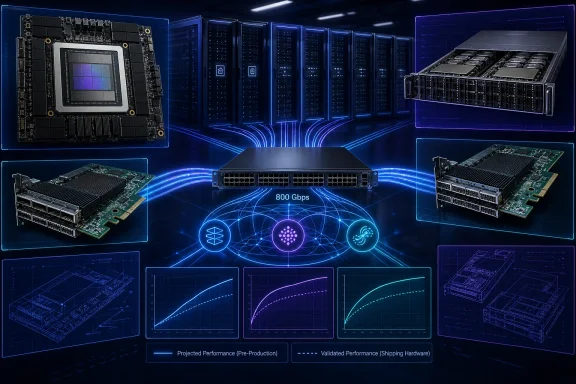 CN6000 is the network component, not a complete AI system
The reference architecture combines Cornelis’ CN6000 SuperNIC, a 48-port Omni-Path switch, and Cornelis’ libfabric-based software stack with AMD’s forthcoming EPYC Venice CPUs and MI400-series GPUs. Cornelis says the NIC is engineered for 800Gbps on PCIe 6.0 x16 and more than 1.6 billion bidirectional messages per second.
Those numbers target a specific bottleneck in distributed AI. Training clusters continually exchange gradients through collective operations such as AllReduce; inference systems increasingly split prompt processing, token generation, and mixture-of-experts routing across separate groups of accelerators. A GPU waiting for data from another node is expensive hardware producing no useful work, so low latency and predictable congestion behavior can matter as much as raw bandwidth.
Cornelis’ differentiator is its attempt to put three transport approaches on one adapter: its own Omni-Path fabric, Ethernet-based RoCEv2, and Ultra Ethernet. That may be meaningful for HPC operators with existing Cornelis installations or for OEMs that do not want to bind an entire product line to a single proprietary fabric. The CN6000 product page also says the adapter is intended to interoperate with conventional Ethernet switch environments and existing CN5000 deployments.
But “supports three protocols” should not be mistaken for an assurance that one cluster can freely combine all three without design tradeoffs. Omni-Path, RoCEv2, and Ultra Ethernet have different operational models, software dependencies, tuning requirements, and interoperability assumptions. Cornelis has not published a detailed bill of materials, network topology, switch-radix design, cable specifications, host configuration, or protocol-by-protocol compatibility matrix for the AMD reference architecture. Those omissions are normal at this stage, but they leave the essential deployment questions unanswered.
The 24% and 13% claims are modeled, not measured
Cornelis says its pre-production simulations completed AllReduce operations about 24% faster than “standard Ethernet,” reducing projected training time by roughly 13% for a simulated 250-billion-parameter model running on 10,000 GPUs. The company also argues that the same communications advantage should help disaggregated inference.
The key qualifier is in Cornelis’ own wording: these are modeling results for hardware that is not yet generally available. No independent benchmark report accompanies the announcement, and the company has not identified the Ethernet adapter, switch design, GPU type, collective library version, model implementation, traffic pattern, congestion settings, or failure conditions behind the comparison.
That missing methodology matters more than the headline percentage. An AllReduce result can swing substantially depending on message size, topology, algorithm selection, rank placement, GPU-to-NIC affinity, PCIe and NUMA layout, and the quality of RoCE lossless-network tuning. A comparison against an unspecified “standard Ethernet” configuration cannot tell a buyer whether CN6000 will outperform a well-designed 800GbE RoCEv2 fabric from another vendor in the workload that buyer actually runs.
Cornelis is making a plausible engineering argument: message rate, latency, and congestion control become increasingly important when clusters reach thousands of accelerators. It has not yet demonstrated the 24% and 13% figures in customer-visible hardware testing. The company’s planned fall OEM validation disclosure is the milestone that should determine whether these claims become procurement evidence or remain projections.
AMD’s MI400 launch makes networking a strategic battleground
AMD’s MI400 family, including the MI455X used in the Helios reference design, raises the scale and bandwidth requirements around the GPU rather than eliminating them. AMD says a full Helios rack design uses 72 MI455X GPUs and combines 31TB of HBM4 memory with up to 2.9 exaFLOPS of peak OCP MXFP4 performance. AMD has said volume Helios-based deployments are expected in the second half of 2026.
At that density, the division between scale-up and scale-out networking is important. AMD Infinity Fabric and UALink-related technologies address high-bandwidth connections among accelerators within a tightly integrated system. Cornelis’ CN6000 is aimed at the separate scale-out problem: moving work among nodes, trays, racks, or larger cluster partitions.
Cornelis is also building on a partnership that predates MI400. It says the two companies have validated more than 25 platform configurations with nine OEM partners and operate an HPC Center of Excellence in Munich. That history gives Cornelis a credible route into AMD-oriented OEM designs, but it does not establish that any OEM has committed to sell a CN6000-and-MI400 product.
AMD’s own published Helios material names Pensando networking as part of its integrated reference design. Cornelis has not said whether CN6000 will appear in an AMD Helios implementation, whether it is intended to replace Pensando components, or whether the two designs address distinct roles. The safest reading is that Cornelis is proposing an adjacent, partner-led architecture for customers that want AMD compute paired with a different scale-out fabric.
The multi-protocol promise has real operational value — and a cost
For Windows-based enterprise IT teams, the direct relevance is mostly at the infrastructure and management layer rather than on Windows client PCs. MI400 and EPYC Venice deployments are Linux-first server environments, especially for ROCm, RCCL, MPI, and containerized AI stacks. Still, the choice of network fabric affects the teams who operate storage, virtualization, telemetry, firmware, supply chains, and hybrid HPC environments across the wider business.
A multi-protocol NIC could reduce hardware fragmentation for sites running traditional MPI-heavy simulation alongside AI training and inference. Cornelis says its libfabric work supports applications using MPI, OpenSHMEM, and RCCL without code changes. If validated, that could let an operator preserve an existing application layer while changing the underlying network transport.
The counterweight is operational complexity. A fabric that can be configured as Omni-Path, RoCEv2, or Ultra Ethernet still requires an organization to decide which one is supported for each workload, how monitoring captures congestion and packet-loss events, how firmware is maintained, and where vendor accountability lies when applications span hardware from several suppliers. Choice is valuable only when the platform owner has the expertise and documentation to exercise it.
Cornelis says CN6000 includes standard telemetry and firmware-management interfaces as well as a post-quantum cryptography-enabled root of trust. Those are useful design objectives, but the company has not released the actual software packages, supported operating-system matrix, management API documentation, pricing, power figures, adapter form factors, or warranty and support model. Those details will decide whether the product is manageable outside specialized HPC deployments.
What buyers should watch before Q4 2026
Cornelis has moved from a November 2025 CN6000 product announcement to a more specific AMD reference architecture, and its latest schedule places general availability in Q4 2026. Its post-Advancing AI update says both CN6000 and EPYC Venice are expected in the second half of 2026, with OEM validation results due this fall.
That sequencing means buyers have time to avoid committing on percentages alone. The material questions are concrete:
- Cornelis needs to publish reproducible benchmark methodology for the 24% AllReduce and 13% training-time claims, including the Ethernet baseline and software stack.
- OEM partners need to identify actual server and switch configurations, supported MI400 variants, and availability dates.
- Operators need clarity on whether the architecture supports mixed Ethernet switching in production, or whether its advertised performance requires a Cornelis end-to-end fabric.
- AMD and Cornelis need to define how CN6000-based designs fit beside AMD Helios and Pensando networking, particularly for customers standardizing on MI455X racks.
The announcement establishes that Cornelis wants to be part of AMD’s MI400 deployment cycle. It does not establish that the company has solved the deployment, validation, interoperability, or support issues that determine whether an 800Gbps AI fabric succeeds in production. Those answers are expected from the OEM validation work promised for the fall, before CN6000’s planned fourth-quarter availability.
