
Phoronix first reported the patch series on July 31, identifying the DCN6 enablement and its association with GFX13. Wccftech published a follow-up on August 1, but explicitly credited Phoronix as its news source. That makes the two reports useful cross-checks on the interpretation, but not independent confirmation of AMD’s plans. The primary event is the public AMDGPU display-code submission itself.
What the code does confirm is that AMD is beginning to teach the open-source display driver about a new display IP block, DCN 6.0.0. What it does not confirm is that AMD has announced “RDNA 5” as the retail architecture name attached to GFX13, or that any particular GPU will use it. That association remains a well-supported inference from the code trail and prior architecture naming, rather than a statement AMD has made in a product announcement.
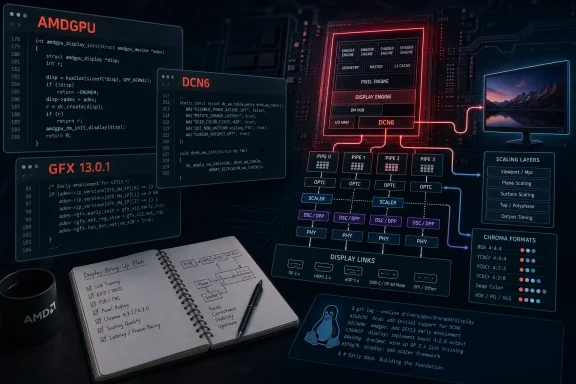 DCN6 is display infrastructure, not the GPU’s performance story
AMD’s Display Core code handles the part of the graphics driver that connects a GPU to monitors: display pipelines, timing, scaling, color formats, link management, multi-display behavior, and related power and bandwidth decisions. It is separate from the shader, ray-tracing, compute, media, cache, and memory subsystems that decide a GPU’s gaming or AI performance.
That distinction is important for anyone tempted to read a new DCN number as a benchmark preview. The DCN6 patches provide no compute-unit count, memory-bus width, cache configuration, clock target, ray-tracing capability, encoder specification, or gaming-performance figure. They do not identify a Radeon RX model number, a PCI device ID, or a board design. They are evidence that display enablement work has started in public; they are not a leak of a finished graphics card.
Phoronix reports that the code ties DCN6 references to GFX 13.0.1, which is widely expected to be part of AMD’s post-RDNA 4 graphics generation. Wccftech makes the stronger assertion that GFX13 corresponds to RDNA 5. Readers should treat that architecture name carefully: AMD has not used this patch series to formally announce an RDNA 5 Radeon product family.
That may sound like a semantic distinction, but it changes the reliability of every downstream claim. A Linux patch can verify that engineers are accommodating a display engine and a graphics-IP identifier. It cannot verify the eventual marketing name, product segmentation, launch window, desktop-versus-mobile split, or whether a given feature will survive until silicon ships.
The missing DCN5 is a real clue, but not an answer
The most interesting detail in the reporting is the version jump. DCN 6.0.0 appears to follow DCN 4.2.1 in the visible driver work, despite at least one code reference to DCN5. Phoronix notes that there is no public DCN5 bring-up in the AMDGPU driver at present.
That gap is not evidence that AMD abandoned a generation. It does, however, undermine the convenient assumption that every public Radeon generation maps neatly to one publicly visible DCN step. AMD can develop and deploy display IP differently across desktop GPUs, mobile processors, semi-custom products, and internal branches. A display block may also be revised between the early hardware-design stage and the point where its supporting code becomes public.
For system builders and Linux users, the more useful conclusion is that DCN version numbering is an engineering marker, not a consumer roadmap. It can reveal that a platform is far enough along to require driver scaffolding, but it cannot reliably identify which products will receive the block.
The current public record leaves major questions unanswered:
- AMD has not named a commercial GPU family associated with DCN6.
- AMD has not said whether the first DCN6 implementation is intended for a desktop Radeon card, a mobile part, an APU, or more than one class of hardware.
- AMD has not described the relationship between the code’s DCN5 references and the newly introduced DCN6 support.
- AMD has not provided a kernel version, Mesa version, firmware package, or distribution release that will support final hardware.
Those omissions are normal at this stage. The error would be treating the absence of details as permission to fill them in with rumored specifications.
The display features point to format handling, not a monitor-standard reveal
Phoronix identifies several technical additions around DCN6: scaling-linearity and cositing surface features for planes, an UPSP pre-scaler capable of upsampling 4:2:0 and 4:2:2 content before scaling, additional pixel formats, and other low-level display changes.
The terminology is dense, but its significance is straightforward. Chroma-subsampled video formats such as 4:2:0 and 4:2:2 carry less color-resolution data than full 4:4:4 content. Correctly placing, upsampling, and scaling that chroma information affects the quality and correctness of video playback, desktop composition, capture, and display-output paths. These are the kinds of capabilities that become visible in real-world use through fewer format restrictions, cleaner video scaling, better behavior in mixed-resolution setups, or fewer edge-case problems in HDR and media workflows.
They do not, on their own, establish support for a new version of DisplayPort, HDMI, HDR, variable refresh rate, 8K output, or a particular refresh-rate ceiling. None of those claims appears in the submitted reporting. Nor does the patch reporting establish that DCN6 will add a feature absent from current Radeon RX 9000-series hardware rather than refine the way existing classes of capability are implemented.
The distinction is especially relevant for Windows users. Windows display support is delivered through AMD’s Radeon Software and the Windows Display Driver Model stack, while the patches in question are for the Linux kernel’s AMDGPU driver. The underlying hardware display engine may eventually serve both platforms, but a Linux driver commit is not a promise that a Windows Adrenalin update is imminent or that a Windows display feature has been enabled.
AMD’s open-source process gives Linux a head start, not immediate support
AMD’s normal Linux strategy is to bring hardware support together from several components: the kernel’s AMDGPU driver, Mesa’s Vulkan and OpenGL drivers, LLVM compiler support where needed, and the linux-firmware package containing GPU microcode. A DCN6 patch series covers only part of that chain.
The company’s own Linux-driver guidance makes clear that very recent GPUs may need newer AMD software packages before mainstream distributions have caught up. In practice, early adopters of a future GFX13 product will need to watch for all four layers, not just a kernel version. An updated kernel without the necessary firmware can leave a card unable to initialize properly; an initialized card without current Mesa support can leave gaming and desktop acceleration incomplete.
That is why the timing of this work matters even if it says little about performance. Public driver bring-up well ahead of retail availability gives kernel maintainers, Mesa developers, distribution packagers, and laptop OEMs time to test display paths before customers start plugging new cards into high-refresh monitors, televisions, docks, KVMs, and unusual multi-monitor configurations.
It also explains why there is nothing for existing Radeon owners to install. These are development patches, not a recommended upgrade path for current RDNA 3 or RDNA 4 systems. There is no user-facing DCN6 toggle, no beta driver download, and no reason to attempt to force the changes into a production kernel.
Watch the code, not the speculative spec sheet
The next meaningful evidence will be more specific than a DCN6 symbol appearing in the driver. Hardware support becomes concrete when AMDGPU patches add stable device identifiers, firmware names, display-pipe and link capabilities, power-management support, video-codec blocks, and the detailed platform definitions needed for a card to initialize. Mesa changes and linux-firmware submissions will then show whether graphics and compute support are progressing on the same timetable.
For now, the record supports one conclusion: AMD is publicly laying display-driver groundwork for GFX13-class hardware, and DCN6 is part of that effort. It does not support treating RDNA 5 specifications, model names, launch timing, or Windows-driver availability as settled.
