
Phoronix first reported the merge on August 6, and TechPowerUp subsequently described it as RDNA 4m iGPU support arriving in Mesa. Both accounts agree on the material change: Mesa now recognizes GFX1171. The more revealing detail is what the merge does not contain. It adds the device identification needed for GFX1171 to follow the already-established GFX1170 driver paths, rather than introducing a fresh rendering architecture, a new Vulkan feature set, or evidence that a retail AMD APU is imminent.
For Windows users, this is a useful signal about AMD’s future silicon, but it does not change Radeon Software support, DirectX behavior, or FSR availability on existing Ryzen systems. Mesa is the open-source graphics stack used principally on Linux. AMD’s Windows graphics driver has its own enablement path, and AMD has not announced a GFX1171-based Ryzen product, launch date, specifications, or Windows driver package.
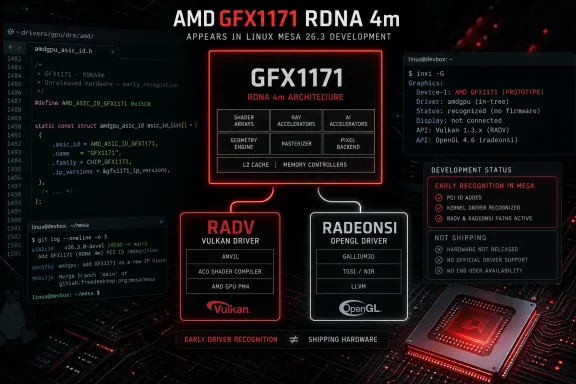 Mesa 26.3 Adds an ID, Not a New GPU Stack
The GFX1171 change matters because it separates a new hardware identifier from the broader RDNA 4m groundwork that landed earlier. Mesa work for GFX11.7, the technical family that includes GFX1170, had already brought RADV and RadeonSI support into the project. That earlier enablement involved common AMD code, driver-specific changes, and a GFX11.7 address-library implementation.
This week’s merge is much narrower. Phoronix reports that GFX1171 follows the same Mesa code paths as GFX1170, which in turn closely follows the GFX115x path used by RDNA 3.5 hardware. In practical terms, Mesa developers have not exposed a second, distinct feature profile here. They have told the drivers that another PCI device ID should be handled as known GFX11.7-class hardware.
That distinction is the part lost in the “RDNA 4m arrives” framing. The development tree has gained support for one additional target; there is still no shipping hardware to test. There are no public Linux game benchmarks, power figures, compute results, or display-engine details for GFX1171. Neither Mesa’s merge nor AMD’s compiler documentation provides CU counts, memory configuration, clocks, ray-tracing changes, media-block capabilities, or the name of the processor that will carry it.
Mesa 26.3 is also a future release branch. Phoronix expects it in the fourth quarter of 2026, so even the normal distribution packaging cycle lies ahead. Hardware enablement in Mesa Git often precedes retail products by months, but it is not a release-date announcement.
RDNA 4m Is GFX11.7, Not Full RDNA 4
AMD’s naming is the source of most of the confusion. Full RDNA 4 graphics hardware is associated with the GFX12 family. The RDNA 4m targets—GFX1170, GFX1171, and GFX1172—are instead documented in LLVM as GFX11.7, within the broader GFX11 lineage historically associated with RDNA 3.
LLVM’s current AMDGPU documentation explicitly groups all three GFX117x IDs under the gfx11-7-generic target. This confirms that GFX1171 is not simply a renamed GFX12 part. It belongs to a separate compiler target family with its own architectural definition.
Earlier LLVM work shows why AMD did not leave this design under the existing RDNA 3.5 label. GFX1170 gained FP8 and BF8 conversion support along with changes around Wave Matrix Multiply Accumulate, or WMMA, and SWMMAC instructions. Those capabilities are relevant to low-precision matrix math and machine-learning-oriented workloads. Other instruction-level changes moved GFX11.7 behavior closer to RDNA 4 in selected areas, while it remained short of the full GFX12 feature set.
The evidence supports a narrower conclusion than either “RDNA 3.5 with a new sticker” or “mobile RDNA 4.” RDNA 4m appears to be an AMD hybrid design: a GFX11-derived graphics architecture with a targeted selection of later-generation instruction capabilities. The “m” branding may prove to mean mobile, but AMD has not defined it publicly, so treating that letter as an official product category would get ahead of the record.
GFX1172 Remains Absent From Mesa
The GFX1171 merge also exposes a gap. AMD’s LLVM work added GFX1171 and GFX1172 together in spring 2026, and both targets were documented as sharing GFX1170’s ISA capabilities. Yet Mesa 26.3 now contains GFX1171 while GFX1172 remains absent, according to Phoronix.
That does not establish a product roadmap, but it does make the three target IDs more interesting than a routine compiler cleanup. If GFX1171 and GFX1172 were merely aliases with no separate silicon or platform purpose, there would be little reason to bring them into Mesa months apart. The timing is consistent with staged preparation for distinct hardware configurations, board variants, or power classes.
It is still only consistent with that theory, not proof of it. AMD has announced neither target in a product brief. The company has not confirmed whether GFX1171 belongs in a mainstream laptop APU, a desktop APU, a handheld-oriented SoC, or an embedded design. It also has not confirmed any connection between GFX117x and the widely reported “Medusa Point” codename.
TechSpot and VideoCardz have linked RDNA 4m to future Medusa Point APUs based on LLVM and industry-roadmap reporting. But both outlets acknowledge the missing confirmation: AMD has not tied GFX1170, GFX1171, or GFX1172 to a shipping product. The stronger wording found in some reports—that Medusa Point will definitively use RDNA 4m while Medusa Halo will definitively use RDNA 5 or UDNA—remains unverified roadmap speculation, not an AMD disclosure.
FSR 4 Is the Tempting but Unproven Connection
The low-precision and matrix-instruction additions naturally invite one conclusion: GFX11.7 is being shaped to run AMD’s newer machine-learning-assisted rendering technologies, potentially including FSR 4. That is plausible, and it is likely why the RDNA 4m discovery has attracted attention beyond Linux driver circles.
But it is not yet a product capability. AMD’s public FSR 4 material has centered on RDNA 4 Radeon RX 9000-series graphics, while later compatibility work for older architectures changes the question further. Software-side support for FSR upscaling does not demonstrate that a particular APU has the same dedicated hardware characteristics, image-quality path, performance profile, or game compatibility as an RDNA 4 discrete GPU.
The Mesa merge itself says nothing about FSR 4. RADV and RadeonSI enable Vulkan and OpenGL driver operation; they are not a certification that a future GFX1171 system will support a specific AMD game feature. Anyone buying a Ryzen AI 300 or Ryzen AI 400 notebook should therefore ignore claims that this commit unlocks an upgrade path for their existing RDNA 3.5 integrated GPU. It does not.
For PC builders and Linux administrators, the actionable takeaway is simpler: GFX1171 hardware is far enough along for Mesa developers to add explicit recognition before the product has been announced. That is a meaningful development milestone, particularly because the driver support is being staged before retail launch rather than rushed after it.
What to Watch Before Calling It an RDNA 4 Laptop GPU
Three missing pieces will determine whether RDNA 4m is a meaningful iGPU advance or chiefly a compatibility-focused refresh.
First, AMD needs to identify the processor family and the market segment. A GFX1171 device in a 15-watt ultraportable APU and the same target in a higher-power desktop chip could have radically different real-world gaming outcomes.
Second, the Linux kernel’s AMDGPU driver and firmware packages need corresponding public enablement. Mesa alone covers the user-space driver component; a functioning retail Linux platform also requires kernel and firmware support. The present reporting confirms Mesa development work, not a complete upstream support stack for a purchasable device.
Third, AMD needs to state what RDNA 4m changes for users: compute-unit counts, display support, media acceleration, power behavior, ray tracing, and the exact FSR 4 feature level. Until then, treating GFX1171 as a full RDNA 4 iGPU would be inaccurate.
Mesa 26.3’s GFX1171 entry is best read as an early hardware breadcrumb. It confirms AMD is preparing another GFX11.7-class RDNA 4m variant and that the open-source Vulkan and OpenGL drivers will recognize it ahead of release. It does not yet confirm Medusa Point, FSR 4 functionality, a Windows driver timeline, or a reason for owners of current Ryzen AI laptops to expect new capabilities.
