
The important qualification is equally simple. The Anker 715 is not literally a complete replacement for every charging kit, because it has one USB-C port. It replaces several chargers in sequence, not all at once. For solo travelers, commuters, and Windows laptop owners who typically charge one device at a time, that distinction may be barely noticeable. For a family at an airport gate or anyone who needs to power a laptop, phone, earbuds, and smartwatch simultaneously, a multi-port charger remains the better tool.
Still, the Anker Nano II 65W stands out because it addresses a problem that has persisted even as USB-C has become commonplace: device chargers have become more universal, but the power adapters supplied with laptops often remain needlessly bulky. By pairing a compact gallium nitride design with a full 65W USB-C Power Delivery output, Anker’s tiny wall charger offers a credible one-brick travel solution for a wide swath of modern hardware.
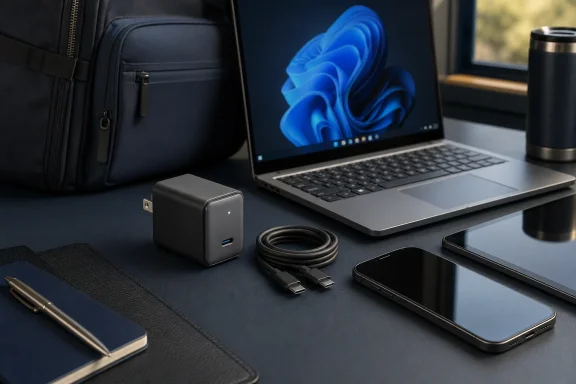 A Small Charger With Proper Laptop-Class Power
The Anker 715 Charger (Nano II 65W) is a single-port USB-C wall charger rated for a maximum output of 65W. Anker lists the device at 1.65 x 1.42 x 1.74 inches and 3.96 ounces, making it considerably smaller and lighter than many OEM laptop adapters. Anker’s product specification page also confirms foldable prongs on the U.S. version and a universal 100–240V, 50–60Hz input range—an especially valuable feature for international travel.
Those dimensions are not merely a marketing exercise. A traditional laptop power brick has a cable, a rectangular transformer block, and usually another permanently attached AC cord or plug. The Nano II moves in the opposite direction: it is a self-contained wall adapter that can disappear into a tech pouch, jacket pocket, or the side compartment of a backpack.
Anker’s stated comparison is that the Nano II 65W is 58% smaller than a conventional 61W USB-C charger. The original product reporting and independent Nano II coverage both repeat that positioning, although “smaller” is inherently dependent on the specific adapter being used as a baseline. What is not in dispute is the physical scale: this is a notably compact 65W charger rather than a compact-looking charger limited to phone-level power.
That distinction matters for Windows users. A 20W or 30W charger can keep a phone and many tablets happy, but it may charge a laptop slowly, only sustain its battery while idle, or fail to keep pace under load. The Nano II’s 65W ceiling gives it enough headroom for many ultraportables, including a range of USB-C-charging Surface, Dell XPS, Lenovo ThinkPad, HP Spectre, ASUS Zenbook, Acer Swift, and similar systems.
The actual electrical profile
Anker publishes the 715’s supported output modes as:
- 5V at 3A — up to 15W
- 9V at 3A — up to 27W
- 15V at 3A — up to 45W
- 20V at 3.25A — up to 65W
Those numbers are important because they describe what the charger can negotiate with compatible USB-C devices. The highest profile—20V at 3.25A—is the one that makes the Anker 715 a genuine laptop charger rather than simply an oversized phone adapter. Anker’s official specifications confirm all four power profiles and the 65W maximum.
The charger’s USB-C Power Delivery support is the other half of the equation. USB PD allows a charger and connected device to negotiate an appropriate voltage and current rather than forcing every device to accept a one-size-fits-all charging level. The USB Implementers Forum describes USB Power Delivery as a charging framework designed to coexist with standard USB battery-charging implementations and support higher-power devices such as laptops. USB-IF’s Power Delivery overview outlines that broader role.
In practice, that means the Anker 715 can adapt downward for smaller devices. A phone will not suddenly receive 65W simply because the wall charger is capable of producing it; the connected device requests a compatible charging profile. The same charger can therefore be used for a smartphone at one moment and a USB-C notebook at another, provided each device supports the relevant charging standard.
Why GaN II Still Matters
The Nano II name includes another critical term: GaN II. GaN, short for gallium nitride, is a semiconductor material commonly used in compact high-output chargers. It allows charger makers to reduce the size of certain power-conversion components compared with older silicon-based designs while retaining high wattage capability.
That is the practical reason a 65W charger can now be a small cube rather than a travel-unfriendly brick. The benefit is not that GaN inherently makes electricity charge a laptop faster; charging speed remains dependent on the device, cable, protocol, and available wattage. Instead, GaN helps make the charger itself smaller and more portable without surrendering laptop-class output.
Anker’s “GaN II” label is its branding for the technology platform used in the Nano II range. The useful consumer takeaway is straightforward: this is a compact charger built around a modern high-density power design, not an older low-wattage mobile-phone adapter masquerading as a laptop accessory.
Independent testing of the Nano II family found that its compact design did not come at the expense of broad charging-standard support. Android Authority’s review reported support for USB PD PPS, USB PD 3.0, Qualcomm Quick Charge 2.0 and 3.0, and Apple 2.4A charging through Anker’s PowerIQ 3 technology. The review tested the lower-wattage model in the family, but noted that the series uses the same underlying protocol support while differing in maximum output.
PPS is useful—but it is not a guarantee of headline speeds
The Nano II’s support for Programmable Power Supply, or PPS, is a meaningful compatibility feature for certain Android devices. PPS is part of the USB Power Delivery 3.0 ecosystem and enables finer-grained power negotiation between a charger and a compatible device. USB-IF explains that USB fast chargers supporting PPS require compatible hosts, devices, and chargers for users to realize the feature’s full benefit.
That wording is worth emphasizing. PPS support does not guarantee that every phone will charge at its theoretical maximum rate. Device makers may use proprietary behavior, impose thermal limits, cap charging after a certain battery percentage, or reserve their fastest charging modes for an approved charger and cable combination.
The Anker 715 is therefore best understood as a well-equipped standards-based USB-C charger, not a universal magic wand. It has the right technologies to work very well with a broad range of hardware, but the connected device ultimately sets the charging rules.
A Strong Fit for Many Windows Laptops
For Windows users, the Anker 715’s 65W rating lands in an unusually useful power category. It is above the 45W level common to compact notebooks and entry-level USB-C adapters, yet it is substantially smaller than the 90W, 100W, or 140W chargers increasingly associated with performance laptops and larger mobile workstations.
Microsoft’s own support guidance illustrates why this range matters. The company says Surface devices that support USB-C charging should be paired with a USB-C Power Delivery charger that meets the device’s recommended wattage, and it lists 60W as the recommended fast-charging level for several current Surface Laptop configurations. Microsoft’s USB-C and Fast Charging guidance and its Surface Laptop charging requirements table show that a 65W charger can be a sensible replacement or travel spare for compatible Surface hardware.
The same logic extends to many ultraportable PCs. If a laptop is designed to accept 45W, 60W, or 65W through USB-C PD, the Anker 715 has the output capacity to power it properly under typical use. It can be particularly appealing for users who carry a 13-inch laptop, a USB-C phone, and perhaps a tablet, but only need to charge one of those devices at a time.
Where 65W is enough
The Anker Nano II 65W is a practical choice for:
- Thin-and-light Windows laptops that support USB-C PD charging at 65W or lower.
- Surface devices with USB-C charging support and recommended wattage at or below the charger’s output.
- 13-inch-class laptops used for web work, Office apps, media playback, coding, and conventional productivity workloads.
- Tablets, including high-end USB-C models that benefit from 30W to 45W charging.
- Smartphones that use USB PD, PPS, Quick Charge, or related charging modes.
- Nintendo Switch-class portable hardware, assuming the cable and accessory arrangement supports the required USB-C power behavior.
- Travel kits where minimizing charger bulk matters more than charging multiple devices in parallel.
The compact design also makes the 715 useful as a secondary charger. It can live in a work bag, remain in a hotel pouch, or serve as an emergency adapter at the office without taking up meaningful space.
Where it reaches its limits
A 65W charger is not ideal for every Windows PC. Gaming laptops, workstation-class machines, many 15-inch and 16-inch performance notebooks, and systems with discrete GPUs can require 90W, 100W, 135W, 140W, or more. In those cases, the Nano II may charge slowly, maintain battery level only under light workloads, or prompt the laptop to reduce performance.
Dell’s own USB-C power-delivery documentation warns that a system may charge more slowly or not charge at all depending on its power requirement and workload when available wattage is insufficient. Dell’s USB-C Mobile Adapter guide makes the broader point clearly: the power adapter, pass-through accessory, and computer all have to align.
That is not a defect in the Anker charger. It is a matter of matching the charger to the computer. A 65W Nano II is excellent for an ultrabook that ships with a 65W adapter; it is a poor substitute for a gaming laptop designed around a 180W proprietary power brick.
The One-Port Problem: Convenience Has a Boundary
The phrase “replace your entire charging kit” is understandable advertising shorthand, but it deserves a more critical reading. The Anker 715 has one USB-C port and no USB-A ports. Anker’s product listing is explicit about that limitation.
This means the charger can power:
- A laptop, or
- A phone, or
- A tablet, or
- Another compatible USB-C device.
It cannot directly power all of them at once. There is no dynamic power allocation because there are no additional ports to allocate power to.
For some users, that is a feature rather than a flaw. A single-port charger can be smaller, lighter, and mechanically simpler. It also avoids the compromises found in multi-port chargers, where plugging in a second or third device can reduce the wattage available to the laptop.
But buyers should not confuse high wattage with high simultaneous capacity. A 65W one-port charger is a focused replacement for one OEM charger. A 65W three-port charger is a shared power source that distributes its total budget across several devices. They solve different travel problems.
Who should choose the single-port design?
The Anker 715 makes the most sense for someone with a simple routine:
- Charge the laptop overnight, then recharge the phone in the morning.
- Use one power outlet on a flight or in a coffee shop.
- Carry a single USB-C cable matched to the device being charged.
- Prioritize the smallest possible charger over port count.
- Keep a dedicated compact charger as a backup for a work laptop.
It is less convincing for users who routinely need to top up a laptop and phone at the same time. In that scenario, Anker’s own multi-port models or a competing 65W-to-100W multi-port GaN charger will generally offer more flexibility, albeit with a larger physical footprint.
Cable Choice Is Not a Minor Detail
A compact charger is only one part of the charging chain. The USB-C cable matters just as much, especially when charging a laptop. A weak, damaged, unknown, or low-capability cable can limit charging speed or create frustrating compatibility problems.
The Nano II package does not include a charging cable, according to Android Authority’s Nano II review. That omission is common with compact chargers and helps keep the package—and potentially the sale price—lean, but it means buyers need to account for cable quality separately.
For a laptop, using the cable included with the device is often the safest starting point. If purchasing an additional cable, it should be marketed for USB-C Power Delivery at the required wattage and purchased from a reputable brand. A good charger cannot overcome a cable that is unsuitable for the power level being negotiated.
This is also where USB-C’s apparent simplicity can be misleading. The connector is uniform, but USB-C cables vary widely in charging capabilities, data speeds, video support, durability, and length. A cable that works perfectly for a pair of earbuds may not be the right cable for a 65W notebook.
Travel Design Is the Charger’s Best Argument
The Anker 715’s strongest case is not raw power alone. Plenty of chargers can deliver 65W. Its real advantage is that it puts that output into a form factor small enough to become an everyday carry accessory rather than a reluctant travel necessity.
Foldable prongs are central to that experience. They prevent the plug from catching on clothing, cables, and bag linings, while also reducing the likelihood that the charger will scratch another device during transit. The charger’s universal-voltage input further reinforces its travel focus, though travelers outside North America will still need an appropriate plug adapter because this is a U.S.-style wall plug.
At under four ounces, the difference may sound trivial on paper. In a minimalist travel setup, however, every small saving compounds. Replacing a large laptop adapter with the Nano II can make room for a spare cable, a power bank, a compact mouse, or simply less bulk in a personal-item bag.
There is a psychological benefit as well. A charger that is easy to carry is one that is more likely to be carried. The best backup power adapter is useless if it is too cumbersome to leave in a backpack.
Value Depends on the Price, but the Design Holds Up
The deal price cited in the original report is what makes the Anker 715 especially attractive. At $19.99, a compact 65W GaN USB-C charger from a well-known charging brand moves from premium accessory territory into a low-risk utility purchase. The deal report presented that discount against a $30 list price, while Anker’s current product page shows the charger listed at $29.99 with a $10 savings indication; pricing and availability can change quickly between retailers and promotional windows. Anker’s current listing should therefore be checked before purchase.
Even at around $30, the product remains competitive if the buyer specifically values the smallest possible single-port 65W adapter. Its original launch-era pricing was far higher—independent coverage listed the 65W Nano II at $54.99 in 2021—so current pricing reflects how much the GaN charger market has matured. Android Authority’s review also noted that the Nano II was relatively expensive versus some competitors at the time, particularly given its single-port layout.
That historical context changes the verdict. The Anker 715 is no longer compelling because it is the most technologically extravagant charger available. More recent options offer higher wattage, more ports, displays, detachable cords, and advanced power-sharing features. It is compelling because the core formula remains sound: 65W, USB-C PD, PPS support, foldable prongs, small size, and a low enough price to justify keeping one in every bag.
The Bottom Line
The Anker 715 Nano II 65W Charger succeeds because it understands that portable power is often about reducing friction rather than adding features. Its single USB-C port is a meaningful limitation, but it is also what allows the charger to remain remarkably compact. For one-device-at-a-time charging, it can replace the bulky adapter supplied with many USB-C laptops while remaining equally useful for a phone or tablet.
Windows users should verify their laptop’s USB-C PD requirements before treating it as a full-time replacement adapter. For ultrabooks and many Surface-class systems that charge at 65W or below, the Nano II is a smart compact option. For high-performance laptops that expect more than 65W, it is better viewed as a light-duty travel charger or emergency backup.
The claim that one tiny adapter can replace an entire charging kit is marketing language—but it is not far from the truth for the right traveler. With a capable USB-C cable and a laptop that fits inside its power envelope, the Anker 715 turns one of the bulkiest parts of modern computing into something that can genuinely fit in a pocket.
