
XiaomiToday reported the 64GB model on August 7, describing unchanged chassis, ports, cooling and storage expansion. But its report does not point to a model-specific AOOSTAR product page, and independent retail listings still prominently identify the NEX 395 as a 128GB LPDDR5X-8533 and 2TB SSD system. For prospective Windows buyers, this looks like a configuration expansion rather than a new NEX 395 generation — and the missing commercial details are more consequential than the unchanged hardware list.
The NEX 395 remains an unusually large “mini PC,” measuring 284 × 159 × 52 mm and weighing about 2 kg. AOOSTAR uses that volume for a vapor-chamber cooling assembly, copper fins, a separate fan for its M.2 storage area, three PCIe 4.0 x4 M.2 2280 slots, dual 2.5GbE, Wi-Fi 7, two 40Gbps USB4 ports, HDMI and DisplayPort. The hardware is aimed less at the usual palm-sized office PC market than at a compact desk workstation or a rack-friendly cluster node.
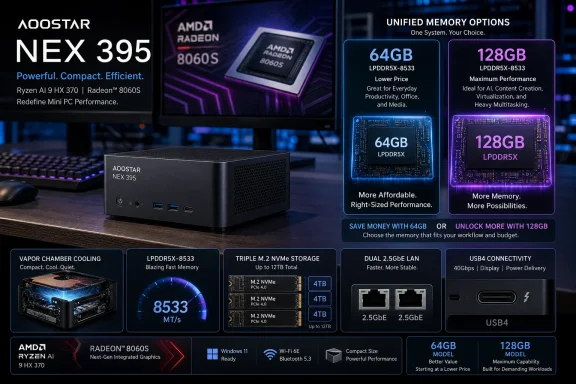 The 64GB model changes the part that matters most
The NEX 395 is built around AMD’s Ryzen AI Max+ 395, a 16-core, 32-thread Zen 5 processor with Radeon 8060S integrated graphics and a 50-TOPS XDNA 2 NPU. AMD rates the chip at 45W to 120W; AOOSTAR says its Glacier VC 5.0 cooling can sustain up to 140W of processor power delivery. That latter figure is an AOOSTAR thermal claim, not AMD’s processor rating, and it should not be read as a promise that every workload will maintain 140W indefinitely.
The core distinction between the 64GB and 128GB systems is not conventional multitasking headroom. It is unified memory: the CPU and Radeon 8060S draw from the same LPDDR5X pool. That is why 128GB was the headline NEX 395 specification when Chinese availability was first reported in December 2025, and why AMD has used 128GB Ryzen AI Max+ 395 systems in recent ROCm demonstrations for local AI inference and image-generation workflows.
With 128GB installed, AMD has documented configurations in which roughly 94GB is addressable to the integrated GPU, while its Ryzen AI Max+ messaging has also promoted up to 96GB of graphics-addressable memory on supported systems. A 64GB NEX 395 cannot offer comparable room after Windows, applications, file cache and GPU allocation share the same physical RAM. The new configuration should still be ample for software development, media work, virtual machines in moderation, and smaller local models. It changes the value proposition for users shopping specifically for the largest LLMs, broad ComfyUI workflows, or GPU-memory-heavy AI experimentation.
That is the underreported consequence of this refresh: the lower-capacity NEX 395 may retain the same processor name and 126-TOPS system-level marketing figure, but it is not equivalent for the workloads that made Strix Halo desirable. AI TOPS does not substitute for memory capacity when model weights, context windows, image-generation components and Windows itself all compete for the same pool.
LPDDR5X-8533 is fast, but it is fixed
The reported 64GB configuration keeps LPDDR5X-8533 memory, a speed already used in the 128GB NEX 395. Earlier coverage from IT Home, republished by Sina, noted that AMD’s then-published Ryzen AI Max platform specification listed LPDDR5X-8000 support even though AOOSTAR was selling an 8533 MT/s configuration. AMD’s more recent Windows-focused ROCm materials now also document a Ryzen AI Max+ 395 test environment with 128GB LPDDR5X-8533 memory, so the speed itself is no longer an outlier in AMD’s software documentation.
Still, the higher transfer rate should not distract from the capacity trade-off. Memory bandwidth helps an integrated GPU because it has no dedicated GDDR memory, and LPDDR5X-8533 gives the Radeon 8060S more bandwidth than ordinary DDR5-based mini PCs can provide. But bandwidth does not make a 64GB system hold a model or graphics workload that requires more memory than remains available.
The second limitation is permanence. The NEX 395’s three M.2 2280 slots are a significant storage advantage: buyers can install several PCIe 4.0 NVMe drives for Windows, project files, game libraries, model files or local databases. They do not provide a path to expand LPDDR5X system memory. The RAM is platform-integrated rather than a pair of replaceable SO-DIMMs, so the memory choice made at purchase time is effectively the machine’s ceiling.
That makes AOOSTAR’s unannounced price especially important. A 64GB version could be sensible if it materially reduces the cost of entry while retaining the NEX 395’s connectivity, storage flexibility and 8060S graphics. If the price gap is narrow, the 128GB system remains the more rational choice for buyers attracted by Strix Halo’s unified-memory advantage in the first place.
The original NEX 395 was already a premium machine
The NEX 395 did not enter the market as a budget mini PC. The original Chinese 128GB plus 2TB configuration was reported at 14,999 yuan ahead of its January 5, 2026 launch date, while Hong Kong retailers currently list the 128GB and 2TB Windows 11 Pro configuration near HK$26,000 before retailer discounts. Those are regional figures rather than a U.S. price, but they establish the class of product AOOSTAR is dealing with: this is a workstation-oriented appliance, not a low-cost desktop.
The system’s physical design reinforces that positioning. It has two 2.5GbE Ethernet ports, dual USB4 ports rated at 40Gbps, three 10Gbps USB-A ports, a legacy-speed USB 2.0 port, HDMI, DisplayPort, integrated speakers and microphones, and a quick-release chassis panel. Liliputing and Notebookcheck previously reported that AOOSTAR intended to sell the NEX 395 globally, although both noted that international pricing and a firm availability schedule had not been supplied at the time.
Neither outlet’s earlier reporting, nor currently visible retailer listings, confirms the newly reported 64GB SKU, bundled storage capacity, operating-system licensing, or its U.S. sales channel. XiaomiToday says the platform otherwise remains unchanged, which means prospective buyers should assume the 64GB edition has the same port layout and three-drive capability — but should not assume it includes the 2TB SSD and Windows 11 Pro package commonly attached to the 128GB retail configuration.
Windows AI users should separate NPU capability from software readiness
The Ryzen AI Max+ 395 is supported by AMD’s current Windows HIP SDK and ROCm documentation, but AMD’s Windows ROCm support still has material limitations. In the current ROCm 7.2.1 guidance, AMD lists Windows support as PyTorch-only rather than the full ROCm stack, limits officially supported LLM batch sizes to one, and says there is no ML training support on Windows. AMD also identifies lower-than-expected performance in some LLM workloads on the Ryzen AI Max+ 395.
Those limitations do not make the NEX 395 unsuitable for local AI work. They do mean that an advertised 126 TOPS figure, combining CPU, GPU and NPU capabilities, is not a direct measure of model throughput in a Windows application. Buyers should check whether their intended tool uses the NPU, Radeon iGPU acceleration, or CPU inference — and whether its Windows build is supported — before treating the NEX 395 as a turnkey AI workstation.
The 64GB edition is therefore easiest to justify for Windows users who want the Radeon 8060S for gaming, content creation, GPU-assisted tools, containers, general development and moderately sized local models, while using the three M.2 slots to keep large files local. The 128GB edition remains the configuration for people buying around a memory-heavy local-AI workflow.
AOOSTAR has expanded the NEX 395 story only on paper so far. Until it publishes a model number, price, included SSD capacity, warranty terms and a regional sales date, the 64GB LPDDR5X-8533 NEX 395 is a potentially useful lower-cost SKU with one defining compromise: it preserves Strix Halo’s compute hardware while cutting in half the shared memory that makes that hardware unusually capable.
References
- Primary source: xiaomitoday.com
Published: August 7, 2026 at 4:56 PM UTC
AOOSTAR Refreshes NEX 395 AI Mini PC With 64GB LPDDR5X-8533 Memory - XiaomiToday
AOOSTAR relaunches the NEX 395 mini PC with 64GB LPDDR5X-8533 RAM, Ryzen AI Max+ 395, Wi-Fi 7, triple M.2 slots, and dual 2.5GbE.xiaomitoday.com - Related coverage: shop.hornington.com
AOOSTAR NEX 395 Ryzen AI Max+ 395 , 128GB + 2T
Powered by AMD AI Max+ 395 CPU and Radeon 8060S GPU, delivering 126 TOPS AI computing power, it features 128GB LPDDR5X RAM and 2TB SSD, includes dual USB4 ports, WiFi 7, and dual 2.5G network connectivity.shop.hornington.com - Related coverage: yohohongkong.com
AOOSTAR NEX 395 (128G+2T SYSTEM) Mini PC(AMD AI Max+ 395 / 128GB+2TB SSD / Win11 Pro) CS-ANEX395 | YOHO
AOOSTAR NEX 395 是目前最強大的 AI 迷你電腦之一。搭載 AMD AI Max+ 395 處理器,擁有 16 核心 32 執行緒,最高加速達 5.1GHz,內建 Radeon 8060S 顯示核心及 50 TOPS NPU,總 AI 算力高達 126 TOPS。 配備 128GB LPDDR5X 8533MHz 高速記憶體及 2TB NVMe SSD,支援三個 PCIe 4.0 SSD 擴充。雙 USB4、WiFi 7 及雙 2.5G 網路提供極致連接體驗。www.yohohongkong.com - Related coverage: shop.hornington.com
AOOSTAR NEX 395 Ryzen AI Max+ 395 , 128GB + 2T
Powered by AMD AI Max+ 395 CPU and Radeon 8060S GPU, delivering 126 TOPS AI computing power, it features 128GB LPDDR5X RAM and 2TB SSD, includes dual USB4 ports, WiFi 7, and dual 2.5G network connectivity.shop.hornington.com - Related coverage: lunar.computer
AOOSTAR NEX 395 Mini PC Packs AMD's Most Powerful APU and 128GB RAM
AMD's most powerful laptop chip lands in a $2,120 mini PC with 128GB RAM and rack-mounting support.lunar.computer
- Related coverage: adrenaline.com.br
Aoostar aposta em AMD Strix Halo e design diferenciado para seu novo mini PC - Adrenaline
Aoostar NEX 395 traz Ryzen AI Max+ 395, mas infelizmente a fabricante não divulgou mais specswww.adrenaline.com.br - Related coverage: minimachines.net
Le MiniPC AOOSTAR NEX 395 Strix Halo est annoncé à 2900€
Lancé dans une version équipée de 128 Go de mémoire vive et 2 To de stockage, le AOOSTAR NEX 395 est listé à 19 999 yuans en Chine. Un prix qui peut se convertir en 2415€ HT et 2900€ avec ju...www.minimachines.net - Related coverage: shop.pegasus.hk
AOOSTAR NEX 395 Mini PC 迷你電腦 - (AMD AI Max+ 395 / AMD Radeon™ 8060S / 128GB DDR5 RAM / 2TB SSD / WiFi-7 / Windows 11 Pro) - 3年保養
處理器 (CPU): AMD AI Max+ 395 顯示晶片 (GPU): AMD Radeon 8060S Graphics (2.9GHz) 記憶體 (RAM): 128GB LPDDR5X 8533MHz 儲存空間: 2TB 固態硬碟 (SSD) 無線網路: Wi-Fi 7 作業系統: Windows 11 專業版shop.pegasus.hk
- Related coverage: notebookcheck.net
Aoostar Nex 395 confirmed for global launch with powerful AMD Ryzen AI Max+ 395 - Notebookcheck News
Aoostar has confirmed that it will be launching its first AMD Strix Halo mini-PC globally. Equipped with an AMD Ryzen AI Max+ 395 APU that integrates a Radeon 8060S iGPU, the Aoostar Nex 395 also features a relatively unassuming design in comparison to other AMD Strix Halo mini-PCs. www.notebookcheck.net
- Related coverage: carousell.com.hk
AOOSTAR NEX 395/ AMD AI Max+ 395 / AMD Radeon 8060S Graphics (2.9GHz) LPDDR5X 8533MHz 128GB RAM / 2TB SSD / Wifi 7 / Windows 11 Pro " "CS-ANEX395 + LB-PCNB" on Carousell
Buy AOOSTAR NEX 395/ AMD AI Max+ 395 / AMD Radeon 8060S Graphics (2.9GHz) LPDDR5X 8533MHz 128GB RAM / 2TB SSD / Wifi 7 / Windows 11 Pro " "CS-ANEX395 + LB-PCNB" in Hong Kong,Hong Kong. 交收地點:大埔安慈路3號翠屏商場1樓21號 公司名稱:暉煌電腦 營業時間:早上11:00-晚上8:00 收款方式:現金/八達通/支付寶/Visa/Master/Payme/FPS/Applepay...www.carousell.com.hk
- Related coverage: liliputing.com
AOOSTAR NEX 395 mini PC with AMD Strix Halo is coming soon - Liliputing
AOOSTAR NEX 395 mini PC with AMD Strix Halo is coming soonliliputing.com - Related coverage: trendhunter.com
Micro-Sized Computer Models: The AOOSTAR NEX 395 Has an AMD Strix Halo Processor | Trend Hunter
The AOOSTAR NEX 395 mini PC has been launched by the brand in China as a micro-sized computing solution that's expected to make waves in the category. www.trendhunter.com
