
The published story calls the graphics processor a “Radeon 860S.” That identifier is wrong. GMKtec’s own current EVO-X3 listing and AMD’s Ryzen AI Max+ 395 specification page both identify the integrated GPU as the Radeon 8060S, a 40-compute-unit RDNA 3.5 design clocked up to 2.9GHz. That is not a cosmetic typo: buyers trying to compare drivers, game results, Linux support, or other Strix Halo systems will get materially better search results using the correct 8060S name.
GMKtec also presents the EVO-X3 as an AI workstation rather than an ordinary mini PC. Its physical design supports that positioning better than the usual palm-sized-box description does. At 353 × 186 × 41 mm without its stand, it is a thin vertical desktop with a triple-fan cooling system—closer to a compact tower or a large external GPU enclosure than a traditional NUC-style machine.
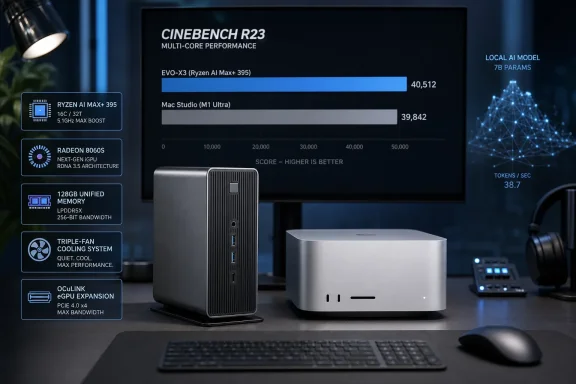 The Cinebench Result Needs a Proper Test Record
The central claim is that the EVO-X3 exceeds the Apple M1 Ultra in Cinebench R24 multi-core rendering. Geeky Gadgets attributes that conclusion to ETA Prime, but the supplied reporting does not publish the EVO-X3’s exact R24 score, the M1 Ultra configuration, Cinebench version details beyond “R24,” Windows power plan, BIOS mode, ambient temperature, or the duration of the run.
Those omissions matter. Cinebench R24 is a CPU rendering benchmark, and it remains useful for comparing throughput in Cinema 4D and Redshift-adjacent workloads. It is not a proxy for GPU rendering, game performance, local language-model inference, battery efficiency, or general responsiveness. It also rewards a machine that can sustain a higher package power draw through its cooling system.
The M1 Ultra is a 2022 workstation-class Apple chip, while the Ryzen AI Max+ 395 is a much newer 16-core, 32-thread Zen 5 part with a configurable 45W-to-120W TDP range. GMKtec says its EVO-X3 Performance Mode can peak at 140W. In that context, beating an older M1 Ultra in a fully loaded multi-core CPU render is meaningful, but it is not an across-the-board declaration that this Windows mini workstation is faster than Apple’s former flagship.
The comparison is also incomplete without the actual margin. An EVO-X3 score modestly above the M1 Ultra would show competitive sustained CPU throughput; a large lead would require closer inspection of power consumption and whether the Apple result came from the 20-core CPU M1 Ultra Mac Studio rather than a lower-tier configuration. The data available publicly does not settle either point.
GMKtec has published its own internal Cinebench R23 figures—2,040 single-core and 37,339 multi-core—but those are a different benchmark generation and should not be converted into an R24 result. A separate report on the EVO-X3 cited a substantially lower R23 multi-core figure of 28,185. Without matching performance-mode settings, firmware, memory allocation, test duration, and thermals, the gap is evidence of why prospective buyers should treat every single benchmark screenshot as configuration-specific.
The Hardware Is Strong, but the Upgrade Path Stops at Storage
The EVO-X3 has the right ingredients for heavy Windows multitasking and local AI experimentation: Ryzen AI Max+ 395, 128GB of LPDDR5X-8000 unified memory, two M.2 2280 PCIe 4.0 ×4 slots, Wi-Fi 7, 2.5GbE, USB4, HDMI 2.1, and an OCuLink PCIe Gen4 ×4 port for an external GPU.
The significant limitation is that the 128GB memory is onboard and non-upgradeable. That is a more consequential restriction than the lack of a socketed desktop CPU, because unified memory is the machine’s defining resource. It serves Windows, applications, the 8060S integrated GPU, and any local AI model loaded into system memory.
GMKtec’s current store page offers 128GB-plus-2TB and 128GB-plus-4TB configurations. The company says the pair of M.2 slots can accommodate up to 16TB total storage, although some early third-party coverage described the ceiling as 8TB. GMKtec’s direct listing is the better record for the shipping specification, but buyers should confirm drive capacity support before ordering high-capacity 8TB modules; early product pages and coverage have not been consistent.
The OCuLink port deserves equal attention. It is the feature that gives the EVO-X3 a route around the limits of the integrated GPU for CUDA-dependent tools, GPU rendering, or higher-end gaming. But GMKtec explicitly says the eGPU dock is sold separately and that OCuLink is not hot-pluggable. The system must be powered off before connecting or disconnecting the external GPU. That makes it an expansion option for a fixed workstation setup, not an equivalent to casually attaching a USB-C peripheral.
“235B LLM Support” Is a Capacity Claim, Not a Performance Claim
GMKtec advertises support for Qwen3 235B models and says the EVO-X3 can allocate up to 96GB as VRAM. This is the part of the pitch that requires the most careful reading.
A 235-billion-parameter model stored at a simple 4-bit weight precision would require roughly 117.5GB before runtime overhead, metadata, context cache, and the operating system’s own memory needs. In other words, 128GB of unified memory can make a very large model possible only with aggressive quantization, constrained context, and careful software settings. It does not mean a 235B model will perform like it does on a data-center GPU, nor that every 235B model file will fit.
GMKtec does not publish the quantization format, context length, tokens-per-second result, model backend, driver version, or the division of memory between Windows and the GPU for that 235B claim. Those are the measurements that determine whether a local model is productive or merely technically loadable.
AMD’s 126 TOPS figure should be read with the same restraint. It is an aggregate platform rating combining CPU, GPU, and NPU capabilities; the XDNA 2 NPU itself is rated for up to 50 TOPS. TOPS figures are useful for platform eligibility and marketing comparisons, but they do not forecast the speed of a specific Ollama, LM Studio, llama.cpp, ComfyUI, or ROCm workflow. Local AI performance is driven by the model, quantization, memory bandwidth, backend, drivers, context size, and whether the workload uses the NPU, Radeon GPU, or CPU cores.
For developers whose immediate need is to fit models larger than the 16GB or 24GB VRAM common in consumer graphics cards, the 128GB memory pool is the EVO-X3’s genuine advantage. For users who require NVIDIA CUDA, expandable system RAM, multiple PCIe cards, or repeatable long-context inference figures, a conventional desktop remains easier to validate and modify.
Cooling Is the X3’s Real Product Change
Tom’s Hardware and TechRadar both identified the EVO-X3 as a redesign of GMKtec’s older EVO-X2 rather than a new silicon platform. The Ryzen AI Max+ 395 and 128GB LPDDR5X-8000 configuration are familiar; the chassis, cooling arrangement, OCuLink port, and intended workload are the meaningful changes.
That history gives the triple-fan design practical importance. Reviews of the EVO-X2 had criticized its fan noise, difficult internal access, and less convincing build quality. GMKtec says the EVO-X3’s three heat pipes and three fans are designed for sustained professional workloads, while Geeky Gadgets reports average gaming temperatures around 66°C and peaks of 83°C under extreme load.
Those thermal figures should be treated as a single-source observation until other reviewers publish repeatable measurements. The processor’s maximum operating temperature is 100°C according to AMD, so an 83°C peak is within specification; it does not by itself establish sustained-clock behavior, acoustics, or whether the system performs equally well in a warm office over hours of rendering or inference.
The published idle, video, and gaming power figures—11W, 18W, and roughly 147W—tell a similar story. They sound efficient for the performance class, but GPU allocation, display count, power profile, peripherals, and game selection can change wall power dramatically. The 147W gaming figure also reinforces why a Cinebench victory over the M1 Ultra must be read alongside watts, not as a standalone efficiency result.
The Price Changes the Buying Decision
The EVO-X3 launched around $3,600 for the 128GB and 2TB configuration. As of August 7, GMKtec’s U.S. store lists the 2TB system at $3,799.99, with a crossed-out $4,100 price. That is a $199.99 increase from the widely reported launch price in only a few weeks, and it places the system firmly in workstation territory.
At that price, the question is not whether the EVO-X3 is fast. Its Ryzen AI Max+ 395, 128GB unified memory, and Radeon 8060S make that plain. The question is whether a buyer specifically needs a compact Windows system capable of running unusually large local models without buying a multi-GPU desktop.
For that buyer, the EVO-X3 offers a rare combination: 128GB of high-bandwidth shared memory, a 16-core CPU, a competent integrated GPU, and an OCuLink escape hatch for future graphics expansion. Everyone else should wait for independent R24 results, sustained-noise testing, actual local-model tokens-per-second figures, and a clearer explanation of the 235B claim before treating the M1 Ultra headline as a purchasing verdict.
Update: Additional details (August 7, 2026)
Notebookcheck reports ETA Prime measured 3,081 single-core and 22,314 multi-core in Geekbench 6, with the Ryzen AI Max+ 395 reaching 5.1GHz. It also says the Radeon 8060S scored 10% above a desktop GeForce RTX 4060 in 3DMark Time Spy Graphics, though that comparison is benchmark-specific and benefits from the EVO-X3’s 140W power ceiling.
The report further cites 90-plus FPS at 1440p Ultra in Forza Horizon 6 without image reconstruction, while Black Myth: Wukong and Crimson Desert reportedly needed FSR to exceed 60 FPS at 1440p High.
