
The configuration reviewed by Wccftech pairs the 12-core, 24-thread Ryzen AI 9 HX 470 with Radeon 890M integrated graphics, a 1TB PCIe 4.0 SSD, and 64GB of LPDDR5X-6400. GMKtec’s own store lists the same 1TB configuration at $1,599.99, while the 2TB model costs more. That price is the central complication: the machine is richly provisioned for memory and I/O, but its graphics silicon remains familiar from the older Ryzen AI 9 HX 370 generation.
AMD’s official Ryzen AI 400 specifications confirm the HX 470 uses four Zen 5 cores and eight dense Zen 5c cores, with a 5.2GHz maximum boost, 55 TOPS NPU, and Radeon 890M graphics with 16 compute units. The chip is a real refresh, but it is not a wholesale architectural reset. The CPU and NPU receive a modest uplift; the GPU rises from the prior 890M’s typical 2.9GHz ceiling to 3.1GHz.
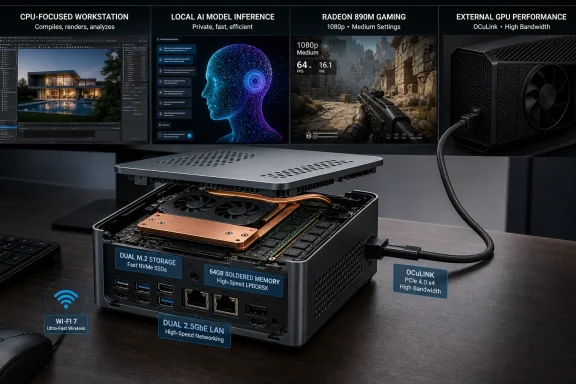
For Windows users looking at this as a small desk PC, home-lab box, or local-AI endpoint, that distinction is more useful than the “AI mini PC” label. The EVO-X1 Pro looks strongest where 64GB of memory, fast CPU throughput, wired networking, and future external-GPU expansion matter together.
 Wccftech’s CPU results favor the HX 470, with an important power caveat
Wccftech found substantial multi-threaded gains for the EVO-X1 Pro versus systems using AMD’s Ryzen AI 9 HX 370. Its 3DMark CPU Profile result was about 24% higher at maximum threads, while CPU-Z multi-core testing showed a roughly 22% lead. Cinebench 2024 and Cinebench 2026 also put the HX 470 system ahead of the earlier 890M-based mini PCs in sustained CPU workloads.
Those results make sense in the context of GMKtec’s firmware choices. The company advertises 35W Quiet, 54W Balanced, and 65W Performance modes. AMD lists the HX 470’s official configurable TDP range as 15W to 54W, so GMKtec is allowing its compact chassis to run the chip beyond AMD’s published upper cTDP figure in its top preset. That does not make the setting improper—the vendor explicitly documents it—but it means benchmark comparisons need to account for power limits rather than treating every HX 470 result as an inherent silicon advantage.
Wccftech’s test data reflects that split. The review presents CPU testing at 65W, while several gaming results label the EVO-X1 Pro at 54W. In other words, buyers should expect the machine’s best CPU performance in Performance mode, but they should not assume that the same preset turns the Radeon 890M into a substantially faster gaming GPU.
The thermal numbers are encouraging within that framework. Wccftech recorded an 88°C peak temperature for the EVO-X1 Pro, below the 97°C peak it measured on a 70W Core Ultra 9 285H mini PC. GMKtec uses a dual-fan arrangement and a large internal copper contact plate, and the review did not report throttling or stability problems under prolonged load. For a mini PC pushing a 65W target, that is a more meaningful result than a brief burst benchmark.
The 64GB configuration is generous, but GMKtec slowed the memory
The EVO-X1 Pro’s defining hardware choice is its fixed 64GB LPDDR5X configuration. GMKtec sells the system only with 64GB, and the memory cannot be upgraded after purchase. That is an advantage for buyers who know they need capacity for virtual machines, containers, RAM disks, local inference, or a large iGPU memory reservation; it is a financial penalty for everyone else.
Notebookcheck reported that the earlier EVO-X1 used LPDDR5X-7500 memory, while GMKtec has moved the EVO-X1 Pro to LPDDR5-6400. GMKtec’s product specifications confirm 64GB at 6400 MT/s. AMD rates the HX 470 for memory speeds up to 8533 MT/s, so this system is operating well below the processor’s maximum supported data rate.
That choice helps explain why the EVO-X1 Pro’s strongest results are CPU-oriented. Higher memory bandwidth benefits an integrated GPU because the graphics cores share system memory with Windows and the CPU. The slower soldered memory does not erase the value of 64GB, especially for local models that would otherwise spill into storage or fail to load, but it limits the gain GMKtec can extract from Radeon 890M graphics.
For administrators and developers, the capacity-versus-speed trade-off should be explicit. A 64GB mini PC can be a credible compact Docker host, test server, or local inference client. It is less compelling if the plan is to run bandwidth-sensitive integrated graphics workloads and expect desktop-class gaming results.
Radeon 890M remains the constraint for gaming and GPU AI work
Wccftech’s gaming suite places the EVO-X1 Pro where the hardware suggests it belongs: competent in many 1080p titles with upscaling, but usually behind newer Intel graphics and far behind systems based on AMD’s Ryzen AI Max+ platform.
At 1080p and medium settings, the review measured 85 frames per second in Forza Horizon 5, 72 fps in F1 24, and 55 fps in Horizon Zero Dawn with upscaling enabled. Those are playable outcomes for a mini PC without a discrete GPU. But in Metro Exodus with ray tracing enabled, it managed 27.5 fps, and in Borderlands 4 at 1080p High, the baseline result was only 16.2 fps before frame generation.
Frame generation can make motion look smoother, but it does not repair a low underlying render rate or solve input latency. It should be treated as a quality-of-life option in supported single-player games, not proof that the Radeon 890M is suitable for every new AAA release at 1080p.
The Wccftech figures also show that this 3.1GHz 890M is not reliably faster than 2.9GHz 890M implementations running in other higher-power mini PCs. In Cyberpunk 2077, the EVO-X1 Pro reached 50.3 fps at 1080p Medium with balanced upscaling, while two Ryzen AI 9 HX 370 mini PCs in the same chart were near 59 fps. The CPU refresh helps compute-heavy work, but the platform’s reduced memory speed and GPU power behavior can narrow or erase its expected graphics advantage.
That is why the OCuLink port is more than a marketing checkbox. GMKtec’s PCIe 4.0 x4 OCuLink connection provides a route to an external desktop GPU for users who need substantially better gaming, rendering, or GPU-accelerated AI performance. TechRadar also noted GMKtec’s warning that OCuLink does not support hot-plugging, so an external GPU must be connected or disconnected while the mini PC is powered down. An eGPU enclosure, graphics card, power supply, cable, and desk space can quickly make this a much more expensive setup, but the port prevents the EVO-X1 Pro from becoming a sealed dead end.
Local AI is viable, though the 86 TOPS headline needs perspective
AMD rates the HX 470’s XDNA 2 NPU at 55 TOPS, while GMKtec cites 86 total platform TOPS when CPU, GPU, and NPU capabilities are counted together. The NPU clears the performance threshold Microsoft uses for Copilot+ PC classification, and GMKtec ships Windows 11 Pro with its GMKClaw software preinstalled.
Wccftech tested local models through LM Studio and reported workable performance across models from 7 billion to 20 billion parameters, including around 19.7 tokens per second with GPT-OSS-20B and about 7.1 tokens per second with a 14B DeepSeek R1 Distill model. Those are Wccftech’s figures, not independently reproduced results, but they illustrate the useful role of 64GB unified memory: it lets users load models that would be impractical on many lower-memory mini PCs.
The bundled AI software deserves more scrutiny than the review gives it. GMKtec says the applications can provide local workflows and connections to cloud services including Kimi and DeepSeek, with regional configurations. Organizations considering the system for work should inventory the preloaded software, verify its update and support path, and remove tools they do not intend to use before placing the device on a managed network. The hardware can run local models; that does not automatically make every bundled assistant appropriate for enterprise data.
The EVO-X1 Pro is best understood as a compact, high-memory Ryzen workstation whose graphics limitations can be bypassed later through OCuLink. Its $1,599 price buys 64GB of non-upgradeable RAM, two PCIe 4.0 storage slots, Wi-Fi 7, dual 2.5GbE, and a 65W performance mode that makes the HX 470’s CPU gains tangible.
It does not buy a new integrated GPU generation. Buyers who need a quiet small PC for CPU-heavy Windows workloads, local models, storage expansion, and wired networking have a coherent use case here. Buyers whose priority is modern AAA gaming or fast GPU inference should budget for an OCuLink eGPU from the outset—or choose a system built around a stronger graphics platform rather than paying premium money for Radeon 890M performance.
