
The listing is meaningful, but it is not a product announcement. GMKtec has not published an EVO-X5 page, specifications, pricing, release date, ports, dimensions, cooling details, or regional availability. More importantly, the two reports should not be treated as two independent confirmations of retail hardware: both trace back to one Geekbench submission. What the record establishes is that a system carrying the EVO-X5 name was tested; it does not establish the configuration consumers will be able to buy.
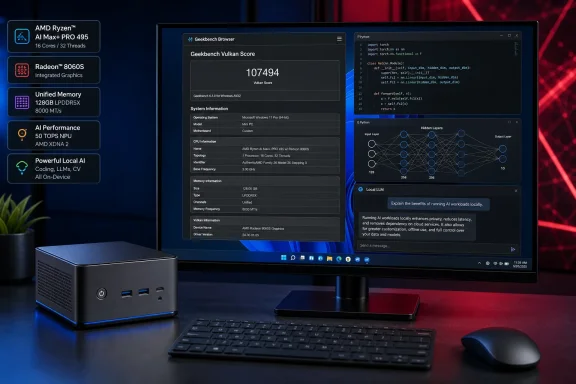 The benchmark confirms Windows hardware, not a finished mini PC
Geekbench identifies the machine as a Windows 11 64-bit system using Geekbench 6.4.0’s Windows AVX2 build. It detects a 16-core, 32-thread Ryzen AI Max+ PRO 495 with a 3.1GHz base clock and a reported 5.242GHz maximum frequency, alongside Radeon 8065S integrated graphics.
Those figures align closely with AMD’s official specifications. AMD announced the PRO 495 in May as the top Ryzen AI Max PRO 400 processor, with 16 Zen 5 cores, 40 RDNA 3.5 graphics compute units, an XDNA 2 NPU rated for up to 55 TOPS, and a configurable 45W-to-120W power envelope. AMD also positions the chip for commercial PCs, small-form-factor systems, and local AI development rather than conventional low-power mini PCs.
The qualification matters. A Geekbench database entry can come from an engineering sample, an internal validation system, or a near-final unit. Even the system’s reported 123.68GB of memory is best read as the operating system’s usable measurement of a nominal 128GB configuration, not proof that 128GB will be the only shipping option.
Geekbench also labels the processor’s codename “Strix Halo,” while AMD markets the PRO 495 generation as Gorgon Halo. That is not evidence of a different chip. Gorgon Halo is an update to the same broader Halo design, retaining Zen 5 CPU cores, RDNA 3.5 graphics, and XDNA 2 AI hardware. Benchmark identification databases often retain an underlying platform codename after a vendor changes commercial branding.
128GB leaves Gorgon Halo’s headline upgrade unused
The EVO-X5 test system’s most revealing detail is also its limitation: it has 128GB of installed memory, the same capacity already offered by earlier Ryzen AI Max+ 395 machines. AMD’s major Gorgon Halo upgrade is support for up to 192GB of unified LPDDR5X memory, with up to 160GB assignable as graphics memory in suitable systems.
That does not make the 128GB EVO-X5 sample uninteresting. A 128GB unified-memory Windows mini PC can reserve far more memory for the Radeon integrated GPU than a normal desktop using a modest discrete graphics card. For local LLM inference, image generation, large datasets, virtual machines, and memory-intensive developer work, capacity can be more important than a small increase in peak clock speed.
But it does mean the benchmark does not demonstrate the defining new capability of the PRO 495 platform. AMD’s official comparison between generations is modest outside memory support: the PRO 495 adds a 100MHz peak-clock increase over the Ryzen AI Max+ 395 and uses the Radeon 8065S rather than the Radeon 8060S. Both retain 40 graphics compute units. Buyers expecting a dramatic compute jump from the processor designation alone should temper that expectation.
The 192GB option is the configuration worth watching. AMD says that capacity can make up to 160GB available as VRAM, which is potentially significant for users who want to keep larger quantized models or larger context windows local without moving the workload to a cloud service. It will also be expensive, and the price of high-capacity LPDDR5X is likely to define whether the configuration becomes a practical workstation alternative or remains a niche developer system.
GMKtec already has an EVO-X3 roadmap
GMKtec’s use of an EVO-X5 name is notable because the company has not finished rolling out the EVO-X3 strategy. The EVO-X3 launched with the previous Ryzen AI Max+ 395 platform and 128GB memory, while GMKtec previously said it planned to offer an EVO-X3 variant with the PRO 495 and up to 192GB later in 2026.
That creates a product-line question GMKtec has not answered. The company could position the EVO-X5 as a redesigned successor, a higher-performance chassis that can better sustain the chip’s upper power range, or a parallel model aimed at business and AI-development buyers. The benchmark alone cannot distinguish among those possibilities.
Cooling and power delivery will be more consequential than the product number. AMD permits the PRO 495 to operate anywhere from 45W to 120W, an enormous range for a processor deployed in a mini PC. Two machines with the same chip and memory could perform very differently in prolonged compilation, GPU compute, games, or local inference if one is tuned for quiet office use and the other is built to hold a high sustained package power.
The existing EVO-X3 supplies one reason not to extrapolate too much from silicon specs. GMKtec added OCuLink, USB4, Wi-Fi 7, and dual M.2 storage support to that model, creating a more expandable system than the earlier EVO-X2. Whether the EVO-X5 keeps those features, adds faster networking, or changes the storage and external-GPU design is unknown. None of that appears in the Geekbench result.
The Windows angle is local AI, with caveats
AMD’s own Ryzen AI Halo material says its current developer platform supports both Windows and Linux and works with tools including PyTorch, vLLM, llama.cpp, Ollama, ComfyUI, and LM Studio. The EVO-X5’s Windows 11 benchmark confirms that GMKtec is at least validating the device in Microsoft’s desktop OS, not treating it as a Linux-only AI appliance.
For Windows users, the practical attraction is consolidation: CPU, graphics, NPU, and a large shared memory pool sit in a single small system. That can simplify deploying local models where data should remain on-premises, or where cloud inference costs and network dependence are unwanted. A mini PC cannot replace a multi-GPU workstation for raw throughput, but 128GB—and especially 192GB—changes which models can fit locally at all.
Software support remains the dividing line. AMD’s ROCm stack has broadened substantially, but Windows users should wait for GMKtec to publish supported driver versions, BIOS guidance, memory allocation controls, and tested AI software configurations. The presence of an XDNA 2 NPU does not mean every desktop AI application will use it; many popular local-model tools rely primarily on the Radeon GPU, CPU, or a particular backend.
For now, the EVO-X5 is a credible but incomplete leak. The public benchmark verifies a Windows 11 GMKtec mini PC carrying AMD’s top Gorgon Halo PRO processor and 128GB of memory. It does not verify a 192GB retail model, sustained performance, ports, thermals, price, or a launch window. GMKtec’s eventual announcement needs to answer those questions before the EVO-X5 can be judged as more than an intriguing entry in a benchmark database.
