
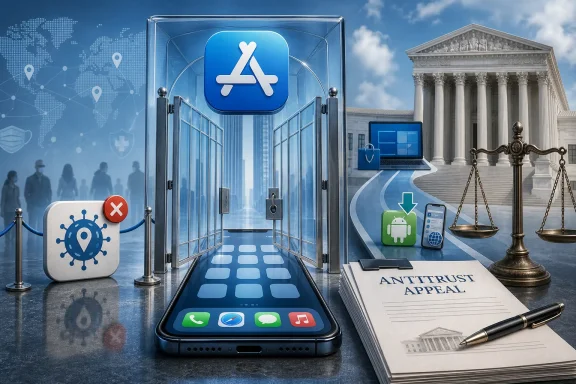
 The Case Against Apple’s App Store
PhantomALERT is best known for an app that provided crowdsourced reports about traffic, road hazards, and law-enforcement activity. During the early stages of the COVID-19 pandemic, the company sought to adapt its technology into a service that could collect and present information related to the spread of the virus.
Apple declined to distribute the proposed COVID-19 app through the iOS App Store. At the time, Apple applied heightened restrictions to pandemic-related software, generally limiting submissions involving COVID-19 information, tracking, diagnosis, or health guidance to recognized public-health organizations, government bodies, medical institutions, and similarly qualified entities.
PhantomALERT argued that Apple’s decision was not merely an isolated content-review outcome. Its complaint alleged that Apple’s control over iPhone software distribution allowed it to unlawfully exclude developers and restrict competition in violation of federal antitrust law, California’s Cartwright Act, and California’s Unfair Competition Law.
The company’s allegations targeted a familiar point of friction in the modern software ecosystem: Apple’s longstanding control over how native apps are installed on iPhones. Unlike Windows, Android, and traditional desktop operating systems, iOS has historically offered no general-purpose, consumer-facing method for installing native applications from competing app stores or directly from a developer’s website.
That model gives Apple a uniquely powerful gatekeeping role. But holding a gatekeeping role is not, by itself, the same as proving an antitrust violation.
Why the Appeal Failed: The Market Definition Problem
The D.C. Circuit’s decision focused on what is often the most consequential question in an antitrust lawsuit: what is the relevant market?
Judge Cornelia T.L. Pillard, writing for the appellate court, concluded that PhantomALERT had not plausibly alleged a relevant product market. That conclusion was enough to sustain dismissal without a trial, without discovery into Apple’s internal decision-making, and without a full evaluation of whether the rejected COVID-19 app should have been approved on its merits.
This distinction matters. Courts do not typically ask whether a platform’s policy was wise, fair, consistent, or even frustrating to a developer before addressing the threshold antitrust requirements. A plaintiff must first show that competition exists within an identifiable market and that the defendant’s conduct harmed competition in that market.
A company can suffer a serious commercial loss and still lack an antitrust claim.
The Difference Between Harm to a Developer and Harm to Competition
PhantomALERT alleged that Apple’s App Store rules shut it out of a meaningful commercial opportunity. That assertion may describe harm to a particular developer. Antitrust law, however, is principally concerned with harm to the competitive process, such as reduced output, diminished consumer choice, higher prices, weakened innovation, or exclusion of rivals in a properly defined market.
The court’s ruling illustrates the divide between these concepts.
An app can be rejected. A developer can lose access to iPhone users. A policy can be applied strictly during a public-health emergency. None of those facts automatically demonstrate that a platform has unlawfully monopolized a market.
To proceed, PhantomALERT needed to identify the market in which Apple allegedly had market power and explain how Apple’s conduct restrained competition there. That required more than describing the App Store as an important route to iPhone users.
The Smartphone Market Was Not Enough
One approach advanced in the litigation relied on the broader smartphone market. Apple undoubtedly participates in that market through the iPhone, which competes with Android devices from Samsung, Google, Motorola, OnePlus, and many other manufacturers.
But PhantomALERT was not claiming to be a smartphone maker competing against Apple in device sales. It was an app developer. The court found a disconnect between Apple’s alleged power in smartphones and the market in which PhantomALERT claimed injury.
This is a recurring issue in platform litigation. A plaintiff may point to a powerful device maker, operating-system owner, cloud provider, or marketplace operator, but courts still expect a direct explanation of how the claimed anticompetitive conduct affects the market where the plaintiff competes.
For a Windows audience, the comparison is straightforward. A software company challenging a Windows Store policy would generally need to do more than say Microsoft is influential in personal computing. It would need to explain the relevant market for the software, distribution channel, operating-system service, or transaction mechanism at issue.
The Single-Brand App Store Theory Also Fell Short
PhantomALERT also sought to frame the Apple App Store as a distinct, Apple-specific aftermarket connected to the broader smartphone market. This type of theory is not impossible under U.S. antitrust law, but it faces a demanding legal standard.
The central idea of an aftermarket claim is that a company may gain power over a secondary market after consumers purchase a primary product. Classic examples often involve replacement parts, servicing, consumables, maintenance, or accessories tied to a particular product ecosystem.
A company selling a machine might later exploit owners by restricting replacement parts or repairs. If customers could not reasonably anticipate that restriction when buying the product, and if switching away from the product later became prohibitively expensive, an aftermarket theory may have traction.
Why the Court Saw No Plausible Lock-In Claim
The lower court had already concluded that PhantomALERT did not plausibly establish the consumer lock-in conditions associated with a single-brand aftermarket. The D.C. Circuit’s affirmation preserves that basic conclusion.
The practical issue is visibility. Apple’s approach to iOS software distribution has been public and well understood for years. The App Store has been the standard method for obtaining native iPhone apps since the store’s launch in 2008.
That history makes it difficult to argue that iPhone buyers were unexpectedly trapped by an undisclosed post-purchase change in how apps could be distributed. Consumers may dislike the restriction, and developers may view it as commercially limiting, but those concerns do not necessarily demonstrate the type of surprise lock-in that makes a single-brand aftermarket legally cognizable.
The court also found problems with claims that Apple was extracting a supracompetitive price for access to the App Store in the sense required by the particular aftermarket theory. The consumer-facing App Store is free to browse and download from, even though Apple’s developer program fees and transaction commissions remain central points of controversy in other litigation and regulatory disputes.
This does not mean all Apple App Store antitrust theories are foreclosed. It means that this particular pleading theory, built around PhantomALERT’s alleged exclusion, did not sufficiently define a market capable of supporting the claims.
The COVID-19 Tracking App “Submarket” Did Not Rescue the Complaint
PhantomALERT also proposed a narrower market involving COVID-19-related tracing apps. The theory attempted to identify a specific category of health-related applications whose availability was allegedly constrained by Apple’s pandemic rules.
The court found that formulation inadequate as well.
A legally viable submarket cannot simply be a descriptive label for a product category. It must represent an economically meaningful grouping, including reasonably interchangeable products and the competitive boundaries that distinguish the submarket from broader alternatives.
COVID-19 tracing apps may have had a highly specific purpose during the pandemic, but the complaint did not plausibly establish that they constituted a market in the antitrust sense. A narrowly defined product category does not become a relevant market merely because it serves a particular need or because a developer was excluded from it.
This is an important lesson for software businesses contemplating App Store antitrust litigation. Narrowing the definition of a market can sometimes help demonstrate a platform’s power, but narrowing too far can make the proposed market seem artificial. Courts look for real-world substitutability and competitive relationships, not labels designed solely to place one defendant at the center of a lawsuit.
Pandemic Safeguards and Platform Moderation
The dispute also reflects a difficult period for technology platforms. In 2020, public-health information was rapidly evolving, misinformation was widespread, and mobile apps had become an immediate channel for symptom reporting, exposure notifications, travel restrictions, vaccination information, and local health guidance.
Apple’s decision to place heightened review requirements on pandemic apps had an understandable public-safety rationale. Health software can collect sensitive information, influence medical choices, and create false confidence if its claims are not responsibly supported.
A rule requiring recognized institutions behind certain COVID-19 apps could help limit:
- Unverified symptom trackers collecting sensitive health data
- Apps making unsupported diagnosis or treatment claims
- Misleading exposure or infection notifications
- Opportunistic data collection during a public-health emergency
- Confusion between official public-health guidance and consumer-generated content
From that perspective, strict App Store review may have protected users. A broadly open marketplace for pandemic-related apps could have created its own serious risks, particularly at a time when reliable guidance and privacy protections were essential.
The Risk of Rules That Favor Established Institutions
At the same time, rules tied to institutional recognition may make it harder for smaller software developers to participate in urgent public-interest innovation.
Startups and independent developers may possess useful ideas, faster development cycles, or specialized technical capabilities without being governments, hospitals, universities, or established medical providers. Requiring formal institutional status can create a barrier that favors organizations already connected to public-health infrastructure.
That concern is not enough to establish an antitrust violation. It is, however, a valid policy concern.
The strongest criticism of platform gatekeeping is not necessarily that every rejected app represents illegal exclusion. It is that a small number of major companies can make consequential decisions about who may reach users during emergencies, often through processes that are difficult for outsiders to audit.
For developers, the practical lesson is clear: an app involving health data, emergency communications, medical guidance, public safety, finance, or other regulated fields should be designed with compliance partnerships in mind from the beginning. Technical quality alone may not be sufficient for approval.
What the Ruling Means for Windows and Cross-Platform Developers
The immediate case concerns Apple and iOS, but its implications matter to developers building for Windows, Android, web platforms, consoles, cloud marketplaces, and enterprise software ecosystems.
Every major platform has some form of gatekeeping:
- Apple controls native iOS app distribution and App Store review.
- Google Play applies content, privacy, security, and billing rules to Android apps.
- Microsoft operates the Microsoft Store and signs many Windows components, drivers, and enterprise services.
- Game-console makers regulate storefront access and certification.
- Cloud vendors set platform terms for marketplaces, APIs, hosting, billing, and identity services.
- Enterprise endpoint-management systems can restrict which software employees may install.
The difference is one of degree and architecture. Windows traditionally permits direct downloads, alternative stores, enterprise deployment tools, sideloading, package managers, and other distribution paths. This flexibility reduces dependence on any single storefront for many types of software.
That does not eliminate gatekeeping on Windows. SmartScreen reputation systems, code-signing expectations, antivirus detection, application-control policies, Store requirements, and corporate IT restrictions can all shape the path from developer to user.
But the Windows ecosystem provides a useful contrast. Alternative distribution mechanisms often create a practical answer to exclusion from a particular marketplace. On iOS, the historic lack of broadly available alternatives makes App Store access far more consequential for developers targeting iPhone users.
The Legal Lesson Is Not “Platforms Can Do Anything”
The decision should not be read as a blanket endorsement of every restrictive platform rule.
Apple continues to face substantial scrutiny over mobile ecosystem practices, payment policies, interoperability, messaging, browser engines, device features, and app distribution. Other cases involve different markets, different facts, different legal theories, different evidence, and sometimes different statutory frameworks.
The ruling instead confirms a narrower proposition: a developer challenging platform control must carefully plead the market in which competition has allegedly been harmed.
That requirement can be formidable, especially where the challenged platform is a single brand and its restrictions have been known to consumers for years.
The result may frustrate developers who see an app-store rejection as evidence of excessive control. Yet courts require a coherent economic theory because antitrust law is meant to protect competition, not to serve as a universal appeals process for disputed moderation or certification decisions.
Why This Case Is Distinct From Broader Apple Antitrust Battles
Apple’s App Store policies have been challenged in several contexts, including disputes involving in-app payment systems, steering restrictions, app distribution, subscription commissions, competitive access, and the treatment of third-party services.
Those cases should not be collapsed into one narrative.
A claim involving Apple’s rules for payment processing may focus on transaction markets, developer commissions, anti-steering provisions, or consumer prices. A claim involving an app rejection may focus instead on content review, eligibility requirements, health and safety rules, or access to a distribution channel.
PhantomALERT’s case had an especially difficult posture because the alleged product was a pandemic-related tracking app subject to a policy that could be presented as a public-health safeguard. It also struggled to connect the alleged exclusion to a viable relevant market.
The appellate ruling therefore says relatively little about whether Apple’s entire App Store model is competitively benign. It says much more about the discipline required in drafting a private antitrust complaint.
The Larger Problem: Private Enforcement Is Expensive and Technical
For smaller developers, the PhantomALERT decision underscores the mismatch between platform power and private litigation resources.
Large technology companies possess legal teams, economists, policy specialists, technical experts, and vast records documenting platform design and security rationales. A smaller developer that believes it has been wrongfully excluded must often formulate a sophisticated market-definition theory before obtaining meaningful discovery.
That can make private antitrust enforcement feel inaccessible.
To plead a serious case, a developer may need evidence and analysis addressing:
- The relevant product market and its economic boundaries
- Reasonable substitutes available to consumers or developers
- The defendant’s market power within that market
- The challenged conduct and how it forecloses competition
- Antitrust injury, rather than merely commercial injury
- Consumer harm, including price, output, quality, innovation, or choice effects
- Why platform justifications such as privacy, safety, and security do not outweigh the alleged harm
This is a high bar, but it exists for a reason. Markets are complicated, and courts are wary of converting every contractual dispute or policy disagreement into an antitrust case.
Still, the practical effect is that platforms can retain significant discretion unless a plaintiff arrives with a well-developed economic story.
A Win for Apple, but Not an End to the Debate
Apple’s victory against PhantomALERT is legally significant because it reinforces the centrality of market definition in mobile app store antitrust cases. The D.C. Circuit did not need to decide whether Apple’s COVID-19 policies were ideal, whether PhantomALERT’s app could have served a valuable public purpose, or whether the App Store’s gatekeeping structure is desirable as a matter of policy.
The complaint failed at the threshold.
For Apple, that is a meaningful win. It avoids the cost and exposure of deeper litigation over a pandemic-era app review decision and preserves a favorable view of the company’s ability to enforce safety-driven platform rules.
For developers, the decision is a reminder that an exclusion claim must be built around more than restricted access to a valuable platform. It must show where competition occurs, why the platform has power in that market, and how the conduct damages competition itself.
The debate over digital platform control will continue across the United States and internationally. But in this case, Apple’s App Store control was not enough on its own to carry PhantomALERT’s antitrust claims past the starting line.
